IN A TIME OF UNIVERSAL DECEIT...TELLING THE TRUTH BECOMES A REVOLUTIONARY ACT

"Capitalism is the astounding belief that the most wicked of men will do the most wicked of things for the greatest good of everyone." John Maynard Keynes

" Labor is prior to, and independent of, capital; that, in fact, capital is the fruit of labor, and could never have existed if labor had not first existed. Labor is the superior of capital and deserves much the higher consideration" Abraham Lincoln

Tuesday, June 7, 2011

WE DREAM OF GINI

The GINI coefficient http://en.wikipedia.org/wiki/Gini_coefficient is a relative measure of income and "wealth" equality. It can, if interpreted judiciously, thinking about the structures and cultures of the countries being assessed, give an accurate picture of the relative health and stability of a nation, based on it's measured inequalities. 

In this case, if we just look at "industrialised" nations, the U.S. is quite low in the assessment, meaning the inequality in wealth, and income, is very high. Note that Mexico, and China, are now in the same grouping, as the U.S. However, remember, this is a relative index. But, in U.S. average income terms, which are much higher than those in Mexico, or China, our society is as unequal as theirs. Of course, in Mexico, and to a certain extent, China, the population of these nations as a whole, have less access to the things we accept as "normal", namely, clean safe tap water, wherever we are, proper sanitation, and a "safe" food supply, wherever we choose to obtain it. In addition most "poor" people in the U.S. have electricity (pre-supposing they are able to afford housing) and the ability to at least obtain food that will ensure their survival in a basic sense. 

However, these things are not to be taken for granted. If current trends and policies continue, the U.S. will develop the structure and insecurities of current "third world" nations within a decade or two.
Your lead editor has visited, lived in, and experienced other countries, where the GINI Index is much lower. And have felt that, as a whole, the majority of the people in these countries, feel happier, and are more satisfied with their nations, feel more a part of and connected to their neighbours and with how they fit in, their nation's role at large, in the World. Countries like Australia, and Canada, and of course, most of Western Europe. Why don't we learn from them, after all, most of us can trace our ancestries back to these countries, and still have connections with them. 

OK, here is a quick assessment of what I learned about Australia, when I stayed there for six weeks in 2008/09. It has a "social democracy" similar to the U.K., New Zealand, Canada, and most other western European countries. 

Minimum Wage: $15.38 per hour AUSD (exchange rate in 2008 with USD about .85)
Health Care: All citizens have universal insurance coverage. Complete health care is available to all. Similar to the U.K.
Vacation: All citizens receive at least four weeks leave, private or public sector.
Unemployment: $1543 AUSD per month. Unlimited, but they have strong, successful fraud monitoring, job application requirements, and job placement services.

Yet, something is different about the U.S., amongst all the industrialised nations. This chart tells a very big picture. Other than Singapore and Hong Kong, the U.S. is far and away the most inequal. And measures poorly in many other of these statistics. This is a direct result of the concerted political strategies of "conservative" politicians since the 1970s, but which really accelerated in the 1980s, and continue unabated to the present day.
We liked this article. http://www.commondreams.org/view/2011/06/05-1 It is written by a true psychologist, so someone who would be able to provide informed and unbiased assessments.

The Rise of the Second-String Psychopaths

The great writer Kurt Vonnegut titled his final book A Man without a Country. He was the man; the country was the United States of America. Vonnegut felt that his country had disappeared right under his – and the Constitution’s – feet, through what he called “the sleaziest, low-comedy Keystone Cops-style coup d’état imaginable.” He was talking about the Bush administration. Were Vonnegut still alive in the post-Bush era, he would not have felt that his country had returned.

How had our country disappeared? Vonnegut proposed that among the contributing factors was that it had been invaded – as if by the Martians – by people with a particularly frightening mental illness. People with this illness were termed psychopaths. (The term nowadays is anti-social personality disorder.) These are terms for people who are smart, personable, and engaging, but who have no consciences. They are not guided by a sense of right or wrong. They seem to be unaffected by the feelings of others, including feelings of distress caused by their actions. Straying from a decent way of treating people, or violating ethical codes causes no anxiety, the anxiety which is what causes the rest of us to moderate our more greedy impulses. If most children feel anxiety when they are pilfering the forbidden cookie jar, psychopaths feel just fine. They can devour the cookies, shatter the jar as evidence and stuff it in the trash can. When accused, they can argue with apparent sincerity that the cookie jar has been missing for at least a week. There suffer no remorse, no guilt, no shame. They are free to do anything, no matter how harmful.

Psychopaths can be very tricky to recognize. As psychiatrist Dr. Hervey Cleckly wrote in his classic The Mask of Sanity in 1941, psychopaths are not technically insane. They don’t have a psychosis, like schizophrenia. They are experts in appearing normal. They can act the role of a caring, concerned executive, even though they actually do not seem to experience such feelings. If they hurt somebody, they don’t modify their behavior.

The United States corporate and government spheres have become, Vonnegut suggested, a perfect habitat for psychopaths. What has allowed so many psychopaths to rise so high in corporations, and then government, he wrote,

“is that they are so decisive. They are going to do something every fuckin’ day and they are not afraid. Unlike normal people, they are never filled with doubts, for the simple reason that they don’t give a f..k what happens next. Simply can’t. Do this! Do that! Mobilize the reserves! Privatize the public schools! Attack Iraq! Cut health care! Tap everybody’s telephone! Cut taxes on the rich!
In a country in which much of human culture has been rendered into machines for the manufacture of money, psychopaths are the ideal leaders. They are very focused. They are outcome oriented. They are frequently charming, and usually very bright and able. They can lay off thousands of people, or deny people health care, or have them waterboarded, and it does not disturb their sleep. They can be impressively confident. Psychopaths can be dynamic leaders of enterprises, but are handicapped by their lack of feelings for relationships. They may be accomplished captains of industry, or senators, or surgeons, but their families are frequently abused and miserable. Most psychotherapists have seen the wives or husband or children of such accomplished people.


Since psychopaths are usually very smart, they can be quite competent at impersonating regular human beings in positions of power. Since they don’t care how their actions affect people, they can rise to great height in enterprises dealing with power and money. They can manufacture bombs or run hospitals. Whatever the undertaking, it is all the same to them. It’s just business.
The economic system that remains after the destruction of American local cultures has created an excellent employment picture for psychopaths. But the opportunities open to them are now so vast that there is apparently now an actual labor shortage. At least that is the only explanation I can find for the rise of a cadre of psychopathic leaders who resemble the usual type in all ways but one: they’re simply not that smart. One has only to look at right-wing not-so-Christian fundamentalists to see the peculiar emergence of a second-string of psychopaths.

The US has been endowed with abundant resources, and there have always been a more than sufficient supply of psychopaths of the first intellectual grade to supply corporate suites and their subsidiary, the Congress. Why is there now a downgrade to the dumb ones, like the lowering of standards for military recruits to deal with a shortage of cannon fodder?

It is no secret that the Koch brothers and others of the super-rich seem to have undertaken a final push to consolidate control through the conversion of a marginally democratic to an essentially fascist state; extreme right-wing, authoritarian, and demagogic. This kind of government is ideal for control of a populace by the moneyed elite. To carry this out requires the employment of many ‘kept’ politicians to excite and misdirect scared and angry – and ignorant – voters. Lest the citizenry realize who stole their money and storm their castles with torches, the rapacious elite need politicians who will carry out the work of re-directing anger at teachers, or labor unions, or the poor. I can only conclude that the people who now own the country couldn’t find any first-rate psychopaths to carry out their work. Or maybe the smart ones were all occupied. So they had to go to second-stringers, people who could actually believe what they were told to say.

We are a country who has become second-best, even in the quality of our psychopaths.
We at the Alaska Progressive Review, think that the reason so many people of this type are in charge of our political and economic system in the U.S. is because of the nation's unresolved and often suppressed racism. That is to say, a majority of the major ethnic group of it, European-descendants, are still afraid of other groups, African-Americans, Asians, Hispanics, and Native Americans. And that the "corporatocracy", or oligarchy, the major powers in U.S. society, the financial sector, fossil fuel, military-industrial, insurance, and other large corporate sectors, use this to persuade people to continue to vote against their own interests. How else can you explain Republican (and now even Democratic) politicians who would decimate social security and medicare, continue to grant tax benefits and breaks to the top few percent of the population and large corporations (that continually send more and more jobs to other countries, with U.S. government support) continuing to get re-elected? Of course, the corporate media does it's share to keep people uninformed, and that is a very large concern. Not to be ignored, and worthy of great concern.
But, the reason these other nations have benefits and security like they do, is because the people in them have more empathy, are not afraid of, and relate more, to their fellow people. A nation gets the government they deserve, in the sense that it is a reflection of the overall feelings and beliefs of the people in it. We think this idea is a good starting point for working for positive change. How do we really feel about people different from us? Of other cultures and ethnicities? Are all people equally worthy with respect to the culture we consider ourselves to be parts of? Are Indigenous peoples, who have completely different world-views, than most of ours in the U.S, culturally and spiritually "equal" to ours? Because if we don't think so, we'll never effectively solve global problems like overpopulation, resource depletion, environmental destruction, and global warming. Which if left unchecked will all combine to render a World much less inhabitable, for our descendants, within the next century. Cheers.

Friday, May 20, 2011

FAHRENHEIT 2051

or the temperature at which Anchorage burns? [apologies to Ray Bradbury, and Michael Moore, eds.]

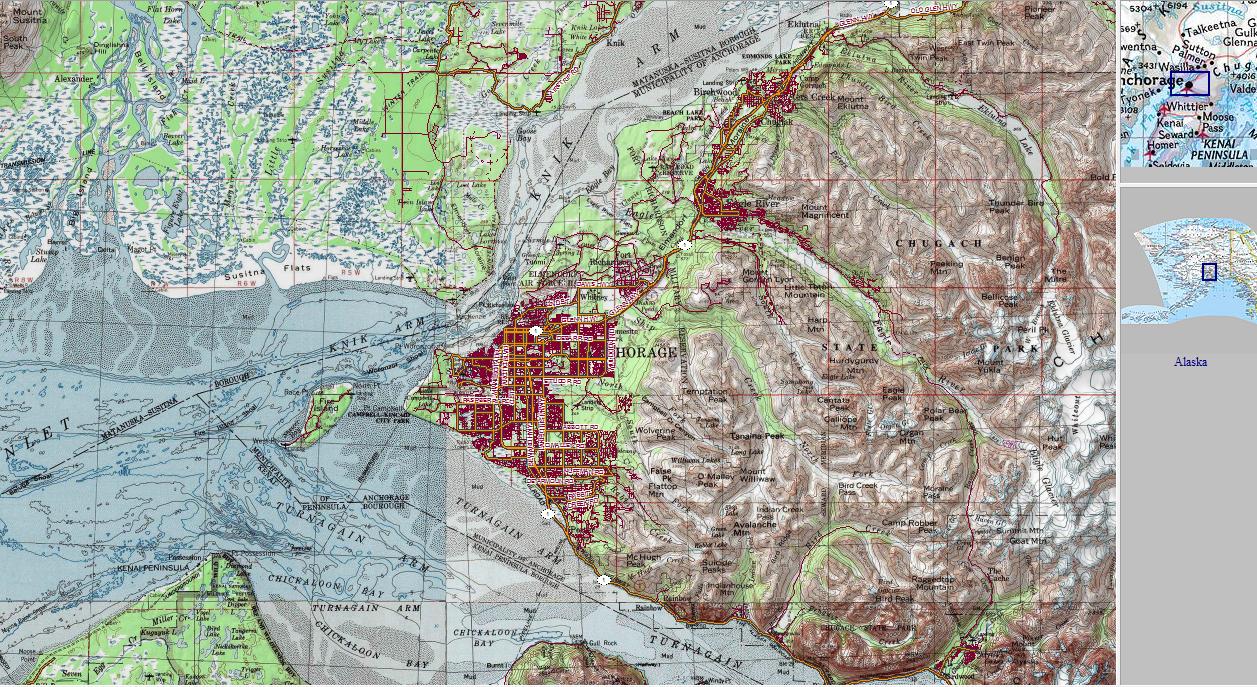
What we are attempting to do in this article, is to quickly project what we think the climate of Anchorage will be fourty years hence, in the year 2051. Using the most up-to-date peer-reviewed scientific research. And your lead editor's 24 years of operational weather forecasting experience throughout the Western Lower 48 and Alaska. And no, we are not expecting Anchorage to burn up, necessarily, though fire seasons will certainly be a little longer, and more intense, than they are currently. But the Anchorage area, because of it's proximity to the cool waters of the Gulf of Alaska and Cook Inlet, will never have as extreme fire danger, or behaviour, as that seen further north, in the warmer (in summer), drier, interior. Your lead editor has some expertise in this area, having worked with and studied from some researchers at the University of Alaska, Fairbanks, and earlier, at the University of Montana, in Missoula. All involved on the cutting edge of climate change/global warming research.
Before projecting ahead though, we need to look at the current climate of the Anchorage area.

Anchorage is blessed with the most favourable climate for human habitation in the entire state! Perhaps that is why it is the largest population centre here. Why is that?
Well, let's look at some statistics, from the three main centres, in which we have all lived, since 1998. First, Juneau, which is a good representation for all of coastal Alaska, around the Gulf, from Kodiak to Ketchikan.
JUNEAU 2, ALASKA (504094)
Period of Record Monthly Climate Summary
Period of Record : 7/ 6/1965 to 12/22/2010
Jan Feb Mar Apr May Jun Jul Aug Sep Oct Nov Dec Annual
Average Max. Temperature (F) 33.3 37.0 40.9 48.7 56.1 62.2 63.7 63.2 56.7 48.7 39.9 36.0 48.9
Average Min. Temperature (F) 24.5 27.3 30.3 34.9 41.5 47.9 51.0 49.9 45.3 38.9 30.8 27.2 37.5
Average Total Precipitation (in.) 6.96 6.12 5.98 5.01 5.67 4.23 5.75 7.57 11.93 12.87 9.45 8.54 90.08
Average Total SnowFall (in.) 24.2 12.0 7.7 0.8 0.0 0.0 0.0 0.0 0.0 0.3 8.0 15.8 68.8
Average Snow Depth (in.) 5 4 2 0 0 0 0 0 0 0 1 2 1

These numbers are from downtown Juneau, which is wetter, and milder, than the airport, or Mendenhall Valley, where the other large residential areas are. But 90 inches of precipitation (229 cm) is alot, and there is no real dry season, though April-July are "drier". Note how mild the winter temperatures are, and how short of duration the average snow depths are.


Because it is so close to the mild Gulf of Alaska, with usually some sort of flow off of it, it rarely stays well below freezing for periods of more than a week or two in winter, separated by rainy, milder, onshore flow periods. Which we found to our great dislike, as it meant good snow for nordic skiing would be ruined after a week or two. And running in driving rain at temperatures of 35-45F (1.5-8C) for much of the year, we found not to prefer. This sort of climate, can be found right around the corner, from Anchorage, up Turnagain Arm, in places like Girdwood, or Portage. Slightly colder and snowier in winter than Juneau, but still having rainy periods in winter disrupting good snow conditions, and much rainier in the warm season. So let's look at Anchorage's numbers:
This is the closest climate station to the Chugach Front Research Centre, about 5 KM to its west. So our winter temperatures are slightly colder than this, but summer's, about the same. And our precipitation is probably slightly higher, maybe by two to three inches (5 to 8 cm).
ALASKA PACIFIC UNIVERSITY, ALASKA (500172)
Period of Record Monthly Climate Summary
Period of Record : 7/ 1/1993 to 10/31/2004

Jan Feb Mar Apr May Jun Jul Aug Sep Oct Nov Dec Annual
Average Max. Temperature (F) 21.0 28.5 34.4 46.3 56.9 64.9 67.5 65.5 56.6 41.3 28.9 23.5 44.6
Average Min. Temperature (F) 8.8 14.1 15.8 28.2 38.4 47.3 51.9 49.3 40.6 27.0 17.1 12.6 29.3
Average Total Precipitation (in.) 0.66 0.85 0.98 0.33 0.63 1.11 1.61 3.00 3.03 2.23 1.25 1.55 17.23
Average Total SnowFall (in.) 9.4 12.0 12.8 1.6 1.1 0.0 0.0 0.0 0.0 7.2 12.0 20.2 76.3
Average Snow Depth (in.) 13 14 17 6 0 0 0 0 0 2 6 11


Look at that annual precipitation, 17.23 inches (44 cm)! Versus the 90 inches (229 cm) in downtown Juneau! Note the colder winter temperatures, and deeper/longer average snow depths. This gives us one of the most favourable climates for nordic skiing, of any city on Earth! It's the Chugach Mountains, and the mountains on the Kenai Peninsula, which cup the Anchorage "bowl" from the northeast to the south, that work their magic for us. By protecting us from precipitation in east to south flows, which occur very frequently, as low pressure systems hang in the Gulf of Alaska for weeks on end, fed by the moisture and relative warmth (in the cool season) of the Pacific Ocean. Annual precipitation at the Alyeska Resort, near Girdwood, just 50 KM (31 miles) southeast, up Turnagain Arm, is 73 inches (185 cm). Note our increasing monthly precipitation values from May through September. In the weak summer jet stream, lows in the Gulf of Alaska become more frequent, and contain more moisture, as the summer wears into fall, and enough of their influence is felt here, but not nearly that seen just around the corner, or in Southeast Alaska, thank you Chugach Mountains!

The Chugach mountains also protect the Anchorage bowl from strong winds associated with other weather patterns as well. Just to the north, in the Matanuska and Susitna valleys, places like Palmer, Wasilla, and Talkeetna, have similar winter temperatures, but can receive very strong winds, especially from the Northeast and East, in the Matanuska valley, which are highly unpleasant in winter, and even scour all the snow away. Talkeetna, north in the Susitna valley, is wetter in summer, and hence boggier, with worse mosquito and fly densities.

What about further north, in Fairbanks? Well, these numbers tell the story very succinctly:

FAIRBANKS WSO AIRPORT, ALASKA (502968)
Period of Record Monthly Climate Summary
Period of Record : 9/ 1/1949 to 12/31/2010

Jan Feb Mar Apr May Jun Jul Aug Sep Oct Nov Dec Annual
Average Max. Temperature (F) -1.2 8.4 23.7 42.6 60.1 70.8 72.3 66.3 54.7 32.2 11.6 1.5 36.9
Average Min. Temperature (F) -18.8 -14.0 -3.2 20.3 37.9 49.3 52.0 46.8 35.6 17.3 -4.8 -15.3 16.9
Average Total Precipitation (in.) 0.58 0.42 0.35 0.29 0.58 1.34 1.97 1.85 1.07 0.77 0.67 0.68 10.56
Average Total SnowFall (in.) 10.5 8.3 6.0 3.1 0.7 0.0 0.0 0.0 1.3 10.4 12.7 12.2 65.1
Average Snow Depth (in.) 17 21 20 10 0 0 0 0 0 2 8 13 7
Percent of possible observations for period of record.
Max. Temp.: 99.8% Min. Temp.: 99.8% Precipitation: 99.9% Snowfall: 99.9% Snow Depth: 99.8%

Those are quite cold temperatures, which represent the interior as a whole, from mid November through February. Sometimes much colder, and sometime warmer. Making outdoor recreation more cumbersome and less enjoyable, especially when combined with the shorter day and low light. It is drier in general, with sometimes very comfortable and enjoyable summers. But also much more prone to summer wildfires in the drier ones, which can lead to heavy smoke accumulations for long stretches, in very active seasons. Which are becoming more frequent.


So now that we have established that Anchorage's climate is the most benificent in the state, what kind of changes are likely in it, by 2051? We think it helps to first see how things have been changing over the past decades. http://climate.gi.alaska.edu/papers/Arctic62-3-295.pdf

We thought this table to be especially significant, showing the seasonal breakdown of temperature changes in each area of  the state. And that in the sixty years from 1949 to 2009, the average increase across the state has been +3F (+1.7C), more than the Earth, as a whole, but predicted by global climate modeling, the "Arctic Amplification". Driven by changes in duration of snow and sea ice cover, which change the "albedo" of the land/water. With shorter durations now of sea ice and snow cover, more solar heat is absorbed, for longer periods of the year.
Seeing how the seasonal breakdown of temperature increase has gone down for Anchorage, and surrounding areas, what does the latest climate change modeling suggest, for the next several decades?

This link, to the Arctic Climate Impact Assessment, research conducted and described by the most prominent atmospheric and climatic scientists in the World, projects, based on an average of the different global CO2 emissions scenarios, a global temperature increase of 2C by about 2050. Given that Alaska has already experienced twice the global increase over the past 60 years, we think it prudent then to expect a 4C average temperature increase across this area by 2051. But it won't be evenly spread across every month. We expect the 4C increase to generally follow the seasonal breakdown, that has already occurred over the past sixty years. Let's revisit that. The summer and fall increases are only half that of spring, and a quarter, of that of winter.

This makes sense, given the fact that we have noticed, over the past few decades, more "highly amplified" jet stream patterns of "meridional" flow, that is, flow more from south to north, than west to east, over Alaska and along the northwest section of North America, from about 40N, in winter and spring, when the jet stream is the strongest. Just a quick reminder, the jet stream is how heat is re-distributed to the poles, from the tropics. Because the poles lose more heat than they gain in solar energy, and the tropics gain more than they lose.

We're seeing more highly amplified patterns where large high pressure ridges extend much further north than they normally have been, in winter and spring. Moving tremendous masses of warm air aloft to very high latitudes, which eventually mixes down to the surface, over higher terrain, and along the north slopes of the Alaska Range, where very strong, dry chinook winds occur more frequently now, and which often produce high fire danger. So a continuance of this pattern is to be expected, and an amplification.
So let's re-work the Alaska Pacific University climate data, which is a proxy for what we see here at the Chugach Front Research Centre. Though our winter temperatures are somewhat colder, especially at night, due to our location in a slight depression, right at the front of the Chugach Range.

ALASKA PACIFIC UNIVERSITY, ALASKA (500172)
Period of Record Monthly Climate Summary
Period of Record : 7/ 1/1993 to 10/31/2051

Jan Feb Mar Apr May Jun Jul Aug Sep Oct Nov Dec Annual
Average Max. Temperature (F)  30.0  36.7  42.3  52.4  58.6  70.0 69.0  68.5 61.0  47.4 34.5  30.4  50.0
Average Min. Temperature (F) 14.5  21.0  24.2  33.5  41.5  50.5  52.9  52.6  45.0 
34.2
 
24.4  18.3  34.3 
Average Total Precipitation (in.) 0.90 0.85 0.98 0.33 0.63 1.11 1.90 3.50 4.10  2.68 1.80 1.80 20.58 
Average Total SnowFall (in.) 18.9  15.0  10.3  0.5  0.0  0.0 0.0 0.0 0.0 2.4  15.0 29.3 91.4 
Average Snow Depth (in.) 18 16 12 0 0 0 0 0 13
Percent of possible observations for period of record.
Max. Temp.: 89.4% Min. Temp.: 89.4% Precipitation: 89.5% Snowfall: 89.1% Snow Depth: 87.7%
Check Station Metadata or Metadata graphics for more detail about data completeness.

The reason the summer increases are the lowest is due to Anchorage's geography.
As the interior, north of the Alaska Range, and in the Susitna Valley, just to the north of the Anchorage bowl, heats up more, overall in the summer, this pulls a south to southeast flow up through and around the region. Cool, maritime air, chilled by the waters of the Gulf of Alaska, Cook Inlet, and Turnagain Arm. Waters, which even in 2051, would only likely warm 1-2C by then, to around 10C in summer (50F). Still quite cool and able to keep average summer temperatures down. In fall, winter, and spring, more highly amplified high pressure ridging episodes would bring greater amounts of sub-tropical warmth for longer durations. Thus fall and winter snowfall would diminish, but in the depths of winter, increase. Snow cover would then take longer to establish in fall, and be earlier to melt, in Spring. By two to three weeks on each end. Winter extreme cold spells, where night-time temperatures can drop to -29 to -32C (-20 to -25F), would be more infrequent, and of shorter duration.

Let's look at a few specific hazards or problems that Anchorage faces, and how that would change.
Wind storms:
Most people have a general idea that the Gulf of Alaska and Bering Seas produce treacherous weather, in the form of deep low pressure systems, and strong fronts, especially from September through April. These don't strike Anchorage full-force, usually, because of our sheltered location, as mentioned before. But once in awhile, one can hold together with enough strength, in just the right pattern, to produce winds of 80-100 mph, or even stronger, along the hill-slopes of the Chugach Front. With continued increases in highly amplified jet stream flow, the conditions for lows to deepen rapidly and become very strong, will increase. Thus, we would expect greater frequencies of these downsloping wind events in Anchorage, overall, and strong winds from frontal passages to increase. Another hazard is strong cold, northerly winds from the interior, to a low in the Gulf of Alaska. Our subjective feeling is that these probably will weaken in intensity, somewhat. Driven by the fact that winter, bitter cold Arctic airmasses over the Interior won't be as deep and of long duration as they are currently.
Snow Storms and Freezing Rain:
Due to Anchorage's unique geography, cold air in winter continually, except only under the strongest of south flows, drains south through the Susitna Valley, from the Interior, after filtering through the gaps in the Alaska Range. This, combined to the proximity of the relatively warm waters of partially ice-covered Cook Inlet, occasionally allows heavy snowfall events to occur, when small lows form right over the Inlet, and move over the Bowl. In which 20-40 cm (8-16 inches) can fall in 24-48 hours. We expect these fairly infrequent events to remain so, since the colder air draining from the interior, will be warmer, as well.

Freezing rain events are another story entirely, however. We expect these to significantly increase over the coming decades to become a real problem, not just in Anchorage, but in most of mainland Alaska. Because in winter we are getting our strongest "meridional" flow patterns (strong southerly flow ahead of an upper-level ridge), which move very mild air north from the subtropics. This is how more heat is delivered to these higher latitudes, and thus, if the climate overall is going to continue warming, the pattern that is most responsible for this, will increase. A perfect example of this was the record-breaking ice storm of this past 21-23 November. Which paralysed Fairbanks with 20 mm (.80") of freezing rain, and Anchorage with about 14 mm. Coating all the roads with ice, causing numerous accidents and downed power lines. And unfortunately for Fairbanks, once that ice accumulated on the roads, it stayed there all winter! This freezing rain event, at one point, for three hours, was depositing ice accumulations from Seward, north, all the way to Barrow! Unprecedented in Alaska history.
http://akprogressive.blogspot.com/2010/11/dont-need-weatherman-and-matties-fourth.html


Wildfire:


The Anchorage Bowl specifically, doesn't experience nearly as many days of higher fire danger, than the interior, north of the Alaska Range, in spring or summer, due to the proximity of the waters of Cook Inlet, and Gulf of Alaska. Any kind of light to average flow from the southeast through southwest is moistened from these, and relative humidities during the day, are usually too high to dry the boreal forest out.

But occasionally, warm/dry spells in May to July can temporarily disrupt this pattern. When high pressure ridging builds directly over the region, and suppresses the local sea-breezes, and drier air from the north through east is forced in. We would expect an increase in this pattern, with stronger high pressure ridging, overall, but only a moderate increase. The other hazardous pattern that can produce higher fire danger, is when strong winds blow along the Chugach Front hill slopes, if the temperatures are high enough, and relative humidities, low enough. This occurs in the warm season, but infrequently. We would expect a moderate increase in these in the shoulder seasons, spring and fall, and slight increases in June and July. Due to the stronger low pressure sytems that would occur in Spring or Fall, having warmer airmasses than currently, and hence, lower relative humdities, in down-sloping winds. The Anchorage hillsides have very thick, tangled boreal forest vegetation, with extensive stands of dead and dying bug-killed white and black spruce trees, which could prove flashy and hazardous, in a very strong, and dry, downsloping wind event.
Thunderstorms:

The Anchorage Bowl usually only sees one or two weak thunderstorms, with just limited lightning, some small hail, and brief heavy rain, each late spring/summer. Some years none occur. This is because of the cool, stable air usually present at lower levels, chilled by the waters of the Gulf of Alaska and Cook Inlet, stabilises the lower atmosphere. Nonetheless, thunderstorm activity across Alaska as a whole has been increasing over the past 25 years, especially over the interior and Alaska Range. This is because, with the summer warming, and a resultant deeper troposphere (the lowest layer of the atmosphere in which all sensible weather occurs, usually 5-10 miles, or 8-16 KM deep, lower in winter), the lowest levels of the atmosphere become more unstable, and then, showers have the ability to become deeper, reaching higher heights, and hence stronger. Capable of generating lightning, as up and downdrafts in the deeper clouds are stronger. People on the Kenai Peninsula, and climbing rangers at Denali base camp, in the Alaska Range, have reported to your lead editor that they are now seeing thunderstorms each summer, when even 10-15 years ago, none ever occurred. I found this out the hard way when I did a 27 mile fast-pack on the Kesugi Ridge trail, in the Alaska Range, and was hit by lightning, when storms with continuous cloud-to-ground strikes overtook me. http://akprogressive.blogspot.com/2009/05/kesugi-ridge-experience.html. What we expect for Anchorage specifically then, are more episodes of stronger thunderstorms forming over the Chugach mountains, then drifting off and weakening over the Bowl, as they encounter cooler, stable lower-level maritime air. This happens in other coastal areas south down the North American continent.

This has been a quick, summary, of what we expect to see by 2051, here in Anchorage. This seems quite likely, as there is no coordinated, global effort to limit CO2 emissions, and unless the general socio-political systems in the "developed countries" change, there won't be for many decades. And the warming by 2090 will easily be doubled, from that in 2051. Cheers.

Monday, May 2, 2011

WORKERS OF THE WORLD

UNITE!

Happy International Worker's Day! Did you know that 01 May, or May Day, as it is also known, is a holiday in 80 countries? Similar to our Labour Day. And what a beautiful spring day it has been, here around Anchorage, as we went for our weekly long run, around 3:15, to train for our warm-season marathons. 

As you know from reading our articles here on the A.P.R., or if you browse any other progressive media, workers world-wide, and especially now, are under threat of the loss of all the labour movement fought, suffered, and died for, over the past 150 years, at the hands of vicious, parasitic and sociopathic unrestrained capitalism.
http://akprogressive.blogspot.com/2011/02/great-turning.html

Things like the 40 hour work week, vacation and health benefits, and the right to collective bargaining. As well as a living wage, and safe working conditions. 

Why is this? Because our system in the U.S. is based on greed, large corporations are in existence to maximise short-term profits, no matter what the human and environmental cost. And as they get larger and more influential, they, through their lobbying and campaign contributions, buy off politicians so that legislation will continue to favour them, as well as the tax structure, at the expense of the vast majority of the rest of the country, and planet. All people have innate qualities of empathy, compassion, and concern for others, to some extent. But when people become part of a group, like a corporation, that acts in harmful ways, it's natural that they look for some kind of affirmation, so that they can justify their actions. One source that the ultra-right Republicans and Libertarians often like to discuss, are the principles laid out by Ayn Rand, who wrote several books in the 1940s and 1950s. Who is Ayn Rand, and what are these principles?

April 27, 2011

The real Ayn Rand

Think Progress - Ayn Rand -- Russian emigre, founder of the mid-century objectivist movement, putative philosopher, writer of the novels The Fountainhead and Atlas Shrugged , and the inspiration for a small but intensely devoted band of acolytes -- has been enjoying a resurgence of late on the American right. The cultural capstone to this resurgence arrived with the release of a filmed adaptation of the first third of Atlas Shrugged, independently financed by a wealthy devotee of Rand's work and pitched explicitly at the Tea Party demographic.

Glenn Beck praises Atlas Shrugged regularly on his various shows, and even held a panel dedicated to asking if Rand's fiction is finally becoming reality. The Economist reported several sharp spikes in sales of Atlas Shrugged since 2007. And according to the Ayn Rand Institute, sales of the novel hit an all-time annual record that year, then reached a new record in 2008, with possibly another peak in 2009. By all accounts, Ayn Rand is now one of the central intellectual and cultural inspirations for the base of the Republican Party.

"For over half a century," says Jennifer Burns, a recent biographer of the novelist, "Rand has been the ultimate gateway drug to life on the right." And with good reason. Besides her prominence in the Tea Party's intellectual and cultural lexicon, some of the Republican Party's leading lights have cited Rand by name as an inspiration. Rep. Paul Ryan (R-WI) said she was the reason he entered public service. Sen. Ron Johnson (R-WI) called Atlas Shrugged "his foundational book." Sen. Rand Paul (R-KY) is an avowed fan and quotes extensively from Rand's novels at Congressional hearings. His father Rep. Ron Paul (R-TX) told listeners that readers ate up Rand's Atlas Shrugged because "it was telling the truth," and even conservative Supreme Court Just ice Clarence Thomas references her work as influence in his autobiography -- and apparently has his law clerks watch the film adaptation of The Fountainhead.

The philosophy, such as it was, which Rand laid out in her novels and essays was a frightful concoction of hyper-egotism, power-worship and anarcho-capitalism. She opposed all forms of welfare, unemployment insurance, support for the poor and middle-class, regulation of industry and government provision for roads or other infrastructure. She also insisted that law enforcement, defense and the courts were the only appropriate arenas for government, and that all taxation should be purely voluntary. Her view of economics starkly divided the world into a contest between "moochers" and "producers," with the small group making up the latter generally composed of the spectacularly wealthy, the successful, and the titans of industry.

On the level of personal behavior, the heroes in Rand's novels commit borderline rape, blow up buildings, and dynamite oil fields -- actions which Rand portrays as admirable and virtuous fulfillments of the characters' personal will and desires. Her early diaries gush with admiration for William Hickman, a serial killer who raped and murdered a young girl. Hickman showed no understanding of "the necessity, meaning or importance of other people," a trait Rand apparently found quite admirable.

For good measure, Rand dismissed the feminist movement as "false" and "phony," denigrated both Arabs and Native Americans as "savages" (going so far as to say the latter had no rights and that Europeans were right to take North American lands by force) and expressed horror that taxpayer money was being spent on government programs aimed at educating "subnormal children" and helping the handicapped. Needless to say, when Rand told Mike Wallace in 1953 that altruism was evil, that selfishness is a virtue, and that anyone who succumbs to weakness or frailty is unworthy of love, she meant it.

Is it any wonder then that we have an accelerating trend now in this country to turn back the clock to the year 1900, toward becoming a vastly unequal third-world-like state? With the majority of the population working in unsafe, low-paying jobs, struggling and fighting each other, just for the chance to hold onto them, while the environment deteriorates, with increasing air and water pollution, and eventually, environmental collapse? I remember, as an undergraduate, at the University of California, Davis, from 1982-86, sometimes rather  strangely-dressed looking young white males would write on our classroom chalkboards "Read Atlas  Shrugged!", one of Rand's most popular books. They were cult-like in this, not much different than the Mormons, out prosletyzing. And really, conservative "free-market" enthusiasts are no less driven by their fanatic beliefs, than any fundamentalist Christian or Mormon. We really think it is because these unfortunate and destructive beliefs, espoused by the likes of Ayn Rand, allow people to feel good about what they are doing, to justify their greed and selfishness.

We have to rebuild the solidarity among all people that our consumerist culture has deliberately tried to destroy. We who understand what is happening must reach out to the working people in the US who have traditionally been voting for conservative politicians, completely against their own interests. We all know, work with, are related to, or are neighbours, with such people. One way to do this is to describe current events and political policies in ways that are completely logical, and understood by them. That we do not have a "free market". Which is completely clear by looking at who holds top positions in both Republican and Democratic administrations. Corporate chieftains, bankers, high-ranking military officers, all people vested in maintaining the system that drives U.S. policy to continue to support policies that enrich them.

We found this article the other day to be very illuminating, and worthy of sharing.

It’s Time to Revive an Old Rallying Cry: Labor Is Not A Commodity!

For America's labor movement to survive, it must recommit to—and defend—the principles that once defined it

During last year’s strike against Mott's, the apple juice maker, Tim Budd, an employee on the bargaining team, heard a plant manager say across the bargaining table that employees were “a commodity like soybeans and oil, and the price of commodities goes up and down.” Mott’s management quickly disavowed their errant manager’s statement. After all, comparing workers to soybeans is not smooth, even for a unionbusting employer.

The verbal slip-up did, however, reveal a fundamental belief of management which has much to do with the future of the labor movement. To management, human labor is a simply commodity—nothing more, nothing less.  A commodity is an object traded in the marketplace without differentiation, such as lumber, oil, or soybeans. In this context, commodities are inputs into the production process. They are things.

To the traditional labor movement— from the 1880s up through the 1960s—the notion that human beings were mere objects to be used up during the production process was highly offensive. As Samuel Gompers, the conservative head of the American Federation of Labor in the first part of the 20th century, melodramatically stated, “You cannot weigh the human soul in the same scales with a piece of pork.”
In fact, labor activists spent decades lobbying Congress, eventually winning inclusion into the 1914 Clayton Act the simple declaration that “The labor of a human being is not a commodity or article of commerce.” While that legislation did not serve its intended purpose of stopping courts from issuing anti-strike injunctions, the ideas underlying labor’s push proved vital in reviving the labor movement during the Great Depression.

During the 1930s, a powerful form of unionism rejected the idea that workers were mere objects holding no rights to the workplaces their very labor created. According to historian Sidney Fine, during the sit-down strike at Flint, Mich., in 1937, the United Auto Workers “contended that the strike was legal since the worker enjoyed a property right in his job.”  As one sit-down striker explained, “Our hides are wrapped around those machines.”

Workers took over their workplaces, blocked scabs at their plant gates, and prevented management from removing equipment from their plants. “The property right of the worker in his job,” explains Fine, “was superior to the right of the company to use its property as it saw fit since the workers had invested their lives in the plant whereas the stockholders of the company had invested only their dollars."

For the last several decades, formerly mainstream trade union principles—such as the ideas that labor is not a commodity, and that labor creates all wealth—have been marginalized within the labor movement. With rare exceptions, such as the United Electrical workers union's takeover of the Republic Windows plant in Chicago, the labor movement has failed to challenge the illegitimate, management-inspired viewpoint embedded in the legal system.

Trade unionists have come to accept a system where workers can spend their entire lives toiling in a plant, and in return, investors can ship their jobs across the world.

Unions cannot win operating under management’s framework. In Wisconsin alone, Mercury Marine, Harley Davidson, and the Kohler Corp. all extracted concessions from unions by threatening to move plants. As Working in These Times contributor Roger Bybee points out, “Without the national labor movement contesting every threat of plant relocation as an act of greed and disloyalty, workers sense no broader movement against de-industrialization and are unable to see any way out through a protracted battle.”
And it is not just in the private sector that this corporate ideology prevails.    The ongoing attack on public-sector unionism is not only an attack on unions and unionism; it is an attack on the very idea of a public sphere not controlled by the market.

Anti-labor conservatives envision a world where capital reigns supreme; where the market rules every sphere of human activity.  So hand in hand with attempts to gut public sector union rights, come attempts to destroy public education and public service. To anti-labor conservatives, everything should be a commodity, human labor, education, and even the water we drink.

As the struggle in Madison shows, the revival of the labor movement is about big ideas and bold action. Through heroic struggle, workers in Wisconsin transformed the terms of debate. Rather than debating public sector pay and benefits, the focus became the very right of workers to collectively bargain and issues of corporate control of the economy. The signature chant of the protesters, “This is What Democracy Looks Like,” pitted people power against a political system fueled by corporate dollars. 

As long as we allow management’s ideas to prevail on the big questions—how wealth is accumulated, the role of labor in production and the rights of capital versus labor—unionism will continue to be on the verge of extinction. Successful trade unionism must, by its very nature, challenge corporate control over the economy.
Joe Burns, a former local union president active in strike solidarity, is a labor negotiator and attorney. He is the author of the forthcoming book Reviving the Strike: How Working People Can Regain Power and Transform America (IG Publishing, 2011) and can be reached at joe.burns2@gmail.com

There are a few countries where the resources in them are being used to meet the needs of the majority of the population. Naturally, several are in South America.
http://www.commondreams.org/headline/2011/04/28-4

Venezuela Institutes Windfall Oil Tax to Support Social Programs, Education

by Fabiola Sanchez
CARACAS, Venezuela - Venezuela is imposing a windfall profits tax on royalties from oil projects when crude prices are above $40 a barrel, seeking to squeeze as much as $16 billion mostly out of foreign oil companies, the government said Tuesday.
Venezuelan President Hugo Chavez (C) attends to a ceremony with representatives of various industrial sectors of the country at Teresa Carreno theatre in Caracas April 26, 2011. Revenue from the oil tax will not be used for investment in the oil industry, but rather will be funneled into the government's social programs and projects aimed at improving health care, education, housing, agriculture and infrastructure. (Credit: Reuters/Miraflores Palace/Handout) Energy Minister Rafael Ramirez said the tax, which was decreed by President Hugo Chavez last week, will allow the government to collect between $9 billion and $16.3 billion this year.

A 20 per cent tax will be in effect when the price of a barrel of Venezuelan oil is between $40 and $70 a barrel, Ramirez said. When the price is between $70 and $90, the tax rises to 80 per cent. Between $90 and $100, the tax reaches 90 per cent, and if the price tops $100 a barrel, a 95 per cent tax will be imposed.
The price of Venezuela's heavy, sulfur-laden crude reached $94.60 a barrel Tuesday, Ramirez said.
The tax will be imposed on Venezuela's state-run oil company as well as foreign oil firms operating in Venezuela's crude-rich Orinoco Belt, Ramirez said.

If Venezuelan crude remains above $90 throughout 2011, an estimated $9 billion will be funneled into a development fund, Ramirez said. If Venezuela's oil prices top $110, an estimated $16.3 billion could be collected.

Ramirez said revenue from the tax will not used for investment in the oil industry, but rather will be funneled into the government's social programs and projects aimed at improving health care, education, housing, agriculture and infrastructure.

"It's a powerful tool the state has designed to acquire windfall income," Ramirez said.
He denied the fund would exclude projects launched by state governors and mayors as some government critics have alleged.

Ramirez told journalists that the tax won't be imposed on "the development of new oil fields," projects aimed at boosting oil production and agreements such as Petrocaribe program, which provides oil and natural gas to some Latin American and Caribbean nations at preferential prices.

It also will not apply to a deal signed last year between Venezuela and China, under which Venezuela ships oil to the Asian giant in exchange for goods and services, Ramirez said. Under that agreement, China lent $20 billion to Venezuela in exchange for shipments of 100,000 barrels a day over a 10-year period.

Ramirez, who is also president of Venezuela's state-run oil company, known as PDVSA, said the company has a $4 billion debt owed to contractors.

PDVSA is negotiating with the owners of 74 oil service firms for compensation after the government expropriated the companies in 2009. Ramirez said negotiations have been slow because authorities believe some of the companies failed to pay taxes. If talks break down, the disputes will be settled in Venezuelan courts, he said.

PDVSA is awaiting a ruling from the World Bank's International Center for Settlement of Investment Disputes in a dispute with Exxon Mobil Corp. The case was brought by the Irving, Texas-based company in 2007 over the government's nationalization of the Cerro Negro heavy oil project.

Exxon Mobil has also sought to recoup increased royalties and taxes imposed by the government starting in 2004. Exxon Mobil's oil project was one of four taken over by Chavez's government in May 2007 as he brought the oil industry under majority state control.

Friday, April 22, 2011

SPRINGTIME IN THE WRANGELLS? [and] VOICES OF OUR ELDERS

               SPRINGTIME IN THE WRANGELLS?

Last week, crack Supercub pilot and best friend of the Alaska Progressive Review, Erik Hursh, and I finally reprised our ski in to the Nugget Creek cabin, at the base of 4997 metre (16390') Mt. Blackburn. A trip originally undertaken late last November under more arduous conditions, fraught with peril for our intrepid assistant editor.

This time around, we had much better conditions, and more importantly, more time to enjoy ourselves in this amazing place. The trail in to the cabin is a slowly rising 24 KM (15 miles) excursion through the boreal forest above the valley of the Kuskulana River/Glacier.

Starting out, you can see how slowly the trail starts rising. These tracks in front, most of them were bear, some moose. The bears are starting to stir from their winter sleep. Some of the tracks were clearly large enough to be of brown bear, and we also saw some wolf tracks. Fortunately, we never ran into any, so Mattie and Homer didn't have to use their sharper survival skills, to protect me. The trail conditions were superb. Snowmachine traffic over the winter was enough to pack it down hard in the middle, so Mattie and Homer weren't post-holing. It was sunny and about 4-5C starting out (39-41F) at 1100, so the top few cm of the snow were melting and loose, but still hard underneath. This gave me great glide on my waxless touring skis, with the ability to slow down and keep in control on the few downhill sections. Perfect spring skiing conditions!

There were only a couple places where I had to take off my skis briefly, this was around KM  14, the last of several creeks that crossed the trail. It was just a little too steep and narrow here for me to be able to stay in control on my skis. But that only took a few minutes, so was not a problem.

The trail just keeps gradually ascending as it heads northeast toward the base of Mt. Blackburn, which becomes visible after the Clear Creek crossing, after KM 14.
A beautiful beacon to guide you on your way. It was so nice to have these perfect spring conditions with the abundant sunshine, and longer days. Very unlike our trip late last November.

Three hours and fifty-five minutes after starting out, this is the view crossing Nugget Creek, with the cabin on the left. What a difference from last November, when it took us 6:30 breaking trail through the frozen rain crust!

Blackburn rises 4050 metres in relief above it's base, greater than that of Denali or Everest, from their bases! From the cabin, to the mountain slope is only about 12-14 KM, so it is an amazing view, which I can gaze at endlessly.

Erik had been fighting off an illness the past week, so he decided to fly the Supercub in, and land it on a little strip by Nugget Creek, down from the cabin about 500 metres. Unfortunately, some nasty person(s) tore up the strip on a snowmachine, to keep planes from landing, but Erik was able to finesse the little cub on it's skis down to a decent landing without flipping. This also meant he hauled most of my gear in it, allowing me to ski with just 10 KG of weight on, all the more nicer! Otherwise it would have been more than double that, since I brought along snowshoes, ice axe, and boots, for climbing around the local heights there.

Erik had a nice fire going when I got there, since he arrived a few hours earlier. The cabin is well-maintained by the National Park Service, since it is in Wrangell/St.Elias N.P., with four cushioned bed platforms, and a new woodstove, with a large wood supply outside. Very comfortable and relaxing.

That first evening, after a short nap, we all had to explore the area around the cabin. Erik and I skied up a trail behind the cabin which was unbroken for a long time. We had to slowly break through several cm crust on top, with almost a metre of powder underneath. Unfortunately, Mattie and Homer wanted to follow along, though I told them to wait at the cabin, because I knew it would be hard for them without snowshoes or skis. Sure enough, they both kept getting stuck and crying/whining. We turned back just 30 min. out, came back to Mattie who was still struggling. Poor ole Homer was much further back, stuck in the snow. At 14 now, his back legs are weaker, and he just gave up. I had to pick him up and basically haul him out. Not easy on skis!

Later that evening, around 830 pm, Blackburn was still fully in the gentle light and clear. Had to get a few pictures right outside the cabin. Zooming in real close with my camera, the perpetually-frozen top of the mountain was crystal-clear. Amazing to think that it was probably -30C (-22F) up there with some wind, when it was around 0C and calm down here. 

After a clear, calm night with no wind, the next day dawned at about -8C (18F). There was another trail right behind the cabin that ascended steeply up to a road to some mining ruins. The conditions were a little better on it for Mattie and Homer, and as we got higher, it actually was hard-packed enough, that they were not sinking in at all. I was on snowshoes, and Erik on skis, it ascended fairly quickly. A few KM up, nice views of Kuskulana glacier, not visible from the cabin, combined with that of the Blackburn. Truly an amazing place. One we'd like to see in the late summer or fall as well. Though we'd likely see more people. Looking at the log book in the cabin, only a few people came in there in March/early April, and none, in Dec/Jan/Feb!

Saturday afternoon, Erik decided it was time for our aerial excursion in the Super-Cub around Blackburn. These amazing little planes burn no more gas than a small car, and can take off and land in as little as 100 metres. And can also fly at very low speeds, as low as 80-100 KPH (50-60 mph). Giving you the sensation of almost floating by whatever scenery is to be found. 

We had to manually pick up the back of the plane and turn it around for the takeoff, which was not easy, as we would break through into as much as a metre of powder snow beneath the top crust. 

But we managed, and the takeoff was a little bumpy because of the attempted ruin of the strip by the snowmachiners. What follows next was scenery to be found in very few places on the planet. 
Sheer walls of rock/snow/ice ascended thousands of metres on each side as we slowly ascended just 50 metres or so above the Kuskulana glacier. I have to admit, I get a little nervous being so close to these, but Erik is a highly experienced and competent pilot, and there was only a very light prevailing northerly wind flow, so we had perfect flying conditions.

This glacier descended straight down from the south face of Blackburn, merging with the Kuskulana glacier. 

We flew around the east and south flanks of Blackburn, then through a pass between sheer knife-like 2625 metre (8600') ridges in front of it. Huge chunks of ice tumbing from glacier fronts passed slowly beneath us. This would not be an easy place to get around on foot in!

On the other side of that pass, another glacier, which runs into the Kuskulana, descended from a bowl, backed by 3000-4000 metre headwalls. Erik decided to see if a landing could be made here. We took one pass where he gently touched the skis down without committing, and it felt good. So, we fluttered down to a landing on this nameless glacier at 2100 metres (6700'), and got out on the hard-packed snow to walk around. It was a beautiful day, here about -7C (20F) with barely a breeze. This is a short video with a 360 deg. view of the site. What a treat to get to see this area, perpetually frozen wilderness that very few people are ever able to venture into. The slopes of Blackburn tumble down precipitously 2000-2500 metres to this glacier in sheer walls of rock and ice.

After this landing, it was just a short 15 minute hop back to the strip by the cabin. This time, after we landed, we turned the plane around to get it ready for Erik's departure the next morning. Which took some doing, as it was a little more off to the side than last time. So it was quite arduous, good thing there were two people.

That evening, saturday evening, the view to the east of the cabin, of the mountains framing the east side of the Kuskulana Creek/Glacier were out in full splendour. They are between 2000-3000 metres (6600-9100 ft), with glaciers as well, very beautiful and worth seeing. 

It was with some reluctance that we both had to leave the next morning. But it was another perfect day, with light northerly winds, and about -1C (30F) when I set out with Mattie and Homer, on skis, from the cabin. Shortly thereafter, Erik buzzed us from above as he flew out, showing off with sharp turns and banks in the agile little moth of a plane. It only took us 2:43 to get out! Because it was a little icier, the snow was faster. I was enjoying it so much, just did it nonstop. We wish it had actually been longer, the conditions and scenery were so perfect. 

If anyone reading this would like instructions on how to find the trailhead for this fairly easy (any novice or intermediate nordic skier could handle it, and it could easily be bikeable) but beautiful route, please let us know. We'll be happy to guide you in the right direction! 

                             VOICES OF OUR ELDERS

Happy Earth Day, this coming Sunday! Which also happens to be Easter Sunday, this year. And, by UN proclamation, Happy Mother Earth Day! Celebrate the arrival of spring, as we are, and let's honour the Earth, of which we are a part, and which provides for us all of our needs.
For the past several thousand years, dating at least from the Romans, in Europe, but even preceding that, the prevailing cultures of Europe, and then the Middle East, have distanced themselves ever more from the Natural World, and set human beings apart from it, and dominant over it. While at the same time, developing rigid hierarchical societies, kept intact through the force of arms. The main religions of the time, Judaism, Christianity, and Islam, all have that basic premise in their belief systems. Even in Asia, during these same times, trends along these lines began, with empires in China forming and enduring, all held intact through fear and intimidation. And so, with this overarching belief and view, that humanity is somehow distinct from, and superior to, the Natural World, and hence, must control it, we have developed our "western" culture in which science, technology, and control of Nature are inherently not questioned, and accepted as a given. And what has that given us? 

In it's most extreme, as in the U.S., but to a lesser extent in Europe, Canada, China, and Japan, technologies that are poisoning the environment, nuclear power, deepwater oil drilling, hydraulic fracturing for natural gas extraction, strip/mountaintop removal coal mining, and the destruction of vast swathes of boreal forests in Canada to extract oil from tar sands. An economic system, developed in Europe, but refined in the U.S. into it's most extreme, vicious, and predatory form, based on greed and competition, deliberately suppressing cooperation and solidarity amongst people, concerned only with short-term profit, at the expense of the vast majority of humanity and the Earth.  Predicated on unlimited resource extraction and growth (cancer), which will lead to global environmental collapse within 30-50 years due to climatic shifts from greenhouse gas warming acting in concert with tropical deforestation.
But it doesn't have to be so. We really liked this article we saw the other day. It's just a simple essay, describing our current reality from an exterior frame of reference. 
http://www.commondreams.org/view/2011/04/19-0

The World of Our Dreams

A stunning and hopeful truth: The world we must create in order to survive is also the vision that unites us.


This is the sixteenth of a series of blogs based on excerpts adapted from the 2nd edition of Agenda for a New Economy: From Phantom Wealth to Real Wealth. I wrote Agenda to spur a national conversation on economic policy issues and options that are otherwise largely ignored. This blog series is intended to contribute to that conversation. —DK

In 1992, I participated in the civil society portion of the Earth Summit in Rio de Janeiro, Brazil. It involved some fifteen thousand people representing the vast variety of humanity’s races, religions, nationalities, and languages. It was, at the time, the largest and most diverse global gathering in human history. Our discussions centered on defining, and committing ourselves to, the vision of the world we would create together.
These discussions were chaotic and often contentious. But at one point it hit me like a bolt of lightning. Despite our differences, we all wanted the same things: healthy, happy children, families, and communities living in peace and cooperation in healthy natural environments. Out of our conversations emerged an articulation of our shared dream of a world in which people and nature live in dynamic, creative, cooperative, and balanced relationships. The Earth Charter, which is the product of a continuation of this discussion, calls it Earth Community, a community of life.
I’ve lived in a lot of places with starkly different cultures: Ethiopia, Nicaragua, Indonesia, the Philippines, California, Massachusetts, Florida, Virginia, New York City, and Bainbridge Island in Puget Sound. Surprise! Look beneath the colorful differences in cultural expression and you find at the core everyone wants to breathe clean air and drink clean water. They want tasty, nutritious food uncontaminated with toxins. They want meaningful work, a living wage, success and happiness for their children, and security in their old age. They want a say in the decisions their governments make and they want to live in peace.

Rabbi Michael Lerner, the editor of Tikkun magazine, observes that:
The great spiritual-religious wisdom traditions of the world have all taugh some variant of this message: The deepest human pleasures come from living in a world based on justice, peace, love, generosity, kindness, and celebration of the universe and service to the ultimate moral law of the universe (whether learned through revelation or through reason).
For 5,000 years we have continuously recreated a world that appeals only to the psychologically deranged.

Beyond our varied races, religions, nationalities, and languages, we humans share a collective dream of a world of healthy, happy children, families, communities, and natural environments joined in peace and cooperation. These are all forms of real wealth that are not available for purchase or sale and have no monetary equivalent. These are our primary sources of true happiness.

We have been trapped in Empire’s pernicious rule-or-be-ruled, kill-or-be-killed, play-or-die dynamic by geographic and cultural barriers that have kept us divided and unable to embrace our true nature and common interest. The possibility to liberate ourselves from this self-inflicted tragedy is within our grasp.

The communication technologies of the Internet in place for little more than 20 years create a potential for collective dialogue, organizing, and action never before available. We now have the means, as well as the need and the right, to bridge the geographic and cultural barriers that have for so long divided us, recognize our common yearning, and bring forth cultures and institutions that cultivate and reward our higher nature.
Do we have the will? I believe we do. It is being expressed by growing millions of people working largely outside the institutions of Empire.

Yet economists prefer to assess economic performance by growth in gross domestic product (GDP), a measure of the market value of economic output. The GDP can be rising in the face of simultaneous epidemics of child obesity and starvation. It can be rising in the face of disintegrating families and a vanishing middle class, increasing prison populations, rising unemployment, the disruption of community, collapsing environmental systems, the hollowing out of domestic manufacturing capabilities, failing schools, growing trade deficits, and costly but senseless foreign wars.

And all the while, economists tell us we are getting richer. Such nonsense.

Consider how differently we might organize our human economies if we measured economic performance by indicators of the outcomes we truly seek—the sources of true happiness.

It is a stunning and hopeful truth. The world we must now create if there is to be a human future is also the world of our common dream. The barriers are self-inflicted. They include the fabricated belief that we are by nature incapable of cooperating in the common good and the use of flawed measures of economic and social performance.

So let us recognize and cultivate the potentials of our true nature and henceforth assess the performance of our economies against the outcomes we truly seek.
This Agenda for a New Economy blog series is co-sponsored by CSRwire.com and YesMagazine.org based on excerpts from Agenda for a New Economy, 2nd edition.

David Korten
David Korten (livingeconomiesforum.org) is the author of Agenda for a New Economy, TheGreat Turning: From Empire to Earth Community, and the international best seller When Corporations Rule the World. He is board chair of YES! Magazine and co-chair of the New Economy Working Group.

There are just a few countries on the planet that have governments now that are becoming more responsive to the needs of their people, and the protection of their environment, which are deeply intertwined. Many of these are in South America, and the most prominent of these, is Bolivia. Which is THE ONLY country so far, in the Western Hemisphere, to be led by their Indigenous people, and in which, are truly trying to govern in a manner reflective of their culture and belief systems. This is primarily why your lead editor felt it necessary to visit that country in 2008, to learn about it, and spread that knowledge. We here at the Alaska Progressive Review feel that it is imperative that humanity as a whole, remember the wisdom of our distant pasts, and heed the warnings from our Indigenous people's in the present. 
http://www.commondreams.org/headline/2011/04/13-2

UN Document Would Give 'Mother Earth' Same Rights as Humans

UNITED NATIONS — Bolivia will this month table a draft United Nations treaty giving "Mother Earth" the same rights as humans — having just passed a domestic law that does the same for bugs, trees and all other natural things in the South American country.
Bolivia is planning to table a draft United Nations treaty giving "Mother Earth" the same rights as humans. (Photograph by: NASA) The bid aims to have the UN recognize the Earth as a living entity that humans have sought to "dominate and exploit" — to the point that the "well-being and existence of many beings" is now threatened.

The wording may yet evolve, but the general structure is meant to mirror Bolivia's Law of the Rights of Mother Earth, which Bolivian President Evo Morales enacted in January.

That document speaks of the country's natural resources as "blessings," and grants the Earth a series of specific rights that include rights to life, water and clean air; the right to repair livelihoods affected by human activities; and the right to be free from pollution.

It also establishes a Ministry of Mother Earth, and provides the planet with an ombudsman whose job is to hear nature's complaints as voiced by activist and other groups, including the state.

"If you want to have balance, and you think that the only (entities) who have rights are humans or companies, then how can you reach balance?" Pablo Salon, Bolivia's ambassador to the UN, told Postmedia News. "But if you recognize that nature too has rights, and (if you provide) legal forms to protect and preserve those rights, then you can achieve balance."

The application of the law appears destined to pose new challenges for companies operating in the country, which is rich in natural resources, including natural gas and lithium, but remains one of the poorest in Latin America.

But while Salon said his country just seeks to achieve "harmony" with nature, he signalled that mining and other companies may come under greater scrutiny.

"We're not saying, for example, you cannot eat meat because you know you are going to go against the rights of a cow," he said. "But when human activity develops at a certain scale that you (cause to) disappear a species, then you are really altering the vital cycles of nature or of Mother Earth. Of course, you need a mine to extract iron or zinc, but there are limits."

Bolivia is a country with a large indigenous population, whose traditional belief systems took on greater resonance following the election of Morales, Latin America's first indigenous president.

In a 2008 pamphlet his entourage distributed at the UN as he attended a summit there, 10 "commandments" are set out as Bolivia's plan to "save the planet" — beginning with the need "to end capitalism."

Reflecting indigenous traditional beliefs, the proposed global treaty says humans have caused "severe destruction . . . that is offensive to the many faiths, wisdom traditions and indigenous cultures for whom Mother Earth is sacred."

It also says that "Mother Earth has the right to exist, to persist and to continue the vital cycles, structures, functions and processes that sustain all human beings."

In indigenous Andean culture, the Earth deity known as Pachamama is the centre of all life, and humans are considered equal to all other entities.

The UN debate begins two days before the UN's recognition April 22 of the second International Mother Earth Day — another Morales-led initiative.

Canadian activist Maude Barlow is among global environmentalists backing the drive with a book the group will launch in New York during the UN debate: Nature Has Rights.

"It's going to have huge resonance around the world," Barlow said of the campaign. "It's going to start first with these southern countries trying to protect their land and their people from exploitation, but I think it will be grabbed onto by communities in our countries, for example, fighting the tarsands in Alberta."

Ecuador, which also has a large indigenous population, has enshrined similar aims in its Constitution — but the Bolivian law is said to be "stronger."

Ecuador is among countries that have already been supportive of the Bolivian initiative, along with Nicaragua, Venezuela, Saint Vincent and the Grenadines, and Antigua and Barbuda.

It has been our premise for several years now, here at the A.P.R., if the human race is to survive with some forms of civilisation intact over the next 50-100 years, we must heed the voices of the Earth's Indigenous people, and incorporate their holistic world-view into "ours". Lest the ecosystems that nurture and provide for us are poisoned and destroyed in the drive for short-term corporate profits, which benefit only a very small portion of humanity, whilst perpetuating illegal and immoral warfare, dehumanizing and enslaving the rest. Cheers.