IN A TIME OF UNIVERSAL DECEIT...TELLING THE TRUTH BECOMES A REVOLUTIONARY ACT

"Capitalism is the astounding belief that the most wicked of men will do the most wicked of things for the greatest good of everyone." John Maynard Keynes

" Labor is prior to, and independent of, capital; that, in fact, capital is the fruit of labor, and could never have existed if labor had not first existed. Labor is the superior of capital and deserves much the higher consideration" Abraham Lincoln

Monday, June 7, 2010

RUN

From Wikimedia, the free multi-media encyclopedia

                          (2045 edition)

  Reformed United
Nations
Flag

HeadquartersInternational territory in Brasilia,
UNASUR

Official languagesArabic, Chinese, English, French, Russian, Spanish
Membership
210 member states
Leaders
 - Secretary-GeneralEvo Morales
Establishment
 - United Nations Charter signed26 June 1945 
 - Entry into force of Charter24 October 1945 


Reformed United Nations Organisation (RUNO) or simply Reformed United Nations (RUN) is an international organisation whose stated aims are facilitating cooperation in international law, international security, economic development, social progress, human rights, environmental restoration, and the maintenance of world peace. The older UN was founded in 1945 after World War II to replace the League of Nations, to stop wars between countries, and to provide a platform for dialogue, and became the Reformed United Nations (RUN) in 2027. It contains multiple subsidiary organisations to carry out its missions. [ holov - r.u.n. hist ]

There are currently 210 member states, including nearly every sovereign state in the world. From its offices around the world, the RUN and its specialised agencies decide on substantive and administrative issues in regular meetings held throughout the year. The organisation has six principal organs: the General Assembly (the main deliberative assembly); the Security Council (for deciding certain resolutions for peace and security, with rotating two-year memberships); the Economic and Social Council (for assisting in promoting international economic and social cooperation and development); the Secretariat (for providing studies, information, and facilities needed by the RUN); the International Court of Justice (the primary judicial organ); and the Reformed United Nations Trusteeship Council (which is currently inactive). Other prominent RUN System agencies include the World Health Organization (WHO), the World Meteorological Organisation (WMO), the World Food Programme (WFP), and Reformed United Nations Children's Fund (RUNICEF). The organization is financed from assessed and voluntary contributions from its member states, and has six official languages: Arabic, Chinese, English, French, Russian and Spanish.

Based upon the original United Nations (UN) organisation, the Reformed United Nations sprang into being in 2027, after the collapse of what was the United States of America. Which was  brought on by it's demise as a significant world power [ holov - u.s.a. collapse ], due to it's unsustainable corruption and militarism (similar to the old Soviet Union, in the 1980s), global warming sea-level rise, and subsequent environmental and societal upheavals in it. This necessitated a new centre and charter for the organisation.

It became apparent as early as 2003 to most of the world's countries, when the old USA engaged in an unprovoked war of aggression against the sovereign nation of Iraq, waged solely in support of corporate profits for it's and other European countries oil and military-industrial corporate entities, [http://akprogressive.blogspot.com/2009/10/capitalisms-dirty-warssecrets.html] that the old United Nations organisation was ineffective in it's stated aims. As the USA further devolved into overt corporate rule, it caused significant problems to the global economic system (from it's deregulated financial sector in 2007-2017), and global ecosystems (from it's deregulated energy sector, and the resulting disastrous oil gushers in the Gulf of Mexico, which poisoned that entire body of water [http://akprogressive.blogspot.com/2010/05/american-chernobyl-and-nationalise-them.html], and which spread north through the Atlantic Ocean, from 2010 to 2014). Due to these factors, as well as it's continued profligate and unchanging emissions of greenhouse gasses, in 2019, the other major world powers, China, Russia, India, UNASUR (the union of South American nations), and finally, much of Europe were forced to band together economically and militarily, to isolate the USA and it's client state Israel, in the Middle East (Israel of course, best being known for it's complete breakdown into a terrorist state, engaging in piracy against other countries efforts to help the starving Palestinians during their cruel blockade of it's suffering population from 2007 to 2012) [http://www.commondreams.org/headline/2010/06/05].

By 2020, it became apparent that the acceleration of global warming, brought about by continued release of  Carbon Dioxide and Methane from global reliance on fossil fuels for energy and transport, was underway when even vasters amounts of these gasses were released from melting permafrost and wildfires in the boreal forests of North America, Scandinavia, Russia, and Siberia [ holov - borealfires ].  A "positive feedback" mechanism, exacerbated also by tropical deforestation. The warming from this caused the coastal glaciers of Greenland and the northern Canadian Arctic islands to break loose from their land-bases. As these slid into their surrounding waters, global sea-level rises of seven metres occurred by 2028. This caused global breakdowns in the transport of food, oil and industrial supplies due to the inundation of all the major seaports world-wide [ holov - sealevelrise ]. It was during the years from 2020 to 2035 that the global population actually declined from it's peak of 7.8 billion, to 4.5 billion, through mass starvation and disease, societal upheaval, and warfare. Heroic efforts by the UN, and then the RUN to help support the rapidly changing infrastructure, and resettle hundreds of millions of refugees on every continent displaced from coastal areas, were undertaken. Resettlement continues to this day, of millions of refugees annually to inland areas, especially in northern Russia, Siberia, and northern North America, where new agricultural colonies are developing, in the warmer climates in these areas.

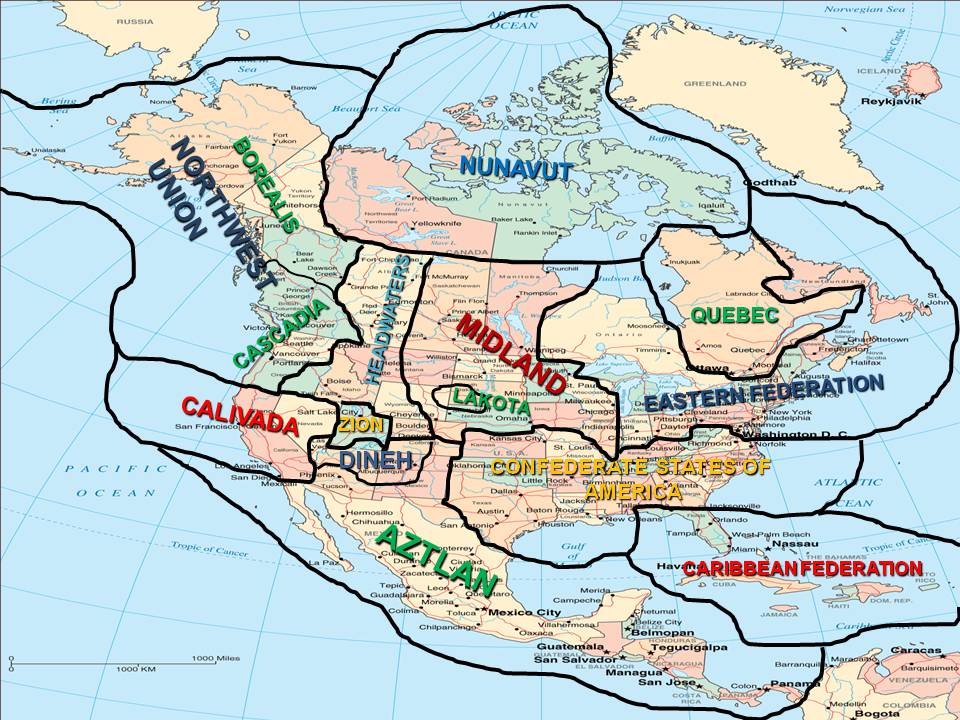
When civil war ensued in the old USA in 2025 between the "southern" states, including Texas, and the rest of the country, over access to resources (especially the oil, gas, minerals, timber, and fisheries from resource-rich Alaska), and neo-fascist corporate-supported christian fundamentalist groups' opposition to social-democratic legislation, the coalition of China, Russia, UNASUR, and India provided economic and materiel support to the non-southern states. After two years of destructive warfare, in which it is estimated that 15 million  U.S. civilians were killed, and many cities across the southern and eastern states, and Alaska ravaged, several coalitions of old USA states and Indigenous nations emerged, and brokered for peace. These new coalitions had also engaged in secret talks with neighbouring Canadian provinces, and the new Bolivarian Socialist Republic of Aztlan (formerly Mexico).  When the treaties of the New North America were signed and ratified by all the new coalitions in Toronto, with RUN aid in 2030, the map of North America changed irrevocably, bringing peace to this section of the World, and those areas previously affected by it's former militarism. As with all the nuclear weapons from the other countries of the World, those of the old USA and Israel were stockpiled for eventual dismantlement with the others at the RUN disposal facility, in Western Australia [ holov - nucleardisp ].

As the old USA city of New York began to be inundated, along with the rest of the major global coastal cities, between 2020 and 2028, the other countries of the UN, and then the RUN, decided to fund and build a new centre in the inland city of Brasilia, UNASUR (formerly the capital of Brasil). [ holov - newcentre ]. Progress on building and developing the centre was slow, due to the major upheavals caused by the rapid global sea-level rises. But by 2044, the new centre was fully dedicated in a globally holovised ceremony,  which was watched by an estimated one-half of the surviving global population [ holov - rundedic ].

The RUN continues today in it's stated aims of the promotion of global peace, stability, environmental restoration, and economic and social development. As well as in it's aid to the hundreds of millions of refugees from the global environmental upheavals of the past two and a half decades [ holov - refugees ]. RUN officials estimate it will be many more decades before climate stabilisation efforts are able to successfully restore stability to the global climate system, ravaged by so many decades of unchecked emissions of GHG's (greenhouse gasses). [ holov - climstabil ].

Now that significant portions of the economies of all the major World powers are no longer devoted to defense/military spending, the RUN is allocated a larger budget from them, and plays a much larger role on the World stage, than did the older UN, before 2027.

Friday, June 4, 2010

CHERNOBYL WEST CONTINUING, OUR TRUE NATURE, and AROUND THE CORNER

                    CHERNOBYL WEST CONTINUING

http://www.commondreams.org/headline/2010/06/03-12
Here's the bad news folks. The untamed pressurised oil/methane gusher from the destroyed BP Deepwater Horizon drilling platform(NOT SPILL, AS MUCH OF THE CORPORATE MEDIA CONTINUES TO CATEGORISE IT!), which BP is still not able to control and cap, as of today, 03 June, will be heading for the US Atlantic Coast. These eminent scientists, peers in the top of their fields, using the most powerful computing platforms in the World, have come up with the following scenario for the vast amounts of oil now in the Gulf of Mexico. Give this important article a read, and the comments afterword, off of the web-site. Very interesting. 


Gulf Oil Spill Likely to Hit U.S. Atlantic Coast This Summer

BOULDER, Colorado - Oil from the massive spill in the Gulf of Mexico is likely to extend along thousands of miles of the Atlantic coast and into the open ocean as early as this summer, according to a detailed computer modeling study released today by the National Center for Atmospheric Research.
[An image from the NCAR computer model of the flow of Deepwater Horizon oil. (Image courtesy NCAR)]An image from the NCAR computer model of the flow of Deepwater Horizon oil. (Image courtesy NCAR)
The research was supported in part by the National Science Foundation, NCAR's sponsor. The results were reviewed by scientists at NCAR and elsewhere, although not yet submitted for peer-review publication

"I've had a lot of people ask me, 'Will the oil reach Florida?'" says NCAR scientist Synte Peacock, who worked on the study. "Actually, our best knowledge says the scope of this environmental disaster is likely to reach far beyond Florida, with impacts that have yet to be understood."
The computer simulations indicate that, once the oil in the uppermost ocean has become entrained in the Gulf of Mexico's fast-moving Loop Current, it is likely to reach Florida's Atlantic coast within weeks.

It can then move north as far as about Cape Hatteras, North Carolina, with the Gulf Stream, before turning east to the open ocean.

Whether the oil will be a thin film on the surface or mostly subsurface due to mixing in the upper ocean is not known. The flow in the model represents the best estimate of how ocean currents are likely to respond under typical wind conditions.

More model studies are underway that will indicate what might happen to the oil in the Atlantic Ocean.
"We have been asked if and when remnants of the spill could reach the European coastlines," says Martin Visbeck, a member of the research team from the Leibniz Institute of Marine Sciences at the University of Kiel, Germany.

"Our assumption is that the enormous lateral mixing in the ocean together with the biological disintegration of the oil should reduce the pollution to levels below harmful concentrations," said Visbeck. "But we would like to have this backed up by numbers from some of the best ocean models."

To model the flow of oil, NCAR scientists are using the Parallel Ocean Program, the ocean component of the Community Climate System Model, a powerful software tool developed by scientists at NCAR in collaboration with the Department of Energy. They are conducting the simulations at supercomputers based at the New Mexico Computer Applications Center and Oak Ridge National Laboratory.

The NCAR scientists simulated how a liquid released at the spill site would disperse and circulate, producing results that are not dependent on the total amount released.

The scientists tracked the rate of dispersal in the top 65 feet of the water and at four additional depths, with the lowest just above the sea bed.

"The modeling study is analogous to taking a dye and releasing it into water, then watching its pathway," Peacock says.

The dye tracer used in the model has no actual physical resemblance to true oil. Unlike oil, the dye has the same density as the surrounding water, does not coagulate or form slicks, and is not subject to chemical breakdown by bacteria or other forces.

Peacock and her colleagues stress that the simulations are not a forecast because it is impossible to accurately predict the precise location of the oil weeks or months from now.

Instead, the simulations provide possible scenarios for the oil dispersal. The timing and course of the oil slick will be affected by regional weather conditions and the ever-changing state of the Gulf's Loop Current, neither of which can be predicted more than a few days in advance.

The dilution of the oil relative to the source also will be impacted by bacterial degradation and other conditions, which are not included in the simulations.

What is possible, is to estimate a range of possible trajectories, based on the best understanding of how ocean currents transport material. The oil trajectory that actually occurs will depend on both on the short-term evolution of the Loop Current, which feeds into the Gulf Stream, and on the state of the overlying atmosphere.
Oil has been spilling into the Gulf of Mexico since April 20 when the oil rig Deepwater Horizon exploded and caught fire. Oil giant BP, which leased the rig to drill a test well 18,000 feet below the seafloor has not been able to stem the flow of oil from the broken wellhead.

Now, 45 days after the spill began, an estimated 540,000 to 1.25 million barrels of oil [some scientists question this number, estimating it to be 10-20 times higher! eds..] have entered the waters of the Gulf of Mexico, according to statements by the National Incident Command's Flow Rate Technical Group and an addition estimate given by Incident Commandert U.S. Coast Guard Admiral Thad Allen in a news briefing this week. Some of this oil has evaporated or been collected by skimmer boats or burned on the surface of the water.

The spill is located in a relatively stagnant area of the Gulf, and the oil so far has remained relatively confined near the Louisiana and Alabama coastlines, although there have been reports of small amounts in the Loop Current. Oil has come ashore in Louisiana, Alabama and Mississippi.

The model simulations show that a liquid released in the surface ocean at the spill site is likely to slowly spread as it is mixed by the ocean currents until it is entrained in the Loop Current. At that point, speeds pick up to about 40 miles per day, and when the liquid enters the Atlantic's Gulf Stream it can travel at speeds up to about 100 miles per day, or 3,000 miles per month.

The six model simulations released today all have different Loop Current characteristics, and all provide slightly different scenarios of how the oil might be dispersed. The simulations all bring the oil to south Florida and then up the East Coast. However, the timing of the oil's movement differs depending on the configuration of the Loop Current.

With the true rate of release of oil from the BP gusher likely many times higher than that given by the US Govt./BP, the results for all coastal dwellers will soon be readily visible. How much of the fisheries will be destroyed on the Atlantic Coast, north to Virginia or New Jersey? (the Gulf Coast's of Florida unfortunately is already slated for destruction) What will be the effect on all the undersea and near-shore ecosystems, and how will that ripple through all the other inter-related ones in these areas? What will happen to the economies of these areas? Will people finally wake up and realise that this is what unregulated Capitalism brings? A system based on greed, an emotion/personality aspect generally thought to be unhealthy, but justified by it's supporters as pushing people to work hard and innovate. On pitting each person against the other, with one's good fortune to be obtained at the expense of others, downplaying and de-emphasizing cooperation. Is this really human nature, and what our political and economic system should be based on?

                                            OUR TRUE NATURE

Last Tuesday, 01 June, a small plane that had just taken off from Merrill Field, an airfield serving mainly small private planes and charters, crashed into an empty building, near a busy downtown street, here in Anchorage.  Twenty-five passers-by on foot, bike, and driving, stopped and rushed to the crash, and were able to pull all but a four-year old boy out of the plane, to safety, before it burst into flame.

http://www.ktuu.com/Global/story.asp?S=12592703

They didn't have to risk their own safety to do this, and there was no profit to be gained by it. But they still did, because it's something almost everyone would do, in a similar situation. It is OUR TRUE NATURE to act cooperatively, to help people when the need is great, out of empathy for their condition. Isn't it time we had a political and economic system that would reflect OUR TRUE NATURE? Think how much healthier, happier, and safer we would all be. This would automatically lead to healthier and more sustainable policies, that would ensure that civilisation as we know it, will be able to continue. What would such a system be like? Most forward-thinkers/progressives, ourselves included here at A.P.R., think that it would be an ethical/democratic form of socialism, somewhat like the Social Democracies of Norway/Finland/Sweden, but with even greater mass control of the economic modes of production. http://www.dsausa.org/pdf/widemsoc.pdf

Until we are able to change our political and economic system, we will continue to see more Deepwater Horizon-type tragedies, and the acceleration of global warming, and global ecosystem collapse. Another article, linked here, describes heartbreaking tragedies experienced daily by the poor people in Nigeria, whose crime it is to live in the Niger Delta, which is being exploited for it's oil, by BP and the other major trans-national oil corporations. This does not, and should not have to happen.
http://www.commondreams.org/headline/2010/05/30-0


Nigeria's Agony Dwarfs the Gulf Oil Spill. The US and Europe Ignore It

The Deepwater Horizon disaster caused headlines around the world, yet the people who live in the Niger delta have had to live with environmental catastrophes for decades

by John Vidal, environment editor
We reached the edge of the oil spill near the Nigerian village of Otuegwe after a long hike through cassava plantations. Ahead of us lay swamp. We waded into the warm tropical water and began swimming, cameras and notebooks held above our heads. We could smell the oil long before we saw it – the stench of garage forecourts and rotting vegetation hanging thickly in the air.

[A ruptured pipeline burns in a Lagos suburb after an explosion in 2008 which killed at least 100 people. (Photograph: George Esiri/Reuters)]A ruptured pipeline burns in a Lagos suburb after an explosion in 2008 which killed at least 100 people. (Photograph: George Esiri/Reuters)
The farther we travelled, the more nauseous it became. Soon we were swimming in pools of light Nigerian crude, the best-quality oil in the world. One of the many hundreds of 40-year-old pipelines that crisscross the Niger delta had corroded and spewed oil for several months.Forest and farmland were now covered in a sheen of greasy oil. Drinking wells were polluted and people were distraught. No one knew how much oil had leaked. "We lost our nets, huts and fishing pots," said Chief Promise, village leader of Otuegwe and our guide. "This is where we fished and farmed. We have lost our forest. We told Shell of the spill within days, but they did nothing for six months."

That was the Niger delta a few years ago, where, according to Nigerian academics, writers and environment groups, oil companies have acted with such impunity and recklessness that much of the region has been devastated by leaks.

In fact, more oil is spilled from the delta's network of terminals, pipes, pumping stations and oil platforms every year than has been lost in the Gulf of Mexico, the site of a major ecological catastrophe caused by oil that has poured from a leak triggered by the explosion that wrecked BP's Deepwater Horizon rig last month.
That disaster, which claimed the lives of 11 rig workers, has made headlines round the world. By contrast, little information has emerged about the damage inflicted on the Niger delta. Yet the destruction there provides us with a far more accurate picture of the price we have to pay for drilling oil today.

On 1 May this year a ruptured ExxonMobil pipeline in the state of Akwa Ibom spilled more than a million gallons into the delta over seven days before the leak was stopped. Local people demonstrated against the company but say they were attacked by security guards. Community leaders are now demanding $1bn in compensation for the illness and loss of livelihood they suffered. Few expect they will succeed. In the meantime, thick balls of tar are being washed up along the coast.

Within days of the Ibeno spill, thousands of barrels of oil were spilled when the nearby Shell Trans Niger pipeline was attacked by rebels. A few days after that, a large oil slick was found floating on Lake Adibawa in Bayelsa state and another in Ogoniland. "We are faced with incessant oil spills from rusty pipes, some of which are 40 years old," said Bonny Otavie, a Bayelsa MP.

This point was backed by Williams Mkpa, a community leader in Ibeno: "Oil companies do not value our life; they want us to all die. In the past two years, we have experienced 10 oil spills and fishermen can no longer sustain their families. It is not tolerable."

With 606 oilfields, the Niger delta supplies 40% of all the crude the United States imports and is the world capital of oil pollution. Life expectancy in its rural communities, half of which have no access to clean water, has fallen to little more than 40 years over the past two generations. Locals blame the oil that pollutes their land and can scarcely believe the contrast with the steps taken by BP and the US government to try to stop the Gulf oil leak and to protect the Louisiana shoreline from pollution.

"If this Gulf accident had happened in Nigeria, neither the government nor the company would have paid much attention," said the writer Ben Ikari, a member of the Ogoni people. "This kind of spill happens all the time in the delta."

"The oil companies just ignore it. The lawmakers do not care and people must live with pollution daily. The situation is now worse than it was 30 years ago. Nothing is changing. When I see the efforts that are being made in the US I feel a great sense of sadness at the double standards. What they do in the US or in Europe is very different."

"We see frantic efforts being made to stop the spill in the US," said Nnimo Bassey, Nigerian head of Friends of the Earth International. "But in Nigeria, oil companies largely ignore their spills, cover them up and destroy people's livelihood and environments. The Gulf spill can be seen as a metaphor for what is happening daily in the oilfields of Nigeria and other parts of Africa.

"This has gone on for 50 years in Nigeria. People depend completely on the environment for their drinking water and farming and fishing. They are amazed that the president of the US can be making speeches daily, because in Nigeria people there would not hear a whimper," he said.

It is impossible to know how much oil is spilled in the Niger delta each year because the companies and the government keep that secret. However, two major independent investigations over the past four years suggest that as much is spilled at sea, in the swamps and on land every year as has been lost in the Gulf of Mexico so far.

One report, compiled by WWF UK, the World Conservation Union and representatives from the Nigerian federal government and the Nigerian Conservation Foundation, calculated in 2006 that up to 1.5m tons of oil – 50 times the pollution unleashed in the Exxon Valdez tanker disaster in Alaska – has been spilled in the delta over the past half century. Last year Amnesty calculated that the equivalent of at least 9m barrels of oil was spilled and accused the oil companies of a human rights outrage.

According to Nigerian federal government figures, there were more than 7,000 spills between 1970 and 2000, and there are 2,000 official major spillages sites, many going back decades, with thousands of smaller ones still waiting to be cleared up. More than 1,000 spill cases have been filed against Shell alone.
Last month Shell admitted to spilling 14,000 tonnes of oil in 2009. The majority, said the company, was lost through two incidents – one in which the company claims that thieves damaged a wellhead at its Odidi field and another where militants bombed the Trans Escravos pipeline.

Shell, which works in partnership with the Nigerian government in the delta, says that 98% of all its oil spills are caused by vandalism, theft or sabotage by militants and only a minimal amount by deteriorating infrastructure. "We had 132 spills last year, as against 175 on average. Safety valves were vandalised; one pipe had 300 illegal taps. We found five explosive devices on one. Sometimes communities do not give us access to clean up the pollution because they can make more money from compensation," said a spokesman.
"We have a full-time oil spill response team. Last year we replaced 197 miles of pipeline and are using every known way to clean up pollution, including microbes. We are committed to cleaning up any spill as fast as possible as soon as and for whatever reason they occur."

These claims are hotly disputed by communities and environmental watchdog groups. They mostly blame the companies' vast network of rusting pipes and storage tanks, corroding pipelines, semi-derelict pumping stations and old wellheads, as well as tankers and vessels cleaning out tanks.

The scale of the pollution is mind-boggling. The government's national oil spill detection and response agency (Nosdra) says that between 1976 and 1996 alone, more than 2.4m barrels contaminated the environment. "Oil spills and the dumping of oil into waterways has been extensive, often poisoning drinking water and destroying vegetation. These incidents have become common due to the lack of laws and enforcement measures within the existing political regime," said a spokesman for Nosdra.

The sense of outrage is widespread. "There are more than 300 spills, major and minor, a year," said Bassey. "It happens all the year round. The whole environment is devastated. The latest revelations highlight the massive difference in the response to oil spills. In Nigeria, both companies and government have come to treat an extraordinary level of oil spills as the norm."

A spokesman for the Stakeholder Democracy Network in Lagos, which works to empower those in communities affected by the oil companies' activities, said: "The response to the spill in the United States should serve as a stiff reminder as to how far spill management in Nigeria has drifted from standards across the world."

Other voices of protest point out that the world has overlooked the scale of the environmental impact. Activist Ben Amunwa, of the London-based oil watch group Platform, said: "Deepwater Horizon may have exceed Exxon Valdez, but within a few years in Nigeria offshore spills from four locations dwarfed the scale of the Exxon Valdez disaster many times over. Estimates put spill volumes in the Niger delta among the worst on the planet, but they do not include the crude oil from waste water and gas flares. Companies such as Shell continue to avoid independent monitoring and keep key data secret."

Worse may be to come. One industry insider, who asked not to be named, said: "Major spills are likely to increase in the coming years as the industry strives to extract oil from increasingly remote and difficult terrains. Future supplies will be offshore, deeper and harder to work. When things go wrong, it will be harder to respond."

Judith Kimerling, a professor of law and policy at the City University of New York and author of Amazon Crude, a book about oil development in Ecuador, said: "Spills, leaks and deliberate discharges are happening in oilfields all over the world and very few people seem to care."

There is an overwhelming sense that the big oil companies act as if they are beyond the law. Bassey said: "What we conclude from the Gulf of Mexico pollution incident is that the oil companies are out of control.

"It is clear that BP has been blocking progressive legislation, both in the US and here. In Nigeria, they have been living above the law. They are now clearly a danger to the planet. The dangers of this happening again and again are high. They must be taken to the international court of justice."

Saturday, May 29, 2010

GETTING IT [and] BACKYARD DISCOVERIES

                  GETTING IT

I found this article the other day by Chris Hedges while doing our normal daily A.P.R. news scan. Chris has written some very insightful anti-war articles, which have appeared on a number of different web-sites. Chris's writing here sums up very well the current socio-political/economic system here in the U.S. You may remember reading about the rioting in Greece several weeks ago, when their government was facing great political and economic pressure from the U.S., other European countries, and the International Monetary Fund (IMF), to enact "austerity measures", aka, a Shock Doctrine. But most of the people in Greece knew better, what this meant. Give this a read...see what you think.
 
The Greeks Get It
by Chris Hedges

Here's to the Greeks. They know what to do when corporations pillage and loot their country. They know what to do when Goldman Sachs and international bankers collude with their power elite to falsify economic data and then make billions betting that the Greek economy will collapse. They know what to do when they are told their pensions, benefits and jobs have to be cut to pay corporate banks, which screwed them in the first place. Call a general strike. Riot. Shut down the city centers. Toss the bastards out. Do not be afraid of the language of class warfare-the rich versus the poor, the oligarchs versus the citizens, the capitalists versus the proletariat. The Greeks, unlike most of us, get it. 

The former right-wing government of Greece lied about the size of the country's budget deficit. It was not 3.7 percent of gross domestic product but 13.6 percent. And it now looks like the economies of Spain, Ireland, Italy and Portugal are as bad as Greece's, which is why the euro has lost 20 percent of its value in the last few months. The few hundred billion in bailouts for other faltering European states, like our own bailouts, have only forestalled disaster. This is why the U.S. stock exchange is in free fall and gold is rocketing upward. American banks do not have heavy exposure in Greece, but Greece, as most economists concede, is only the start. Wall Street is deeply invested in other European states, and when the unraveling begins the foundations of our own economy will rumble and crack as loudly as the collapse in Athens. The corporate overlords will demand that we too impose draconian controls and cuts or see credit evaporate. They have the money and the power to hurt us. There will be more unemployment, more personal and commercial bankruptcies, more foreclosures and more human misery. And the corporate state, despite this suffering, will continue to plunge us deeper into debt to make war. It will use fear to keep us passive. We are being consumed from the inside out. Our economy is as rotten as the economy in Greece. We too borrow billions a day to stay afloat. We too have staggering deficits, which can never be repaid. Heed the dire rhetoric of European leaders.

"The euro is in danger," German Chancellor Angela Merkel told lawmakers last week as she called on them to approve Germany's portion of the bailout plan. "If we do not avert this danger, then the consequences for Europe are incalculable, and then the consequences beyond Europe are incalculable."
Beyond Europe means us. The right-wing government of Kostas Karamanlis, which preceded the current government of George Papandreou, did what the Republicans did under George W. Bush. They looted taxpayer funds to enrich their corporate masters and bankrupt the country. They stole hundreds of millions of dollars from individual retirement and pension accounts slowly built up over years by citizens who had been honest and industrious. They used mass propaganda to make the population afraid of terrorists and surrender civil liberties, including habeas corpus. And while Bush and Karamanlis, along with the corporate criminal class they abetted, live in unparalleled luxury, ordinary working men and women are told they must endure even more pain and suffering to make amends. It is feudal rape. And there has to be a point when even the American public-which still believes the fairy tale that personal will power and positive thinking will lead to success-will realize it has been had.

What is happening in Greece, what will happen in Spain and Portugal, what is starting to happen here in states such as California, is the work of a global, white-collar criminal class. [aka The Shock Doctrine http://akprogressive.blogspot.com/2009/10/capitalisms-dirty-warssecrets.html, eds]

No government, including our own, will defy them. It is up to us. Barack Obama is simply the latest face that masks the corporate state. His administration serves corporate interests, not ours. Obama, like Goldman Sachs or Citibank, does not want the public to see how the Federal Reserve Bank acts as a private account and ATM machine for Wall Street at our expense. He, too, has helped orchestrate the largest transference of wealth upward in American history. He serves our imperial wars, refuses to restore civil liberties, and has not tamed our crippling deficits. His administration gutted regulatory agencies that permitted BP to turn the Gulf of Mexico into a toxic swamp. 
The refusal of Obama to intervene in a meaningful way to save the gulf's ecosystem and curtail the abuses of the natural gas and oil corporations is not an accident. He knows where power lies. BP and its employees handed more than $3.5 million to federal candidates over the past 20 years, with the largest chunk of their money going to Obama, according to the Center for Responsive Politics
We are facing the collapse of the world's financial system. It is the end of globalization. And in these final moments the rich are trying to get all they can while there is still time. The fusion of corporatism, militarism and internal and external intelligence agencies-much of their work done by private contractors-has given these corporations terrifying mechanisms of control. Think of it, as the Greeks do, as a species of foreign occupation. Think of the Greek riots as a struggle for liberation.
Dwight Macdonald laid out the consequences of a culture such as ours, where the waging of war was "the normal mode of existence." The concept of perpetual war, which eluded the theorists behind the 19th and early 20th century reform and social movements, including Karl Marx, has left social reformers unable to deal with this effective mechanism of mass control. The old reformists had limited their focus to internal class struggle and, as Macdonald noted, never worked out "an adequate theory of the political significance of war." Until that gap is filled, Macdonald warned, "modern socialism will continue to have a somewhat academic flavor."

Macdonald detailed in his 1946 essay "The Root Is Man" the marriage between capitalism and permanent war. He despaired of an effective resistance until the permanent war economy, and the mentality that went with it, was defeated. Macdonald, who was an anarchist, saw that the Marxists and the liberal class in Western democracies had both mistakenly placed their faith for human progress in the goodness of the state. This faith, he noted, was a huge error. The state, whether in the capitalist United States or the communist Soviet Union, eventually devoured its children. And it did this by using the organs of mass propaganda to keep its populations afraid and in a state of endless war. It did this by insisting that human beings be sacrificed before the sacred idol of the market or the utopian worker's paradise. The war state provides a constant stream of enemies, whether the German Hun, the Bolshevik, the Nazi, the Soviet agent or the Islamic terrorist. Fear and war, Macdonald understood, was the mechanism that let oligarchs pillage in the name of national security.

"Modern totalitarianism can integrate the masses so completely into the political structure, through terror and propaganda, that they become the architects of their own enslavement," he wrote. "This does not make the slavery less, but on the contrary more- a paradox there is no space to unravel here. Bureaucratic collectivism, not capitalism, is the most dangerous future enemy of socialism."

Macdonald argued that democratic states had to dismantle the permanent war economy and the propaganda that came with it. They had to act and govern according to the non-historical and more esoteric values of truth, justice, equality and empathy. Our liberal class, from the church and the university to the press and the Democratic Party, by paying homage to the practical dictates required by hollow statecraft and legislation, has lost its moral voice. Liberals serve false gods. The belief in progress through war, science, technology and consumption has been used to justify the trampling of these non-historical values. And the blind acceptance of the dictates of globalization, the tragic and false belief that globalization is a form of inevitable progress, is perhaps the quintessential illustration of Macdonald's point. The choice is not between the needs of the market and human beings. There should be no choice. And until we break free from serving the fiction of human progress, whether that comes in the form of corporate capitalism or any other utopian vision, we will continue to emasculate ourselves and perpetuate needless human misery.
As the crowds of strikers in Athens understand, it is not the banks that are important but the people who raise children, build communities and sustain life. And when a government forgets whom it serves and why it exists, it must be replaced...

Chris Hedges writes a regular column for Truthdig.com. Hedges graduated from Harvard Divinity School and was for nearly two decades a foreign correspondent for The New York Times. He is the author of many books, including: War Is A Force That Gives Us Meaning, What Every Person Should Know About War, and American Fascists: The Christian Right and the War on America.  His most recent book is Empire of Illusion: The End of Literacy and the Triumph of Spectacle.

We know it can be overwhelming when we think of the Powers That Be, using the control of the corporate media, to maintain the existing order of mostly unregulated capitalism that is destroying the environment and keeping the majority of humanity on this planet locked in poverty and hopelessness. Yet, we must not give in to despair. It took generations of struggle for civil rights to be won in the US, and other countries, for people of colour, for women's suffrage, and for unions and working people to win things we take for granted now like 40 hour work-weeks, paid vacations, and workmen's compensation (which are now, and have been, for the last 20+ years, under threat of being rolled-back, thanks to both Democratic and Republican politicians being bankrolled by corporate interests). So it helps to remember that, and appreciate those millions of people in the past, who sacrificed so much, to give us a more civilised society. And it will take years, and probably decades more, of struggle, to bring a more sane and just society to this country, and the World, with a political and economic system based not on greed, but on love and respect for all life and the environment. But it will and must happen, or civilisation as we know it will be destroyed, due to global ecosystem collapse and rapid climate change.

                             BACKYARD DISCOVERIES

It was a fairly smooth move for us last week, as things were packed up by a moving company, then shipped down to Anchorage. Homer though was a little upset, changes to his routine can leave him rather uneasy. He managed to squeeze his large body under our bed friday before last, while the movers were packing things. But he calmed down after I reasoned with him, and has been fine since.

We've been pretty busy in just the one week since our relocation to the balmy latitude of 61.15 North, near the bustling metropolis of Anchorage (population around 300,000). And we are not too keen on spending much time in the larger city, with it's wide, busy streets, clogged with traffic during the day. Fortunately though, Anchorage's traffic is not nearly as bad as most large lower 48 cities, and quiets down greatly in the evenings and on weekends. Another nice thing is that trails and parks are never too far away, when a refuge from the city noise and bustle is required. The best thing though, at least for us, is that our backyard is Chugach State Park, 1300 square KM of unspoiled alpine terrain, glaciated at the higher elevations (that range from sea level to 2441 metres, or 8005 ft.), and is laced with trails and routes for quick access into real Alaskan wilderness, which continues much further beyond the boundaries of the park.

So we were able to get out on a few hikes last sunday, and again yesterday. Last sunday, we lit out from the site of the new Chugach Front Research Centre (in 3-4 weeks hence). I just threw a light pack together with food/water and extra layers, and we got onto the "Tank Road", which is a dirt/gravel road, in the Ft. Richardson army base property, which is protected wilderness on the eastern edge of the city, and abuts the Chugach State Park. We ran down this several KM, and got onto the Powerline Trail, which angles in to the mountains. The Powerline trail ascend gradually as it heads southeast into the Chugach. Giving you nice views of the city below, which seems so small from an oblique angle, with all the trees. We took a spur trail off the Powerline trail, which connected with others, eventually leading to the Near Point Trail. This spur trail had nice views of the coming mountains, and led down into the canyon of Campbell Creek, a nice clear, free-running stream.

In fact, one thing we really love about being in the backcountry in this area, is the abundance of clear-flowing streams, and all the benefits they provide. Lower elevation streams in the Interior (which are fewer, because of the drier climate), are usually sluggish and turbid, not very attractive. Here though, on these trails, we were happy to see one at least every 500 metres, or less, thanks to the moister climate, and steeper terrain.

Mattie of course, since she thinks she is an otter, has to make the most of each one, no matter how muddy or dirty, and rolls whole-heartedly into them. Fortunately, she gets clean when we get to another, larger one.

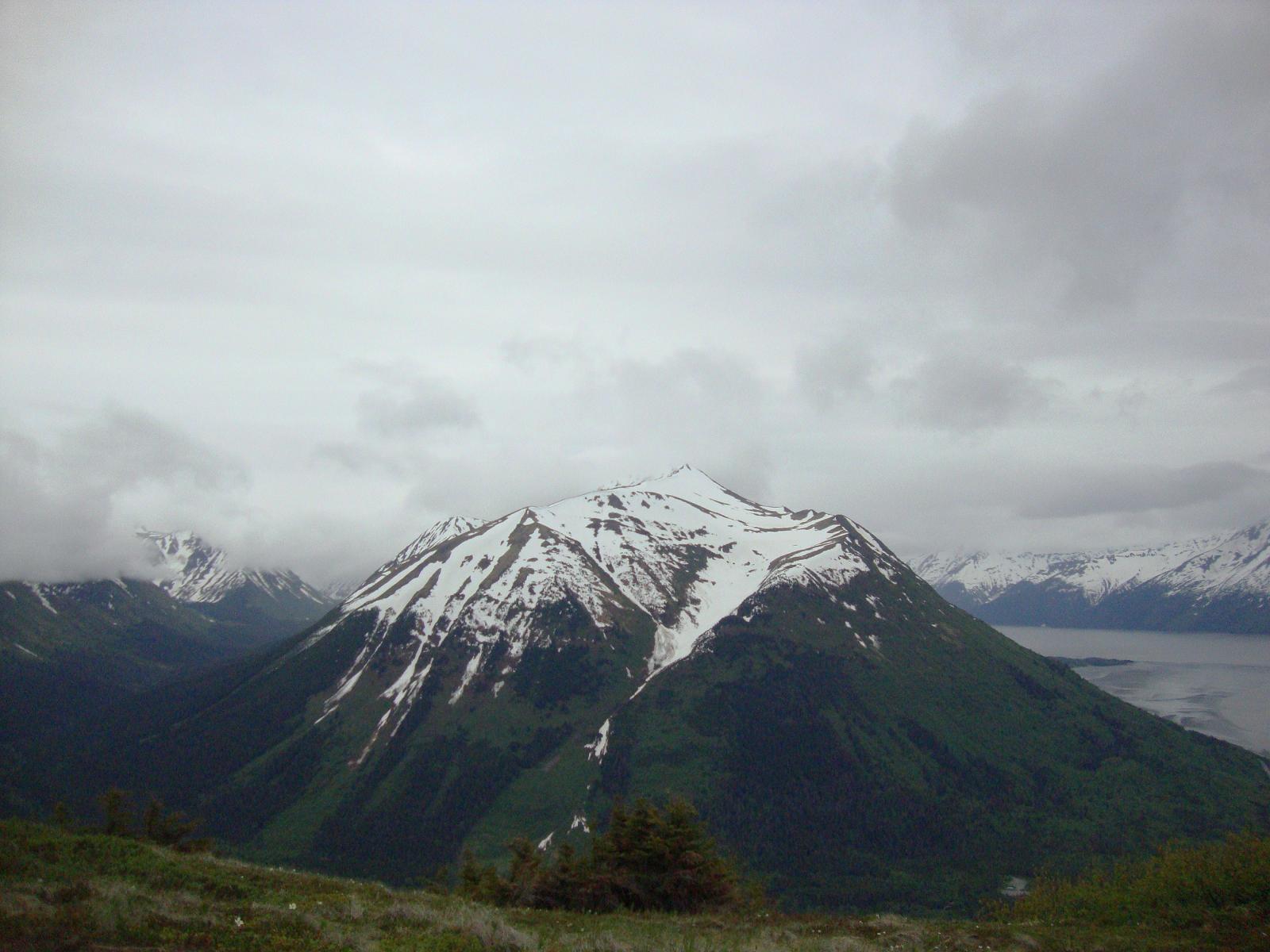
By the time we got onto the trail junction for the Near Point, it got quite a bit steeper, and I had to stop running, and just hike briskly. Which is what I usually do on my fast-packs, run the downhills/levels/slight inclines, and walk the steeper uphills. It was very steep and muddy in sections heading up the face of Near Point, a 950 metre knob, coming off the main Chugach Front. So much so, that I went knee-deep a few times into some mud, which took some effort pulling out, not to lose one of my multi-sport shoes. But with those and my neoprene socks, my feet stayed warm and comfortable. This is about 3/4 the way to the top of Near Point, looking back in to the mountains. There were still alot of snow patches at tree-line and above (700 metres and higher). The top of Near Point, which we acquired in just two hours of running and walking from near the site of our new Chugach Front Research Centre, gave us stunning views. This is looking east, further into the Chugach mountains. If you look closely, a trail is visible heading in. Once we get established in our new research centre, I'll get a 3-4 day pack together, and we'll head up from it into this valley, and over a pass, for a thorough reconnaissance of this beautiful area. Travel will be easier then, as more snow melts. You can see just how close the new research centre is to the mountains from the view looking down from Near Point.  That's why we chose that site for it!

We had a quick lunch, and savoured the views for a half-hour or so. It was probably only about 8C up there at 950 metres, with a stiff breeze, much cooler than where we started, where it was probably 14C (58F).  As you can see, I had gotten pretty muddy, during the walk up.

The view to the south shows how the Chugach Front continues, then angles southeast, above Turnagain Arm. Lots of different routes and trails are located throughout this area.

We headed down after a half-hour of savouring the view and a quick lunch. Although we just walked briskly back the rest of the way, this only took two hours as well, since it was mostly downhill.

We are very happy that a 23 KM fast pack from our new research centre on the edge of the city, will take us to places like this. Longer multi-day outings can also occur for us without any driving. And for just our daily runs and nordic skis, on the trails in lower terrain, access will also be right from our door.

Yesterday we just had time for a short hike up the Wolverine Peak trail, which also connects with the Powerline trail, making it accessible from the C.F.R.C. But we drove to a trailhead, since we were already running errands in town. This trail ascends rapidly up from the Campbell Creek canyon.

Near this saddle area where the trail levels off, we made an interesting discovery, on a north-facing slope above.

A grove of stunted, wind-flagged mountain hemlocks stretched above us. These beautiful small trees grow at higher elevations up to tree-line, only in cool, moist areas, from the Cascades of Oregon and Washington (and even around Glacier Park, Montana), north along the coastal margins, to here in Alaska. When our friend Erik and I fast-packed the Chilkoot Trail last labour-day weekend, we came across some just on the other side of Chilkoot Pass.

We think this grove here in the Chugach, may just be the furthest-north one of it's kind! They can't tolerate extreme arctic cold, say -35C (-31F) or colder, and they require cool, moist growing season conditions. The Chugach Front is the furthest north area in North America where winter-cold doesn't usually reach those extremes, combined with much cooler and moister summer conditions than those found further north and inland over the Interior. Interesting. These trees are also "flagged" from the southeast. Meaning all the branches on the top halves of the trees point northwest. This is because strong prevailing southeast winds occur here, which often exceed 110 km/hr, and can reach 160 km/hr (100 mph), when low pressure systems are in the vicinity, over the Gulf of Alaska. You'll see flagged trees in many areas where strong prevailing winds occur, another excellent example being around the Columbia Gorge of Oregon/Washington.

The trail, as it wound through the beautiful stunted hemlocks, quickly became clogged with snow, so we turned back, since I was wearing my Chaco sandles. In a few weeks, the snow patches will be gone, and we'll be going to the top of Wolverine Peak, and further on our multi-day outings. How fortunate we are, to able to enjoy places like this, so close to a city. I think Anchorage very likely provides the best, and quickest access to true alpine terrain of any city on Earth! Cheers.

Thursday, May 20, 2010

IN CASE YOU'D FORGOTTEN [and] OUR NEW BACKYARD

IN CASE YOU'D FORGOTTEN

what kind of system we live under in the USA, here are a few reminders. This is a link to an event that occurred two days ago, when CBS-News reporters wanted to view some oil-threatened areas of the Louisiana coastline, from the Deepwater Horizon BP gusher. But were turned back by the US COAST GUARD, UNDER THREAT OF ARREST.


Here is the actual video.

Now, correct us if we are wrong, but isn't the US Coast Guard a part of the US government, which in theory is a democracy, answerable to the citizens of this country? Or is the US government for sale, to large corporations, to enable their profits to keep flowing? What do you think?

The corporate media though is slowly coming around to the magnitude of the BP gusher, as this NY Times article shows. It's hard to distort and suppress reality when it rears it's ugly head, as here, or when radiation spread around the Northern Hemisphere in 1986, after the Chernobyl explosion/fire.

http://www.nytimes.com/2010/05/16/us/16oil.html?hp

Giant Plumes of Oil Forming Under the Gulf

Jim Wilson/The New York Times

Secretary of the Interior Ken Salazar visited a wildlife treatment center in Louisiana on Saturday.

By JUSTIN GILLIS

Published: May 15, 2010

Scientists are finding enormous oil plumes in the deep waters of the Gulf of Mexico, including one as large as 10 miles long, 3 miles wide and 300 feet thick in spots. The discovery is fresh evidence that the leak from the broken undersea well could be substantially worse than estimates that the government and BP have given.

Times Topic: Gulf of Mexico Oil Spill (2010)“There’s a shocking amount of oil in the deep water, relative to what you see in the surface water,” said Samantha Joye, a researcher at the University of Georgia who is involved in one of the first scientific missions to gather details about what is happening in the gulf. “There’s a tremendous amount of oil in multiple layers, three or four or five layers deep in the water column.”

The plumes are depleting the oxygen dissolved in the gulf, worrying scientists, who fear that the oxygen level could eventually fall so low as to kill off much of the sea life near the plumes.

Dr. Joye said the oxygen had already dropped 30 percent near some of the plumes in the month that the broken oil well had been flowing. “If you keep those kinds of rates up, you could draw the oxygen down to very low levels that are dangerous to animals in a couple of months,” she said Saturday. “That is alarming.”

The plumes were discovered by scientists from several universities working aboard the research vessel Pelican, which sailed from Cocodrie, La., on May 3 and has gathered extensive samples and information about the disaster in the gulf.

Scientists studying video of the gushing oil well have tentatively calculated that it could be flowing at a rate of 25,000 to 80,000 barrels of oil a day. The latter figure would be 3.4 million gallons a day. But the government, working from satellite images of the ocean surface, has calculated a flow rate of only 5,000 barrels a day.

BP has resisted entreaties from scientists that they be allowed to use sophisticated instruments at the ocean floor that would give a far more accurate picture of how much oil is really gushing from the well.

“The answer is no to that,” a BP spokesman, Tom Mueller, said on Saturday. “We’re not going to take any extra efforts now to calculate flow there at this point. It’s not relevant to the response effort, and it might even detract from the response effort.”

[Wow, we certainly know who's calling the shots now, don't we? This is what happens with unregulated capitalism, the large corporations are the government. What did B. Mussolini call that? Oh yeah, FASCISM! eds.]

The undersea plumes may go a long way toward explaining the discrepancy between the flow estimates, suggesting that much of the oil emerging from the well could be lingering far below the sea surface.

The scientists on the Pelican mission, which is backed by the National Oceanic and Atmospheric Administration, the federal agency that monitors the health of the oceans, are not certain why that would be. They say they suspect the heavy use of chemical dispersants, which BP has injected into the stream of oil emerging from the well, may have broken the oil up into droplets too small to rise rapidly.

BP said Saturday at a briefing in Robert, La., that it had resumed undersea application of dispersants, after winning Environmental Protection Agency approval the day before.

“It appears that the application of the subsea dispersant is actually working,” Doug Suttles, BP’s chief operating officer for exploration and production, said Saturday. “The oil in the immediate vicinity of the well and the ships and rigs working in the area is diminished from previous observations.”

Many scientists had hoped the dispersants would cause oil droplets to spread so widely that they would be less of a problem in any one place. If it turns out that is not happening, the strategy could come under greater scrutiny. Dispersants have never been used in an oil leak of this size a mile under the ocean, and their effects at such depth are largely unknown.

Much about the situation below the water is unclear, and the scientists stressed that their results were preliminary. After the April 20 explosion of the Deepwater Horizon, they altered a previously scheduled research mission to focus on the effects of the leak.

Interviewed on Saturday by satellite phone, one researcher aboard the Pelican, Vernon Asper of the University of Southern Mississippi, said the shallowest oil plume the group had detected was at about 2,300 feet, while the deepest was near the seafloor at about 4,200 feet.

“We’re trying to map them, but it’s a tedious process,” Dr. Asper said. “Right now it looks like the oil is moving southwest, not all that rapidly.”

He said they had taken water samples from areas that oil had not yet reached, and would compare those with later samples to judge the impact on the chemistry and biology of the ocean.

While they have detected the plumes and their effects with several types of instruments, the researchers are still not sure about their density, nor do they have a very good fix on the dimensions.

Given their size, the plumes cannot possibly be made of pure oil, but more likely consist of fine droplets of oil suspended in a far greater quantity of water, Dr. Joye said. She added that in places, at least, the plumes might be the consistency of a thin salad dressing.

Dr. Joye is serving as a coordinator of the mission from her laboratory in Athens, Ga. Researchers from the University of Mississippi and the University of Southern Mississippi are aboard the boat taking samples and running instruments.

Dr. Joye said the findings about declining oxygen levels were especially worrisome, since oxygen is so slow to move from the surface of the ocean to the bottom. She suspects that oil-eating bacteria are consuming the oxygen at a feverish clip as they work to break down the plumes.

CBS's Sixty Minutes actually put together some excellent in-depth stories about the Deepwater Horizon tragedy and gusher. At least the word is slowly getting out.
[false-color image from a European polar-orbiting satellite on 18MAY2010 showing the large surface oil-slick, the tail-looking appendage is a heavier surface concentration heading for the Loop current, which will soon bring it to Florida, then up and around in the Gulf Stream further north along the US Atlantic Coast. eds]

Here is another demonstration showing us who really runs the US government (as if we really needed it).

BP Withholds Oil Spill Facts — and Government Lets It
by Marisa Taylor and Renee Schoof

WASHINGTON - BP, the company in charge of the rig that exploded last month in the Gulf of Mexico, hasn't publicly divulged the results of tests on the extent of workers' exposure to evaporating oil or from the burning of crude over the gulf, even though researchers say that data is crucial in determining whether the conditions are safe.

Moreover, the company isn't monitoring the extent of the spill and only reluctantly released videos of the spill site that could give scientists a clue to the amount of the oil in gulf.

BP's role as the primary source of information has raised questions about whether the government should intervene to gather such data and to publicize it and whether an adequate cleanup can be accomplished without the details of crude oil spreading across the gulf.

Under pressure from senators, BP released four videos Tuesday, but it hasn't agreed to better monitoring.

The company also hasn't publicly released air sampling for oil spill workers although Occupational Safety and Health Administration, the agency in charge of monitoring compliance with worker safety regulations, is relying on the information and has urged it to do so.

"It is not ours to publish," said Dean Wingo, OSHA's assistant regional administrator who oversees Louisiana. "We are working with (BP) and encouraging them to post the data so that it is publicly available."

Much of the worker exposure data is being collected by contractors hired by BP.

Toby Odone, a BP spokesman, said the company is sharing the data with "legitimate interested parties," which include government agencies and the private companies assisting in the cleanup. When asked whether the information can be released publicly, he responded, "Why would one do it? Any parties with a legitimate interest can have access to it."

Joseph T. Hughes Jr., the director of the worker education training program for the National Institute of Environmental Health Sciences, said he didn't think "anyone has seen much of that data at all."

"The hard part about it is that in a normal response, when the government is doing this, there might be more transparency on the data," Hughes said. "In this case, when you have BP making the decisions and collecting the data it's harder to have that transparency."

Unlike the response to other past national disasters such as Hurricane Katrina where the government was in charge, BP has been designated as the "responsible party" under federal law and is overseeing much of the response to the spill. The government is acting more as an adviser.

So far, the government has been slow to press BP to release its data and permit others to evaluate the extent of the crisis.

"I think that one of the lessons learned here is whether the federal government should have more of a role in the response and not leave that decision-making in the hands of the responsible parties," said Hughes, whose institute was one of the first to raise questions about air quality at the World Trade Center site in the wake of the Sept. 11 attacks.

A recent report in the New England Journal of Medicine found that many Sept. 11 rescue workers still suffer from impaired lung function.

The Center for Toxicology and Environmental Health, one of BP's consultants, is collecting air quality samples over the coast and the water.

"It's fair to say that a majority of the air monitoring along the shoreline is being done by our organization," said Glenn Millner, a partner with the CTEH and a principal toxicologist.

Gina Solomon, a medical doctor and a senior scientist with the Natural Resources Defense Council, said her environmental organization has been pressing the government to release the data, after hearing reports of fishermen concerned about exposure.

"The fact that OSHA is saying that it's safe is important because they have access to data that we don't have," she said. "It's sort of awkward to have to take that on face value given the fact that there are fishermen who feel they are getting sick."

The Environmental Protection Agency is releasing shoreline data on its website, but not information about the air quality workers encounter on the water.

OSHA has access to that data and is monitoring it to determine what type of equipment the workers should be issued and other questions related to worker safety. So far, the air quality does not require workers to receive respirators, Wingo said.

Millner said that data as a matter of practice is shared only with the oil clean up worker and the company overseeing the cleanup.


BP also has exercised considerable control over how much is known about the amount of oil gushing into the gulf.

Early on, the government estimated that 210,000 gallons was being released daily. That estimate was based on satellite observations of the water's surface.

The first look at the oil coming out of the pipe on the sea floor was a video clip that BP released last week in response to demands from reporters and others. It caused a stir because some experts who analyzed it estimated that the amount of oil pouring into the gulf was many times the government's official estimate.

Sens. Bill Nelson, D-Fla., and Barbara Boxer, D-Calif., on Monday asked BP on Monday to provide all available video footage.

BP provided clips from several days of the spill on Tuesday.

The clips, however, would still result only in rough estimates because the oil flows at different rates at different times and it's mixed with gas, said BP spokesman Mark Proegler.

The company had no other equipment on the sea floor to monitor the amount of the flow, and no plans to install any.

"We've said from the beginning . . . it's difficult if not impossible to measure from the source of the flow," Proegler said on Tuesday. BP's focus is stopping the flow and keeping the oil away from shore, he said.

Jeff Short, an oil pollution expert and former National Marine Fisheries Service official who now works for the environmental group Oceana, said the estimate based on surface observations was very imprecise, and that looking at the flow rate from the pipe would be better.

"The public has the right to see what harm the environment is exposed to, and knowing the flow rate is fundamental to that," he said.


Judy McDowell, the chair of the biology department and a senior scientist at the Woods Hole Oceanographic Institution in Massachusetts who's studied many oil spills, said that in addition to knowing the amount of oil flowing in, scientists also need to figure out how it's dispersing and breaking down in order to know what effect it would have on living organisms in the water.

Jane Lubchenco, the administrator of NOAA, said in testimony to a Senate committee Tuesday said it was important, but difficult to get a better estimate of the amount of oil. She said that the Coast Guard planned to set up a team to get a better estimate.

Some university researchers have been frustrated by the lack of data and the refusal of federal agencies to press BP to collect detailed measurements from the broken well pipe or fully assess what might be happening underwater.

"We have been screaming from day one for data,'' said Peter Ortner, a fisheries biologist at the University of Miami.

Ortner also said that NOAA had been slow to consider sub-surface effects and didn't deploy the sophisticated gear that might help surveying for submerged oil.


Lubchenco said Monday that the agency had been discussing ideas about more sensing gear on the ocean floor but said "the priority at this point is to stop the flow.''

Meanwhile, an analysis of satellite imagery by the University of Miami's Rosenstiel School of Marine and Atmospheric Science, reported Tuesday that the spill has grown to more than 7,500 square miles, or about the size of New Jersey.

(Curtis Morgan of The Miami Herald contributed to this article.)
© McClatchy Newspapers 2010


It's imperative to understand, we must not take any information about the oil gusher, the release rate, the biological effects, etc. at face value from BP. Their livelihood is at stake, and they will do whatever they think they can get away with, not to jeopardise their profits, and existence. They have a proven history of willful disregard for safety in pursuit of profit, all over the World (including here in on the North Slope of Alaska). BP is saying now that they are siphoning off 3000 barrels per day from the gusher, yet we know from scientific estimates, that the release rate is still 10 to 20 times that!  

When people living around the Gulf of Mexico, Florida, and the US Atlantic coast start to see the effects of all this oil as it moves into their areas, they will understand. The collapse of fisheries and tourism, lost jobs and livelihoods, destruction of ecosystems, and human health effects. And hopefully realise, how and why this all happened. Remember, hurricane season is just about upon us. Think about what will happen if/when an area of heavy oil concentration is pushed onshore by a storm surge. 

                                           OUR NEW BACKYARD 

In just two days hence, the staff and materiel of the Alaska Progressive Review will be relocating to the balmy latitude of 61.15 degrees N., adjacent to the city of Anchorage. Our new facility will be the Chugach Front Research Centre. Negotiations are currently underway for the acquisition of a suitable facility, right at the base of the Chugach Mountains, about 10 KM east of downtown Anchorage. We say in Alaska, that Anchorage, because it is a big city, with all of the resulting characteristics that entails, is not really Alaska, but you can see it from there. In fact, the Chugach Front Research Centre, will only be two blocks from Alaska! 

We will be able to quickly pack/run/ski/bike, from the Research Centre, right onto trails that connect with all the Anchorage area ones, and those that go right into the heart of the Chugach Range. A very special and desirable characteristic, necessary for our well-being. So we will have the best of both worlds, true wilderness for our backyard, and the social benefits of being in a larger community. We'll be able to interact and work with more progressive people and groups as well, in our quest for a more sane and just society, in this, and other countries. 

We'll have to be more careful though. Your assistant editor, Mattie, is literally fearless. She will chase, or at least investigate, any large animal present. Moose, Caribou, etc.. She has not come across any bears yet. South-Central Alaska has a much higher black and brown bear concentration than the Interior. Because there is more food available, fish in the rivers/streams, and berries on land, along with a milder, slightly maritime-influenced climate. So we'll have to keep an eye on her. Homer of course is much calmer and wiser, in his advanced age of 14 years, so we are not worried about him. 

Avalanche danger is very high on the steeper slopes of the Chugach Range in winter and spring, these mountains receive tremendous volumes of snow, and are heavily glaciated above 1500 metres, since they are close to the Gulf of Alaska, and wring out moisture moving over them from storms in it. Combine that with strong winds, from different directions, and very hazardous conditions occur, from wind-loading of these heavy snowfalls.  Something we here at the Alaska Progressive Review are aware of, have studied, and will always be cognisant of as we traverse these mountains through the year on foot, ski, bike, or snowshoe. Cheers.