IN A TIME OF UNIVERSAL DECEIT...TELLING THE TRUTH BECOMES A REVOLUTIONARY ACT

"Capitalism is the astounding belief that the most wicked of men will do the most wicked of things for the greatest good of everyone." John Maynard Keynes

" Labor is prior to, and independent of, capital; that, in fact, capital is the fruit of labor, and could never have existed if labor had not first existed. Labor is the superior of capital and deserves much the higher consideration" Abraham Lincoln

Monday, March 7, 2011

A.P.R. EXCLUSIVE - AN INTERVIEW WITH JOHN PERKINS


John Perkins is one of the leading progressive voices in the U.S.A. He gained his greatest notoriety in 2005, after the publication of his smash best-selling book, Confessions of an Economic Hitman
http://www.powells.com/biblio/17-9780452287082-0
"Economic hit men," John Perkins writes, "are highly paid professionals who cheat countries around the globe out of trillions of dollars. Their tools include fraudulent financial reports, rigged elections, payoffs, extortion, sex, and murder. They play a game as old as Empire but one that has taken on terrifying dimensions during this time of globalization." 

John Perkins should know — he was an economic hit man for an international consulting firm that worked to convince developing countries to accept enormous loans and to funnel that money to U.S. corporations. Once these countries were saddled with huge debts, the American government and international aid agencies were able to request their "pound of flesh" in favors, including access to natural resources, military cooperation, and political support. Confessions of an Economic Hit Man is the story of one man's experiences inside the intrigue, greed, corruption and little-known government and corporate activities that America has been involved in since World War II, and which have dire consequences for the future of democracy and the world. [publisher's notes]

He has written several books since, describing how the "Corporatocracy" in collusion with the U.S. government and military, has built the shadowy, globalised empire and predatory capitalistic economic structure that keeps billions of people in poverty, and is leading to global environmental destruction. He runs a web-site, http://www.johnperkins.org/,
that he writes articles for, on current events, and a number of other interesting topics. 

Before he decided to speak out about his life as an "economic hitman", he had spent many years working with tribes in the Amazonian rain-forest in Ecuador, whom he first met during his Peace Corps days in the late 1960s. He studied their cultures, and learned from their shamanic practioners, their ways of healing and advising their people. He led groups for many years to these tribal areas, many of whom were distinguished scientists and researchers, so that they could learn as well, what he had, of their cultures. One of our favourite books, here at A.P.R., that he wrote, The World Is As You Dream It, documents his work in Ecuador in the 1990s. 

Through an interesting coincidence, your lead editor was able to get in contact with John, and he liked our work, and agreed to an interview with us. It is a great honour for us to have been able to talk with him, and we learned a great deal. What follows is a transcription of the audio interview, conducted by phone from here in Anchorage, with him in Seattle. This interview is about basic current events and was conducted three weeks ago. We will have a follow-up interview, at a later date, to ask him questions about his work in South America, and to share some concepts he has learned from the tribes there, which he feels would benefit us all. Below, is a link to the actual audio of the interview. Click on it, and then click on the file entitled, "01Track1.wma", if you wish to listen to it. 
https://box742.bluehost.com:2083/frontend/bluehost/filemanager/index.html?dirselect=domainrootselect&domainselect=akprogressive.com&dir=%2Fhome4%2Fakprogre%2Fpublic_html


APR:  Our first question is probably one you always get, but what exactly is an Economic Hitman, and what role did you play in that process, when you wrote your book, Confessions of an Economic Hitman, which was a huge best-seller. Some of the people listening probably haven’t read that, and so I guess we would need a quick summary about what that means.

JP: Well I think it’s fair to say Michael that we “Economic Hitmen” really have created the world’s first truly global empire without using the military, for the most part. The military sort of stands in the background. We do this in many different ways. However the most common is that we’ll identify a country that has resources our corporations covet, like oil. Then arrange a huge loan to that country from the World Bank or one it’s sister organizations. And yet that money actually never goes to that country, instead it goes to our own corporations to build big infrastructure projects in that country, things like power plants and highways and industrial parks that benefit a few wealthy people, wealthy families, but don’t help the majority of the people at all, who really can’t afford much electricity, don’t drive cars, or can’t get jobs in industrial parks, because they don’t hire many people. Yet the citizens of that country are left holding a huge debt that they can’t repay ultimately. And so at some point, we Economic Hitmen go back and say “since you can’t repay your debt, vote with us on the next United Nations vote, or allow our corporations to go in and take your oil, or whatever other resources, without worrying about environmental damage, or social concerns. Or let us build a military base, or something along those lines.” 

And in the few cases where we fail, I mentioned in my book how I failed with the democratically elected president of Ecuador, Jaime Roldoz, and with Omar Torrijos, of Panama. In those cases, the “Jackals” [CIA, or other covert mercenary operatives, eds.] go in and either overthrow governments or assassinate their leaders. Both Roldoz of Ecuador and Torrijos of Panama were assassinated because I couldn’t bring them around, they would not be corrupted, they stood up to me, they would not be corrupted. And then in the few instances where the “Jackals” also failed, then we send in the military, and that’s what happened to Sadam Hussian in Iraq. 

APR: That was going to be one of my questions, is that there are a number of theories out there as to what actually happened in Iraq that caused this country to invade it. One of them was that he [Saddam Hussein] was manipulating the oil market, creating instability in it, making Saudi Arabia unhappy, and other countries too, as well as the oil companies. And the other one was that the “neo-conservatives”, the other theory, was that they wanted to make Iraq a free-market paradise in the Middle East with no oversight or regulations, and to actually use it as a model, for what they wanted to do with other countries. Is that what you see as being responsible for what happened in Iraq?
JP: Well, I think all of that’s the case. And I talk in Confessions of an Economic Hitman about this amazing deal we put together in Saudi Arabia. We had this oil embargo levied against the United States by OPEC and as a result I was sent over to Saudi Arabia to make sure that would never happen again. We knew we had to bring Saudi around because it was the largest producer of oil, and really controlled OPEC. We struck this deal with the house of Saud, the royal family, whereby they agreed not to increase the price of oil any higher than the price our oil companies wanted it, and they agreed to keep the oil flowing, and they also agreed to only sell oil for dollars, which put the dollar in a much stronger position. And a number of other things, and we [the U.S.] agreed in turn to protect the house of Saud and keep it in power. After that, we [the U.S.] decided we should do the same thing with Sadaam Hussein, Iraq was the next largest producer of oil. But he wouldn’t buy into it. And there were others, two more of course, but that was the big one, why we first sent the troops in, because we couldn’t take him out, the Jackals couldn’t take him out, he was too careful, security was high, he had a lot of look-alike doubles which made it difficult. And then after his military was destroyed by the first Bush administration, we figured he be sufficiently chastised that he’d now come around. He didn’t, so the second Bush administration really sent in the forces and took him out of course, as we all know. Those are all factors, another important one though is that the U.S. industrial complex likes wars, because it makes a lot of money off wars. Vietnam was long gone, we’d been looking for another war for awhile. It’s interesting that in the film South of the Border, in an interview with Kirchner, the former president of Argentina, he tells Oliver Stone, that Bush Jr. admitted to him that the U.S. economy is based on war. 

APR:  Yeah, that’s one thing that Martin Luther King Jr. spoke out about in 1967, one year before to the day he was killed. And that’s one thing a lot of progressive people have wondered, do you think that the corporatocracy, the military industrial complex, those entities we all know run things, have they actually been responsible for people like MLK’s, RFK’s, assassinations, or even Paul Wellstone, the progressive senator from Minnesota who was killed in a plane crash in 2002? 

JP:  I have no doubt about it. I recently wrote about that in Tikkun magazine, and it’s been on my website, johnperkins.org, in fact I encourage your listeners to go to my website and subscribe to my newsletter, also Facebook and Twitter me at Economic_Hitman, because I send things out about current events all the time. Right now alot is focusing on Egypt and the Middle East. 

You know it’s always been interesting that most of us know that President Eisenhower in his farewell address as president, warned about the military industrial complex. And you have to ask yourself, why didn’t he ever mention this when he was president and had the power to do something? Why didn’t he ever speak about it again? And the answer is pretty obvious, he knew he could get away with it once, but before that and after that, he couldn’t do it. So the next president comes along, Kennedy, the only president in my lifetime who wasn’t financed by big corporations, his campaign was financed primarily by his father. And he went after U.S. Steel in a big way, and U.S. Steel was the backbone of the U.S. economy in those days. And the president of U.S. Steel at the time absolutely hated Kennedy, and turned a lot of the business community against him. At the same time, the CIA and Pentagon became incensed at Kennedy because of the Bay of Pigs and the Cuban Missile Crisis when they wanted us to take out the missiles, rather than reach an accord with Khrushchev, and so Kennedy was taken out. And I have no doubt that the CIA was deeply involved in his assassination. There’s a new book out called JFK and the Unthinkable that goes into a tremendous amount of detail about that, very, very well covered. Then Robert Kennedy tried to follow in his footsteps, he was taken out, MLK, yes, I think that anyone who really speaks out, and has power, and has immediate impact on people in terms of rallying them and exposing the truth is in a very dangerous position, and I think since that time, every U.S. president has been very aware of that.
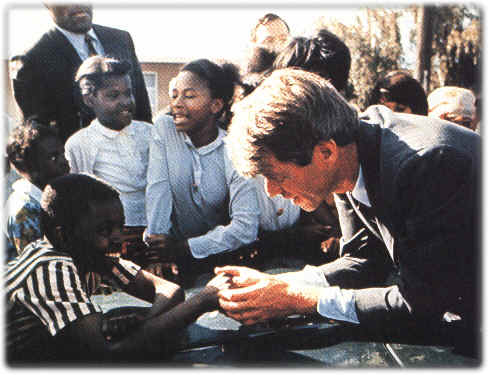
And then of course, there was the character assassination of Clinton, Monica Lewinsky, and Linda Tripp. Linda Tripp was a real economic hitwoman, she’d come out of the Pentagon, she’d come out of the Bush Administration, the first Bush Administration. And we learned from all that, today, you don’t have to take a president out with a bullet, you can do it by assassinating his character. And we’ve seen shots fired across the bow of Obama with these questions, is he really American, was he born in Indonesia, you know, is he a Muslim, these questions are warnings to him. That if he steps out of line, he can be taken down too, and it doesn’t have to be with a bullet anymore. 

APR: Right. That’s a very good point. Maybe we should move on to the economic crisis, I think that has a direct impact on what’s happening in the Middle East right now and one will kind of lead into the other. So, most people I think, assume that the economic crisis that started in 2007 was a result of the “housing bubble” where real estate became overvalued, and subprime loans, risky loans, were let out and then repackaged and sold as really confusing derivatives and securities, which nobody really understands. And that it basically was caused by unregulated banking and financial industry practices. But I know you speak a lot about this and have a better picture about what actually happened. 

JP:  Well certainly deregulation played a big role in it. When I was in business school in the late 1960s, I was taught that we’d never have another depression like we had in the 1930s because the regulations were in place to protect us. And I think that was true but they went down. The Glass-Steagall that was taken out under Clinton, for example, but there’s a whole series. And that had an impact. But the greater impact, is that we’ve been in a phase that I call “Predatory Capitalism”. I wrote extensively about this in Hoodwinked. It really got underway in the 1970s when I was an economic hitman, but it caught on in a big way in the U.S. when Reagan came in the 1980s, and Thatcher in England. And they all embraced the theories of Milton Friedman, from the Chicago School of Economics. And his guiding principles, there’s three really for business. They say the only responsibility of business is to maximise profits. Regardless of everything else. Regardless of social and environmental costs, disregard all that. The second principle is that business shouldn’t be regulated, or at least, minimise all regulations on business. And the third one is that everything should be run by private business, privatise the schools, the jails, and the military as we’re seeing happening in Afghanistan today. And beginning in the 1970s, these principles were adopted by every U.S. president since, Democrat and Republican alike, and they’ve created a failed global economic system, an economic system, where less than five percent of us who live in the U.S. consume almost 30 percent of the World’s resources. That’s not a viable model, not something you can pass on to India, or Africa, or Latin America. You can’t do it, it would take five to six planets to make that happen. So there is a huge underlying fallacy to the system. We need to come up with a different approach to our economics, we need to move out of this period of what I call “predatory capitalism”, into a form that is much more compassionate and into a form that says business can make profits and give a decent rate of return to their investors, but let’s do so within the context of creating a sustainable, just, and peaceful World. Let’s understand that businesses are here to serve us the people, not just a few wealthy investors. 

APR: Everyone in the progressive community I think understands that, but with the corporate control of the media, it just seems like it’s so hard to get that message out and to get people to understand that. For us here, it just seems like an extreme uphill battle for this to happen, and we don’t have I think the luxury of decades of time to try and fix this, because we’re facing things like global environmental collapse, overpopulation, and resource depletion. So what would you say about that? As far as, you know, are we approaching these crises, and in the next 20 to 30 years, really, unless things change quickly, could there be some big problems?

JP: Unless things change, there will be big problems. There are already some big problems, half the World is starving to death, or on the verge of starvation. Doomsday has come to three billion people on this planet. And we need to recognize and understand that, it’s a huge problem for us. We need to understand that our children and grandchildren can not inherit a World we would want to see them inherit, unless every child on this planet inherits that World.  And this is new, it used to be that we only needed to worry about Alaska, or people in Alaska, Washington State, if you live there, as I do. Or  the United States. But today we have to understand that we are an incredibly interdependent World, and we’re truly living on a fragile space station. But unlike a space station our astronauts build, this one doesn’t have any shuttles. We’re stuck on it, we can’t get off, we’ve got to do something and realise that we are very well integrated. And that the only way we’re going to have Homeland Security, anywhere, is when we recognise the the whole World is our Homeland. It isn’t Alaska, it isn’t Washington State, it isn’t the United States, it’s the whole World. And we better catch on to that, and I think we are. I’ve seen tremendous changes in the six years since Confessions published, and I’ve been out on the road, almost constantly, in the United States, China, Latin America, Iceland, and many other places. I’ve seen a real change in consciousness in these six years, and six years is a pretty short time really. It may seem long to you or me, but it’s really a short time in historical terms. 

APR: That’s great, because we all need to hear good news, because it seems like most of the what we hear is bad. I think we should talk about Egypt, and the significance of that, and to the global economic picture and the mutant form of Capitalism, the predatory Capitalism you’ve been talking about. Are these popular uprisings in Tunisia, and Egypt, and then possible ones to come, are they a direct response to this sort of predatory Capitalistic structure?

JP: Well they are, and in Latin America, it’s happened in ten countries, where there have been significant changes in less than a decade. It’s been amazing, what’s happened in Latin America, and it hasn’t been as violent as what we’re seeing in the Middle East, so it hasn’t made the news as much. But it’s happened through a democratic process. And now it’s happening in the Middle East, and yeah, people are speaking loud and clear, they’re rising up and saying, “we don’t want this brutality anymore” ,”we don’t want to be ruled by these terrible dictators who keep us in dire poverty”.

And we’re really hearing the voice of the people. At the same time, now we’re certainly seeing a tremendous amount of jockeying going on, the Economic Hitmen are in Egypt big-time, and they’re trying to get Vice President Suleiman to take over, and we have to remember, he was head of the Secret Service, in Egypt. He had and still has very close ties with the CIA, very close ties with the Israelis and Mossad, and he’s not what the people want, but I’m sure he’s what the Corporatocracy wants. And certainly what the Israeli government wants, and so there’s a struggle going on, and once you overthrow a dictator, you’ve got an amazing vacuum, and no matter where you are, you never know what’s going to happen. And of course, the United States and Israel do not want to see the Moslem Brotherhood take over. And I think the people don’t want to see Vice President Suleiman take over. So it’s very interesting, what’s going on there right now. 

APR: Yeah, do you think other countries nearby, like Jordan, Syria, Saudi Arabia, have any potential for uprising like this, and what would do for our economic picture in this country. Would there be oil supply shortages, or oil supply increases, that could impact our economy? 

JP: It’s very very difficult to say what could happen. I wish I had a crystal ball that would tell me that, but I don’t. We really don’t know. The one model we have to base this on is Iran, where you went from a very brutal CIA-supported dictator, the Shah, to this regime that has basically been run by the Mullahs, and it has not been a particularly good experience for most Iranians, or anyone else. On the other hand, I think probably Iranians under the Mullahs are a lot better off than the Iraqis under the U.S. military occupation. And that plays a major factor, countries in the Middle East have seen how Iraq has gone from what they had under Sadaam Hussein, nobody can deny he was not a good leader. But to much, much worse, under U.S. occupation. On the other hand, Iran with it’s Mullahs, has done better than Iraq. And that certainly is sending a message in the Middle East. It’s very unfortunate, I think, that we’ve put ourselves in this position. Rather to defend good presidents, democratically elected presidents, like Mossadegh in Iran, who we basically overthrew in the early 1950s. And who was then replaced by the Shah, and who was then replaced by the Mullahs. Rather than supporting those really good movements, we’ve stepped in and replaced them with people who would keep the oil companies really happy, and our big corporations happy. And in the process, we’ve put ourselves in the position of being looked at by much of the World as a very materialistic power. It’s really unfortunate, and we have to do everything we can to turn that around, and truly lead the World into a democratic process. And I think it’s up to us, the American people, to insist on that happening. 

APR:  Do you think that can actually happen in this country? It just seems to us, that the corporate media being so powerful, and voices like yours and Noam Chomsky’s totally excluded from any participation in the mass media, it just seems so difficult. 

JP:  That depends on how you define the mass media Michael. You know, if you talk about the mass media as being NBC and CBS and Fox, and CNN, then, you’re right. But I think a great deal of the World now sees that as irrelevant. I know most young people that I talk to, I have great hope from the young people, when I travel around to colleges. They don’t even pay much attention to that media, they get most of their information off the internet. And you know, the power of the internet, the power of media like yours, like what you’re doing right here, is very very strong today. Confessions has sold over a million copies. And I have a number of other books out there. So Noam Chomsky is heard, around the World, and he may not be heard on Good Morning America, but he is heard around the World, and all of these voices, are a great hope, and the blogging that’s going on, and the alternative media, and the streaming. I can talk to a small radio station someplace in Arizona, and can get questions texted in to me from South Africa, and the Phillipines, and Indonesia. And that happens, it’s quite remarkable today, how we have created this alternative media. 

APR: You’re absolutely right about that, I’m sure your interview today is going to be heard by people all over the country, and probably all over the World, at some point. I really thank you John, it has been a great honour talking with you, we look upon you as one of the most prominent progressive voices in the country, and we wish you all the best in your endeavours. We really encourage all our readers to visit your website, johnperkins.org. Because there are some great  things on there, and hopefully we’ll have the pleasure of talking with you again at some point.

Tuesday, February 22, 2011

THE GREAT TURNING [and] JUST SAY NO!

Are the spreading uprisings, revolts, and revolutions enveloping the Middle East/North Africa, part of a "shift in global consciousness"? Some people think so, this comment, written about the link for global uprising coverage, http://www.commondreams.org/uprising demonstrates what some "new-age" type people are thinking lately:


"What is happening in the Arab world is part of a worldwide revolution of consciousness - the old paradigms of hierarchy, authoritarianism, corporatism, oligarchy, parasitic capitalism, materialism, etc. are breaking down .

America , being part of the world, will also undergo turmoil, chaos, revolt against the system.
The Wisconsin and Arab protests are intricately connected at a deep level. On the surface they appear isolated from each other, but they are both part of a morphogenetic field http://www.experiencefestival.com/morphogenetic_fields - a phrase coined by Rupert Sheldrake -sweeping across the world.

These upheavals will increase and spread worldwide and they are representative of a kind of awakening and a tectonic shift in human consciousness.

American philosopher Ken Wilber outlined how these memes of collective consciousness evolve in his 'Integral Politics" theory.

The monetary system, which is a house of cards designed to protect the few powerful corporate entities and the international banking system, will collapse and America will experience the same kind of unrest, riots, and upheaval as we are seeing around the world.

The thieves, the capitalists, the corrupt parasites have reached the end of the line . Their time is up. They will use deadly force to retain power but, in the end, their time is simply up because the old paradigms are fast becoming obsolete.

These events will move rapidly and probably accelerate over the next two years."

We do here at A.P.R certainly feel that some sort of shift is occurring, globally, and often do ponder the possibility that all humans and beings are linked on some level, and exchange information. That perhaps the way technology has developed over the last several decades with the "Information Revolution", and continues to, is to mimic what occurs in the other realities, before/after death, and during our dream states. Which is to say, having instantaneous communication with anyone, at any time, when we desire it, and instant manifestation of our desires and fears.
Irregardless of all that, we recognise and accept that most of the successful uprisings and revolutions that bettered living conditions in many countries, across the world, over the last 200 years, had strong spiritual components to them. That there must be a spiritual awakening, in a general sense, among a great many people, for a successful, peaceful change to occur. Because we all have to really realise, and act in the beliefs, that all people are truly equal, and worthy of life, liberty, and the ability to make a good living in a sustainable manner that is helpful to one's society, and the environment. And to empathise and aid those people who are struggling for their dignity with aspirations to live  healthy and happy lives, free from grinding poverty, insecurity, and repression. Because we know that their suffering diminishes us all. That the economic and political policies of the "developed world", not just the U.S., are at least partly, if not mostly, to blame for the misery of poverty for more than half of the globe's population. 
http://akprogressive.blogspot.com/2009/10/capitalisms-dirty-warssecrets.html

We have been greatly inspired by the events of the last six weeks across the Middle East/North Africa, which seems to have taken the World by surprise, much as did the fall of the Berlin Wall. 

But these events were based on years of quiet, but increasingly large, collaboration of thousands, and then millions of people. And, like then, it is spreading now:

From Cairo to Madison: Hope and Solidarity are Alive

Here in Madison, Wisconsin, where protesters have occupied the State Capitol Building to stop the pending bill that would eliminate workers’ right to collective bargaining, echoes of Cairo are everywhere. Protesters here were elated by the photo of an Egyptian engineer named Muhammad Saladin Nusair holding a sign in Tahrir Square saying “Egypt Supports Wisconsin Workers—One World, One Pain.” The signs by protesters in Madison include “Welcome to Wiscairo”, “From Egypt to Wisconsin: We Rise Up”, and “Government Walker: Our Mubarak.” The banner I brought directly from Tahrir Square saying “Solidarity with Egyptian Workers” has been hanging from the balcony of the Capitol alongside solidarity messages from around the country.
243994594
My travels from Cairo to Madison seem like one seamless web. After camping out with the students and workers in the Capitol Building, I gave an early morning seminar on what it was like to be an eyewitness to the Egyptian revolution, and the struggles that are taking place right now in places like Libya, Bahrain and Yemen. Folks told me all day how inspiring it was to hear about the uprisings in the Arab world.
Some took the lessons from Cairo literally. Looking around at the capitol building that was starting to show the wear and tear from housing thousands of protesters, I had mentioned that in Cairo the activists were constantly scrubbing the square, determined to show how much they loved the space they had liberated. A few hours later, in Madison’s rotunda, people were on their hands and knees scrubbing the marble floor. “We’re quick learners,” one of the high school students told me, smiling as she picked at the remains of oreo cookies sticking to the floor.

I heard echoes of Cairo in the Capitol hearing room where a nonstop line of people had gathered all week to give testimonies. The Democratic Assemblymembers have been giving folks a chance to voice their concerns about the governor’s pending bill. In this endless stream of heartfelt testimonies, people talk about the impact this bill will have on their own families—their take-home pay, their healthcare, their pensions. They talk about the governor manufacturing the budget crisis to break the unions. They talk about the history of workers’ struggles to earn living wages and have decent benefits. And time and again, I heard people say “I saw how the Egyptian people were able to rise up and overthrow a 30-year dictatorship, and that inspired me to rise up and fight this bill.”

Solidarity is, indeed, a beautiful thing. It is a way we show our oneness with all of humanity; it is a way to reaffirm our own humanity. CODEPINK sent flowers to the people in Tahrir Square—a gesture that was received with kisses, hugs and tears from the Egyptians. The campers in Madison erupted in cheer when they heard that an Egyptian had called the local pizza place, Ians Pizza, and placed a huge order to feed the protesters. “Pizza never tasted so good,” a Wisconsin fireman commented when he was told that the garlic pizza he was eating had come from supporters in Cairo.

Egyptian engineer Muhammad Saladin Nusair, the one whose photo supporting Wisconsin workers went viral, now has thousands of new American Facebook friends. He wrote in his blog that many of his new friends were surprised by his gesture of solidarity, but he was taught that “we live in ONE world and under the same sky.”

“If a human being doesn’t feel the pain of his fellow human beings, then everything we’ve created and established since the very beginning of existence is in great danger,” Muhammad wrote. “We shouldn’t let borders and differences separate us. We were made different to complete each other, to integrate and live together. One world, one pain, one humanity, one hope.”

Since we only are able to write our articles weekly, or semi-weekly here, we can't keep you instantly abreast of all the latest developments, in this amazingly rapid transformation, in so many areas. But we will do our best to put them all in perspective, and talk to others, so they can help provide us and you with insightful information.
To that end, we have a special feature coming soon, an exclusive A.P.R. interview that occurred two weeks ago with an internationally-known progressive figure, who has written many amazing books, and is involved with many important causes. Stay tuned, and we will have that out as soon as we can. It takes some time to professionally edit, and transcribe a studio-recorded interview, so bare with us. Cheers. 

p.s. I just came across this interesting chart today. It shows how low the US rates in many measures of quality of life, of the "industrialised" nations. Clearly, there is alot of work to be done. Only Hong Kong and Singapore outrank the US in terms of wealth inequality, and as mentioned before here, thanks to sentencing disparities for possession of different kinds of drugs in the senseless and useless "war on drugs", we have far and away, the highest per capita and actual number of prisoners, than any other of these nations. 

This is why it is so imperative, that we "Just Say No" to the sociopaths in both political parties, but especially of course, the Republicans, who want to turn back the clock to the year 1900. 

This article below, by Ms. DeMoro, the head of the largest professional nurses union, puts everything in great perspective, about just what working people are up against, and what needs to be done. Spread it around!                http://www.commondreams.org/view/2011/02/22-13

Just Say No – No More Cuts for Workers

There should be two lasting lessons to emerge from the heroic labor-led protests in Wisconsin.

First, working people, with our many allies, students, seniors, women’s organizations, and many more, are inspired and ready to fight.
Kill the bill 03
Second, we need to send a clear and unequivocal message to the rightwing politicians and those in the media suggesting further concessions from working people.

Working people did not create the recession or the budgetary crisis facing Washington or state or local governments, and there can be no more concessions, period.

What should be very apparent is that the right wants to scapegoat workers and their unions, and are trying to exploit the economic crisis for an all out assault on unions, public employees, and all working people in a campaign that is funded by far right, corporate billionaires like the Koch Brothers.

Their goal is no less than to break unions and silence the voice of all working people who fight for better working conditions and improved standards for all working people.

For example, while demanding major cuts in public pensions, the right also wants to make sweeping cuts in Social Security, even though Social Security is in sound economic shape.

What all working families should know:

1. Who caused the economic crisis? Banks, Wall Street speculators, mortgage lenders, global corporations shifting jobs from the U.S. overseas.

2. Who is profiting in the recession? Corporate profits, 3rd quarter of 2010, were $1.6 trillion, 28 percent higher than the year before, the biggest one year jump in history. Meanwhile, average wages and total wages have fallen for all incomes, except the wealthiest Americans whose income grew five-fold.

3. Who is not paying their fair share? In U.S. states facing a budget shortfall, revenues from corporate taxes have declined $2.5 billion in the last year. In Wisconsin, two-thirds of corporations pay no taxes, and the share of state revenue from corporate taxes has fallen in half since 1981. Nationally, according to a General Accountability Study out today, 72 percent of all foreign corporations and about 57 percent of U.S. companies doing business in the United States paid no federal income taxes for at least one year between 1998 and 2005

4. Are public employees overpaid? State workers typically earn 11 percent less, local public workers 12 percent less than private employees with comparable education and experience. Nationally, cutting the federal payroll in half would reduce spending by less than 3 percent.

5. Would pay and benefit concessions by public employees stop the demands? The right has made it clear it wants A- cuts in public pay, pensions, and health benefits, followed by B- restricting collective bargaining for public sector workers, followed by C- prohibiting public sector unions.

6. Will the right be troubled if cuts in working standards make it harder to recruit teachers and other public servants? No. Take public teachers many of whom have accepted wage freezes and other cuts in recent years. Many in the right have a fairly open goal of privatizing education and destabilizing public schools to make it harder for them to function serves this purpose. The right also salutes the shredding of government workforce, part of its overall goal to gut all government service and make it harder to crack down on corporate abuses or implement other public protections and services.

7. Will the right stop at curbing public workers rights? Employers across the U.S. are demanding major concessions from private sector workers, and breaking unions. Rightwing governors and state legislators are seeking new laws to restrict union rights for all private and public employees.

8. Does everyone have a stake in this fight? Yes. It’s an old axiom that the rise in living standards for the middle class in the 1950s was the direct result of a record rate of unionization in America. It is of course unions that won the eight-hour day, weekends off, and many other standards all Americans take for granted that are now often threatened with the three-decade long attack on unions spurred by that rightwing icon Ronald Reagan. The corollary is that increased wages and guaranteed pensions put money into the economy, with a ripple effect that creates jobs and spurs the economy for all.

So it’s time for all of us to say it loud:
  • No More Cuts in Public Sector Pay, Pensions, or Health Benefits
  • Balance Budgets By Closing Corporate Tax Loopholes, Restoring Fair Share Taxes on Corporations and Wealthy Individuals
  • Guarantee Retirement Security and Healthcare for All
Rose Ann DeMoro
Rose Ann DeMoro is executive director of the 160,000-member National Nurses United, the nation’s largest union and professional association of nurses, and a national vice president of the AFL-CIO.

Tuesday, February 8, 2011

FROM THE BOTTOM UP [and] 1000 METRES OF LIFE

                                                   FROM THE BOTTOM UP

The now essentially complete corporate control and dominance of US government has brought, and will continue to bring increasing poverty and suffering, around the World, and in this country, unless it can be changed. We've run many articles about this here, and will continue to, from time to time. Of course, it is essential to understand a problem, before it can be fixed, but if there is to be any hope for a more just and sustainable society, here and abroad, we need to identify and share any possible solutions. One such glimmer of hope was given recently, by this article, describing how local governments are getting involved by passing ordinances to put citizens rights and environmental protections, ahead of corporate interests. It's a slow, and fragmented process, but these are hopeful steps, and if enough of us can support them, they will expand. See what you think:

Corporate Control? Not in These Communities

Can local laws have a real effect on the power of giant corporations?

by Allen D. Kanner

Mt. Shasta, a small northern California town of 3,500 residents nestled in the foothills of magnificent Mount Shasta, is taking on corporate power through an unusual process-democracy.

The citizens of Mt. Shasta have developed an extraordinary ordinance, set to be voted on in the next special or general election, that would prohibit corporations such as Nestle and Coca-Cola from extracting water from the local aquifer. But this is only the beginning. The ordinance would also ban energy giant PG&E, and any other corporation, from regional cloud seeding, a process that disrupts weather patterns through the use of toxic chemicals such as silver iodide. More generally, it would refuse to recognize corporate personhood, explicitly place the rights of community and local government above the economic interests of multinational corporations, and recognize the rights of nature to exist, flourish, and evolve. 
     Citizens of Mt. Shasta, California have developed an ordinance to keep corporations from extracting their water. Photo by Jill Clardy.
Mt. Shasta is not alone. Rather, it is part of a (so far) quiet municipal movement making its way across the United States in which communities are directly defying corporate rule and affirming the sovereignty of local government.

Since 1998, more than 125 municipalities have passed ordinances that explicitly put their citizens' rights ahead of corporate interests, despite the existence of state and federal laws to the contrary. These communities have banned corporations from dumping toxic sludge, building factory farms, mining, and extracting water for bottling. Many have explicitly refused to recognize corporate personhood. Over a dozen townships in Pennsylvania, Maine, and New Hampshire have recognized the right of nature to exist and flourish (as Ecuador just did in its new national constitution). Four municipalities, including Halifax in Virginia, and Mahoney, Shrewsbury, and Packer in Pennsylvania, have passed laws imposing penalties on corporations for chemical trespass, the involuntary introduction of toxic chemicals into the human body.

These communities are beginning to band together. When the attorney general of Pennsylvania threatened to sue Packer Township this year for banning sewage sludge within its boundaries, six other Pennsylvania towns adopted similar ordinances and twenty-three others passed resolutions in support of their neighboring community. Many people were outraged when the attorney general proclaimed, "there is no inalienable right to local self-government."

Bigger cities are joining the fray. In November, Pittsburg's city council voted to ban corporations in the city from drilling for natural gas as a result of local concern about an environmentally devastating practice known as "fracking." As city councilman Doug Shields stated in a press release, "Many people think that this is only about gas drilling. It's not-it's about our authority as a municipal community to say 'no' to corporations that will cause damage to our community. It's about our right to community, [to] local self-government."

What has driven these communities to such radical action? The typical story involves a handful of local citizens deciding to oppose a corporate practice, such as toxic sludge dumping, which has taken a huge toll on the health, economy, and natural surroundings of their town. After years of fighting for regulatory change, these citizens discover a bitter truth: the U.S. environmental regulatory system consists of a set of interlocking state and federal laws designed by industry to serve corporate interests. With the deck utterly stacked against them, communities are powerless to prevent corporations from destroying the local environment for the sake of profit.

Enter the Community Environmental Legal Defense Fund, a nonprofit public interest law firm that champions a different approach. The firm helps communities draft local ordinances that place the rights of municipalities to govern themselves above corporate rights. Through its Democracy School, which offers seminars across the United States, it provides a detailed analysis of the history of corporate law and environmental regulation that shows a need for a complete overhaul of the system. Armed with this knowledge and with their well-crafted ordinances, citizens are able to return to their communities to begin organizing for the passage of laws such as Mt. Shasta's proposed ordinance.

The Community Environmental Legal Defense Fund is collaborating with Global Exchange, an international environmental and workers' rights organization, to help supporters of the Mt. Shasta ordinance organize. In an interview for this article, I asked Shannon Biggs, who directs Global Exchange's Community Rights Program, if she expected ordinances of this type to be upheld in court. Biggs was dubious about judges "seeing the error of their ways" and reversing a centuries-old trend in which courts grant corporations increased power. Rather, she sees these ordinances as powerful educational and organizing tools that can lead to the major changes necessary to reduce corporate power, put decision-making back in the hands of real people rather than corporate "persons," and open up whole new areas of rights, such as those of ecosystems and natural communities. Biggs connects the current municipal defiance of existing state and federal law to a long tradition of civil disobedience in the United States, harkening back to Susan B. Anthony illegally casting her ballot, the Underground Railroad flouting slave laws, and civil rights protesters purposely breaking segregation laws.

But the nascent municipal rights movement offers something new in the way of political action. These communities are adopting laws that, taken together, are forming an alternative structure to the global corporate economy. The principles behind these laws can be applied broadly to any area where corporate rights override local self-government or the well-being of the local ecology. The best place to start, I would suggest, is with banning corporations from making campaign contributions to local elections.

The municipal movement could provide one of the most effective routes to building nationwide support for an Environmental and Social Responsibility Amendment to the U.S. Constitution. In fact, the movement is already expanding. In Pennsylvania, people are now organizing on the state level and similar stirrings have been reported in New Hampshire.

What about your community?
 
Allen D. Kanner, Ph.D., is a cofounder of the Campaign for a Commercial-Free Childhood, co-editor of Psychology and Consumer Culture and Ecopsychology, and a Berkeley, California child, family, and adult psychologist. 

These are very inspiring developments, and show how often it is, that beneficial changes start, "from the bottom up", by average people, banding together, and working for change. Let's all get behind these movements in our local communities!

                                                     1000 METRES OF LIFE

That's all the vertical room we have here on the mainland of Alaska, from the Brooks Range south, for life to exist. In fact, by the time you ascend just 750 metres (2500 feet), here in South-Central Alaska, you approach tree-line. This is because, in these high latitudes, even in summer, temperatures are quite often just too cold to support the growth of plants. More than just above 0C temperatures are needed, there has to be a certain number of hours above 10C (50F) for any shrubs or trees to grow, as well.

But by the time you get just up to 1000 metres, summer temperatures are quite often below that, for long periods, when low pressure systems with strong winds, and driving rain move through And during the rest of the year? Well, you can just imagine, if it's -10C (14F) down on the floor of the "Anchorage Bowl" with a light northeast breeze, it might will be -20 to -30C over the higher terrain, with gale and storm force , or even stronger winds.

I'm always reminded of this when venturing into our high country, which surrounds Anchorage, but also protects it. The "Anchorage Bowl" and Susitna valley, to the north, as well as the western side of the Kenai Peninsula, to the south, are probably the most favourable climatic areas in Alaska for human habitation and agriculture (such as it is in AK). Mountains on all sides generally limit strong winds from occurring, except during certain rare weather patterns.  Annual precipitation in Anchorage is only 38-51 cm (15-20 inches), depending on how close to the Chugach Front you are. Just around the corner, to the east up Turnagain Arm, this increases rapidly to two and three times that, and all along the outer coast of the Gulf of Alaska, it is many times what we get in Anchorage, and much windier. And of course, to our north, on the other side of the Alaska Range, winters are much, much colder, dimmer with lower sun angles, and a little longer.

So we always make sure to check the weather situation before venturing into our high country, because it can be quite vicious there, and change rapidly.

Our latest outing drove this home very well. We just did a six-hour, 24 km snowshoe from the Glen Alps Trailhead, on the hillside in South Anchorage, up to a pass between two aptly named peaks in the Chugach Mtns., "the Wedge", and "the Ramp", 1450, and 1600 metres high, respectively, yesterday.

The first 6 km just follows the Powerline Trail, in the valley of the South Fork of Campbell Creek. This valley is already around 800 metres elevation, so only small groves of wind-swept mountain hemlock are present, our highest-elevation tree species here. The small Hidden Lake trail then goes north, up a slope, then divides, one branch to Hidden Lake, the other, here, up this narrow valley between the Wedge, on the right, and the Ramp, on the left, in the far distance.

You can see already, at only 850 metres elevation here, that only a few very small hemlocks are able to make it, and how wind-swept the landscape is. Fortunately, on this day, it was only about -10C the whole time, with just a light northeast breeze.

Just before the pass between the two peaks, here at about 1150 metres elevation (3800 feet), all signs of life are gone. Not a blade of grass, shrub, or anything, sticking up through the snow and ice. This pass must get exceedingly strong winds from the north through east, judging by the huge drifts we saw in the lee of ridges, and how on many slopes, the snow was blown clean away, leaving an ice crust, or bare rock. And there were even small rocks on some slopes, that had been blown there, in previous storms. This would happen when there is a strong low pressure system in the Gulf of Alaska, and cold, Arctic air present, over the interior. Not the time to be here, or anywhere in our high country then!

We only got up to about 1350 metres on the Wedge before turning back. My snowshoes had good grip on the ice, but Homer's back legs kept slipping, he has some arthritis there. So we turned back, and it was getting on toward 3 pm. 

But not before savouring the view, on the other side of the pass! A Shangri-La of alpine terrain, surrounding the deep valley of Ship Creek, at the bottom of which, small trees re-appear.

Mattie was just as captivated as I was by this alpine panorama. 

A seemingly endless expanse of sharp, snowy, and glaciated peaks. But there are non-technical routes through all these areas, which we will be traversing, as time allows, winter and summer. Winter allows faster travel, when skiing is possible, without the possible complications of stream crossings. 

But, of course, the longer, warmer days, and greenery in the lower reaches of this alpine expanse, can't be beat. 

I'm not even sure which peak this was, shining in the distance. But it quite possibly could be one of the 3000-4000 metre highest peaks in the Chugach Range, which are at least 80 KM to the east. It takes elevations of over 2300 metres (7500 ft) to see that much snow/ice cover on the peaks.

The view back, toward the Anchorage Bowl, as we headed down from the pass, shows our route. We started at the base of the smallest hump, there in the middle of the valley, where it seemingly drops off. It's always amazing how small Anchorage looks from these heights, you'd never guess there's a big city (at least by our standards!), with all it's attendant activity, down there.
And even though we always wish we had more time to spend in these places, we at least are rewarded at the end, with our view of Denali and Foraker, shining in the evening sun, across the Susitna Valley. Why would we want to be anywhere else? Cheers.

Tuesday, February 1, 2011

IT CAN HAPPEN HERE?

Three cheers for the valiant people of Egypt, struggling to overthrow the corrupt dictatorship of Hosni Mubarak, who has been "president" there for 31 years. Events there are unfolding so quickly, that by the time you read this, quite a bit will have changed, since our writing.

The Mubarak regime in Egypt, actively supported by the US government with billions of dollars in aid over the past 31 years, has a history of jailing and torturing any individuals or groups opposing it's policies. Corruption of the police force there is endemic and has been worsening over the past 20 years especially. And, the policies they follow, under the dictates of the World Bank, and the global (but mostly US) financial/corporate sectors, has guaranteed that little would change for the masses of poor people in that country, with extremely high unemployment, rising prices, and little opportunity for any improvements in their low standards of living. It took the inspiration of the popular uprising in Tunisia last month to act as a catalyst for their actions.

Now, the global elites in all the "developed" countries, and especially the US, are quite uneasy, because there are signs that masses of people in other countries are waking up to the injustice of the current socio-political and economic system. Where goverments prop up corrupt financial and corporate sectors that swindle their populations and perpetuate policies guaranteeing massive unemployment and poverty, which keeps wages and benefits low, and people afraid. Countries ripe for popular uprisings like Tunisia had, and Egypt now undergoing, are these: In the middle east /Africa- Syria, Morocco, Algeria, Yemen, Jordan, Saudi Arabia, Pakistan, in Asia - Burma (Myanmar), Bangladesh, Uzbekistan, Kazakhstan, and in the Western Hemisphere - Mexico, Honduras, Guatemala, and Colombia.

All these countries are controlled by corrupt, despotic, oligarchical governments that rely on torture and intimidation to stay in power and prevent any real change in living standards to occur in the masses of the people's lives there, in support of  multi-national corporate profit. Most supported by the US government and corporatocracy (really, one and the same thing).
 

A good summation of the situation in Egypt, and it's ramifications, can be found in this article, off of Common Dreams. We'd like to quote the first several paragraphs, as they are very astute:

Tunisia's Spark & Egypt's Flame: The Middle East Is Rising

by Phyllis Bennis
Is this how empires end, with people flooding the streets, demanding the resignation of their leaders and forcing local dictators out? Maybe not entirely, but the breadth and depth of the spreading protests, the helplessness of the U.S.-backed governments to stop them, and the rapidly diminishing ability of the United States to protect its long-time clients, are certainly resulting in a level of revolutionary fervor not visible in the Middle East in a generation. The legacy of U.S.-dominated governments across the region will never be the same. The U.S. empire's reach in the resource-rich and strategically vital Middle East has been shaken to its core.

There's a domino effect underway in the Arab world. Tunisia was the spark, not only because its uprising came first but because the people of Tunisia won and the dictator fled. Egypt remains for the United States the most important strategic Arab ally.

The fall of Hosni Mubarak, the U.S.-backed dictator in power for more than three decades, would mean an end to Washington's ability to rely on Cairo to stave off Arab nationalism and independence and an end to Egypt's role as a collaborator in the Israeli occupation of Palestine. Whatever happens, what's likely, though not inevitable, is that never again will Tunisia be used as a transit point or Egypt as a "black site" secret prison for U.S. agents engaged in the "extraordinary rendition" of detainees for interrogation and torture.

Stirrings of popular dissent are already underway in Yemen and Jordan too. All the other U.S.-backed monarchies and pseudo-democracies across the region are feeling the heat. The U.S. empire in the region is crumbling.

Tipping Points
The alliances of the last half century are being shattered, the old order is ending. What's next? As is always the case when revolutionary processes erupt, it's still too soon to tell. Things move slowly until a sudden tipping point, and then it's all too quick, too sudden to keep up.

The breadth of public participation is key for understanding the implications of these uprisings. In Tunisia, the protests involved workers and middle class professionals, but were composed at the core by disenfranchised, disempowered, and educated unemployed people. Mohammed Bouazizi, a young man in the impoverished town of Sidi Bouzid, symbolized these demonstrators by setting himself ablaze to protest not only unemployment and poverty, but also the humiliation and degradation he faced.

Among the hundreds of thousands across Tunisia who marched, chanted, demanded, and won the abdication of their longstanding dictator, thousands are the young men and women whose college degrees have provided no security, whose lives were constrained by the lack of jobs, lack of opportunities, and lack of hope.

In Egypt, participation was even broader. The thousands and hundreds of thousands filling the streets, occupying Cairo's famed Tahrir (Liberation) Square, include not only the most impoverished of Egypt's urban slums and rural farmers and peasants. They also include the educated, the middle classes, even many of the wealthy, all finally saying no to the paucity dignity and freedom of their lives. Their demand was clear: not just reform, not just new elections, but an end to the Mubarak regime.

It is also important to recognize what the demands in Tunisia and most essentially in Egypt were not about. They were not about opposition to the United States; we have not seen the U.S. flag burning or crowds attacking the U.S. embassy. They were not even about Egypt's thirty years of collaboration with Israel's occupation, especially its role in maintaining the siege of Gaza – opposition to which is arguably the greatest point of political unity in the country. People have been very clear – and very public in the media – about their awareness of and outrage towards the U.S. history of arming Mubarak with the very weapons killing protesters in the streets; the "Made in USA" tear gas canisters from Jonestown, PA are featured all over the media. But the demands of this mobilization are directed to domestic, internal issues, aimed at changing the very nature of the ruling structures of the country and its impact on the people who live there. Foreign policy will come just a little bit later.

It's very telling that today in Jordan, King Abdullah sacked the current government cabinet, and appointed a new prime minister, as popular unrest there grows.
http://www.bbc.co.uk/news/world-middle-east-12336960

But will that be enough to satisfy the demands of the people of that country for political and economic justice? Probably not, with the active inspiration now being provided by the people of Egypt. So Jordan may be next in line to finally see a more democratic government. Isn't it amazing and inspiring, how quickly and suddenly positive changes like this can occur, that seemingly come out of the blue. These events are reminiscent of the fall of the Berlin Wall in 1989, as East Germans finally were able to achieve their dream of reunification with the West. 

But we here at A.P.R. view these events in Tunisia and Egypt, as even more hopeful. As they are so inspirational, showing that the aspirations of long-suffering impoverished peoples can be achieved, when they come together in solidarity, and stand up to the forces of oppression. It does almost seem like a wildfire, or even, conflagration, is beginning, of uprising against the global corporate oligarchy

Major ramifications of these events for the U.S. empire are many. For one thing, whatever new government Egypt ends up with, and other countries (and there will be others), will be less likely to follow the unjust economic policies that kept most of their population in poverty. They will demand more control, and more just compensation, for their resources, which are usually extracted by US and European corporations. Of course, oil springs instantly to mind here, so the major oil companies will probably have to make concessions to these new governments. Oil prices will most certainly rise greatly in the US and Europe, over the next few years, leading to inflation, and an even worse economic situation for most people. With the already high unemployment levels, significant inflation and even worsening job creation prospects, we think it will only be a matter of time, before significant pressure begins to develop in this country. For things like jobs programmes, and universal health care. The US corporate media so far hasn't really been able to demonise the Egyptian protestors, and have even (some of them, not Faux News of course) shown rather thorough coverage of the situation there. 

This will only help to embolden people in the US, and we must, all of us, when we talk with people about what is happening in Egypt, and other countries, spread the word, that yes, positive change, can happen here! 

In spite of the billionaire-supported ravings of racist fringe people like Glenn Beck:

http://www.commondreams.org/headline/2011/01/30-1

Frances Fox Piven Defies Death Threats After Taunts by Anchorman Glenn Beck

by Paul Harris in New York 

Frances Fox Piven is not going into hiding. Not yet.

[Frances Fox Piven]Frances Fox Piven
The 78-year-old leftwing academic is the latest hate figure for Fox News host Glenn Beck and his legion of fans. While she has decided to shrug off the inevitable death threats that have followed, she is well aware of the problem. "I don't know if I am scared, but I am worried," she told the Observer as she sat in a bar on Manhattan's Upper West Side.

"At the start I thought it was funny, but now I know that is dangerous... their paranoia works better when they can imagine a devil. Now that devil is me."

For the past three weeks Beck has relentlessly targeted Piven via his television and radio shows as a threat to the American way of life, seizing on an essay that she and her late husband wrote in 1966 as a sort of blueprint for bringing down the American economy.
Called The Weight of the Poor, it advocated signing up so many poor people for welfare payments that the cost would force the government to bring in a policy of a guaranteed income. For Piven, a committed voice of the left, known in academic circles but little recognized outside them, it was just one publication in a lifetime dedicated to political activism and theorizing.

For Beck, however, Piven is a direct threat to the US. In show after show, the rightwing commentator has demonized Piven and framed her as part of a decades-old conspiracy to take over the country that culminated in the election of President Barack Obama. Beck's heated language has provoked a tidal wave of death threats against both Piven and her academic colleagues at the City University of New York.

The threats are blunt and - in light of the recent shooting of Arizona congresswoman Gabrielle Giffords - truly frightening. Many appear on Beck's news website, The Blaze. "One shot... one kill," wrote one. Others are sent directly to her email address or those of her colleagues. There are so many that she has contacted the police and this week will ask her college to make a formal complaint to the FBI.

Despite that real security fear, she refuses to back down. Indeed, for someone portrayed as a revolutionary communist, Piven's choice of a meeting place with the Observer was a sly poke back at her critics: a Cuban hangout called Havana Central.

It is typical of Piven. The spry, twinkle-eyed academic pulls no punches when talking of Beck. "He is a very neurotic and peculiar type of person. I don't think he is capable of sane discussion," she said. And his supporters? "They creep me out."

One thing to remember, the numbers of the mainly aging, white, male, racist people in the US are dwindling. So even though the corporatocracy/oligarchy are using/supporting people like the Tea Party, Glenn Beck, and Rush Limbaugh, to continually scapegoat and demonise progressives and minorities, their influence will continue to decline. Especially now, in light of current events. Amen to that!

So, again, here's to the valiant people of Tunisia and Egypt, and the other countries to come! Thank you for your courage and inspiration, lighting the way for people all over the World, in their quest for sane and just political and economic systems! Cheers.