IN A TIME OF UNIVERSAL DECEIT...TELLING THE TRUTH BECOMES A REVOLUTIONARY ACT

"Capitalism is the astounding belief that the most wicked of men will do the most wicked of things for the greatest good of everyone." John Maynard Keynes

" Labor is prior to, and independent of, capital; that, in fact, capital is the fruit of labor, and could never have existed if labor had not first existed. Labor is the superior of capital and deserves much the higher consideration" Abraham Lincoln

Thursday, August 12, 2010

HOW CLOSE ARE WE NOW

to reaching climatic "tipping points", when positive feedbacks in the system, such as melting sea ice, melting/thawing permafrost (releasing even more CO2/Methane), and wildfire CO2 emissions, create warming that is overwhelming and unstoppable? Due to our accelerating emissions of CO2 and Methane from fossil fuel combustion.

As you may or may not be aware, Russia has been enduring it's worst-ever measured drought/summer heat wave this year. Which has accelerated wildfire outbreaks west of the Urals in it's more heavily populated European section, including even near Moscow. The normal mortality rate in Moscow has more than doubled, over the past month, due to the heat, and dangerously unhealthy air quality.
The Russian wheat harvest is now expected to sustain a loss of at least one-third, because of this. And for this reason, their government has suspended wheat exports, so that there will be an adequate supply for their own population.   http://www.commondreams.org/view/2010/08/06-7

The price of wheat has risen 88 percent on the international grain market so far this year, as a result, since Russia is the globe's fourth largest exporter of it.

What's been causing the severe drought/heat wave in Russia? The same thing that causes our droughts/bad fire seasons here in Alaska. Anomalously strong and persistent high pressure ridging, which pushes very warm air northward from the tropics and subtropics, to the high latitudes. This is the pattern that in the middle and high latitudes that has been increasing over the past few decases with global warming, as more heat is pushed northward, in order to try and maintain a global heat balance. I found this image to be incredible, from 01 August. This is a 500 millibar analysis (the height at which the pressure equals 500 mb, which is a function of the airmass temperature, usually between 5500 and 5800 metres in summer) overlain with the temperature at the 850 mb level (roughly 1500 metres).

This incredibly strong high pressure ridge (on the far right portion of the image), extending well north beyond 65 degrees north (Moscow is at about 56 degrees N latitude), has 850 mb temperatures exceeding 20C north to just past 60 deg. N. The highest-ever measured 850 mb temperature in Interior Alaska has been 19C. This is why surface high temperatures in European Russia have been 30-40C (86-104F) for several weeks this summer, 8-15C above average (the average high temperature in July in Moscow is a comfortable 24C, or 75F), and why there has been very little rainfall. Here in Alaska, after an early start to our fire season in May and early June, abundant rainfall from mid-June on slowed things down considerably. Yet we still burned 536,000 hectares (1.19 million acres) in the state, which is above the 1955-2009 mean of 405,000 hectares.

At the same time, the heaviest monsoon rains ever recorded this summer, in tropical Pakistan, have killed thousands, and affected 14 million people in that country. Global climate change modeling has been suggesting that more extremes of heavy precipitation will also be occurring, as warmer temperatures enable the atmosphere to hold more water vapour, which can then fall as heavier rainfall, when weather patterns permit. 

Then, there are these three facts to consider:

1.  According to the National Oceanic and Atmospheric Administration, the planet has just come through the warmest decade, the warmest 12 months, the warmest six months, and the warmest April, May, and June on record.

2.  A “staggering” new study from Canadian researchers has shown that warmer seawater has reduced phytoplankton, the base of the marine food chain, by 40% since 1950. All marine life depends, ultimately, on the health and availability of phytoplankton.

3.  Nine nations have so far set their all-time temperature records in 2010, including Russia (111 degrees), Niger (118), Sudan (121), Saudi Arabia and Iraq (126 apiece), and Pakistan, which also set the new all-time Asia record in May: a hair under 130 degrees.


Huge ice sheet breaks from Greenland glacier

A glacial bay on the western coast of Greenland - 2008 file photo Thousands of icebergs calve from Greenland's glaciers every year.
 
A giant sheet of ice measuring 260 sq km (100 sq miles) has broken off a glacier in Greenland, according to researchers at a US university.

The block of ice separated from the Petermann Glacier, on the north-west coast of Greenland.
It is the largest Arctic iceberg to calve since 1962, said Prof Andreas Muenchow of the University of Delaware.

The ice could become frozen in place over winter or escape into the waters between Greenland and Canada.
 
If the iceberg moves south, it could interfere with shipping, Prof Muenchow said.

Cracks in the Petermann Glacier had been observed last year and it was expected that an iceberg would calve from it soon. The glacier is 1,000 km (620 miles) south of the North Pole.
Graphic
A researcher at the Canadian Ice Service detected the calving from Nasa satellite images taken early on Thursday, the professor said. The images showed that Petermann Glacier lost about one-quarter of its 70km-long (43-mile) floating ice shelf. There was enough fresh water locked up in the ice island to "keep all US public tap water flowing for 120 days," said Prof Muenchow.

He said it was not clear if the event was due to global warming.

Patrick Lockerby, a UK engineer with a background in material science, told the BBC he had predicted the calve on 22 July, posting images on the science2.0 website.

"I was watching the floating ice tongue wedged between two walls of a fjord for three quarters if its length with the last part at the outlet end wedged by sea ice. I thought once the sea ice was gone, the pressure would be too great and the tongue would calve."

He said there could be a beneficial outcome if the calving drifts to block the Nares Strait and effectively prevents the loss of more ice from the Lincoln Sea.

The first six months of 2010 have been the hottest on record globally, scientists have said.
Map 
 
All of these things occurring, right now as you read this, are exactly what climate change modeling has been suggesting will occur. More extremes of heat waves and wildfires, heavy precipitation and flooding, and glacial breakup in Greenland, and the northern fringes of Antarctica. Since this part of the Petermann Glacier in Greenland was a floating ice shelf, it is not expected to cause any global sea level rises. However, as more of this, and other glaciers on Greenland's fringe melt further back, and land-based ice surges into the sea, this will soon be occurring. 

Because we are losing our Arctic summer sea ice. Once this occurs more fully, the Arctic Ocean waters will absorb far greater amounts of heat than they do currently, which will be transported in the air above, and through ocean currents to the surrounding lands and glaciers throughout the region. Which will cause even more melting. In addition, the Arctic sea ice will take longer to form each year, forming later, freezing thinner, and melting earlier.

This image is from two days ago, showing the current state of the Arctic Ocean's sea ice. The colours of blue and green correspond to just 20-30 percent ice coverage, while yellow and red is 50-70 percent, and the purple shades, 80 percent or more. What this is showing, is that a large area of broken ice and water with just 20-50 percent ice coverage is now reaching north from Canada, to the North Pole, and south, across the other side, toward western Siberia. This has never been observed before! And, there are six more weeks, at least, of melting left, in the warm season.

So, let's sum things up, as they are currently occurring. European Russia is experiencing it's worst ever drought and heat wave, causing massive wildfire outbreaks, and high death rates in Moscow and other cities from the heat and dangerous air quality. The cutback in grain exports from Russia, due to the drought, has already raised wheat prices 88 percent. This in and of itself will cause suffering and even some starvation in poorer countries. Pakistan is experiencing it's worst ever flooding, with a large percentage of it's population being affected. Globally, the past decade, year, six months, and spring have been the warmest ever recorded, with many countries also setting extreme heat records. Glaciers in the Arctic are losing large portions of ice, and the Arctic sea ice is melting in a way never seen before. With more and even worse droughts expected in the coming few decades, and global population continuing to increase to over 7, and eventually, 8 billion, what will the effect be on the global food supply?

It is our estimation then, here at the Alaska Progressive Review, that we are currently pushing through the "tipping points" leading to the positive feedbacks previously mentioned, that will then produce enough warming that will melt much of Greenland's ice, in the coming decades. The "developed" capitalist countries, whose energy policies are dictated by the transnational fossil-fuel energy corporations, are not going to do anything, until it is much too late. Within 30 years, we will be up to at least 450-500 ppm CO2, up from the current 390 ppm. Remember, from previous research we described, the last time atmospheric CO2 concentration was 390 ppm, global sea levels were 5-8 metres higher than they are now. What will they be when we reach 500 ppm? That's the reality. Sorry for the bad news, but that is really what we are seeing. 

Cheers.

Thursday, July 29, 2010

WHICH WOULD YOU PREFER?

I came across this article several days ago in the truthout.org. website. It's interesting, and refreshing to see, that people are out there working on technologies that could really help move our society in the right direction toward sustainability. At the same time, it illustrates just who runs our system of government in the US, and how unhealthy that is for us, and the global environment. Give this a read, and see what you think.

http://www.truth-out.org/clean-energy-and-us-handicap-one-mans-story61706

Clean Energy and the US Handicap: One Man's Story 

Sunday 25 July 2010

On-again, off-again federal support cripples emerging industries in the United States, America’s pre-eminent wind energy pioneer believes.
Jim Dehlsen, America’s most successful wind power innovator and entrepreneur, has been tilting at windmills since the early 1980s.

Back then, he installed one of the largest wind farms in the world in the mountains near Mojave, Calif., where a strong gust could snap a windmill blade in two. He called it his “Victory Garden.”
Today, at 73, Dehlsen is producing one of the most advanced and efficient windmills in the world, employing 300 people at a plant in Cedar Rapids, Iowa. And he is building a plant in England to manufacture the largest offshore windmill in the world, creating 500 green jobs.

Like Don Quixote of La Mancha, the errant knight of windmill fame, Dehlsen is on a life’s quest, propelled by the vision of a moral world — by his definition, a planet that is much less dependent on coal and oil.
Now, he is drawing on his expertise in wind to explore the untapped energy of the sea. With his son Brent, Dehlsen has designed an underwater “windmill” to harvest the unstoppable flow of the Gulf Stream off Florida. For the wind-whipped waters off the U.S. West Coast, the Dehlsens have designed a grid of floating pods equipped with pistons to capture the energy in the rise and fall of the waves.
In his lifetime, Jim Dehlsen hopes to see the ocean powering American homes and providing American jobs.
 
“We’re determined to make it happen,” he said. “I really want to see this in deployment. The continental shelf off the coast of Florida extends out 20 miles, and flowing over it is a river that has a constant flow equal to 50 times all the rivers of the planet. It’s just tremendous. It’s always there.”
What’s not always there, Dehlsen said, is government support in grants and subsidies for pioneers who, like him, struggle to come up with the millions needed to invest in new technologies in renewable energy. Federal support for wind blows hot and cold: During the past decade, tax credits for wind power have expired and been extended — usually for one or two years at most — on seven different occasions, creating uncertainty in the market and scaring investors away. The American Recovery and Reinvestment Act of 2009, or stimulus fund, gave wind power big boost with cash grants covering 30 percent of construction costs, but the time frame, as usual, was short: To qualify, projects have to begin construction by the end of this year.
By contrast, the U.S. government showers support on fossil fuels for electricity.
Most of Dehlsen’s early competitors went bankrupt in 1985, when the first round of subsidies dried up. After giving birth to the wind-power industry, the U.S. lost its position as the top producer of wind power in the world for more than two decades. It holds the No. 1 spot for now, but China is the world’s leading manufacturer of wind turbines.
The U.S. also has ceded a global market in offshore wind to Europe, where generous government subsidies, higher energy prices and $7-per-gallon gasoline provide a more favorable climate for renewables. Denmark built the first offshore “wind park” in 1991, and as of last year, according to one report, there were 67 in operation or pending in Northern Europe.
The first offshore wind farm in the U.S., a 131-turbine project off Cape Cod, was approved by the U.S. interior secretary in April. The turbines themselves will be manufactured by Siemens, Europe’s largest engineering conglomerate.
“In Europe, the oil and gas industries have much less influence on government policymaking,” Dehlsen said. “That kind of environment is crucial for wind.”

Likewise, in the field of marine renewable energy, the U.S. is roughly a decade behind Europe, where 15 tidal energy and 13 wave energy plants are in operation or pending, primarily in the British Isles. By contrast, the U.S. has installed only a few pilot projects, including a “power buoy” off Hawaii and tidal energy turbines in New York City’s East River. As noted in a special issue of Oceanography this month on marine renewable energy, the industry doesn’t even have the proper infrastructure to test new devices.
Dehlsen hopes the country will learn from its past mistakes.

“The real subsidies are going to carbon fuels,” he said. “How can we turn this around in the U.S.? It’s ingrained in the whole system.”
Wind is the world’s fastest-growing energy source: In the U.S. alone, the wind-power industry expanded by 39 percent last year.
But in the early days of modern windmills, Dehlsen recalled, investors wouldn’t even look at wind farms. “It was just too far out,” he said. “The response was, ‘You’re going to do what?’ You could see their eyes glaze over.
“Early-stage technology is really the appropriate place for government support to be involved, because traditional financing can’t deal with new concepts. They put a risk premium on it.”
When the government began offering tax credits and grants for emerging wind technologies, Dehlsen was able to test his design, attract investors and compete with oil, an industry that has been heavily subsidized in the U.S. since the 1920s. By 1985, he employed 600 people at his windmill manufacturing plant in Mojave. But the nation’s memories of the 1973 and 1979 oil embargoes faded, and the government allowed the subsidies for wind to expire.
“It really killed off the industry,” Dehlsen said. “We managed to survive, but we were one of the few.”
Dehlsen later sold his wind farm to Enron, which sold it to General Electric. To date, he said, GE has produced 13,000 of the Mojave-style windmills, with some refinements to his design.
In the 1990s, as U.S. support for wind picked up again, Dehlsen received $32 million in federal grants to create three generations of wind turbines, each the largest in the world when they were built. He also won an additional $9 million federal grant to develop a windmill that could operate in variable wind speeds. This model was a significant technological advance that opened up new areas for the industry, places where the wind was not perpetually howling. The blades of variable-speed wind turbines accelerate in gusts of wind, retaining their momentum when the gusts pass.
It’s the kind of breakthrough that would not have been possible without government support, Dehlsen said. Plus, he added, “you got to have crazy people like me who think they can do it.”
In testimony before the U.S. House of Representatives Subcommittee on Energy and Environment in December, Dehlsen told how the $9 million grant had helped attract $150 million in private investment for his Liberty wind turbine. It is now being manufactured in Cedar Rapids by Dehlsen’s company, Clipper Windpower Inc.,which recently sold 49 percent of its stock to United Technologies Corp. Clipper has 700 employees worldwide and has produced 500 windmills for 17 projects in the U.S. and Mexico.
“But there is the other side of the coin,” Dehlsen told the committee. He related how the government abruptly ended its support for offshore wind projects in 2006, just as Clipper was trying to partner with the National Renewable Energy Laboratory on a project.
“Perhaps the hardest policy lesson that has come out of the American wind effort has been the repeated crippling effect on the industry from discontinuity in government support,” Dehlsen testified.
In 2007, finding no support for offshore wind in his own country, Dehlsen turned to United Kingdom and was received with open arms. To date, Clipper has received nearly $30 million from the royal family’s Crown Estate and the British government to develop and manufacture what will be the largest offshore turbine in the world. The Crown Estate owns the rights to the offshore regions of the British Isles and is advancing the price of Clipper’s first commercial windmill. The manufacturing plant for the blades is under construction in Newcastle, once best known for its coal; production will begin in 2013.

Dehlsen’s views on government support are shared by entrepreneurs and investors alike.
Peter Grubstein, the founder and managing member of NGEN Partners, a Santa Barbara, Calif.-based firm that bills itself as “one of the most active cleantech venture investors in the world,” with $500 million under management, said that government grants are “extraordinarily important” for emerging technologies to succeed. Without that help, Grubstein said, “a lot of little companies will not get funded, particularly given the dearth of capital in the financial sector.”
NGEN typically invests in early-stage companies that have developed proven prototypes for the products, a process that can take five years, Grubstein said.


“Companies that are small and not well-financed are unlikely to get our financing,” he said. “Taking a chance on the new technologies that are unproven is very, very hard for an investor to do.”
Sidney Tassin, the founder and president of Carta Energy LLC, a Dallas-based investment firm, and a director of Clipper Windpower, oversaw an $11 million investment in Clipper in 2001 when the Liberty turbine, then the world’s largest, did not yet exist. It was in very early design stages. Dehlsen needed the money to launch Clipper, develop the turbine and purchase options on land. It was not a traditional investment for Energy Spectrum Capital LLC, the Dallas firm that Tassin headed at the time, and, he said, his partners were initially reluctant to take the risk.

Dehlsen’s stature as a pioneer in the U.S. wind industry helped change their minds, and so did the government’s $9 million grant to Clipper, Tassin said.

“It definitely helped attract the capital,” he said. “It said that our equity dollars would go further because we would be matching these federal government dollars.”
“I tend to be a strong free-market oriented person,” Tassin added. “I’m not looking for the government to decide who’s going to get the money and who’s going to have the better idea. But I think a nascent industry like renewables is an appropriate place for government research dollars to help prime the pump of innovation.
“We can always find another deal somewhere. Deals are like streetcars; one comes by every 15 minutes. But government funding helps energize the entrepreneurial part of it.”
Zachary Solomon, a project manager for American Ventus Energy LLC, an Austin, Tex.- based company that develops wind farms, put it this way:

“Without government subsidies, I wouldn’t be in this business,” he said.
“Private industry can only invest so much. If you look at Europe’s successes in this area, you have to recognize the fact that the governments there have been very open-minded when it comes to investing in renewable technologies for the past two decades. Europe has a better understanding of the potential applications of renewable energy.”

Robert Thresher, a research fellow at the National Renewable Energy Laboratory, a facility of the U.S. Department of Energy, and a former director of the lab’s National Wind Technology Center, said that Europe first “started to get religion” about renewable energy after the nuclear meltdown at Chernobyl in Ukraine in 1986. In 2007, the European Union set a goal of supplying 20 percent of its energy needs from renewable sources by 2020. The U.S. clean energy bill passed by the House last year set a similar target, but the Senate last week shelved plans for a broad energy bill.

American support for renewable energy has been driven by crises and the high cost of oil, Thresher said. “It’s a classic American way of doing business. We do everything sort of piecemeal, so there’s no stable policy. That’s been the key problem. Every administration changes its energy plan. It’s been very difficult for people like Jim Dehlsen to know what the ground rules are so that they can make a rational investment.
“But no matter what happens, I don’t think this industry can be stopped. It may have slowdowns and speedups, but it’s the cheapest form of very low-carbon energy. And people want jobs.”

On Dehlsen’s hypothetical energy map of the U.S., there are land-based wind farms in the Midwest and offshore wind farms along the East Coast north of North Carolina. As previously reported by Miller-McCune, the combined output of a fleet of offshore wind farms could provide more than enough electricity for the heavily populated East Coast, without interruption, because when the wind dies down in one spot off the Atlantic coast, it’s invariably kicking up in another spot.
Florida has no good wind resources, but it could get power from the Gulf Stream, Dehlsen said. The U.S. Minerals Management Service has calculated that harvesting just one one-thousandth of the Gulf Stream’s energy flow could supply Florida with 35 percent of its electrical needs. Ocean current speeds are lower than wind speeds, but because water is 835 times denser than wind, a 12 mile-per-hour water flow packs the same amount of energy as 110-mile-per-hour hurricane.
As for the West Coast, Dehlsen said, wave energy could be harnessed along the windy shores north of San Francisco and at Point Conception in Santa Barbara County.

“It’s all stuff to be done,” he said.
Palpable federal support for marine renewable energy began in 2008, the first year of a $250 million five-year appropriation for research in the field. At the House committee hearing in December, Dehlsen and others requested a reauthorization of those funds. In its report, the committee noted that approximately 10 percent of U.S. national electricity demand “may be met through river in-stream sites, tidal in-stream sites and wave generation,” not including ocean currents.

A 10-year reauthorization has been included in a Senate energy bill, but the upcoming House version does not yet include those funding levels. Meanwhile, the proposed Marine Renewable Energy Promotion Act, legislation that would accelerate federal tax breaks and technological aid, has been stalled in Congress for more than a year.

This spring, in a “roadmap” drawn up by Thresher and modeled after the U.K.’s, the National Renewable Energy Laboratory proposed setting a goal of 23 gigawatts from marine renewable energy in the U.S. by 2030. That’s the equivalent of 23 nuclear power plants – an aggressive plan, Thresher said, but attainable, in part because the technology of wind is transferable to marine energy.

“It reminds me of where wind was in 1985,” he said. “But it doesn’t have to take 30 years for marine renewables to mature. There’s a potential for a much more stable market with climate change and the rising cost of carbon fuels.”

In a recent survey, the department found that most entrepreneurs in the field, including Dehlsen, were operating on small amounts of money – between $2 million and $10 million – and were struggling to find the capital to test their expensive designs beyond the lab. They said they needed between $4 million and $25 million each to build demonstration projects and get certified by an independent engineering firm. That’s how an emerging technology proves that it is “bankable” and can borrow money.

“In the early stages of an industry, the support has to be continuous,” Jim Dehlsen said. “You can’t build projects if it takes three years to put it together and the support expires and you’re not going to get financing.”
The Dehlsens have patented their design for the Aquantis Current Plane, or C-Plane, a series of “windmills” 
that would be suspended about 150 feet underwater, tethered to the ocean floor about 12 miles offshore. The Dehlsens also have patents for the Centipod, which can be installed in waves 6 feet high between offshore wind turbines or along the coast, a mile from shore.
Dehlsen has received $3 million in federal funding for the Aquantis and about $150,000 for the Centipod for preliminary engineering expenses. He estimates there will be two more years of engineering costs before prototypes can be built. For Aquantis alone, Dehlsen says he’ll need $26 million, primarily in government funding, to get it ready for the market.

For this undaunted entrepreneur, it’s not just clean energy: It’s the way to rebuild America.
“There really needs to be consistent support for these projects, or you kind of waste your money,” Dehlsen said. “Ten years ago, we had the luxury of being frivolous about supporting this type of thing. We don’t have that luxury anymore. We have so much loss of industry, we’d better find a way to start building it back. How will we ever regain our position as an economic force in the world?” 

So, you can see, if our government would shift its priorities and act in the best interests of people in this country, to support research, development, and implementation of environmentally friendly industries, large amounts of good jobs would result. And there would be significant progress in reducing the US's global emissions of greenhouses gasses from using fossil fuels to generate electricity.

Instead, this is what we are getting:

http://counterpunch.org/roberts07282010.html
Deaf, Dumb and Blind

US Treasury is Running on Fumes

By PAUL CRAIG ROBERTS 

The White House is screaming like a stuck pig. WikiLeak's
http://www.commondreams.org/view/2010/07/27 release of the Afghan War Documents “puts the lives of our soldiers and our coalition partners at risk.” 

What nonsense. Obama’s war puts the lives of American soldiers at risk, and the craven puppet state behavior of “our partners” in serving as US mercenaries is what puts their troops at risk. 

Keep in mind that it was someone in the US military that leaked the documents to WikiLeaks. This means that there is a spark of rebellion within the Empire itself. 

And rightly so. The leaked documents show that the US has committed numerous war crimes and that the US government and military have lied through their teeth in order to cover up the failure of their policies. These are the revelations that Washington wants to keep secret.

If Obama cared about the lives of our soldiers, he would not have sent them to a war, the purpose of which he cannot identify. Earlier in his regime, Obama admitted that he did not know what the mission was in Afghanistan. He vowed to find out what the mission was and to tell us, but he never did. After being read the riot act by the military/security complex, which recycles war profits into political campaign contributions, Obama simply declared the war to be “necessary.” No one has ever explained why the war is necessary.

The government cannot explain why the war is necessary, because it is not necessary to the American people. Any necessary reason for the war has to do with the enrichment of narrow private interests and with undeclared agendas. If the agendas were declared and the private interests being served identified, even the American sheeple might revolt.

The Obama regime has made war the business of America. Escalation in Afghanistan has gone hand in hand with drone attacks on Pakistan and the use of proxy forces to conduct wars in Pakistan and North Africa. Currently, the US is conducting provocative naval exercises off the coasts of China and North Korea and instigating war between Columbia and Venezuela in South America. Former CIA director Michael Hayden declared on July 25 that an attack on Iran seems unavoidable. 

With the print and TV media captive, why doesn’t Washington simply tell us that the country is at war without going to the trouble of war? That way the munitions industry can lay off its workers and put the military appropriations directly into profits. We could avoid the war crimes and wasted lives of our soldiers.

The US economy and the well-being of Americans are being sacrificed to the regime’s wars. The states are broke and laying off teachers. Even “rich” California, formerly touted as “the seventh largest economy in the world,” is reduced to issuing script and cutting its state workers’ pay to the minimum wage. 

Supplemental war appropriations have become routine affairs, but the budget deficit is invoked to block any aid to Americans--but not to Israel. On July 25 the Israeli newspaper, Haaretz, reported that the US and Israel had signed a multi-billion dollar deal for Boeing to provide Israel with a missile system. 

Americans can get no help out of Washington, but the US ambassador to the UN, Susan Rice, declared that Washington’s commitment to Israel’s security is “not negotiable.” Washington’s commitment to California and to the security of the rest of us is negotiable. War spending has run up the budget deficit, and the deficit precludes any help for Americans.

With the US bankrupting itself in wars, America’s largest creditor, China, has taken issue with America’s credit rating. The head of China’s largest credit rating agency declared: “The US is insolvent and faces bankruptcy as a pure debtor nation.”

On July 12, Niall Ferguson, an historian of empire, warned that the American empire could collapse suddenly from weakness brought on by its massive debts and that such a collapse could be closer than we think.
Deaf, dumb, and blind, Washington policymakers prattle on about “thirty more years of war.”

Paul Craig Roberts was an editor of the Wall Street Journal and an Assistant Secretary of the U.S. Treasury.  His latest book, HOW THE ECONOMY WAS LOST, has just been published by CounterPunch/AK Press. He can be reached at: PaulCraigRoberts@yahoo.com

This is why in our earlier post, we came up with our future vision of North America, and the World, based on current trends.   http://akprogressive.blogspot.com/2010/06/run.html

It seems pretty likely that a scenario like we described earlier will occur, unless enough people in this country become educated to what is really going on, and decide to do something about it. Democrats are clearly not going to "save us" from the predations of unregulated capitalism and the neo-fascist corporatists. They are part and parcel of that system, bought and paid for just as much as the Republicans, though not quite as overtly fascistic. The conservative movement over the past 30+ years has done an incredible job of shifting the discourse of accepted political wisdom in this country, through control of the media. Most people in this country really believe that government is bad, taxes must be cut on the wealthy, and "defense" spending should never be touched. As well as all the manifest lies about the "Global War on Terrorism", which is creating more terrorism, because of the destruction and killing of innocent civilians in Iraq and Afghanistan that continues apace.

We have to do our best to wake people up in this country, to get alternative parties in power, and help them realise, why there are fewer jobs in this country, thanks to both Democrats and Republicans encouraging corporations to outsource their jobs (because they are bought and paid for by them). Which occurred through tax breaks and treaties like NAFTA. Because if we don't, we will end up with an overtly fascist state, and/or, there will be a truly horrendous attack in this country, possibly involving the destruction of a city with a nuclear weapon. That is what we will be reaping, if we allow our country to continue on it's path of unrestrained greed and militarism. Our greatest export now, instead of autos, electronics, or other manufactured consumer goods, are weapons, death, and destruction. Cheers.

Wednesday, July 7, 2010

WHAT'S GOING ON (and how we'd fix it) [and] NITE SHIFT RESET


http://www.youtube.com/watch?v=SJR71e6zTtc

Rockets, moon shots
Spend it on the have nots
Money, we make it
Fore we see it you take it

Oh, make you wanna holler
The way they do my life
Make me wanna holler
The way they do my life
This ain't livin', This ain't livin'
No, no baby, this ain't livin'
No, no, no

Inflation no chance
To increase finance
Bills pile up sky high
Send that boy off to die

Oh, make me wanna holler
The way they do my life
Make me wanna holler
The way they do my life

Dah, dah, dah
Dah, dah, dah

Hang ups, let downs
Bad breaks, set backs
Natural fact is
I can't pay my taxes

Oh, make me wanna holler
And throw up both my hands
Yea, it makes me wanna holler
And throw up both my hands

Crime is increasing
Trigger happy policing
Panic is spreading
God knows where we're heading
Oh, make me wanna holler
They don't understand

Dah, dah, dah
Dah, dah, dah
Dah, dah, dah

Mother, mother
Everybody thinks we're wrong
Who are they to judge us
Simply cause we wear our hair long

Ah...the immortal words of Marvin Gaye, from his masterful 1971 l.p. "What's Going On". Here we are almost 40 years later, and has anything really changed, in this country, or the World, for all that much better, for most people? What do you think? 

Now, I know much of what you read here in the Alaska Progressive Review might be considered depressing, but we feel it is necessary, to describe WHAT'S GOING ON, in our society at large, for better or worse, so that we can make positive changes, to develop a sane, just, and sustainable society, based on meeting people's needs, and respecting Pachemama (the Aymara people's of Bolivia's term for Mother Earth). Rather than one based on greed, which is destroying the environment and maintaining billions of people in abject poverty. And if left unchecked, will bring an end to civilisation as we know it, by the end of this century.  

I'd like to introduce this article that was on today's CommonDreams website, one of our favourite news-sites. Because it illustrates so nicely how the system we live under works, which we'll discuss, and offer our take on it.


Dead Zone in Gulf Linked to Ethanol Production

by Carolyn Lochhead, Chronicle Washington Bureau

WASHINGTON - While the BP oil spill has been labeled the worst environmental catastrophe in recent U.S. history, a biofuel is contributing to a Gulf of Mexico "dead zone" the size of New Jersey that scientists say could be every bit as harmful to the gulf.

[The Gulf of Mexico dead zone threatens valuable commercial and recreational Gulf fisheries that generate about $2.8 billion annually. (Credit: NOAA) ]The Gulf of Mexico dead zone threatens valuable commercial and recreational Gulf fisheries that generate about $2.8 billion annually. (Credit: NOAA)
Each year, nitrogen used to fertilize corn, about a third of which is made into ethanol, leaches from Midwest croplands into the Mississippi River and out into the gulf, where the fertilizer feeds giant algae blooms. As the algae dies, it settles to the ocean floor and decays, consuming oxygen and suffocating marine life.
Known as hypoxia, the oxygen depletion kills shrimp, crabs, worms and anything else that cannot escape. The dead zone has doubled since the 1980s and is expected this year to grow as large as 8,500 square miles and hug the Gulf Coast from Alabama to Texas.

As to which is worse, the oil spill or the hypoxia, "it's a really tough call," said Nathaniel Ostrom, a zoologist at Michigan State University. "There's no real answer to that question."
Some scientists fear the oil spill will worsen the dead zone, because when oil decomposes, it also consumes oxygen. New government estimates on Thursday indicated that the BP oil spill had gushed as much as 141 million gallons since an oil-rig explosion and well blowout on April 20 that killed 11 workers.

Corn is biggest culprit

The gulf dead zone is the second-largest in the world, after one in the Baltic Sea. Scientists say the biggest culprit is industrial-scale corn production. Corn growers are heavy users of both nitrogen and pesticides. Vast monocultures of corn and soybeans, both subsidized by the federal government, have displaced diversified farms and grasslands throughout the Mississippi Basin.
"The subsidies are driving farmers toward more corn," said Gene Turner, a zoologist at Louisiana State University. "More nitrate comes off corn fields than it does off of any other crop by far. And nitrogen is driving the formation of the dead zone."

The dead zone, he said, is "a symptom of the homogenization of the landscape. We just have a few crops on what used to have all kinds of different vegetation."

In 2007, Congress passed a renewable fuels standard that requires ethanol production to triple in the next 12 years. The Department of Agriculture has just rolled out a plan to meet that goal, including building ethanol refineries in every state. The Environmental Protection Agency will decide soon whether to increase the amount of ethanol in gasoline blends from 10 percent to 15 percent. 

A 2008 National Research Council report warned of a "considerable" increase in damage to the gulf if ethanol production is increased.

Pet cause of Congress

One of the authors of that report, agricultural economist Otto Doering at Purdue University, said that a 50 percent boost in the ethanol blend in gasoline will significantly raise corn prices, driving farmers to pull land out of conservation and pastureland and into corn production. They are also likely to add more nitrogen fertilizers to boost yields.

Corn ethanol has been heavily subsidized since the Arab oil embargo in the 1970s. Viewed by the corn industry as a lucrative market, ethanol is a perennial favorite in Congress.

Ethanol consumes two-thirds of all federal subsidies for renewable fuels, said Ken Cook, president of the Environmental Working Group, an advocacy group, leaving solar, wind and the rest to fight over the remaining third. Corn ethanol cost taxpayers $17 billion from 2005 to 2009, his group estimates.

"This is another industry that's entirely a creature of the government, even more so than corn growing per se," Cook said. "The production of ethanol wouldn't happen at all without government subsidies and protection."

The National Corn Growers Association ran a media blitz in Washington last week to press for the renewal of the 51-cents-a-gallon tax credit for ethanol. With pictures of the BP oil spill looming in the background, the Corn Growers' video announces, "Ethanol: Now is the time."

Conservation plan hurt

The ethanol boom over the past decade has lured farmers to withdraw millions of acres from the Conservation Reserve Program, which pays farms not to plant fragile land. Much of this land has been returned to native prairie grasses, at taxpayer expense. Millions more acres are up for renewal over the next few years.

"There's been a very large-scale conversion of these CRP lands to biofuel production," Ostrom said. Those soils have accumulated carbon from the atmosphere and stored it, becoming "a pretty significant sink for atmospheric CO2," he said. "If we suddenly start farming those soils, we basically release all of the carbon that's been sequestered for decades, and that may more than offset any carbon benefit of switching to biofuels."

To meet its goal of tripling ethanol production, Congress called for more cellulosic ethanol, which is made from wood, crop waste, perennial grasses such as switchgrass, and even native prairie grasses. Perennial grasses are considered far less damaging to the environment than corn because they require less fertilizer and their roots remain in the ground, helping to stabilize the soil and reduce runoff.

But commercial production of cellulosic ethanol remains a pipe dream. It would require large subsidies to dislodge corn ethanol.

There is no experience with commercial production of switchgrass. Purdue's Doering said it will require fertilizer and is likely to be planted on conservation lands and pasture instead of displacing corn.
Joan Nassauer, a professor at the University of Michigan who has studied how alternative agricultural policies could alleviate the dead zone, said cellulosic ethanol could work.

"It might be one of those win-wins, but it's not in production yet," she said. "What we've got now all over the Corn Belt is corn, and that's definitely not a win-win."

Then there is this: BP and federal officials are deliberately downplaying/hiding health hazards/effects associated with the Gulf oil poisoning.

http://www.commondreams.org/headline/2010/07/07-4 Millions of people will possibly be affected by this over the coming months and years! It will be impossible to hide then.

Your lead author has been asked to dispatch to Venice, Louisiana and Mobile, Alabama in the last week. To serve as an incident meteorologist, forecasting weather conditions for the support/cleanup operations associated with the BP gusher. I haven't been able to go, because we are still putting together the Chugach Front Research Centre. But in a week or so, after we are finished with this, it's quite likely I will. I'm certainly uneasy, but there are very few meteorologists that have oil spill response training and experience, and so I feel a responsibility, as the safety of the people working there is our primary concern. Just have to hope for the best. It will be a great opportunity though for me to learn from people there how operations are proceeding, and how they feel they are being treated. As well as to see first-hand, the actual area/magnitude of the poisoning. We'll keep you posted!

So what are we to do, if we want to change things for the better? To make our national and global society healthy and sustainable, before it is too late? The Alaska Progressive Review thinks first that we need to step back, and examine just what we believe in, and lay out our priorities. Then find people and political organisations that believe as we do, and support them. So, for your edification, this is what we think, and would like to see.

That all human beings are entitled to food, clothing, shelter, medical care, education, and the possibility to engage in meaningful work that will benefit themselves and their families, as well as their society at large. THESE ARE HUMAN RIGHTS not "SOMETHING FOR NOTHING" as many conservatives like to describe social benefits, in countries that offer them. Many of them, if not most, probably never knew what it feels like to be out of work, with no prospects, while their families suffer. Now that almost all the manufacturing in the US has been outsourced to China and other low-wage countries (driven in part by governmental tax credits from the 1980s on, lobbied for by, guess who?), where are the 20 percent of the working population of this country who are unemployed going to find jobs [the official rate is listed as around 9.2 percent, but hey, guess what, the criteria for measuring unemployment, was changed in....the 1980s! eds]?

Something for nothing? How about the bailouts of the criminally greedy financial institutions, "too large to fail", that nearly destroyed the global economy, and which will end up costing trillions of dollars? Or, no-bid contracts for grossly inflated, un-necessary, and destructive weapons systems, in the offense (defense) industry.

But the "oligarchy" (large corporations, etc...) who drive US, and increasingly, global economic and political policy like having high percentages of unemployment. Because then desperate people will work for increasingly lower wages, and in worse conditions, raising profits. Which is why we will not see any significant relief in the overall dismal employment situation in this country, and why it will get worse, as long as the major two parties are in power in the US. And, within a few decades we will live in a society very much like the third world, where poor people literally die in the streets, and if they can find work, it is hard, physically debilitating, and without medical or retirement benefits. Don't believe us? Visit Mexico any time, it's the easiest for us in the US to see, and quite representative of how most of the World's population lives. 

Within a few decades, if not sooner, this is what we'll be seeing on the streets of any city in the US. A ten year old child (child labour still occurs in these countries), in this case, in Bangladesh, part of a group protesting low wages in their garment industry a few weeks ago, set upon by the police, paid for by their corporate masters. Look at your clothing labels, if anything is made in Bangladesh, this is what you are paying for! Those that are fortunate enough in these kind of societies to be in the "middle" or "upper class", surrounded by the prevailing poverty, live cloistered in fear behind walls and gated communities. In my Bolivian and Peruvian travels a few years ago, in the "richer" areas, the walled houses had razor-wire and broken glass on tops of them! Coming soon...to neighbourhoods like yours! If nothing is done soon...
So this is why we must first educate ourselves and others to WHAT'S GOING ON, and then find people and groups to work with to effect positive changes. We don't have much time! Here at the Alaska Progressive Review, we support the Green Party, as they espouse the same ideals and goals as we do. All the socialist parties, for the most part, do as well. 

What would we do, if the Alaska Progressive Review could decide on governmental policies? First and foremost, immediately cease all military operations in Afghanistan and Iraq, and bring all the soldiers and civilian contractors home.

Negotiate with the governments of those countries for reparations payments to be made to them, for the death and destruction caused by the illegal and immoral actions in their countries.


Slash the military offense (not defense) budget by 3/4, and close all overseas bases, 700 or more in number.

End "corporate personhood" by a constitutional amendment, and change campaign financing laws to only allow government funding of candidates, who initially are pre-screened by voters, then those selected in this process, stand in a general election. Immediately end "bailout" programmes to the finance industry, and force repayment from them. Implement small financial transaction taxes on stock, bond, and investment purchases. Strictly regulate this industry to downsize the larger institutions, and prevent them from engaging in risky and destructive trading/investment schemes. Create a national bank that caters to smaller customers for basic loans for housing, transportation, small business development, education, etc.. Declare college educations to be accessible to all, through guaranteed zero-interest loans, repayable after the student enters the workforce, with repayment scalable to income.

Amend the Constitution to declare that food, clothing, shelter, medical care, and gainful employment, are human rights, and set policy accordingly. For example, expanding medicare to cover the entire population, and creating massive public-works programmes to rehabilitate decaying infrastructure such as roads, bridges, rail-lines, schools, and hospitals.

Increase corporate income tax rates to companies that have outsourced significant portions of their labour force. Give tax credits to those who will return jobs to this country. Give tax credits to worker-owned, and publicly owned cooperatives, like credit unions, farmers cooperatives, public utilities, etc.. Either nationalise or strictly regulate corporations that government regulations require people to purchase from. Automobile insurance companies, for instance.

Expropriate the resources and infrastructure of all the major energy companies and merge them into a nationalised energy sector. Expropriate all the major "defense" corporations resources and infrastructures, unless they agree to be bought out for fair and reasonable sums. Put the people and resources of these high-technology corporations immediately to work developing and building alternative energy and transportation sources (solar power stations in desert areas, wind-farms, geothermal power stations, high-speed inter-city rail systems, intra-city light-rail systems, improved battery technology for electric cars, intensive algae cultivation to produce aviation fuel that is carbon neutral, etc..).

So there you have it, some ideas from us, about how we would like to change things. The important thing is to think about these things, talk about them with people, and support groups and politicians who can help make them happen. Forget the commercial, corporate media, for the most part. Get your real and unbiased news from web-sites like truthout.org, counterpunch.org, commondreams.org, and many others. Together, we need to make a difference, before it is too late! We must have a political and economic system that is based on meeting people's needs, and respecting the environment, it's that simple. There is no alternative, if we with to preserve some form of civilisation.

                                            NITE SHIFT RESET  

Part of your lead editor's other job as a meteorologist, which helps fund the Chugach Front Research Centre, and the activities of the Alaska Progressive Review, entails working night shifts, about one week out of four. After working a string of these, I need to come back to the day world, as after a few days off, I'll be on day shifts again. And I much prefer being a day person. One thing I've found which really helps me make that transition, is to do something physically tiring, so that after getting off my last shift in the morning, that same night, I'll fall down hard, and get a good sleep. And be mostly transitioned, in one night. It usually works quite well.

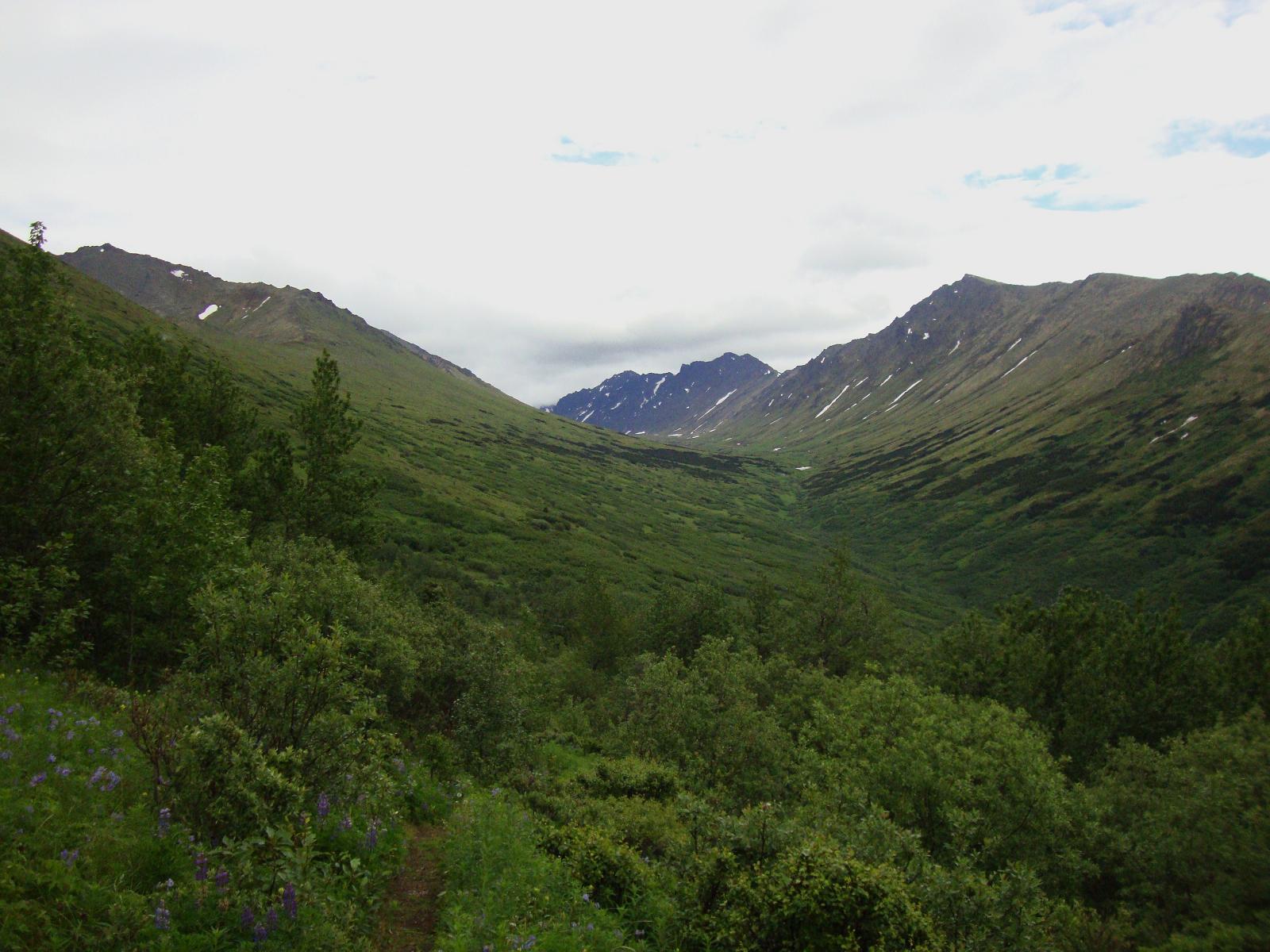
This last 04 July, after working five 10 hour nite shifts, from 1900-0500, I slept about four hours, got up, and we decided a good thing to do, would be to hike up to Konoya point a 1423 metre (4669 ft) knob in the Chugach Range, visible from, and looming above the Chugach Front Research Centre.

We would have liked to do an overnight or two night pack trip, but the weather promised to get colder and rainy at the higher elevations, so we decided just to make a day hike out of it. But which would still tire us out, as it is a very steep route, going from only 30 metres elevation, up to 1423, in only 8-9 km (though the last 3 km were very steep).