IN A TIME OF UNIVERSAL DECEIT...TELLING THE TRUTH BECOMES A REVOLUTIONARY ACT

"Capitalism is the astounding belief that the most wicked of men will do the most wicked of things for the greatest good of everyone." John Maynard Keynes

" Labor is prior to, and independent of, capital; that, in fact, capital is the fruit of labor, and could never have existed if labor had not first existed. Labor is the superior of capital and deserves much the higher consideration" Abraham Lincoln

Monday, January 20, 2014

LOCAL MATTERS [and] SPIRITUAL DEATH

                         LOCAL MATTERS   

As we all know now, the US political system represents large corporate/financial interests almost exclusively, and very little substantive differences exist on the national level in the policies of Democratic, and Republican politicians; albeit for some "wedge" issues, like gay marriage, abortion, and gun control. 


They both are pushing this, and other countries further into the savage world of completely unregulated "casino" capitalism, which, if continued, will make this and other "developed" countries more like what we presented some time ago, in this article describing the horrors of life for the masses in Jakarta, Indonesia. In addition to accelerating global environmental resource depletion and collapse.

http://akprogressive.blogspot.com/2012/03/free-market-train-jakarta-is-coming.html

Yet, all is not hopeless, because in the past, as now in the present, positive changes often have, and do start at local and regional levels, before expanding, and becoming national in scale. Good examples right now are the erosion, due to the legalisation of marijuana sales/consumption in a few states (CO and WA for now, more coming over the next few years...) of the useless and punitive "War on Drugs", which has disproportionately imprisoned vast numbers of non-white people in the US, and given it the world's highest prison population. And in many states, the minimum wage is now higher than the national minimum of 7.25 USD per hour. These state-level developments, in turn, expanded from ones on municipal scales, where various towns and cities had before passed their own legislation in these areas. 

So it is always encouraging to follow positive developments at these levels, and watch how they expand. One of our favourite events recently was the election in Seattle, WA, of an actual Socialist to their city council, Kshama Sawant, who is an economics professor. She gave a beautiful inaugural address, which follows below:

http://www.commondreams.org/view/2014/01/09-4


I Wear the Badge of Socialist With Honor

The full text of the new Seattle city council member’s inauguration speech

Editor’s note: At a ceremonial swearing-in on Monday, Kshama Sawant became Seattle’s first socialist city council member in almost a century. The full text of her inauguration speech is below.
My brothers and sisters,
Thank you for your presence here today.
This city has made glittering fortunes for the super wealthy and for the major corporations that dominate Seattle’s landscape. At the same time, the lives of working people, the unemployed and the poor grow more difficult by the day. The cost of housing skyrockets, and education and healthcare become inaccessible.New Seattle Council member Kshama Sawant, left, stands with Nicole Grant, who assisted in a ceremonial swearing-in. (AP Photo/Elaine Thompson)
This is not unique to Seattle. Shamefully, in this, the richest country in human history, fifty million of our people—one in six—live in poverty. Around the world, billions do not have access to clean water and basic sanitation and children die every day from malnutrition.
This is the reality of international capitalism. This is the product of the gigantic casino of speculation created by the highway robbers on Wall Street. In this system the market is God, and everything is sacrificed on the altar of profit. Capitalism has failed the 99%.
Despite recent talk of economic growth, it has only been a recovery for the richest 1%, while the rest of us are falling ever farther behind.
In our country, Democratic and Republican politicians alike primarily serve the interests of big business. A completely dysfunctional Congress DOES manage to agree on one thing—regular increases in their already bloated salaries—yet at the same time allows the federal minimum wage to stagnate and fall farther and farther behind inflation. We have the obscene spectacle of the average corporate CEO getting seven thousand dollars an hour, while the lowest-paid workers are called presumptuous in their demand for just fifteen.
To begin to change all of this, we need organized mass movements of workers and young people, relying on their own independent strength. That is how we won unions, civil rights and LGBTQ rights.
Again, throughout the length and breadth of this land, working people are mobilizing for a decent and dignified life for themselves and their children. Look at the fast food workers movement, the campaigns of Walmart workers, and the heroic activism to stop the Keystone XL pipeline!
Right here in SeaTac, we have just witnessed the tremendous and victorious campaign for fifteen dollars an hour. At the same time, in Lorain County, Ohio, twenty-four candidates ran, not as Democrats or Republicans, but as ‘Independent Labor’ and were elected to their City Councils.
I will do my utmost to represent the disenfranchised and the excluded, the poor and the oppressed—by fighting for a $15/hour minimum wage, affordable housing, and taxing the super-rich for a massive expansion of public transit and education. But my voice will be heard by those in power only if workers themselves shout their demands from the rooftops and organize en masse.
My colleagues and I in Socialist Alternative will stand shoulder to shoulder with all those who want to fight for a better world. But working people need a new political party, a mass organization of the working class, run by—and accountable to—themselves. A party that will struggle and campaign in their interest, and that will boldly advocate for alternatives to this crisis-ridden system.
Here in Seattle, political pundits are asking about me: will she compromise? Can she work with others? Of course, I will meet and discuss with representatives of the establishment. But when I do, I will bring the needs and aspirations of working-class people to every table I sit at, no matter who is seated across from me. And let me make one thing absolutely clear: There will be no backroom deals with corporations or their political servants. There will be no rotten sell-out of the people I represent.
I wear the badge of socialist with honor. To the nearly hundred thousand who voted for me, and to the hundreds of you who worked tirelessly on our campaign, I thank you. Let us continue.
The election of a socialist to the Council of a major city in the heartland of global capitalism has made waves around the world. We know because we have received messages of support from Europe, Latin America, Africa and from Asia. Those struggling for change have told us they have been inspired by our victory.
To all those prepared to resist the agenda of big business—in Seattle and nationwide—I appeal to you: get organized. Join with us in building a mass movement for economic and social justice, for democratic socialist change, whereby the resources of society can be harnessed, not for the greed of a small minority, but for the benefit of all people. Solidarity.


Many progressive people, some quite prominent, have even expressed that they feel voting is useless to enact significant changes, due to the corporate-owned mass media's stranglehold on US life. And we can understand their point of view, and discouragement. But, the more people who vote for other parties candidates on a national level, the greater the message will be to "the powers that be" of dis-satisfaction with the status quo. And to not vote on the local and state scales would definitely hinder many positive events from occurring, so we here at the APR do encourage any and all to get out and vote early and often! 

                                   SPIRITUAL DEATH

Of course, today marks the birthday of Dr. Martin Luther King, Jr., whose murder in 1968 (one year to the day after his famous speech in which he first vocally and strongly came out against the Vietnam War) came directly in response to his increasingly radical anti-war and economic justice stances. Which is conveniently, and deliberately suppressed in all "mainstream" stories on his life and work. We've written several articles on his legacy though, we can't imagine what he'd think of how the US government has behaved over the past 30 years. 

http://akprogressive.blogspot.com/2010/01/remembering-what-he-died-for.html

Our favourite article we saw today on MLK's birthday was this one, describing how US President Obama is trying to sell the NSA spying programs as being beneficial, legal, and not a threat to personal freedom. Yet it was programs like these, using the technologies of their day, that were used against all the prominent civil rights, anti-war, and progressive figures in the 1950s and 60s, including MLK. To blackmail and discredit them, at the minimum. Give it a read, it's really enlightening. 

http://www.commondreams.org/view/2014/01/20-4


Gov’t That Surveilled MLK in Bid to Destroy Him Wants Us to Trust Them

(Photo: Reuters/Rowland Scherman/U.S. Information Agency/U.S. National Archives)Among the ironies of Barack Obama trying to sell us the gargantuan NSA domestic spying program is that such techniques of telephone surveillance were used against the Reverend Martin Luther King, Jr. in an attempt to destroy him and stop the Civil Rights movement. Had the republic’s most notorious peeping tom, J. Edgar Hoover, succeeded in that quest, Obama might never have been president, or even served in Virginia restaurants.
Now that MLK is recognized by all but a tiny minority of Americans (Dick Cheney being in the minority) as a national hero, it is sometimes hard to remember that the Establishment treated him in his own lifetime like a criminal conspirator. He merely demanded the end of Jim Crow Apartheid and equal rights and opportunities for African-Americans with whites in every state of the union. As a result of this entirely reasonable demand, required by the 14th Amendment, he was placed under 24 hour a day surveillance by the Federal Bureau of Investigation. As with everything in the Cold War, the pretext was that King might have Communist associates. Just as the NSA grabbing our metadata today is justified by the pretext that all 310 million of us might have al-Qaeda associates.
King’s powerful “I have a Dream” speech from the steps of the Capitol provoked a frothing at the mouth Hoover to swing into full action against him.
“In the light of King’s powerful demagogic speech…We must mark him now, if we have not done so before, as the most dangerous Negro of the future in this Nation from the standpoint of communism, the Negro, and national security.”
At Hoover’s urgent request, Bobby Kennedy permitted the FBI secretly to break into King’s premises and those of his associates and plant bugs. They also bugged meetings where he spoke and hotels he stayed in. Let me repeat that. The reaction of the head of the FBI and the attorney general of the US to King’s dream that little boys and girls of different races would play games with each other was to record his every word and action and those of his friends.
If that speech can get you that kind of scrutiny in the USA, then why should we ever trust any high government official with our personal information? Most of us are at least as idealistic as that.
The FBI caught MLK in a couple of extramarital encounters. Hoover, who had profound sexual hang-ups probably to the point of psychosis, hated him with a passion. Having spent his career using the information he gathered on Congressmen to blackmail them, he apparently hoped to use MLK’s “alleycat” “degenerate” (Hoover’s words) against him.
Hoover, the supreme perv, sent him an anonymous threatening letter:
You are a colossal fraud and an evil, vicious one at that . . . The American public … will know you for what you are — an evil, abnormal beast . . . Satan could not do more . . . King you are done . . . King, there is only one thing left for you to do . . . You know what it is … You better take it before your filthy, abnormal fraudulent self is bared to the nation.”
Presumably Hoover hoped to drive King to suicide under threat of having his dalliances revealed; presumably also MLK would have put together that Hoover had his private life in his files.
When King was awarded the Nobel Peace prize, Hoover attempted to derail the ceremony by trying to leak the affairs to the press. To their credit, the editors and reporters recoiled from the squalor of the entire matter and refused to touch it.
The point is that King’s private life is irrelevant to his public demands and his public role. He was demanding constitutional rights for all Americans. Who he shtupped in his spare time is not germane to the rightness of that demand.
Note that today’s NSA collection of all Americans’ smartphone records shows who they called and texted and where they were when they did it. All American dalliances are as transparent in those records as King’s were to Hoover. If the US government was willing to try to blackmail King and many other public figures (Hoover always went straight to any Congressman on whom he got dirt and let him know about it, putting the man in his back pocket), then it is willing to blackmail anyone who becomes inconvenient.
That Barack Obama thinks we’re so naive or uninformed about American history that we will buy his assurances that the NSA information on us would never be used is a sad commentary. Indeed, we cannot know for sure that Obama himself and other high American officials are not being blackmailed into taking the positions they do on domestic surveillance. If the American people do accept such empty words, then I suppose they deserve to have Hoover’s pervy successors in their bedrooms.

Wednesday, December 25, 2013

SOLSTICIAL GREETINGS [and] PROMISE KEPT?

            SOLSTICIAL/CHRISTMAS GREETINGS

Winter Solstice in Alaska. A time definitely worth celebrating, meaning 5-6 minutes more sunlight daily within a few weeks, though the coldest temperatures stay with us through February, most years.

Although the sun is low in the sky at our latitude of 61N, just five degrees above the horizon, when it is out, we get beautiful, gentle lighting, when combined with the snow lacing our boreal forest trees.

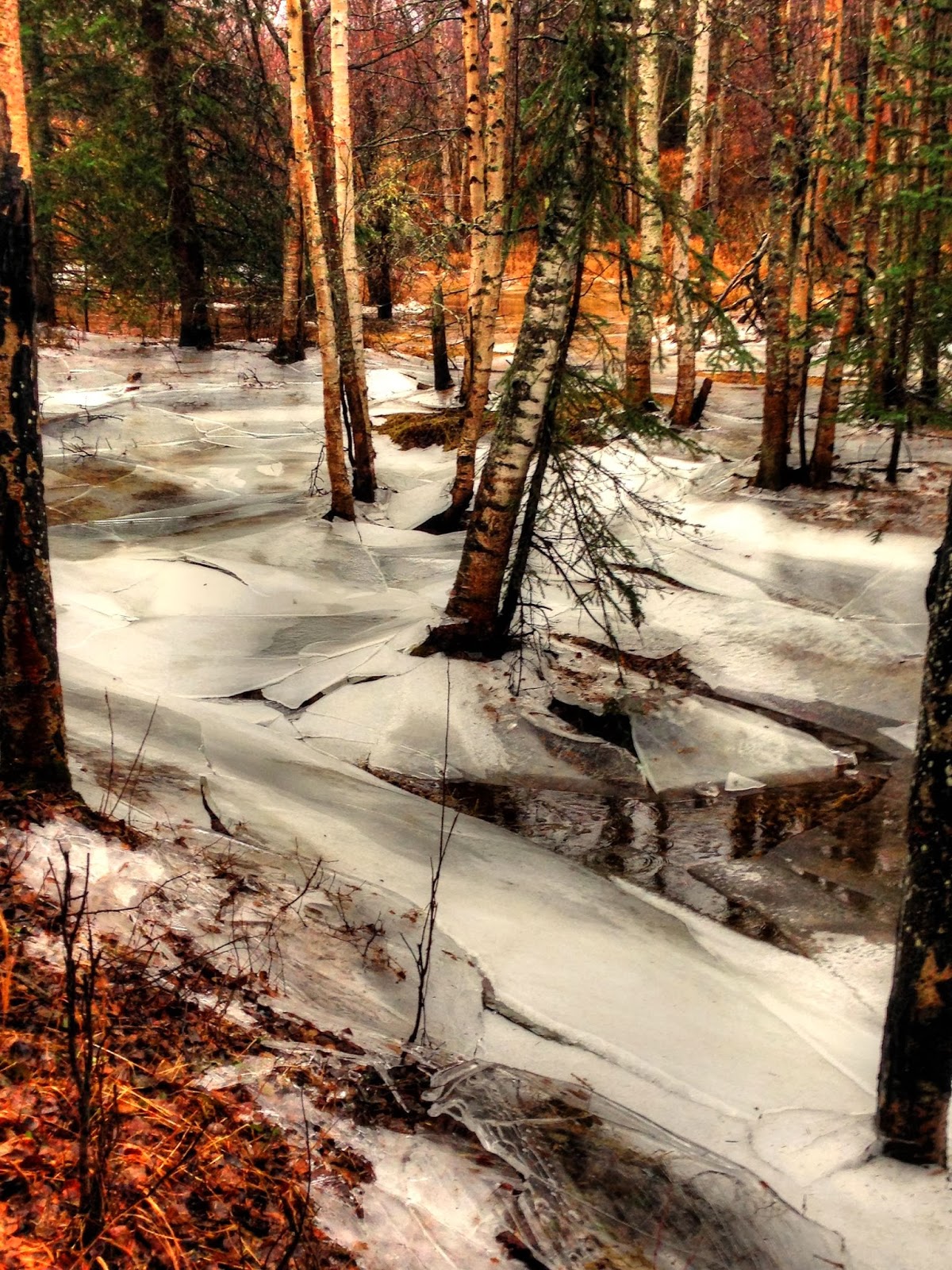
The ice in the creeks builds up from the bottom during our colder spells, and makes for interesting colouring.

Our snowpack by this time is at depths perfect for all our winter recreational needs.

Yet we know with certainty that these conditions are changing rapidly, as we have frequently documented for you before.

We sometimes even fall into a funk, thinking about how potentially dire the future of humanity's place on the Earth really is, in light of the changes that are occurring in the atmospheric/oceanic systems (not just global warming, but ocean acidification is/will prove just as harmful to the global web of life), due to the continuing, and escalating emissions of CO2 and methane, from fossil fuel extraction/combustion, and industrial activity. And the lack of any real attempts to stop them, and transition to sustainable and clean sources of energy.

We are certainly not alone in our assessment. We particularly liked Dahr Jamail's article, summing up the latest scientific assessment, of where we are at globally speaking, with respect to global warming, and its impacts. Because he is of a similar age to your lead editor, and seems to have similar interests/outlooks, this article really resonated with us. Here is a highly alarming excerpt, but the whole article is well worth reading, please do.
http://www.truth-out.org/news/item/20686-are-we-falling-off-the-climate-precipice-scientists-consider-extinction

"Professor Peter Wadhams, a leading Arctic expert at Cambridge University, has been measuring Arctic ice for 40 years, and his findings underscore McPherson’s fears. “The fall-off in ice volume is so fast it is going to bring us to zero very quickly,” Wadhams told a reporter. According to current data, he estimates “with 95% confidence” that the Arctic will have completely ice-free summers by 2018. (U.S. Navy researchers have predicted an ice-free Arctic even earlier -- by 2016.)

British scientist John Nissen, chairman of the Arctic Methane Emergency Group (of which Wadhams is a member), suggests that if the summer sea ice loss passes “the point of no return,” and “catastrophic Arctic methane feedbacks” kick in, we’ll be in an “instant planetary emergency.”

McPherson, Wadham, and Nissen represent just the tip of a melting iceberg of scientists who are now warning us about looming disaster, especially involving Arctic methane releases. In the atmosphere, methane is a greenhouse gas that, on a relatively short-term time scale, is far more destructive than carbon dioxide (CO2). It is 23 times as powerful as CO2 per molecule on a 100-year timescale, 105 times more potent when it comes to heating the planet on a 20-year timescale -- and the Arctic permafrost, onshore and off, is packed with the stuff. “The seabed,” says Wadham, “is offshore permafrost, but is now warming and melting. We are now seeing great plumes of methane bubbling up in the Siberian Sea… millions of square miles where methane cover is being released.”

According to a study just published in Nature Geoscience, twice as much methane as previously thought is being released from the East Siberian Arctic Shelf, a two million square kilometer area off the coast of Northern Siberia. Its researchers found that at least 17 teragrams (one million tons) of methane are being released into the atmosphere each year, whereas a 2010 study had found only seven teragrams heading into the atmosphere.
The day after Nature Geoscience released its study, a group of scientists from Harvard and other leading academic institutions published a report in the Proceedings of the National Academy of Sciences showing that the amount of methane being emitted in the U.S. both from oil and agricultural operations could be 50% greater than previous estimates and 1.5 times higher than estimates of the Environmental Protection Agency.

How serious is the potential global methane build-up? Not all scientists think it’s an immediate threat or even the major threat we face, but Ira Leifer, an atmospheric and marine scientist at the University of California, Santa Barbara, and one of the authors of the recent Arctic Methane study pointed out to me that “the Permian mass extinction that occurred 250 million years ago is related to methane and thought to be the key to what caused the extinction of most species on the planet.” In that extinction episode, it is estimated that 95% of all species were wiped out.

Also known as “The Great Dying,” it was triggered by a massive lava flow in an area of Siberia that led to an increase in global temperatures of six degrees Celsius. That, in turn, caused the melting of frozen methane deposits under the seas. Released into the atmosphere, it caused temperatures to skyrocket further. All of this occurred over a period of approximately 80,000 years.

We are currently in the midst of what scientists consider the sixth mass extinction in planetary history, with between 150 and 200 species going extinct daily, a pace 1,000 times greater than the “natural” or “background” extinction rate. This event may already be comparable to, or even exceed, both the speed and intensity of the Permian mass extinction. The difference being that ours is human caused, isn’t going to take 80,000 years, has so far lasted just a few centuries, and is now gaining speed in a non-linear fashion.

It is possible that, on top of the vast quantities of carbon dioxide from fossil fuels that continue to enter the atmosphere in record amounts yearly, an increased release of methane could signal the beginning of the sort of process that led to the Great Dying. Some scientists fear that the situation is already so serious and so many self-reinforcing feedback loops are already in play that we are in the process of causing our own extinction. Worse yet, some are convinced that it could happen far more quickly than generally believed possible -- even in the course of just the next few decades."

It doesn't have to be this way though. As we have documented before, and in articles like these, researchers world-wide are developing renewable, "carbon-neutral" methods of producing fuels that could be used in existing road and aerial transportation systems, as well as for power generation, in addition to solar and wind power.
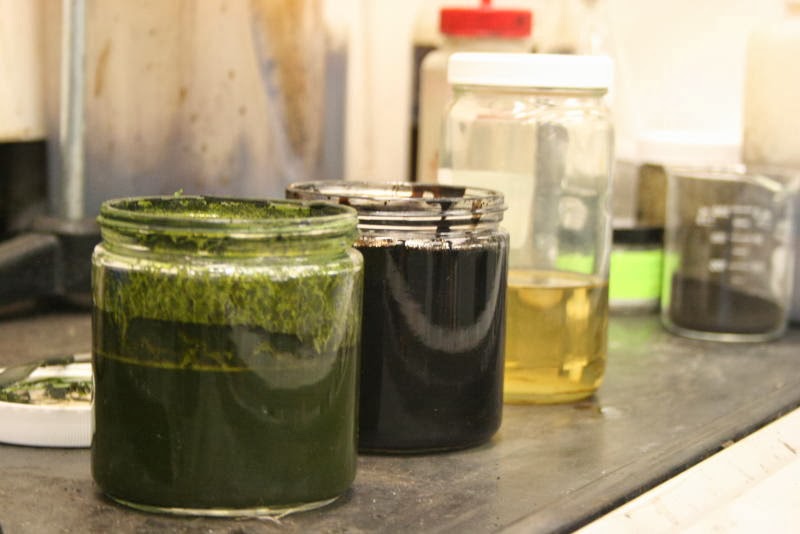
"Algae to Crude Oil: Million-Year Natural Process Takes Minutes in the Lab
Dec. 18, 2013Engineers have created a continuous chemical process that produces useful crude oil minutes after they pour in harvested algae -- a verdant green paste with the consistency of pea soup.


The research by engineers at the Department of Energy's Pacific Northwest National Laboratory was reported recently in the journal Algal Research. A biofuels company, Utah-based Genifuel Corp., has licensed the technology and is working with an industrial partner to build a pilot plant using the technology.

In the PNNL process, a slurry of wet algae is pumped into the front end of a chemical reactor. Once the system is up and running, out comes crude oil in less than an hour, along with water and a byproduct stream of material containing phosphorus that can be recycled to grow more algae.

With additional conventional refining, the crude algae oil is converted into aviation fuel, gasoline or diesel fuel. And the waste water is processed further, yielding burnable gas and substances like potassium and nitrogen, which, along with the cleansed water, can also be recycled to grow more algae.

While algae has long been considered a potential source of biofuel, and several companies have produced algae-based fuels on a research scale, the fuel is projected to be expensive. The PNNL technology harnesses algae's energy potential efficiently and incorporates a number of methods to reduce the cost of producing algae fuel.

"Cost is the big roadblock for algae-based fuel," said Douglas Elliott, the laboratory fellow who led the PNNL team's research. "We believe that the process we've created will help make algae biofuels much more economical."
In addition, there are also methods under development to actually extract CO2 from the atmosphere using various chemical means, which if implemented on a large scale, could actually reduce levels from the dangerous one of 400 ppm now (or the 550 ppm it will be in 2050 if nothing is done!), to 300-320 ppm, where it was around 1900-1920 in a few decades, if done in concert with renewable/clean energy source development. 
http://www.bbc.com/future/story/20121004-fake-trees-to-clean-the-skies/all

All of this could be done on a scale massive enough to prevent catastrophic warming effects, just by the US, if a .025 or .050 FTT (Financial Transaction Tax-a small surcharge on stock trades, etc..) were enacted, combined with a massive reduction in the bloated, immoral defense budget, which is 8 times higher than the next highest country's, China's. In addition, in shifting funding to large scale projects such as these, surplus military personnel, defense companies, etc.. could/would all play a part. And large-scale jobs programmes would provide meaningful, gainful employment to all those in need, in this country.

So there is hope, if we can change our socio-political/economic system(s) in this and other countries, to ones that put the needs of people and the maintenance/protection of the environment, for this and future generations, ahead of short-term corporate profit. It's that simple.

                                              PROMISE KEPT?

Your lead editor has lived and worked in Alaska for over 15 years now. And greatly enjoyed the bulk of the time spent here, first in Juneau, then Fairbanks, and now, near Anchorage. Yet, in all these years, in the back of my mind, I never lost sight of where I left before arriving in Alaska, which was Missoula, Montana. This is where your lead editor lived, for the most part, in 1990-98, at a time of great change in that area, and in me personally. It was then, and still is, an oasis of vibrant, progressive culture, in the "Northern Rockies" of the USA, as it contains the University of Montana, nestled in a mountain setting that provides outstanding outdoor and wilderness recreational possibilities. In a gentler, much drier climate, than here in South-Central Alaska.
http://en.wikipedia.org/wiki/Missoula,_Montana

[view from "Mt. Jumbo", 200m above the valley floor and "Rattlesnake" neighbourhood, where I used to, and will live, again]

With it's interesting history (Ernest Hemingway lived there for a time in the 1930s), and beautiful older (by western USA standards) buildings and neighbourhoods, combined with its relatively pristine mountainous setting, it is a place I instantly fell in love with as soon as I arrived there in 1990, to work in fire weather forecasting. In fact, a very prominent memory of mine is gazing at the fresh October snow in 1992 on 2440m Stuart Peak, and thinking that I'd like to spend the rest of my life there.

After unsuccessfully trying to make a living in the private sector, developing a weather forecast/consulting business (the market just wasn't/isn't big enough there) in 1995-98, I returned to government service by taking a position in Juneau, Alaska.  But an opportunity recently arose to apply for a fire-weather forecasting position in Missoula, and I ended up getting offered the position. Thanks in part to the fact that I had worked there before in the 1990s, and took forestry courses at the University of Montana then.

So the entire staff of the Alaska Progressive Review will be re-locating to Missoula in early March. Assistant editor Mattie, and Research Assistant Kluane, being Alaska born and bred and used to the colder, wetter climate here will need some adjustment. But we will have good trail access for our runs, as we do now. For our nordic skiing needs, we will have to drive a little further. But we will have access to good trail systems. And most importantly, we will be able to access wilderness areas within 30 min. to 3 hrs. driving, in all directions, where we will all be able to enjoy skiing, hiking, running, and backpacking at altitudes of 1800-3000m, in the presence of clear, cold streams that rejuvenate us, and will help keep Kluane and Mattie cool.
[Avalanche Crk. in Glacier NP, Montana USA]
http://www.wilderness.net/NWPS/wildView?WID=360

Just as an example of the kind of culture and forward thinking that exists there, and that we feel to be missing, here in Alaska (other than in isolated instances, due to it's domination by the oil industry and large military installations), is this presentation.
http://missoulian.com/presentation-on-city-ownership-of-mountain-water-co/pdf_f8eea62e-3ad3-11e3-b9f5-001a4bcf887a.html#.UrjdVZmPDT8.email

The mayor and city council of Missoula, with the support of the bulk of the population, has come up with a plan to buy back the privately-owned water company that supplies the city with it's water. To make it a municipal utility, and hence, a non-profit source of clean, affordable water for the population. Because they know in the years/decades ahead, with global warming, the climate of the region is becoming much warmer and drier, especially in summer. And that a privately-owned, profit-driven water company would take advantage of this, and not be willing/able to commit to keeping up with necessary upgrades to maintain adequate supplies. Which is going well against the prevailing policies across much of the rest of the country, where governmental functions and property are often facing privitisation (theft) due to corporate pressure. It appears this project by the city of Missoula is well on it's way to succeeding, in no small part due to its more progressive, educated populace supporting policies like these (Missoula also has been a hotbed of environmental activism over the past 40 years). 

We will continue to offer our unique blend of wilderness advocacy and environmental/progressive reporting, but from our Montana setting. Hence, we'll have to change our name, and a few ideas so far, are "Montana Progressive Standard" or "Rattlesnake Progressive Record". Any other ideas will be happily entertained. Cheers.  

Tuesday, December 3, 2013

A FAIR GO [and] UNCHARTED TERRITORY

                                A FAIR GO

Some years ago, near on to five now, your lead editor was able to live and work in Sydney Australia for a month, and spend some extra time afterward in this beautiful and interesting country.
 

I spent all my spare time touring what I could of the country, whilst meeting wonderful people. In all my time there, I had nothing but good experiences, relating to people from many different backgrounds. Sydney is incredibly diverse culturally, and I met Fijian-Indian Australians, Polish-Australians, Lebanese-Australians, and Indigenous/Aboriginal Australians, in addition to the most prevalent people, descended from the prisoners and settlers from the UK and Ireland.
[Jervis Bay NP, New South Wales, Australia. The clarity of the water here was astounding. eds.]
All citizens of that nation, with a fascinating history. I learned from all of them about that and their way of life and government, becoming very impressed and in admiration of what they have achieved. Not that it is a utopia in a real sense, there still is racism, crime, and all the other problems any "developed" nation has. Yet they have created and are sustaining a more just and fair society than we have in the USA, as we wrote about at the time. With things like a minimum wage, at that time, of 15.38 AUSD (about the same in USD), mandated paid leave for all citizens of four weeks minimum, unemployment insurance that does not expire (and fraud is not a problem there), and of course, universal health care. Thus, we never saw any homeless people in our travels, and crime rates were much lower than what we were used to, living in the USA.

This is all part of their history, as described here:


[Giant 100m tall Blue Gum trees in the Australian Alps at 1300m (4270 ft), near Thredbo, NSW]
http://en.wikipedia.org/wiki/Culture_of_Australia#A_.22fair_go22

A "fair go"[edit]

The belief in a "fair go" is a key part of Australian culture and Australian society.[140] One accepted definition of a "fair go" in this Australian sense is "a chance, an adequate opportunity. Often used to describe a fair and reasonable course of action".[141] The right to "a fair go" has been found to be the most highly rated value on a recent published survey of the opinion of Australian citizens.[142]
This belief sustains bipartisan political support for strong public health and education systems in Australia, as well as legislation such as equal opportunity legislation to ensure people are not excluded from jobs or positions by their race, gender or sexual orientation.[143] This value is frequently cited by politicians who wish to associate themselves or their party with the positive connotations of this notion.[144][145]

There has been ongoing public and political discussion of the place and future of "the fair go" in Australian society. This is especially frequent with reference to economics issues and policies.[146][147][148]

So it was interesting to see this article a few days ago. What a citizen of Australia sees of the USA, and their reaction and analysis. It shows what could be possible here, if enough people would be able to educate themselves. Give it a read, it's well worth the time. If every citizen of the USA who cares about their fellow brothers/sisters in their country did, some great energy and ideas would result!  
http://www.truth-out.org/opinion/item/20248-labor-as-seen-from-down-under-fair-wages-and-decent-benefits-profit-everyone

UNCHARTED TERRITORY

Here in South-Central Alaska, the environment is still reflecting signs of our unusually wet and mild Aug-Oct period, which we discussed earlier.

Even though, and partially because, we returned to more "average" conditions for the month of November. Which we were thankful for, as it allowed us to return to our favourite means of exertion, nordic skiing, by the middle of the month. Two spells of colder than average conditions, with temperatures on the eastern edge of Anchorage reaching -20C to -29C occurred during the month, which caused rapid buildups of ice along the streams emanating from the Chugach Mountains.


PRELIMINARY LOCAL CLIMATOLOGICAL DATA (WS FORM: F-6) , PAGE 2

                                          STATION:  ANCHORAGE AK
                                          MONTH:    NOVEMBER
                                          YEAR:     2013

                                          LATITUDE:   61 10 N
                                          LONGITUDE: 150  2 W

[TEMPERATURE DATA]      [PRECIPITATION DATA]       SYMBOLS USED IN COLUMN 16

AVERAGE MONTHLY: 21.9   TOTAL FOR MONTH:   1.94    1 = FOG OR MIST
DPTR FM NORMAL:  -0.4   DPTR FM NORMAL:    0.78    2 = FOG REDUCING VISIBILITY
HIGHEST:    43 ON  1    GRTST 24HR  1.27 ON 10-10      TO 1/4 MILE OR LESS
LOWEST:     -9 ON 30    
                                            [Source, NOAA/NWS Anchorage, AK, http://pafc.arh.noaa.gov/]
 
But the sheer volume of excessive rainfall that we experienced last August-October, is still "working its way" through the groundwater and streams, causing interesting, and potentially damaging effects. The water-table depth is becoming shallower, and in some areas, surfacing. If this trend continues, some residences in already swampy areas at the base of the Chugach Mtns. will have to be raised, or abandoned, as new spring-fed streams are forming, and expanding.  

In addition, the larger of our streams emanating from the Chugach mountains maintained much higher than average flows through the month of November, which when mixed with the near-average temperatures, and the cold spells, have created interesting effects.

Much greater volumes of ice building up on the larger streams, in some cases forcing vast areas of "overflow" hundreds of meters from their banks. Which freezes solid, in a few areas, to a depth of a metre!
This was our South Fork of Campbell Creek, at the base of the Chugach Mountains, a few days ago. It drains the canyons and mountains of the lower Chugach behind Anchorage, the ones you see from town, which only rise to about 1370-1650m (4500-5400'). But this is a much moister area than Anchorage, receiving at least  double the precipitation amounts than the city.

The ice has built-up around the banks 1-2m, and up from the bottom (anchor ice), while raised up in the middle, a deep 1-2m channel of fast water races through. In early November, before the sudden freeze-up after 11/10, the water here was just 0.5 metre deep.

In an area just downstream from this, in a level spot where the banks were shallower, the water has over-spilled, and created a 200+ metre wide plain of overflow ice, which is 0.3-1.0m thick, as of this writing.  
 
There is a natural gas line which serves as the source for all of the east/northeast sections of Anchorage's heating, including here at the Chugach Front Research Centre. It is being overtaken by the rising water/ice levels.
This is how at looked on 11/30, just five days ago.

Here it is four days later, the ice/water level has risen substantially in this short period!
Needless to say, we are a little nervous. We hope this gasline is engineered to withstand these conditions of becoming encased in solid ice. It does cross the creek under water, so hopefully this is the case. Should repair be required on it, they'd have to cut the fence down, as it may eventually be encased in 1m of solid ice (it's probably about 50-60cm currently).

Everyone we've talked with here has never seen this kind of ice build-up and overflow flooding from these streams before. It has completely buried under solid ice the first portion of a vital connecting trail in our Far North Bicentennial Park, the notorious (for brown bear encounters/maulings) Mellen's Way. Rendering it useless, and unusable, unless you are in hip-waders with crampons on your boots. On our outing there 11/30, your lead editor wore knee-high boots with ice-spikes on, and still nearly got drenched feet. We won't be going back in that area for some time, even though we were fortunate to see an eagle perched out, another thing we've never seen here before in the middle of winter. 

All this icing is creating incredibly beautiful scenery though, in spite of its potential hazard.

Unfortunately, some homes in town are now starting to see the effects of the stream ice build-up, as documented in this article from our local Anchorage Daily News.
http://www.adn.com/2013/12/03/3210815/unusual-winter-floodwater-overflows.html

This description from the article, from a hydrologist describes the problem, and what we have been seeing:

"Chester Creek overflowed its banks Tuesday, sending cold water into the basements and crawl spaces of a handful of homes near Valley of the Moon Park.

The recent cold snap caused water to freeze from the bottom of the creek to the surface, said Jeff Urbanus, a city hydrologist.

With the bottom of the creek bed solid ice, water flowed over the banks in places, he said.

The phenomenon is caused by an uncommon confluence of weather events, he said. Cold air plus warm-season rains -- this is the second-wettest year for Anchorage on record -- made conditions ripe for the phenomenon called "anchor ice," Urbanus said."

Read more here: http://www.adn.com/2013/12/03/3210815/unusual-winter-floodwater-overflows.html#storylink=cpy
 
Combined with our lavish and colourful slow sunrises/sets at the higher latitudes, it is amazing. Since we've never seen this before, we are very curious as to what the rest of the winter, and spring will bring in our area. This is global warming at work, real-time. Cheers.


Wednesday, November 20, 2013

CATEGORY 6

                                                               CATEGORY 6
 
Although  it has been over two weeks now since Super Typhoon Haiyan, possibly the strongest hurricane ever recorded to make landfall, ravaged the central Philippines, recovery is only slowly occurring. The true death toll is still climbing, and may never be fully known.

Many articles have since been written about Haiyan, how unusual it's rapid deepening was, the long duration of it's Super-Typhoon (Category 5 on the Saffir-Simpson hurricane wind scale) status, and it's unusual path. In fact, there are even calls now to revise the Saffir-Simpson scale, in the expectation that as global warming of the oceans and atmosphere continues, tropical storms as strong as Haiyan will become more frequent.
 
The best, most detailed one we've seen was written by Dr. Jeff Masters, an atmospheric scientist who writes informative articles on nationally/globally significant weather/climate events.

http://www.wunderground.com/blog/JeffMasters/comment.html?entrynum=2579

By: Dr. Jeff Masters, 6:25 PM GMT on November 13, 2013
A remarkable warming of the sub-surface Pacific waters east of the Philippines in recent decades, due to a shift in atmospheric circulation patterns and ocean currents that began in the early 1990s, could be responsible for the rapid intensification of Super Typhoon Haiyan. Hurricanes are heat engines, which means they take heat energy out of the ocean, and convert it to kinetic energy in the form of wind. It's well-known that tropical cyclones need surface water temperatures of at least 26.5°C (80°F) to maintain themselves, and that the warmer the water, and the deeper the warm water is, the stronger the storm can get. Deep warm water is important, since as a tropical cyclone tracks over the ocean, it stirs up cooler water from the depths, potentially reducing the intensity of the storm.
 
When both Hurricane Katrina and Hurricane Rita exploded into Category 5 hurricanes as they crossed over a warm eddy in the Gulf of Mexico with a lot of deep, warm water, the concept of the total heat energy available to fuel a hurricane--the Tropical Cyclone Heat Potential (TCHP)--became one that gained wide recognition.
 
The Pacific Ocean east of the Philippines has the largest area of deep, warm water of anywhere on Earth, and these waters have historically fueled the highest incidence of Category 5 storms of anywhere on the planet. Super Typhoon Haiyan tracked over surface waters that were of near-average warmth, 29.5 - 30.5°C (85 - 87°F.) However, the waters at a depth of 100 meters (328 feet) beneath Haiyan during its rapid intensification phase were a huge 3°C above average, according to Professor I-I Lin of the Department of Atmospheric Science at the National Taiwan University.

An analysis by the Japan Meteorological Agency for October showed ocean temperatures 4 - 5°C (7 - 9°F) above average during October (Figure 1). This analysis was from a model. When looking at actual measurements made by the Argo float data in early November, the temperatures in the layer 100 meters below the surface under Haiyan were about 3°C above average, not 4 - 5°C, according to Dr. Lin. As the typhoon stirred this unusually warm water to the surface, the storm was likely able to feed off the heat, allowing Haiyan to intensify into one of the strongest tropical cyclones ever observed.

Figure 1. Modeled departure of temperature from average at a depth of 100 meters in the West Pacific Ocean during October 2013, compared to a 1986 - 2008 average. The track and intensity of Super Typhoon Haiyan are overlaid. Haiyan passed directly over large areas of sub-surface water that were much above average in temperature, which likely contributed to the storm's explosive deepening. While this model showed 4 - 5°C departures from average in October, the actual values were closer to 3°C in early November, according to Argo float data. Image credit: Japan Meteorological Agency.

Why was there such unusually warm sub-surface water?
The sub-surface waters east of the Philippines have warmed dramatically over the past twenty years. According to Pun et al. (2013),
"Recent increase in high tropical cyclone heat potential area in the Western North Pacific Ocean", the depth to where ocean temperatures of at least 26°C (79°F) penetrates has increased by 17% since the early 1990s, and the Tropical Cyclone Heat Potential has increased by 13%. The warm-up is due to an increase in the surface winds blowing across the region--the trade winds--which have caused a southward migration and strengthening of the North Equatorial Current (NEC) and the North Equatorial Counter Current (NECC). The strong trade winds have pushed a large amount of water up against the east coast of the Philippines in the past twenty years, resulting in a rate of sea level rise of 10 mm per year--more than triple the global average of 3.1 mm/yr (Figure 2.) This extra sea level rise contributed to the storm surge damage from Super Typhoon Haiyan. Sea level rise data from Legaspi in the Eastern Philippines shows a rise of about 305 mm (12 inches) since 1949. For comparison, global average sea level rose 7.5" (190 mm) since 1901. Part of the rise along the eastern Philippine coast is from tectonic processes--the subsidence of the Philippine plate under the Eurasian plate--but most of it is due to the stronger trade winds piling up warm water along the coast, and the fact that warmer waters expand, raising sea level.

Figure 2. Trend in sea level from satellite altimeter measurements in 1993 - 2010. Black lines are the Sea Surface Height (SSH) in cm from Rio et al. (2009.) Image credit: Qiu, B., and S. Chen, 2012, "Multidecadal sea level and gyre circulation variability in the northwestern tropical Pacific Ocean", Journal of Physical Oceanography 42.1 (2012): 193-206.

Why have the trade winds sped up?
The surface trade winds in the equatorial Pacific are part of the Walker Circulation--a pattern of rising and sinking air along the Equator that the El Nino/La Nina cycle influences. A strong Walker circulation means there is lower pressure over Indonesia, which pulls in more air at the surface along the Equator from the east, increasing the easterly trade winds. As these trade winds strengthen, they pull surface ocean waters away from South America, allowing cold water to upwell to the surface. This is a La Niña-like situation, which takes heat energy out of the atmosphere, putting it into the ocean, keeping global surface temperatures cooler than they would otherwise be. A weakened Walker circulation is the reverse, resulting in weaker trade winds, and a more El Niño-like situation with higher global surface temperatures. As long as the stronger Walker circulation that has been in place since the early 1990s holds, global surface temperatures should stay cooler than they otherwise would be, prolonging the slow-down in global surface warming that has received much attention this year.


There may also be a greater chance of super typhoons and higher storm surges affecting the Philippines, due to the warmer sub-surface waters and re-arranged ocean currents. A 2013 paper by L’Heureux et al. notes that the climate models predict that the Walker circulation should weaken (a more El Niño-like situation)--the reverse of what has been observed the past twenty years. The researchers took the observed pressure patterns over the Pacific in recent decades and removed the atmospheric response to the El Niño/La Niña cycle. The resulting pattern they found showed a steady strengthening of the Walker circulation, in concert with global rising temperatures. So, are we seeing a failure of the climate models? Or is the recent speed-up of the Walker circulation a decades-long temporary "speed bump" in the climate system? Time will tell. It is worth pointing out that a just-released paper by British and Canadian researchers shows that the global surface temperature rise of the past 15 years has been greatly underestimated. As discussed at realclimate.org, "The reason is the data gaps in the weather station network, especially in the Arctic. If you fill these data gaps using satellite measurements, the warming trend is more than doubled in the widely-used HadCRUT4 data, and the much-discussed “warming pause” has virtually disappeared."I appeared on PBS Newshour last night to discuss the linkages between stronger tropical cyclones and climate change, video here.

References
L’Heureux, Michelle L., Sukyoung Lee, and Bradfield Lyon, 2013,
"Recent multidecadal strengthening of the Walker circulation across the tropical Pacific", Nature Climate Change 3.6 (2013): 571-576.

Pun, Iam‐Fei, I‐I. Lin, and Min‐Hui Lo, 2013,
"Recent increase in high tropical cyclone heat potential area in the Western North Pacific Ocean", Geophysical Research Letters (2013).

Qiu, B., and S. Chen, 2012,
"Multidecadal sea level and gyre circulation variability in the northwestern tropical Pacific Ocean", Journal of Physical Oceanography 42.1 (2012): 193-206.

Jeff Masters

It's clear to us here at the Alaska Progressive Review that all areas of the globe will continue to see stronger, more extreme, and unusual weather patterns and storms. As the excess heat from continually escalating levels of atmospheric CO2 and methane from fossil fuel extraction/combustion affects oceanic-atmospheric system. Things like this, strong, unusually late-season severe weather in the central US.
 
And for us here in mainland Alaska, more chaotic winter weather patterns with greater frequencies of strong wind-storms, and sudden warm-ups accompanied by freezing rain and rain, sometimes followed by heavy snowfalls.  
[source - NOAA/National Weather Service Alaska, 12NOV 2013]
 
This fall over mainland Alaska especially was interesting, as our previous article attested, due to the unprecedented October warmth, which persisted until around the 10th of this month. In fact, on 01 NOV, the APR staff was shocked at what we saw when we ran from the base of the Chugach mountains at 150m elevation, to near 1000m, then back down.  
Heading up past 500m (1640'), it was clear our bears were still active, the trails were completely unfrozen (most years the ground freezes here by early/mid-October), and stream flows much higher than usual, due to the very wet, mild weather S-Central Alaska endured since mid-August.   
 

Even at 762m (2500') there was no snow, and not a trace of frost or ice on the ground. When we finally turned round near 1000m (3280') and headed back down, there was just a few cm of fresh snow from the night before. But what was most shocking to us, was that the ground was completely unfrozen at this elevation, underneath the scant snow. In fact, this area of trail, the one toward Williwaw Lakes, while notoriously swampy and muddy all summer, was often under 10-30 cm of standing water. And was completely un-negotiable in running shoes (albeit with fleece-lined neoprene socks, so my feet were relatively comfortable). This is what forced us to turn back. Every year we've been in these areas above 700m, the ground often begins to freeze even by the fall equinox (9/21). This trail in fact will have to be re-routed, as the last two years of much heavier than normal precipitation have taken it's toll.  
[source - NOAA/National Weather Service Alaska 02NOV 2013]

In fact, in our estimation, the trend of increasing precipitation in South-Central Alaska will continue apace with global warming. As the jet stream continues to shift further north and persist longer over higher latitudes throughout the year. Here at the base of the Chugach mtns., where the Chugach Front Research Centre resides, the water table is very low, and many of the neighbourhoods were built in former swamps/muskegs. We are now seeing the water table rising to the ground here, producing more streams and ponds.

Unfortunately, it looks like some homes in this area will eventually have to be either raised, or abandoned. Cheers.