IN A TIME OF UNIVERSAL DECEIT...TELLING THE TRUTH BECOMES A REVOLUTIONARY ACT

"Capitalism is the astounding belief that the most wicked of men will do the most wicked of things for the greatest good of everyone." John Maynard Keynes

" Labor is prior to, and independent of, capital; that, in fact, capital is the fruit of labor, and could never have existed if labor had not first existed. Labor is the superior of capital and deserves much the higher consideration" Abraham Lincoln

Wednesday, November 20, 2013

CATEGORY 6

                                                               CATEGORY 6
 
Although  it has been over two weeks now since Super Typhoon Haiyan, possibly the strongest hurricane ever recorded to make landfall, ravaged the central Philippines, recovery is only slowly occurring. The true death toll is still climbing, and may never be fully known.

Many articles have since been written about Haiyan, how unusual it's rapid deepening was, the long duration of it's Super-Typhoon (Category 5 on the Saffir-Simpson hurricane wind scale) status, and it's unusual path. In fact, there are even calls now to revise the Saffir-Simpson scale, in the expectation that as global warming of the oceans and atmosphere continues, tropical storms as strong as Haiyan will become more frequent.
 
The best, most detailed one we've seen was written by Dr. Jeff Masters, an atmospheric scientist who writes informative articles on nationally/globally significant weather/climate events.

http://www.wunderground.com/blog/JeffMasters/comment.html?entrynum=2579

By: Dr. Jeff Masters, 6:25 PM GMT on November 13, 2013
A remarkable warming of the sub-surface Pacific waters east of the Philippines in recent decades, due to a shift in atmospheric circulation patterns and ocean currents that began in the early 1990s, could be responsible for the rapid intensification of Super Typhoon Haiyan. Hurricanes are heat engines, which means they take heat energy out of the ocean, and convert it to kinetic energy in the form of wind. It's well-known that tropical cyclones need surface water temperatures of at least 26.5°C (80°F) to maintain themselves, and that the warmer the water, and the deeper the warm water is, the stronger the storm can get. Deep warm water is important, since as a tropical cyclone tracks over the ocean, it stirs up cooler water from the depths, potentially reducing the intensity of the storm.
 
When both Hurricane Katrina and Hurricane Rita exploded into Category 5 hurricanes as they crossed over a warm eddy in the Gulf of Mexico with a lot of deep, warm water, the concept of the total heat energy available to fuel a hurricane--the Tropical Cyclone Heat Potential (TCHP)--became one that gained wide recognition.
 
The Pacific Ocean east of the Philippines has the largest area of deep, warm water of anywhere on Earth, and these waters have historically fueled the highest incidence of Category 5 storms of anywhere on the planet. Super Typhoon Haiyan tracked over surface waters that were of near-average warmth, 29.5 - 30.5°C (85 - 87°F.) However, the waters at a depth of 100 meters (328 feet) beneath Haiyan during its rapid intensification phase were a huge 3°C above average, according to Professor I-I Lin of the Department of Atmospheric Science at the National Taiwan University.

An analysis by the Japan Meteorological Agency for October showed ocean temperatures 4 - 5°C (7 - 9°F) above average during October (Figure 1). This analysis was from a model. When looking at actual measurements made by the Argo float data in early November, the temperatures in the layer 100 meters below the surface under Haiyan were about 3°C above average, not 4 - 5°C, according to Dr. Lin. As the typhoon stirred this unusually warm water to the surface, the storm was likely able to feed off the heat, allowing Haiyan to intensify into one of the strongest tropical cyclones ever observed.

Figure 1. Modeled departure of temperature from average at a depth of 100 meters in the West Pacific Ocean during October 2013, compared to a 1986 - 2008 average. The track and intensity of Super Typhoon Haiyan are overlaid. Haiyan passed directly over large areas of sub-surface water that were much above average in temperature, which likely contributed to the storm's explosive deepening. While this model showed 4 - 5°C departures from average in October, the actual values were closer to 3°C in early November, according to Argo float data. Image credit: Japan Meteorological Agency.

Why was there such unusually warm sub-surface water?
The sub-surface waters east of the Philippines have warmed dramatically over the past twenty years. According to Pun et al. (2013),
"Recent increase in high tropical cyclone heat potential area in the Western North Pacific Ocean", the depth to where ocean temperatures of at least 26°C (79°F) penetrates has increased by 17% since the early 1990s, and the Tropical Cyclone Heat Potential has increased by 13%. The warm-up is due to an increase in the surface winds blowing across the region--the trade winds--which have caused a southward migration and strengthening of the North Equatorial Current (NEC) and the North Equatorial Counter Current (NECC). The strong trade winds have pushed a large amount of water up against the east coast of the Philippines in the past twenty years, resulting in a rate of sea level rise of 10 mm per year--more than triple the global average of 3.1 mm/yr (Figure 2.) This extra sea level rise contributed to the storm surge damage from Super Typhoon Haiyan. Sea level rise data from Legaspi in the Eastern Philippines shows a rise of about 305 mm (12 inches) since 1949. For comparison, global average sea level rose 7.5" (190 mm) since 1901. Part of the rise along the eastern Philippine coast is from tectonic processes--the subsidence of the Philippine plate under the Eurasian plate--but most of it is due to the stronger trade winds piling up warm water along the coast, and the fact that warmer waters expand, raising sea level.

Figure 2. Trend in sea level from satellite altimeter measurements in 1993 - 2010. Black lines are the Sea Surface Height (SSH) in cm from Rio et al. (2009.) Image credit: Qiu, B., and S. Chen, 2012, "Multidecadal sea level and gyre circulation variability in the northwestern tropical Pacific Ocean", Journal of Physical Oceanography 42.1 (2012): 193-206.

Why have the trade winds sped up?
The surface trade winds in the equatorial Pacific are part of the Walker Circulation--a pattern of rising and sinking air along the Equator that the El Nino/La Nina cycle influences. A strong Walker circulation means there is lower pressure over Indonesia, which pulls in more air at the surface along the Equator from the east, increasing the easterly trade winds. As these trade winds strengthen, they pull surface ocean waters away from South America, allowing cold water to upwell to the surface. This is a La Niña-like situation, which takes heat energy out of the atmosphere, putting it into the ocean, keeping global surface temperatures cooler than they would otherwise be. A weakened Walker circulation is the reverse, resulting in weaker trade winds, and a more El Niño-like situation with higher global surface temperatures. As long as the stronger Walker circulation that has been in place since the early 1990s holds, global surface temperatures should stay cooler than they otherwise would be, prolonging the slow-down in global surface warming that has received much attention this year.


There may also be a greater chance of super typhoons and higher storm surges affecting the Philippines, due to the warmer sub-surface waters and re-arranged ocean currents. A 2013 paper by L’Heureux et al. notes that the climate models predict that the Walker circulation should weaken (a more El Niño-like situation)--the reverse of what has been observed the past twenty years. The researchers took the observed pressure patterns over the Pacific in recent decades and removed the atmospheric response to the El Niño/La Niña cycle. The resulting pattern they found showed a steady strengthening of the Walker circulation, in concert with global rising temperatures. So, are we seeing a failure of the climate models? Or is the recent speed-up of the Walker circulation a decades-long temporary "speed bump" in the climate system? Time will tell. It is worth pointing out that a just-released paper by British and Canadian researchers shows that the global surface temperature rise of the past 15 years has been greatly underestimated. As discussed at realclimate.org, "The reason is the data gaps in the weather station network, especially in the Arctic. If you fill these data gaps using satellite measurements, the warming trend is more than doubled in the widely-used HadCRUT4 data, and the much-discussed “warming pause” has virtually disappeared."I appeared on PBS Newshour last night to discuss the linkages between stronger tropical cyclones and climate change, video here.

References
L’Heureux, Michelle L., Sukyoung Lee, and Bradfield Lyon, 2013,
"Recent multidecadal strengthening of the Walker circulation across the tropical Pacific", Nature Climate Change 3.6 (2013): 571-576.

Pun, Iam‐Fei, I‐I. Lin, and Min‐Hui Lo, 2013,
"Recent increase in high tropical cyclone heat potential area in the Western North Pacific Ocean", Geophysical Research Letters (2013).

Qiu, B., and S. Chen, 2012,
"Multidecadal sea level and gyre circulation variability in the northwestern tropical Pacific Ocean", Journal of Physical Oceanography 42.1 (2012): 193-206.

Jeff Masters

It's clear to us here at the Alaska Progressive Review that all areas of the globe will continue to see stronger, more extreme, and unusual weather patterns and storms. As the excess heat from continually escalating levels of atmospheric CO2 and methane from fossil fuel extraction/combustion affects oceanic-atmospheric system. Things like this, strong, unusually late-season severe weather in the central US.
 
And for us here in mainland Alaska, more chaotic winter weather patterns with greater frequencies of strong wind-storms, and sudden warm-ups accompanied by freezing rain and rain, sometimes followed by heavy snowfalls.  
[source - NOAA/National Weather Service Alaska, 12NOV 2013]
 
This fall over mainland Alaska especially was interesting, as our previous article attested, due to the unprecedented October warmth, which persisted until around the 10th of this month. In fact, on 01 NOV, the APR staff was shocked at what we saw when we ran from the base of the Chugach mountains at 150m elevation, to near 1000m, then back down.  
Heading up past 500m (1640'), it was clear our bears were still active, the trails were completely unfrozen (most years the ground freezes here by early/mid-October), and stream flows much higher than usual, due to the very wet, mild weather S-Central Alaska endured since mid-August.   
 

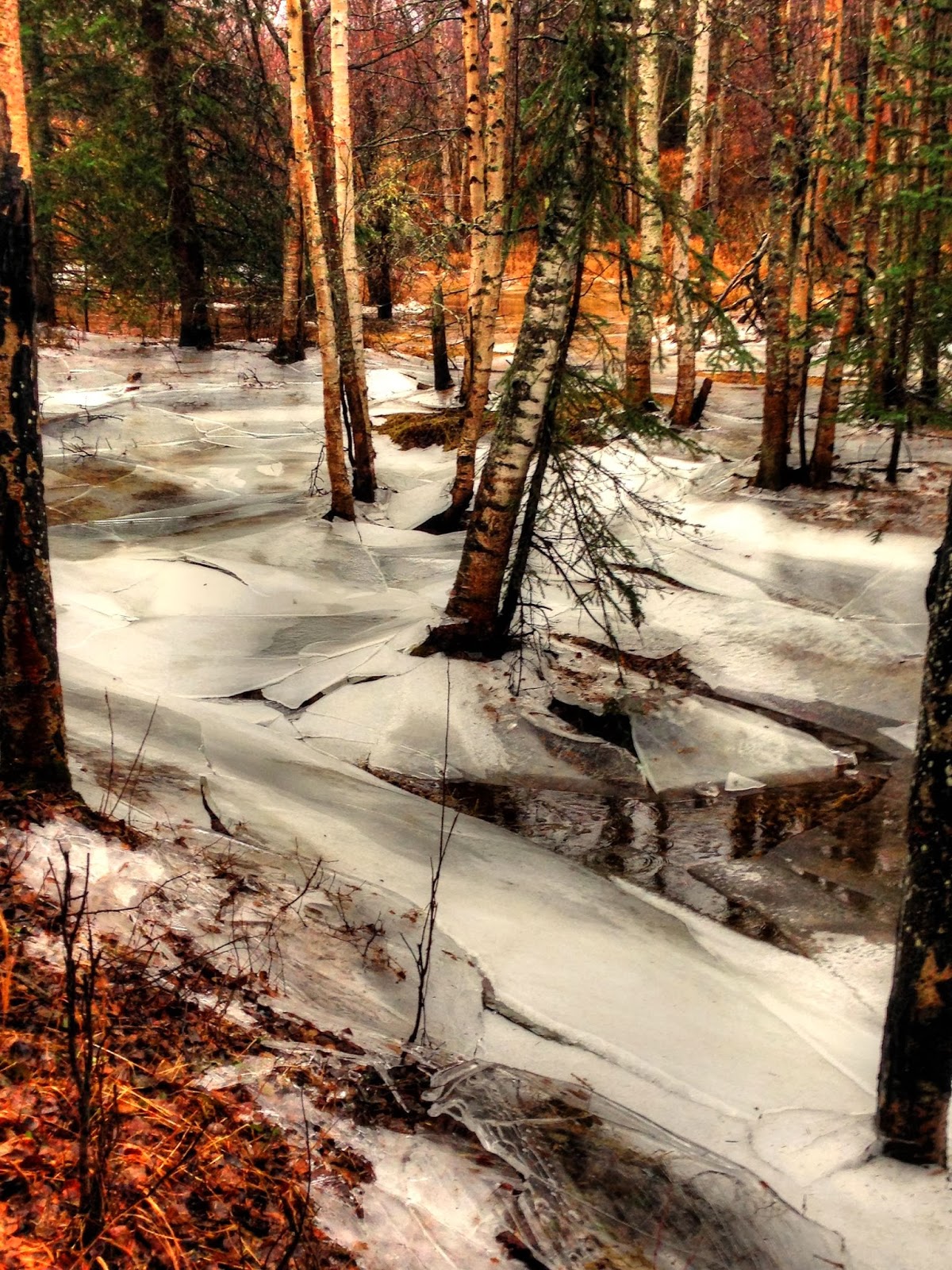
Even at 762m (2500') there was no snow, and not a trace of frost or ice on the ground. When we finally turned round near 1000m (3280') and headed back down, there was just a few cm of fresh snow from the night before. But what was most shocking to us, was that the ground was completely unfrozen at this elevation, underneath the scant snow. In fact, this area of trail, the one toward Williwaw Lakes, while notoriously swampy and muddy all summer, was often under 10-30 cm of standing water. And was completely un-negotiable in running shoes (albeit with fleece-lined neoprene socks, so my feet were relatively comfortable). This is what forced us to turn back. Every year we've been in these areas above 700m, the ground often begins to freeze even by the fall equinox (9/21). This trail in fact will have to be re-routed, as the last two years of much heavier than normal precipitation have taken it's toll.  
[source - NOAA/National Weather Service Alaska 02NOV 2013]

In fact, in our estimation, the trend of increasing precipitation in South-Central Alaska will continue apace with global warming. As the jet stream continues to shift further north and persist longer over higher latitudes throughout the year. Here at the base of the Chugach mtns., where the Chugach Front Research Centre resides, the water table is very low, and many of the neighbourhoods were built in former swamps/muskegs. We are now seeing the water table rising to the ground here, producing more streams and ponds.

Unfortunately, it looks like some homes in this area will eventually have to be either raised, or abandoned. Cheers.
 

Friday, November 1, 2013

CHANGE YOU CAN BELIEVE IN

                CHANGE YOU CAN BELIEVE IN


The pace and magnitude of Global Warming/Climate Change is faster and greater here in the Arctic than most other areas of the World (as well as in the Antarctic Peninsula, on Antartica, at similar latitudes south of the Equator as Alaska/Scandinavia are north). This is due to our relatively small surface area, combined with the facts that small changes in snow cover extent/duration, and sea ice extent/thickness with resulting milder sea-water temperatures, add great amounts of heat to the Arctic atmosphere. And now, this article estimates it is at it's warmest levels, in some parts, than in the last 120,000 years.
 
 
This has been manifesting itself in many ways, here in Alaska. Two of them are stronger and more frequent fall/winter windstorms, and longer cycles of wet/dry weather, when the jet stream slows. Leaving Alaska under a persistent wet flow, for 4-6 weeks, or a drought, of similar duration when a persistent upper ridge lies over it.
 
Much to our dismay here at the Alaska Progressive review, most of Alaska, including all of South-Central, where Anchorage resides, has been under a wet, mild south-southwest flow aloft, since late August. Giving us 2-3 times our normal rainfall for this period, and this month, making it the warmest October on record. With only a trace of snowfall (when 25-30cm is average for the month) and infrequent frosts. Leaving the ground thawed and muddy, with green grass still present. I don't think anyone has ever seen green grass in Anchorage like this on Halloween!


[credit, NOAA/NWS Alaska]

Alaska has even made national news, as this informative article from Climate Central illustrates:

 
Alaska Roasts During October, Reigniting Wildfire
Now is the time of year when Alaska’s snowpack starts to build and temperatures plunge as the days become shorter and shorter. But this year, October has turned out to be more like September, with rainstorms instead of snowstorms, and some of the mildest temperatures on record for the month, particularly across interior Alaska.
Temperature departures from average during October 2013, showing the relative warmth in Alaska.
Click image to enlarge. Credit: WeatherBell Analytics.

While the warm weather pattern, which has been dominated by a high pressure area in the upper atmosphere, is beginning to change with colder and snowier conditions arriving just in time for Halloween, the above-average temperatures have already carved October 2013’s place in the record books.

According to the National Weather Service in Fairbanks, rain aid in a note on its Facebook page. Temperatures in the 50s at Eielson Air Force Base and Fort Greely were the warmest on record for so late in the fall.
 
The warm weather led to an even more unusual sight for the fall: smoke from an active wildfire. The Mississippi wildfire, which started in May about 70 miles southeast of Fairbanks, flared up again on Oct. 28, when strong winds were blowing and there were record warm temperatures in the lower 60s.
 
According to the Alaska News-Miner newspaper, this is “the latest anyone at the Alaska Fire Service can remember fighting an active Interior fire.” [sadly, unprecedented wildfire behaviour is now becoming the norm over the most vulnerable areas  of the the globe, such as Australia and western North America, as warming/climate shifts accelerate, eds.]
 
In Fairbanks, the monthly average temperature was 36.5°F through Oct. 30, which was nearly 12°F above average for the month, and according to weather.com, ranks among the warmest Octobers on record in the city.
 
The NWS said that in Anchorage, the state’s largest city, the temperature set or tied the mark for the warmest overnight low temperature during 6 of 7 days in the period from October 14-20. It was also the warmest mid-October (11-20) on record there, with an average temperature of 47.9°F, which is close to average for mid-September.
Smoke from the Mississippi wildfire visible in Alaska in late October.
Credit: NWS via Facebook.
 
Studies have shown that sea ice loss can speed warming of parts of the Far North, thereby helping to melt permafrost and unlock the greenhouse gases currently locked in such frozen lands. The Arctic is warming faster than any other area in the Northern Hemisphere, and as the country's only Arctic state, Alaska has been warming rapidly in recent years as well. That has had wide-ranging impacts, including coastal flooding that threatens the viability of some coastal communities, as well as melting permafrost that has wreaked havoc with home foundations in interior Alaska.
 
The coastline of northern Alaska continues to see a trend toward warmer-than-average fall seasons due to the late formation of the sea ice pack. As Arctic sea ice has declined in recent years, it has been slower to build back up close to the shoreline during the fall. That has resulted in above-average temperatures in places like Barrow — the northernmost town in the U.S. — and other locations on the North Slope, since open water allows more heat to escape into the atmosphere than sea ice would have.
 
The NWS said that it was the warmest mid-October on record in Barrow, with an average temperature of 28.4°F from Oct. 11-20 and has been 10°F or more above the 1981-2010 normal every day since October 13th. Through Oct. 30, the monthly temperature was about 8°F above average for the month.
 
However, it appears that Barrow will not break the record for the warmest October, a benchmark that was set just last year.
 

So what has that does that look like here, in South-Central Alaska? Allow us to illustrate, from our daily activities in the beautiful, interesting, and potentially dangerous landscapes here. 

There have been very few clear days here since August. The fall colours in the deciduous birch/aspen/balsam poplar came on later, and were more muted, with the lingering wet mild weather through September. All the creeks and rivers were swollen with continued high runoff from the various mountain ranges.
 
Many of our local running/hiking/biking/ski trails were completely swamped by mid-September from the excess rainfall. Especially here at the base of the Chugach, where groundwater under pressure from the mountains just behind, seeps to the surface in many areas.  
 
The mild wet weather with just a few frosts continued all through October, so that, amazingly, even at 300-400m elevation (1000-1400'), the landscape was snow-free, and the trails only half-frozen. The snow line on the mountains was still only near 900-1000m (3000-3400').   
 
We have been relatively lucky this fall so far, to have only experienced one fairly strong windstorm in the Anchorage area, as opposed to September of 2012, but many weaker ones.  
 
This moderately strong windstorm earlier this week swept through the Anchorage "Bowl", bringing wind gusts as high as 170 kph (106mph) on the slopes of the Chugach (the "Hillside" it is called here, and this part of Anchorage has the most expensive real estate, due to the beautiful views and wilderness proximity). Here at the Chugach Front Research Centre, we estimated our peak wind gusts to be in the 130-150 kph range, based on how our building shook, and the windows rattled. We've been able to calibrate this fairly well, unfortunately. Although we are at the Chugach Base, and not on the slopes, strong wind gusts funnel/whip out of the N. Fk. Campbell Creek Canyon behind us whenever a windstorm has strong winds aligned with it.  A few neighbourhoods nearby were without power from blown-down trees taking down power lines, for 24 hours or so, but better than the 4-5 days for some that happened 9/2012!


These trees came down in our latest storm, across one of our favourite daily-access trails, which all the staff here at the Alaska Progressive Review greatly enjoy running/hiking on.
 
In spite of the often gloomy, dreary weather, there were some sunny breaks where the gentle waning sub-Arctic winter sun would illuminate the landscape in a nice glow. On one of these, we were highly fortunate to run into a relatively rare lynx. She bounded right in front us on one of our favourite trails, and leapt into a birch tree, where she placidly observed us for 5 min., whilst we in our excitement kept circling, angling for the best photo/viewing opportunities. 


We always feel blessed when we can see and appreciate the other large animals that live alongside us in our sub-Arctic environment. In which the ecosystems are complete, unlike in much of the rest of the US, where brown bears and wolves have been exterminated.


With the pace and magnitude of changes occurring here, we are constantly wondering what will be next! Overall though, it has already been shown that when atmospheric CO2 levels were last the same (400ppm) as they are today (from naturally occurring increased volcanism it is thought), the climates in the Arctic were more similar to what we find over the Northwestern US and SErn BC Canada. Meaning that even in winter, the Arctic Ocean was mostly ice-free, the climate of Fairbanks would have been something like that found currently in SErn BC Canada (say Kelowna or Kamloops), and Anchorage would have probably been similar to a place like Port Townsend, Washington, USA.
 
Yet, atmospheric CO2 concentrations by the year 2050 will likely be up to 550 ppm! So not only does the Earth's climate system have to catch up to the much warmer climates that occurred 3 million years ago, but to levels that will be even much warmer! Cheers. 

Wednesday, September 25, 2013

ALASKA FIRE SEASON 2013 - DODGING BULLETS


The 2013 Alaska wildland fire season could best be summed up as "it could have been worse". Alot worse. 528,000 hectares burned (1.32 million acres), which is significantly above the mean value (since 1955) of 364,000 (910,000 acres). As you can see from our graph of Alaska wildfire acreages plotted along with May-Aug Fairbanks average temps., summer-time temperatures were also significantly above-average, and many high temperature records were broken, especially in June and July.  
In fact, the situation was looking quite dire by mid-June, when an anomalously strong and warm high pressure ridge built in over the mainland of Alaska. High temperatures of 30-36C (86-96F) occurred on several days in many locations across the Interior and South-Central Alaska.  
 
This led to something your lead editor had never seen before in my time in Alaska since 1998, this.
The majority of the state under Red Flag Warnings or Watches, including Anchorage and Fairbanks. Red Flag Warnings are issued by the National Weather Service to the land management agencies, Bureau of Land Management (BLM), US Forest Service, etc.., whenever pre-defined weather criteria combined with dry forest fuels, are met or exceeded. Which would lead to extreme fire behaviour in new or existing fires. Usually, just parts of the Interior, or South-Central Alaska will see these conditions at any given time during the summer.
 
Fortunately for residents of the Alaska Interior, where most of the fires occurred, two well-timed rainfall events during the second week of July, helped temporarily slow things down, before warmer/drier weather returned the following week. Significant rains and below-average temperatures brought an end to the season after 8/15, which is the case in most years. July and August are usually the wettest months in Interior Alaska, and when this pattern is disrupted by long dry spells of three weeks or more, large fire outbreaks occur and continue through the summer. Three good examples of this just in the past decade were in 2004 (the largest in AK recorded history), 2005, and 2009.
The fires of 2013 were also fairly evenly spatially distributed across the Interior, widespread lightning events fueled by westward-moving "easterly waves", which are remains of old frontal systems from the Gulf of Alaska, circulating around an upper-level low in the Gulf. These tend to occur several times each summer, and produce the most widespread thunderstorms, on some occasions, 10-13 thousand lightning strikes can occur with these, igniting numerous wildfires if the boreal forest is dry enough.
 
In the eastern Interior, east of Fairbanks, to the Canadian border, conditions in July and August were drier, so dry in fact that extreme fire behaviour occurred on many occasions. Take a look at the Alaska "Fire Tornado" that occurred near Tetlin Junction, not far from the Canadian Border, on 17 August.  
 
This is what happens when summertime temperatures and precipitation in the Alaska Boreal Forest reflect conditions that usually occur much further south, say in southern British Columbia, or northwest Montana. Conditions the Alaska Interior will be seeing much more of in the years ahead, as global warming continues apace.
 
This fire, to the right, called the Mississippi Fire, burned nearly 28,000 hectares (70,000 acres), mainly from 8/06 to 8/18, when strong southerly chinook winds pushed it to life, and nearly to the Tanana River, and approaching the town of Delta Junction. Active suppression efforts on its north end though, helped ensure that it would be unable to threaten Delta again, often by "burning out" areas behind the fireline, as shown here. Nevertheless, the boreal forest tree deciduous species in this area of the interior in the first few weeks of August, such paper birch, aspen, and balsam poplar were showing significant drought stress. With brown, withered leaves, and/or early fall colour.
 
Conditions in Canada were much worse overall, for the country as a whole, 3.8 million hectares burned in 2013 (9.5 million acres), more than twice the 25-year average there of 1.5 million hectares.

This is all in line with the fact that the Earth is responding to global warming,  albeit slowly. Because the oceans are absorbing a good percentage of the increasing heat from our escalating levels of CO2 and methane (CH4) from fossil fuel extraction and combustion.
 
As we have mentioned before, latest research is now showing that the last time atmospheric CO2 levels were at the current level of 400 ppm (2.2 - 3.6 million years ago), global sea levels were 20m (66ft) higher. And the climates of Siberia and Alaska were similar to that which were found in the Northwestern US and southern BC Canada, until relatively recently. Given that it is quite likely atmospheric CO2 levels will reach at least 550-600 ppm by 2060, until either nature, or humanity is able to stop this, we have to therefore expect that the Arctic climates will continue warming to levels even warmer than they were 2.2-3.6 million years ago. Interior Alaska's climate would likely then become similar to, or even warmer than that found in the interior of the Northwestern lower 48 states. Places such as Missoula, MT, Spokane, WA, or even The Dalles, OR. The main uncertainty now is how long this will take. Will it be 50 years, 100, 200 or more, before the climate system "catches up" with the increased CO2 levels?
 
The boreal forest ecosystems will not be able to tolerate the warmer/drier summers, leading to massive die-offs, especially at the lower elevations of the Interior, and on drier, southeast-west facing slopes. With the warmer and drier weather, and vast swaths of the Interior having dead/dying boreal forest stands, we think it's safe to say our increasing wildfire acreage trends will continue, and amplify. And the fire behaviour seen will become increasingly extreme, as we saw this summer on the Tetlin Junction fire.
 
As well, the increasing wildfire acreages across the boreal forest systems throughout the Arctic are also "positive feedback" mechanisms, releasing even more CO2 and CH4 from combustion and permafrost melting, leading to even more greenhouse warming.

Cheers.

Tuesday, September 10, 2013

DEMOCRACY NOW? [or] DOOMSDAY AVERTED?

We were working on our 2013 Alaska Fire summary, when current events broke in.

Thank goodness the U.S. Government has backed off on the imminent use of cruise missile bombings (amongst other modern methods of remote destruction) against the nation of Syria. One that has not directly attacked or threatened this one, any of it's neighbours, or any other country. But has been accused of using Sarin nerve gas on innocent civilians, killing anywhere from 500 to 1500. Accusations which are unproven still at this time. We are in a pivotal time in US and World History, these next few weeks and months. When people world-wide will have to think about what large-scale war(s) could do in this era, that will have global effects. And pressure their governments to stop it.  
We like David Swanson, Secretary of Peace, in the Green Shadow Cabinet's analysis of the Syrian Crisis.
 
["The Green Shadow Cabinet includes nearly 100 prominent scientists, community and labor leaders, physicians, cultural workers, veterans, and more, and provides an ongoing opposition and alternative voice to the dysfunctional government in Washington D.C.. As with shadow cabinets in other countries, the Green Shadow Cabinet of the United States responds to actions of the government in office and demonstrates that another government is possible. This cabinet is led by the 2012 Green Party presidential nominees of Dr. Jill Stein and Ms. Cheri Honkala and supports independent politics and policies. However, it is not a project of any political party."]

http://greenshadowcabinet.us/statements/10-problems-latest-excuse-war

The following article is a frightening look at the power of the Euro/American financial sector, at essentially running the World, driving the policies of all the major "developed countries", and in this case why Syria is being threatened.
 
 
And this does follow right along with what other important voices have said, concerning the actual motivation for the illegal and immoral invasion and occupation of the country of Iraq, in 2003-2008.

Keep following the alternative news sources for the best coverage of this Syrian Crisis, here are some of our mainstays. 

http://www.commondreams.org/
http://www.counterpunch.org/
http://www.truth-out.org/
http://prorev.com/
http://www.alternet.org/
http://www.democracynow.org/

 We really like and respect these sites, and they also have other extensive links to useful and accurate information. It's the kind of event too, that may act to sharpen people's socio-political awareness on a large scale in many countries, and with that, enact significant changes. To move toward systems that put the rights and needs of people and the environment above corporate and short-term greed.
 
Tomorrow marks two sad anniversaries, as we know. The first being on 11 September, 1973. The right-wing coup in Chile that overthrew a freely and fairly elected left-leaning President Allende and his government. Supported by the Nixon Administration/CIA, and documented by numerous former US officials, not least Henry Kissinger.
 http://www.counterpunch.org/2013/09/10/remember-the-first-911/
 
What happened there was truly a tragedy, when fascism came to that country, which we've written about before. Chile is still recovering from it's violent past, but it does have a hopeful future, we are happy to say.
 http://akprogressive.blogspot.com/2010/09/victor-jaras-hands.html
 
Cheers. 

Monday, September 2, 2013

LABORING FOR THE FUTURE

                          Happy Labor Day!

In honor of this holiday dedicated to working people in the USA, we found these two articles to be highly informative.
 
This first gives a short history of how Labor Day originated, and is really interesting:
 
It seems as though most US people either don't know, or have forgotten how many people sacrificed their livelihoods and lives to improve working conditions through the 1930s. Howard Zinn's Peoples History of the US is one of our favourite sources about our neglected labour history.
 
This second article, by Dr. Richard Wolff, economics professor emeritus, Amherst Univ., MA. describes exactly how labor unions declines were driven by corporate forces over the past 60+ years. But he also provides some realistic methods that could be used to reverse this, and allow cooperative enterprises to increase their market share and influence in democratising our economy.
 
Unfortunately, articles like this rarely are ever seen in the US Corporate media. This is from the UK Guardian newspaper. They are probably the largest news concern in the World pushing the envelope, in the sense of getting out the truth about corporate domination of the global political/economic system, and it's ramifications.
http://www.commondreams.org/view/2013/09/02-5

Organized Labor's Decline in the US is Well-Known. But What Drove it?


To secure gains for working people requires a social transition that puts them in charge of producing society's services


Organized labor's decline in the US over the past half century is well-known; what drove that decline, less so. The New Deal's enemies – big business, Republicans, conservatives – had developed a coordinated strategy by the late 1940s. They would break up the coalition of organized labor, socialist and communist parties: the mass base that had forced through the 1930s New Deal. Then each coalition member could be individually destroyed.Anonymous workers Photograph: Richard Baker/Corbis
 
One line of attack used anti-communist witch-hunts (McCarthyism) to frighten socialists and labor unions into dissociating themselves from former communist allies. Another attack targeted socialists by equating them with communists and applying the same demonization. Still another attack, the 1947 Taft-Hartley Act, directly weakened labor unions, their organizing capability and their alliance with the left. [One of our favourite novels, Barbara Kingsolver's The Lacuna, features this prominently and very sadly, eds.]
 
Business and political leaders, mass media and academics cultivated a paranoid anxiety among Americans: suspect anything even vaguely leftist, see risks of "subversion" everywhere, and avoid organizations unless religious or loudly patriotic. Legal, ideological and police pressures rendered communist and socialist parties tiny and ineffective. Destroying unions took longer. The unionized portion of private sector workers fell from a third to less than 7% now. Since 2007, conservatives used crisis-driven drops in state and city tax revenues to intensify attacks on public employee benefits and unions. Both were denounced as "excessive and unaffordable for taxpayers". That plus public worker layoffs reduced public sector unionization.

Nor did labor unions or the left find or implement any successful strategy to counter the 50-year program aimed to destroy them.


[Right-wing coup by General A. Pinochet in Chile, 9/11/1973. Aided/abetted by the Nixon Admin., eds

To reverse organized labor's decline and to rebuild the left requires either reviving the old New Deal coalition or forming a new comparably powerful alliance. That means confronting and outwitting the long demonization of unions and the left. It requires a strategy that engages and wins struggles with employers. More importantly, it requires a strategy to reposition labor unions and their allies as champions of broad social gains for the 99%. To escape the label of "special interest" unions must work for far more than their own members.

The needed strategy is available. It proposes a new alliance among willing labor unions, community organizations and social movements. The alliance's basic goal is a social transition in which workers cooperatives become an increasing proportion of business enterprises. The increasingly used term workers self-directed enterprises (WSDEs) stresses democratic decision-making. In WSDEs, all workers democratically decide what, how and where to produce and how to use the net revenues their work generates. In WSDEs, whether or not workers are owners or self-manage, they function, collectively and democratically, as their own board of directors, "their own bosses".
 
This goal and strategy could solidify this alliance. Democratizing enterprises realizes inside them the same goals that inspire many community organizations and social movements. WSDEs established and nurtured by community organizations and social movements could, in turn, provide important financial and other resources for their allies.

Labor unions could regain strength from such an alliance. For example, consider employers who demand concessions (lower wages and benefits) and threaten otherwise to relocate enterprises, often abroad. Unions have mostly compromised on concessions to retain employers. The proposed new alliance offers a new bargaining tool for these situations. If an employer relocated, the alliance would assist workers to try to continue the enterprise as a WSDE. The relocated employer risks competition from a WSDE asking customers to favor it over an employer who had abandoned workers and communities for higher profits.

To establish new WSDEs in such ways, unions would draw upon their allied community organizations and social movements to mobilize local political support as well as funding. Local politicians could not easily refuse job-saving demands from that alliance (proven daily in Europe).
Another way for the proposed alliance to help form WSDEs would be a bold new federal or state program to combat unemployment. This would follow the example of Italy's 1985 Marcora Law. That law offers a new, second alternative to the usual unemployment dole. An unemployed worker can instead choose to take all unemployment benefits as an immediate lump-sum payment and pool that with lump sums similarly chosen by at least nine other unemployed workers. The total must then be used as start-up capital for a workers coop. Marcora's success is one reason why Italy has many more workers coops than the US.
These and still other actions by the proposed new alliance could build a significant WSDE sector while helping to solve major US social problems. That sector would enable many Americans to see and evaluate WSDEs. A WSDE sector gives Americans two new freedoms of choice: (1) between working in a top-down, hierarchical capitalist firm or a democratized worker coop, and (2) between buying the products of capitalist or cooperative enterprises. A significant WSDE sector would add its demands for government technical, financial, and other supports to those from other economic sectors.

As the Republican and Democratic parties increasingly cannot or will not serve average Americans' economic needs, the proposed alliance, strategy and actions would do exactly that. Here lie opportunities for resurgence in the labor movement and the left.

While reminiscent of the old New Deal coalition, the proposed new alliance would differ in one crucial dimension. The old coalition believed that it could not win more than progressive taxation, new regulations and new institutions (such as Social Security). It could not transform enterprises themselves. The old coalition left in their corporate positions the major shareholders and the boards of directors they selected. Those shareholders and boards then used corporate power and profits to systematically evade, weaken, and, when possible, dismantle the New Deal across the past 40 years.

Building a WSDE sector in the economy applies the lesson of those years. To secure gains for working people requires a social transition that puts them in charge of producing society's goods and services. A democratic society requires a democratic economy and that, the new alliance would insist, means a transition to democratically organized enterprises. When this September's AFL-CIO convention considers building an alliance with community groups and social movements, the strategic focus on WSDEs ought to be included.

Wednesday, August 7, 2013

TO TIDE YOU OVER

We need to tide you over until we have more time to finish our Alaska 2013 fire season update, and commentary upon what is happening with wildfire trends across the rest of the World. A quick projection, we are estimating our 2013 Alaska seasonal total of wildfire acreage to be around 1.3 million acres (520,000 hectares). Somewhat above the 1955-2013 mean of 910,000 acres.  
 
But first, here are some of our favourite articles we've come across the past few weeks. Together with some of our usual incisive and informed commentary.
 
This is a very important, interesting article from the Science Daily website describing the ability researchers at the University of Colorado have just perfected, of more cheaply and reliably producing hydrogen using solar thermal reaction processes. Which could be done in many areas of the US and the World that have abundant solar energy resources. Which could then help usher in the widespread use of hydrogen as a fuel for transportation, and energy generation. As a reminder, when hydrogen is burned as a fuel, the only emissions are of water vapour. Existing internal combustion engines can be easily converted to run on it safely, which was demonstrated over 30 years ago.
One paragraph though from this article unfortunately sums up why so far, no major efforts have been undertaken by the US or other governments to further develop and put into widespread practice methods like this, which could save us from runaway global warming and rapid sea level rises.

"Despite the discovery, the commercialization of such a solar-thermal reactor is likely years away. "With the price of natural gas so low, there is no incentive to burn clean energy," said Weimer, also the executive director of the Colorado Center for Biorefining and Biofuels, or C2B2. "There would have to be a substantial monetary penalty for putting carbon into the atmosphere, or the price of fossil fuels would have to go way up."

Anyhoo, give this article a read, it's very interesting, and in a World where governments put the health of people and the environment ahead of corporate profits, things like this would be given high priority and funding to develop and implement.
 
MIT linguistics professor Noam Chomsky is a revered elder in the Progressive movement in the USA and throughout the World. Always weighing in with his trademark incisive commentary on the state of national and global political and economic developments. This is one of his latest articles concerning the fallout from the Edward Snowden leaks of the NSA surveillance methods, describing how Latin America is standing up to US pressure to find and return him for prosecution. Very interesting and informative as always.


The trial of Bradley Manning, the unfortunate US Army soldier who exposed war crimes and many other mis-deeds, acting in his sworn duty "to protect and defend the US Constitution against all enemies, foreign and domestic", and what it means for us as US citizens, is the subject of attorney Rob Hager's article here.
 
We especially thought this paragraph summed it up concisely, and all US citizens need to understand what is happening.

"The fundamental structural defenses against tyranny – the separation of powers and federalism – are collapsing, while the democratic liberties enumerated in the Bill of Rights are eroding. These developments are the product of an elite political class consolidating the power necessary to impose the extreme economic inequality of a plutocratic tyranny in a time of a disintegrating civilization.

Those at the forefront of undermining the Constitution are acting in violation of their oaths as “executive and judicial officers … to support this Constitution.” Art, VI, cl 3. Bradley Manning, like every other member of the military subset of those officers, took this same oath to uphold the Constitution. He fulfilled that oath by disclosing war crimes. Those who have imprisoned and court-martialed him stand in violation of their constitutional oaths."

Now that overt corporate rule has overtaken the US, because of the power of them to lobby and buy both Democratic and Republican politicians, casino capitalism and it's destructiveness are described in good detail in Paul Buchheit's article about the rush toward "privitisation" of governmental services and property. Which of course you'll never hear about in the corporate media.

Finally, here are a few pictures from Homer, where a few weeks ago we went for a halibut fishing trip. Seeing this beautiful little town in it's peaceful setting facing south, at land's end at the tip of the Kenai Peninsula was very inspiring. 
So much so, that your lead editor was inspired to run for the first time since my operation last 15 May, to remove the titanium hardware in my leg that was causing me some problems.
Seeing these beautiful views, like this of Augustine Volcano looking south into Cook Inlet, gave me so much energy that I ran about 12 km, without running shoes or shorts, but it was a spur of the moment decision.
 
I felt quite sore, but was able to run again about four days later without any serious issues.
 
Unfortunately though, after a strenuous hike up Bird Ridge, a showpiece trail in Turnagain Arm that offers incredible views in only 11-12 km round trip as it ascends abruptly 1100 metres, followed by a run two days later, pains and swelling forced me to end my running experiment for the time being. In another month or so, I'll try it again, but more slowly.
 
Meanwhile, here are a few pictures of the Bird Ridge outing, though fog limited the views, it sure is a worthwhile and beautiful hike to do if you are able.


Cheers.