IN A TIME OF UNIVERSAL DECEIT...TELLING THE TRUTH BECOMES A REVOLUTIONARY ACT

"Capitalism is the astounding belief that the most wicked of men will do the most wicked of things for the greatest good of everyone." John Maynard Keynes

" Labor is prior to, and independent of, capital; that, in fact, capital is the fruit of labor, and could never have existed if labor had not first existed. Labor is the superior of capital and deserves much the higher consideration" Abraham Lincoln

Wednesday, August 7, 2013

TO TIDE YOU OVER

We need to tide you over until we have more time to finish our Alaska 2013 fire season update, and commentary upon what is happening with wildfire trends across the rest of the World. A quick projection, we are estimating our 2013 Alaska seasonal total of wildfire acreage to be around 1.3 million acres (520,000 hectares). Somewhat above the 1955-2013 mean of 910,000 acres.  
 
But first, here are some of our favourite articles we've come across the past few weeks. Together with some of our usual incisive and informed commentary.
 
This is a very important, interesting article from the Science Daily website describing the ability researchers at the University of Colorado have just perfected, of more cheaply and reliably producing hydrogen using solar thermal reaction processes. Which could be done in many areas of the US and the World that have abundant solar energy resources. Which could then help usher in the widespread use of hydrogen as a fuel for transportation, and energy generation. As a reminder, when hydrogen is burned as a fuel, the only emissions are of water vapour. Existing internal combustion engines can be easily converted to run on it safely, which was demonstrated over 30 years ago.
One paragraph though from this article unfortunately sums up why so far, no major efforts have been undertaken by the US or other governments to further develop and put into widespread practice methods like this, which could save us from runaway global warming and rapid sea level rises.

"Despite the discovery, the commercialization of such a solar-thermal reactor is likely years away. "With the price of natural gas so low, there is no incentive to burn clean energy," said Weimer, also the executive director of the Colorado Center for Biorefining and Biofuels, or C2B2. "There would have to be a substantial monetary penalty for putting carbon into the atmosphere, or the price of fossil fuels would have to go way up."

Anyhoo, give this article a read, it's very interesting, and in a World where governments put the health of people and the environment ahead of corporate profits, things like this would be given high priority and funding to develop and implement.
 
MIT linguistics professor Noam Chomsky is a revered elder in the Progressive movement in the USA and throughout the World. Always weighing in with his trademark incisive commentary on the state of national and global political and economic developments. This is one of his latest articles concerning the fallout from the Edward Snowden leaks of the NSA surveillance methods, describing how Latin America is standing up to US pressure to find and return him for prosecution. Very interesting and informative as always.


The trial of Bradley Manning, the unfortunate US Army soldier who exposed war crimes and many other mis-deeds, acting in his sworn duty "to protect and defend the US Constitution against all enemies, foreign and domestic", and what it means for us as US citizens, is the subject of attorney Rob Hager's article here.
 
We especially thought this paragraph summed it up concisely, and all US citizens need to understand what is happening.

"The fundamental structural defenses against tyranny – the separation of powers and federalism – are collapsing, while the democratic liberties enumerated in the Bill of Rights are eroding. These developments are the product of an elite political class consolidating the power necessary to impose the extreme economic inequality of a plutocratic tyranny in a time of a disintegrating civilization.

Those at the forefront of undermining the Constitution are acting in violation of their oaths as “executive and judicial officers … to support this Constitution.” Art, VI, cl 3. Bradley Manning, like every other member of the military subset of those officers, took this same oath to uphold the Constitution. He fulfilled that oath by disclosing war crimes. Those who have imprisoned and court-martialed him stand in violation of their constitutional oaths."

Now that overt corporate rule has overtaken the US, because of the power of them to lobby and buy both Democratic and Republican politicians, casino capitalism and it's destructiveness are described in good detail in Paul Buchheit's article about the rush toward "privitisation" of governmental services and property. Which of course you'll never hear about in the corporate media.

Finally, here are a few pictures from Homer, where a few weeks ago we went for a halibut fishing trip. Seeing this beautiful little town in it's peaceful setting facing south, at land's end at the tip of the Kenai Peninsula was very inspiring. 
So much so, that your lead editor was inspired to run for the first time since my operation last 15 May, to remove the titanium hardware in my leg that was causing me some problems.
Seeing these beautiful views, like this of Augustine Volcano looking south into Cook Inlet, gave me so much energy that I ran about 12 km, without running shoes or shorts, but it was a spur of the moment decision.
 
I felt quite sore, but was able to run again about four days later without any serious issues.
 
Unfortunately though, after a strenuous hike up Bird Ridge, a showpiece trail in Turnagain Arm that offers incredible views in only 11-12 km round trip as it ascends abruptly 1100 metres, followed by a run two days later, pains and swelling forced me to end my running experiment for the time being. In another month or so, I'll try it again, but more slowly.
 
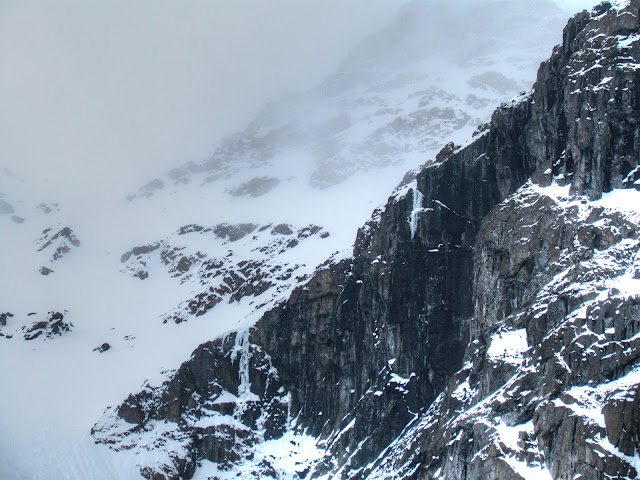
Meanwhile, here are a few pictures of the Bird Ridge outing, though fog limited the views, it sure is a worthwhile and beautiful hike to do if you are able.


Cheers.

Monday, July 22, 2013

ROGUE PETRO-STATE? [and] KLUANE UPDATE

                         ROGUE PETRO-STATE?

It has been somewhat of a mystery to progressive type folks here in Alaska, and the northern US lower 48, as to how/why our neighbouring country of Canada continues in it's aggressively destructive path of developing one of the most threatening projects to the global climate system. Mining the oil sands in Northern Alberta, which takes huge volumes of water and energy, to extract the oil. Which uses natural gas to heat/pressurise water, and also to dilute the sludge into "oil", which is then called Diluted Bitumen, or "Dilbit". Dilbit is not like regular oil, it is more corrosive and flammable. This is why the oil-train disaster in Quebec several weeks ago occurred, with more than 50 fatalities.
 
The following article also describes Dilbit, and how dangerous it is.

Your lead editor does seem to notice a change for the worse, in some respects, just in our brief visits to Whitehorse, Yukon, over the past 12 years. To run the Yukon trail marathon there, or just to enjoy the scenery. In 2002, during one of my first visits there, my truck at the time was the vicious target of anti-American graffiti :). Whilst parked in an alley overnight behind a hotel in downtown Whitehorse, someone scrawled in the dust on it, "Americans suck, go home!". This was during the run-up to the illegal/immoral US invasion of the poor country of Iraq, so that was probably one factor leading to that. But starting in about 2005, I started noticing more poverty and mayhem in Whitehorse during my visits, especially so after 2007, and continuing. Part of that may be due to the economy there taking a downturn, and believe it or not, Whitehorse has been "discovered/gentrified", much like Missoula, MT, or Boulder, CO and other nice outdoor cities in the western lower 48. Property prices in Whitehorse now are just as expensive as in these places.
 
Give this article a read, it's very interesting and informative. We used to think of Canada as a more sane, and progressive country than the USA. And it still is in a few ways, for example their banking industry is more heavily regulated, and hence, they have not had any major banking scandals/meltdowns, and government bail-outs of their financial sector. But as the following article attests, our neighbour to the east (and north), is not nearly what we used to think of Canada as being.
http://www.commondreams.org/view/2013/07/01-8

Oh, Canada: How America's Friendly Northern Neighbor Became a Rogue, Reckless Petrostate


For decades, the world has thought of Canada as America's friendly northern neighbor -- a responsible, earnest, if somewhat boring, land of hockey fans and single-payer health care. On the big issues, it has long played the global Boy Scout, reliably An aerial view of tar sands mining in Alberta, Canada. (Photo: howlmontreal/ Flickr)providing moral leadership on everything from ozone protection to land-mine eradication to gay rights. The late novelist Douglas Adams once quipped that if the United States often behaved like a belligerent teenage boy, Canada was an intelligent woman in her mid-30s. Basically, Canada has been the United States -- not as it is, but as it should be.
 
But a dark secret lurks in the northern forests. Over the last decade, Canada has not so quietly become an international mining center and a rogue petrostate. It's no longer America's better half, but a dystopian vision of the continent's energy-soaked future.

That's right: The good neighbor has banked its economy on the cursed elixir of political dysfunction -- oil. Flush with visions of becoming a global energy superpower, Canada's government has taken up with pipeline evangelists, petroleum bullies, and climate change skeptics. Turns out the Boy Scout's not just hooked on junk crude -- he's become a pusher. And that's not even the worst of it.

With oil and gas now accounting for approximately a quarter of its export revenue, Canada has lost its famous politeness. Since the Conservative Party won a majority in Parliament in 2011, the federal government has eviscerated conservationists, indigenous nations, European commissioners, and just about anyone opposing unfettered oil production as unpatriotic radicals. It has muzzled climate change scientists, killed funding for environmental science of every stripe, and in a recent pair of unprecedented omnibus bills, systematically dismantled the country's most significant long-cherished environmental laws.
The author of this transformation is Prime Minister Stephen Harper, a right-wing policy wonk and evangelical Christian [why does this not surprise us? eds..] with a power base in Alberta, ground zero of Canada's oil boom. Just as Margaret Thatcher funded her political makeover of Britain on revenue from North Sea oil, Harper intends to methodically rewire the entire Canadian experience with petrodollars sucked from the ground. In the process he has concentrated power in the prime minister's office and reoriented Canada's foreign priorities. Harper, who took office in 2006, increased defense spending by nearly $1 billion annually in his first four years, and he has committed $2 billion to prison expansion with a "tough on crime" policy that ignores the country's falling crime rate. Meanwhile, Canada has amassed a huge federal debt -- its highest in history at some $600 billion and counting.

Liberal critics like to say that Harper's political revolution caught many Canadians, generally a fat and apathetic people, by surprise -- a combination of self-delusion and strategic deception. That may be true, but though Canadians live in high latitudes, they're not above baser human instincts -- like greed. Harper is aggressively pushing an economic gamble on oil, the world's most volatile resource, and promising a new national wealth based on untapped riches far from where most Canadians live that will fill their pocketbooks, and those of their children, for generations. With nearly three-quarters of Canadians supporting oil sands development in a recent poll, Harper seems to be selling them on the idea.

THE RESOURCE UNDERWRITING many of these ugly behavioral changes is bitumen, a heavy, sour crude mined from oil sands. Deposits of the badly degraded asphalt-like substance lie under a forest the size of Florida in northeastern Alberta and comprise the world's third-largest petroleum reserves. Over the last decade, as oil prices increased fivefold, oil companies invested approximately $160 billion to develop bitumen in Alberta, and it has finally turned profitable. Canada is now cranking out 1.7 million barrels a day of the stuff, and scheduled production stands to fill provincial and federal government coffers with about $120 billion in rent and royalties by 2020. More than 40 percent of that haul goes directly to the federal government largely in the form of corporate taxes. And the government wants even more; it's pushing for production to hit 5 million barrels a day by 2030.

Never mind that the entire process is a messy and wasteful one. It takes copious amounts of water, capital, and energy to dig out the carbon-rich sands, let alone upgrade and process the heavy crude, which can't even move through a pipeline until it is diluted with an imported gasoline-like condensate. With brazen cheek, the government nonetheless defends the Alberta megaproject as "responsible" and "sustainable" -- "an enterprise of epic proportions, akin to the building of the pyramids or China's Great Wall. Only bigger." Bigger indeed: Approved bitumen mining projects could potentially excavate a forest area six times as large as New York City. Reclamation and reforestation remain an uncertain and costly proposition. To date, oil companies have already created enough toxic mining sludge (6 billion barrels) to flood the entirety of Washington, D.C. 

Unsurprisingly, Ottawa has become a master at the cynical art of greenwashing. When Harper's ministers aren't attacking former NASA scientist and climate change canary James Hansen in the pages of the New York Times or lobbying against Europe's Fuel Quality Directive (which regards bitumen as much dirtier than conventional oil), his government has spent $100 million since 2009 on ads to convince Canadians that exporting this oil is "responsible resource development." Meanwhile, Canada has bent over backward to entice Beijing. Three state-owned Chinese oil companies (all with dismal records of corporate transparency and environmental sensitivity) have already spent more than $20 billion purchasing rights to oil sands in Alberta.
 
The kowtowing to China, now the world's largest oil consumer, highlights Canada's big bitumen dilemma: how to get dirty, landlocked oil to global markets. The United States, Canada's biggest customer, doesn't seem to need it as much anymore; imports declined by more than 4 million barrels a day between 2005 and 2011, and with pipeline projects to the United States like Keystone XL stuck in the mud, Harper's vision of being an "emerging energy superpower" appears in danger.
 
Unsurprisingly, Harper has recently jettisoned criticism of China's human rights record. As a secret foreign-policy document leaked last fall to the Canadian Broadcasting Corp. (CBC) makes clear, Canada has new priorities: "To succeed we will need to pursue political relationships in tandem with economic interests even where political interests or values may not align."
In 2012, Canada quietly signed a controversial trade agreement with the People's Republic and approved a $15 billion takeover of Nexen, an oil sands player, by the state-owned China National Offshore Oil Corp. And, perhaps to warm Canadians' hearts to the Chinese, the government recently lobbied to rent two traveling pandas at a cost of $10 million over the next 10 years.

Now that oil sands mining accounts for nearly 10 percent of Canada's greenhouse gas emissions, Ottawa can't really brook any discussion of a carbon tax, though a majority of Canadians would support one. Harper described the Kyoto Protocol as "a socialist scheme" and a "job-killing, economy-destroying" accord before pulling out of the agreement altogether in 2012. Many of Canada's ministers are now die-hard skeptics even about the science behind climate change. As Natural Resources Minister Joe Oliver recently explained to the Montreal newspaper La Presse: "I think that people aren't as worried as they were before about global warming of 2 degrees.… Scientists have recently told us that our fears [on climate change] are exaggerated." To silence any would-be exaggerators, the government simply stopped funding the Canadian Foundation for Climate and Atmospheric Sciences, disbanded Environment Canada's Adaptation to Climate Change Research Group, and eliminated the role of chief science advisor. And since 2008, political minders have vetted all media requests for the country's 23,000 federal scientists.
 
After the government barred a federal scientist from talking about the discovery of a large Arctic ozone hole, a 2012 editorial in the influential science journal Nature demanded that the Canadian government "set its scientists free." It seems Harper heard "cut them loose" instead: His government summarily closed the world-famous Experimental Lakes Area research station, a gem of Canadian environmental science that has helped spur global policy on acid rain, to save the princely sum of $2 million a year (though the Ontario government is working to keep it open).
 
THE SINGLE-MINDED PURSUIT of this petroproject has stunned global analysts. The Economist, no left-wing shill, characterized Harper, the son of an Imperial Oil senior accountant, as a bully "intolerant of criticism and dissent" with a determined habit of rule-breaking. Lawrence Martin, one of Canada's most influential political commentators, says that Harper's "billy-club governance" has broken "new ground in the subverting of the democratic process." Conservative pollster Allan Gregg has described Harper's agenda as an ideological assault on evidence, facts, and reason.
 
To be fair, Harper's government does have a plan for climate change -- pumping the problem to the United States and/or China. Oil sands crude transported to the United States by the proposed Keystone XL pipeline, for example, could over a 50-year period increase carbon emissions by as much as 935 million metric tons relative to other crudes. And the planned $5.5 billion Northern Gateway pipeline from Alberta to the Pacific Ocean would result in up to 100 metric tons of carbon dioxide emissions a year, from extraction and production in Canada to combustion in China -- more than British Columbia's total emissions in 2009. The 2012 National Inventory Report by Environment Canada, the country's environmental department, actually boasts that Canada has partly reduced overall emission intensity in the oil sands "by exporting more crude bitumen."
 
All this underscores Canada's new reality: Just about any kind of rational evidence has now come under assault by a government that believes that markets -- and only markets -- hold the answers. Any act that industry regards as an obstacle to rapid mineral extraction or pipeline building has been rewritten with a Saudi-like flourish. One massive omnibus budget bill alone changed 70 pieces of legislation, gutting, for example, the Fisheries Act, which directly prohibited the destruction of aquatic-life habitats but stood in the way of the Northern Gateway pipeline, which must cross 1,000 waterways en route to the Pacific Ocean. Meanwhile, funding for Canada's iconic park system has been cut by 20 percent in what critics have called a "lobotomy." The CBC, the respected state broadcaster long scorned by Harper as an independent check on power, has suffered a series of cutbacks. The Health Council of Canada, which once ensured national health standards and innovation across Canada's 13 provinces and territories, also got the ax. Furthermore, with the élan of a Middle Eastern petroprince, Harper appointed the head of his security detail to be ambassador to Jordan. And he did it all with nary a peep from your average Canadian.
 
More than a decade ago, American political scientist Terry Lynn Karl crudely summed up the dysfunction of petrostates: Countries that become too dependent on oil and gas riches behave like plantation economies that rely on "an unsustainable development trajectory fueled by an exhaustible resource" whose revenue streams form "an implacable barrier to change." And that's what happened to Canada while you weren't looking. Shackled to the hubris of a leader who dreams of building a new global energy superpower, the Boy Scout is now slave to his own greed.


Some of the comments following this article are equally interesting and informative, written by Canadians, and which add more "fuel to the fire" so to speak.

"I lived up there and still have family that lives up there.
Here is the thing. Many of the people that work there or get jobs up there come from poorer provinces and have lower levels of education.
Yety they make LOTS of money. People with only a high school education can make 100k a year up there quite easily and with that they can buy a lot of things.
It very very hard to tell these people that this all a great mistake that is destroying the ecosystem.
To them it "Do not work here and go back to being unemployed 6 months of the year and have an income of less then 20k or make 100k a year and buy all those things".
To those critiquing the tar sands it is "Guys working in office towers making 80k a year jealous and wanting me to go back to a minimum wage job"
It hard to break that down."


and

"I too have family that works up there, so I know exactly what you're talking about. It is reminiscent of poor youth joining the military in order to attain a decent standard of living that would otherwise be out of reach. Thus are poor people pitted against one another for perceived "self-interest" which, in the final analysis, is anything but. This will continue until capitalism is eradicated -- or we are."

Good stuff, it sounds like Canada is not going to be the safe refuge for us we thought it could be, if/when full-on fascism in the more repressive sense, is implemented in this country.

                                           KLUANE UPDATE

Our research assistant Kluane has fully matured now, having reached the age of three last May. With that has come a noticeable improvement in his attentiveness on our outings, and a general trend toward limiting his excursions to interact with our other residents of the natural world that we often encounter. Nevertheless, there have been some lapses.
Last month, during one of our daily walks here on the Chugach Front, he brought his first treat back to us. We think he didn't actually kill this little rabbit, but stole it from some other animal's stash, such as a lynx, or eagle. Nevertheless, we were proud of him, glad that he has feral instincts, and can fend for himself.
On a planned pack trip late last month, up to one of our most beautiful, easily accessible favourite haunts, Crow Pass, he became separated from Mattie and I near these falls beneath the pass. It was very windy, 80-120 kph wind gusts were howling. We think he lost sight of us after one of his explorations, and the strong winds eliminated our scent/sound. He then went all the way back to the trailhead, whilst Mattie and I set up camp beyond the pass, waiting.
After talking with a few people who came up, we knew he'd keep waiting by our car, so we had to pack back up and abort our trip, though we did at least get to enjoy the scenery a little bit, on both sides of the pass.


At this point, it had been just five weeks since my surgery to remove the metal in my left leg, and it was still rather sore/tender. I hadn't planned on hiking 25 km that day, just half that, with a 13 kg pack. I actually had to throw my pack down the steepest section of trail, coming down from the pass, to maintain stability/traction, since my left leg was weaker than the right one. But, we didn't mind, he did have the sense to stay and wait for us, and we were not going to leave him out there all night, where he could have been abducted.
 
A week later, we went into another one of our favourite nearby Chugach Range areas, Hanging Valley, which is adjacent to the South Fork of the Eagle River valley. We had planned a 22 km round trip, my leg was slightly stronger.
This little valley ascends in just 6 km from the main S. Fk. Eagle River trail to a sheer headwall that looms some 750 metres above the end of the trail. Kluane became separated again, but Mattie and I proceeded up anyway, figuring he'd rejoin us at some point.
 
When we reached the headwall, I was able to hear him barking in the distance, toward the headwall.

It was fairly cold and windy in here on this day, perhaps 5C at 950 metres elevation with about a 60 kph wind. A typical above-treeline Chugach summer day :). After some investigation, we were finally able to see him. We had to hike up to the bottom of the headwall to see him. Apparently he had herded this moose aways up from some brush.

Upon closer investigation, it does appear that they were actually enjoying each other's company! He wasn't barking, just walking around with her (looks like she was a younger cow moose).
We were quite amused, and happy that he seemed to have found a new playmate. Nevertheless, I was getting cold, and wanted to head back down to a lower, less windy spot, to have lunch, before returning to the trailhead. But he wouldn't respond to our calls, and I didn't want to jeopardise my leg by climbing any higher. So we headed back down to this little lake, about 3 km back out the way we came and waited.
After waiting an hour, without him showing, we decided to just keep going. Sometimes he will actually pull ahead of us on outings, and surprise us by meeting us in front. But we walked all the way back to the trailhead, and no sign of him was apparent. So, I decided we had to walk back in, at least partially. Several people returning on the main trail had not seen him, so we walked 8 km back to near the junction of the Hanging Valley trail, to hopefully meet up. We were there 15 minutes, and then I did see him up on top of the Hanging Valley rim, about a km away. I yelled as loud as I could, and he came running. By this time, we'd been separated almost 4 hours, he must have really enjoyed his new playmate's company. My leg was quite tired/sore by the time we returned back to the car, having done 30 km that day, 6 weeks after my surgery. But we were just glad to have him back.

We decided two weeks later, when high pressure ridging brought warmer/calmer conditions to the Chugach, to head back in to Hanging Valley, for an overnight excursion. Perhaps Kluane would even reunite with his playmate.
This time, with temperatures near 15-17C, and just light northerly breezes and some sunshine, it was much more relaxing and enjoyable. We set up camp near Hanging Valley Lake, which is about a km before the headwall, off a side trail to the south of the Hanging Valley trail, and 100 m above it. The play of dappled sunshine on the aquamarine waters of this beautiful clear little lake made for beautiful scenery.
By the time we set up camp, had dinner, and then were relaxing for the evening, the breezes died off, and the mosquitoes became quite intense, almost requiring me to wear a headnet. But both Mattie and Kluane were enjoying the evening, in the beautiful, gentle Sub-Arctic evening.
I could tell our Assistant Editor Mattie, and Kluane were both tired the next morning though, probably from guarding camp, nocturnal expeditions, and fighting off the vicious mosquitoes.
It's very rare to ever see them both sitting next to each other resting, when we are out and about in unrestricted settings. And when we did pack up and head back out that day, he was exceptionally tired, but happy, when we returned to the Chugach Front Research Centre. He really does enjoy being out and free in our natural settings here. And we are quite happy he is with us, and proud of his growing knowledge and faithfulness as he accompanies us on our outings. He has had two brown bear encounters in my presence in the past year, when we surprised one behind the CFRC on different occasions. And he had the sense to listen to me, and not approach them.

On all of our backpacking trips, he stays around camp, and sleeps about 15 metres out. Whilst Mattie sleeps right next to the tent; two layers of security. We look forward to many more outings with him, as he continues to grow in his wisdom and experience.
 
Back in February I had a dream that he was walking upright like a man. I took this to mean he was growing in his maturity and wisdom, into a "power animal" even, like Homer (1996-2011), 

and my old Coyote (1990-2003) were.

So my dream is half-right, but that is changing. As a dedicated "new-age" man in the spiritual sense, I take great stock in my dreams, and this one was very vibrant and powerful. Cheers.

Monday, June 24, 2013

MONTANA ON OUR MINDS [and] CORPORATISM UNMASKED

                                   MONTANA ON OUR MINDS

It has been very warm the last few weeks here in Alaska, due to an anomalously strong high pressure ridging episode, which has since weakened, but is in the process of re-building. So warm in fact, that here at the Chugach Front Research Centre, we had to dig out a fan that we had not used ever before since moving to Anchorage in 2010, to bring a little relief from the heat. Many high temperature records were broken over much of the state, during this episode. It reminded your lead editor of many hot, stifling summer days in Missoula, MT, when I lived there in 1990-98. The hot, still late afternoon and evening times with temperatures in the 80s, and no breeze, heating up our home to uncomfortable levels. This article, from the Climate Central website, below, gives a good summary of what has been happening. The following statement from the NWS Anchorage office also describes the record-breaking temperatures.
 

NOAK48 PAFC 180614 AAA
PNSAFC

PUBLIC INFORMATION STATEMENT
NATIONAL WEATHER SERVICE ANCHORAGE AK
1010 PM AKDT MON JUN 17 2013

...ALL TIME RECORD HIGHS FALL AT SEVERAL LOCATIONS ACROSS SOUTH CENTRAL ALASKA...

A EXPANSIVE RIDGE OF HIGH PRESSURE OVER SOUTHERN ALASKA IS CONTINUING
THE STRING OF UNUSUALLY HOT DAYS. TEMPERATURES AT MANY LOCATIONS WERE IN THE 80S TO MID 90S.

THE FOLLOWING STATIONS SET ALL-TIME HIGH TEMPERATURE RECORDS TODAY:

TALKEETNA....96 DEGREES. PREVIOUS RECORD WAS 91 SET ON JUNE 16
                  2013...JUNE 14 1969...AND JUNE 26 1953.
CORDOVA......90 DEGREES. PREVIOUS RECORD WAS 89 SET ON JULY 16 1995.
VALDEZ.......90 DEGREES. PREVIOUS RECORD WAS 87 SET ON JUNE 26 1953
                  AND JUNE 25 1953.
SEWARD.......88 DEGREES. PREVIOUS RECORD WAS 87 SET ON JULY 4 1999.

THE VALDEZ TEMPERATURE WAS RECORDED IN THE CITY OF VALDEZ. THE HIGH
TEMPERATURE AT THE AIRPORT WAS 84 DEGREES.

TEMPERATURES WILL REMAIN ABOVE NORMAL ON TUESDAY BUT WILL BE COOLER
THAN TODAY. THE COOLING TREND WILL CONTINUE ON WEDNESDAY.

MORE CLIMATE INFORMATION FOR SELECT SITES IN SOUTHCENTRAL ALASKA MAY
BE FOUND AT PAFC.ARH.NOAA.GOV/CLIMATE.PHP

Let's look at one of the graphics again, from the Climate Central article, the 500 millibar analysis, from 6/18/13. As a reminder, the contours on this map are the height at which the atmospheric pressure equals 500 millibars, which is a function of temperature. The higher these heights (plotted in dekameters, so 546 is 5460 metres), the warmer, overall, the atmosphere is. And the flow is parallel to these contours, which at these elevations, depicts the overall "jet-stream" flow with it's high pressure ridges, and low pressure troughs. Also depicted on this map are "standardised anomalies" of these 500 millibar heights, which are a statistical method of depicting the rarity, or strength, of an event, related to departures from mean values.


What this is showing, is that the high pressure ridge, the mass of warm air aloft, that was over Alaska on 18 June, had standardised anomalies of 3-4, which is highly unusual. Meaning these values were essentially four standard deviations above the mean values of the 500 millibar heights for this date. Which would mean that this is a very rare event. It seems we are seeing more events of this nature globally. Which brought our extreme fire season here in Alaska in 2004, the heat waves/fires in Australia in 2009 and earlier this year, and the ones in Russia in 2010.
http://akprogressive.blogspot.com/2011/04/alaska-fire-seasons.html

Further, in our last post,
we presented research findings from a meteoric crater lake in Siberia, that was never scoured away by the ice ages of the past few million years. Which showed that 3 million years ago (mya), the climate there, in what has been the coldest area of the northern hemisphere in winter, was incredibly warmer, much like what would be found today in western Montana. At that time, global atmospheric CO2 concentrations were the same as they are today, 400 ppm, and sea levels were 25 metres higher. In addition, other research is now suggesting that the loss of the Arctic Ocean summer sea ice is acting to slow down the northern hemisphere jet stream, making events like our strong high pressure ridging episodes, and extended winter snowy periods, or wet, stormy fall periods, more likely. And as these patterns shift, the changes can be drastic in nature.
 
Our wildland fire season in Alaska is off to a robust start, currently around 160,000 hectares (400,000 acres). The 1955-2013 seasonal average is around 365,000 hectares, so we are almost halfway there, and the season is just beginning.

Above, is a fire history map of Alaska obtained from the BLM/Alaska Fire Service's website.
 
These are decadal contours of wildfire perimeters, and what we wish to point out, is the orange-coloured ones. These are from the 2001-2010 decadal breakdown. The 1990s are a greyish colour, and the 1980s, a light blue, both of which don't show up very well in this image. Look how much more area has burned in the 2001-2010 period. The two largest single years in the 1940-present period of record were in 2004 and 2005, during which 2.7 million hectares (6.72 million acres) and 1.8 million hectares (4.6 million acres) burned. There are currently dozens of active wildfires burning in the Alaska interior, and enough lightning has been occurring over the last several days, and will continue to occur for several more, to start even more fires. Hence, we think that with another high pressure ridging episode beginning to develop now, it will be an easy bet that a minimum of 800,000 hectares (2 million acres, over twice the 1940-1955 average) will burn in the Alaska interior, if not more, in 2013. Meaning the people living in Fairbanks, and the other settlements will have to deal with smoky, unhealthy conditions at times, and possibly, even danger from encroaching fires, if large, threatening ones are able to move closer to populated areas.
This has been, over the past few decades, and will continue to be, an increasingly frequent occurrence in the Alaska interior, as the climate system "catches up" to our ever-increasing CO2 levels due to fossil-fuel combustion. As it stands now, when it does, at 400 ppm, the climate of the Alaska interior would likely be that of central/eastern Oregon/Washington, but we are heading toward a minimum of 550 ppm, under current emissions scenarios, by 2060. The main unknown, is just how long this "catching up" will take. 50 years, 100, 200, more? For certain, this also means the boreal forests will die off and transition to a grass/sagebrush/aspen type at the lower elevation, with wildfires being an integral part of this process. We'll be sure to keep you informed of future developments this summer.


                  CORPORATISM UNMASKED

The fallout from the Edward Snowden leaks of the USA's National Security Agency's practices of surveillance of all communications globally (not in just the US) continues. The Alaska Progressive Review was not particularly surprised when this story broke a few weeks ago. Nonetheless, this is a gripping story, with huge potential to bring about significant changes to political systems (hopefully of a beneficial nature) in this and other countries. Here are several of our favourite articles we have seen recently, which are well worth reading.
 
http://www.alternet.org/chomsky-nsa

http://www.guardian.co.uk/commentisfree/2013/jun/22/snowden-espionage-charges

http://www.guardian.co.uk/environment/earth-insight/2013/jun/14/climate-change-energy-shocks-nsa-prism

http://www.commondreams.org/headline/2013/06/23-1

http://www.commondreams.org/headline/2013/06/24-9

We especially liked the founder of Wikileaks, Julian Assange's statement, released recently about Edward Snowden.
 

Statement by Julian Assange after One Year in Ecuadorian Embassy

Saturday June 22nd, 15:00 GMT

It has now been a year since I entered this embassy and sought refuge from persecution.
As a result of that decision, I have been able to work in relative safety from a US espionage investigation.

But today, Edward Snowden’s ordeal is just beginning.

Two dangerous runaway processes have taken root in the last decade, with fatal consequences for democracy. [And which are completely unconstitutional in the USA, so much for our politicians "solemnly swearing to uphold, defend, and protect the Constitution of the United States of America, against all enemies, foreign and domestic" as they all must do when entering federal employment as an elected official, eds..]

Government secrecy has been expanding on a terrific scale.
Simultaneously, human privacy has been secretly eradicated.
A few weeks ago, Edward Snowden blew the whistle on an ongoing program - involving the Obama administration, the intelligence community and the internet services giants - to spy on everyone in the world.

As if by clockwork, he has been charged with espionage by the Obama administration.
The US government is spying on each and every one of us, but it is Edward Snowden who is charged with espionage for tipping us off.

It is getting to the point where the mark of international distinction and service to humanity is no longer the Nobel Peace Prize, but an espionage indictment from the US Department of Justice.
Edward Snowden is the eighth leaker to be charged with espionage under this president.
Bradley Manning’s show trial enters its fourth week on Monday.

After a litany of wrongs done to him, the US government is trying to convict him of "aiding the enemy."

The word "traitor" has been thrown around a lot in recent days.
But who is really the traitor here?

Who was it who promised a generation "hope" and "change," only to betray those promises with dismal misery and stagnation?

Who took an oath to defend the US constitution, only to feed the invisible beast of secret law devouring it alive from the inside out?

Who is it that promised to preside over The Most Transparent Administration in history, only to crush whistleblower after whistleblower with the bootheel of espionage charges?

Who combined in his executive the powers of judge, jury and executioner, and claimed the jurisdiction of the entire earth on which to exercise those powers?
Who arrogates the power to spy on the entire earth - every single one of us - and when he is caught red handed, explains to us that "we’re going to have to make a choice."
Who is that person?

Let’s be very careful about who we call "traitor".
Edward Snowden is one of us.
Bradley Manning is one of us.

They are young, technically minded people from the generation that Barack Obama betrayed.
They are the generation that grew up on the internet, and were shaped by it.

The US government is always going to need intelligence analysts and systems administrators, and they are going to have to hire them from this generation and the ones that follow it.
One day, their generation will run the NSA, the CIA and the FBI.

This isn’t a phenomenon that is going away.
This is inevitable.

And by trying to crush these young whistleblowers with espionage charges, the US government is taking on a generation, and that is a battle it is going to lose.

This isn’t how to fix things.
The only way to fix things is this:
Change the policies.

Stop spying on the world.
Eradicate secret law.

Cease indefinite detention without trial.
Stop assassinating people.

Stop invading other countries and sending young Americans off to kill and be killed.
Stop the occupations, and discontinue the secret wars.

Stop eating the young: Edward Snowden, Barrett Brown, Jeremy Hammond, Aaron Swartz, Gottfrid Svartholm, Jacob Appelbaum, and Bradley Manning.

The charging of Edward Snowden is intended to intimidate any country that might be considering standing up for his rights.

That tactic must not be allowed to work.
The effort to find asylum for Edward Snowden must be intensified.
What brave country will stand up for him, and recognize his service to humanity?
Tell your governments to step forward.
Step forward and stand with Snowden.

The current US government is completely and unabashedly under corporate control, and the younger generation now, of people under 30, crushed with student debts from soaring higher education costs, or else just looking for work, are waking up and starting to realise this. And knowing that there will never be enough meaningful, well-paying jobs enabling them to get a decent start to their lives, under the current system. And that the corporate-controlled government which is based on sociopathic greed, is destroying their futures as it continues to accelerate environmental destruction. Remember, "Truth is the Enemy of Empires" [A.P.R. 2013]. That's where things stand, we hope meaningful changes can occur peacefully, because they must. Cheers.

Thursday, May 23, 2013

WHERE WE ARE GOING [and] WHERE WE HAVE BEEN

                                                  WHERE WE ARE GOING

Many people in Alaska the last few months have been wondering if global warming has stopped. Here in South-Central AK, Anchorage had it's 3rd coldest April since records began at the airport location in 1940, as well as abundant snowfall, making for prime nordic skiing. And most areas across the state had similar conditions. May continued in this vein. On the 17th, it was snowing right here at the Chugach Front Research Centre, and we picked up about 15 cm! (while our research-assistant Kluane was getting his birthday steak, he just turned 3, all grown up now!). In fact, it was the second-latest measurable snowfall in Anchorage, since 1940. 

In the back-country about 10 km into the Chugach mtns., from its western front, snow conditions here just at 700 metres (2300 ft) in mid May were looking much like they would in March, with excellent packed powder and very little melt.
But, as you can see from this global surface temperature anomaly plot for the month of April 2013, although most of Alaska, and south through much of Canada into the central US was below-average, much of Siberia experienced above-average temperatures of about the same magnitude of departure from the means.
April 2013 Global Temperatures 13th Highest on Record

This extended cold period in Alaska makes sense to us, because as we have mentioned previously, the northern hemisphere jet stream seems to be slowing down, related to the loss of Arctic sea ice cover and decreased temperature gradients from the Equator northward.
 
And if the area you are in just happens to be stuck under a stationary low pressure trough in the jet stream, then cooler/wetter conditions will occur for an extended period. Warmer and drier if your area is stuck under a ridge ahead of or behind such a trough, as has been occurring in Siberia recently.
 
Latest research is also showing the melting conditions that occurred in Greenland last year, will likely become the norm in the next few decades. Which is not good news for sea-level rise scenarios.
 
As you probably know, globally-averaged atmospheric CO2 concentrations have reached 400 ppm recently, up from about 280 ppm 150 years ago, before the bulk of the "industrial revolution" and large-scale fossil fuel combustion. Well, as it turns out, there have been periods in the "relatively" recent geologic past where atmospheric concentrations have been that high, or even higher. From naturally-occurring volcanic activity, it is thought. And using various "proxy" methods of reconstructing temperatures from fossil data, it turns out that temperatures in the Arctic were as much as 5-10C warmer (9-18 deg F) on average, than they are currently (and global sea levels were 10-30 metres higher!). But what does that mean, as far as climatic conditions, and the ecosystems in the Arctic, what were they like during those times?
 
Fortunately, more light is being shed on that thanks to research on-going in northern Siberia at Lake El'gygytgyn, which was never scoured away by ice sheets during the ice ages of the past several hundred thousand years. So there are actually pollen traces in sediments dating from 2.2 to 3.6 mya, providing a fascinating glimpse of what conditions were like there in a currently very cold, treeless Arctic environment. Give this article a read, we're putting in some comments with it, and also afterward we'll discuss in more detail what we think may occur here in Alaska.

http://www.sciencedaily.com/releases/2013/05/130509142048.htm 

Ice-Free Arctic May Be in Our Future, International Researchers Say

May 9, 2013Analyses of the longest continental sediment core ever collected in the Arctic, recently completed by an international team led by Julie Brigham-Grette of the University of Massachusetts Amherst, provide "absolutely new knowledge" of Arctic climate from 2.2 to 3.6 million years ago.
"While existing geologic records from the Arctic contain important hints about this time period, what we are presenting is the most continuous archive of information about past climate change from the entire Arctic borderlands. As if reading a detective novel, we can go back in time and reconstruct how the Arctic evolved with only a few pages missing here and there," says Brigham-Grette.
Results of analyses that provide "an exceptional window into environmental dynamics" never before possible were published this week in Science and have "major implications for understanding how the Arctic transitioned from a forested landscape without ice sheets to the ice- and snow-covered land we know today," she adds.

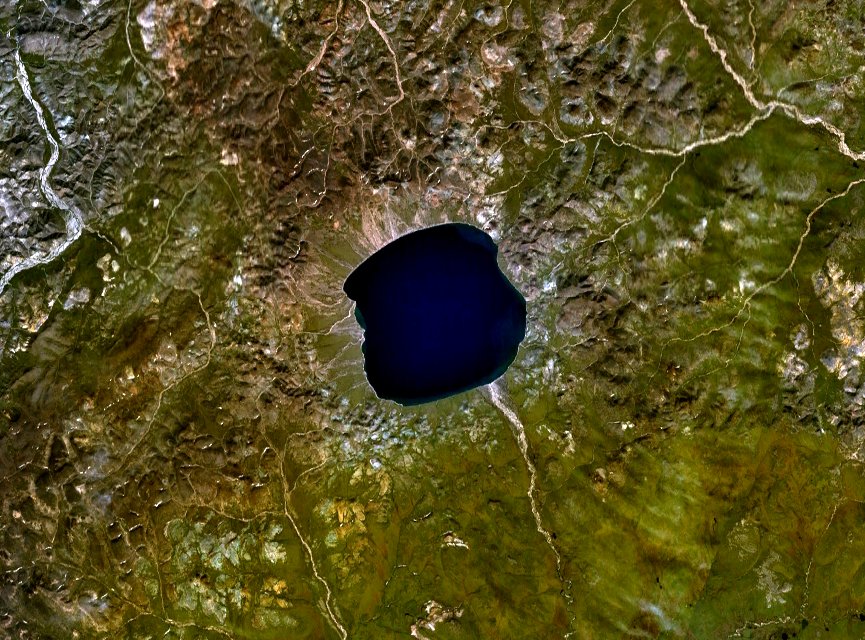
Their data come from analyzing sediment cores collected in the winter of 2009 from ice-covered Lake El'gygytgyn, the oldest deep lake in the northeast Russian Arctic, located 100 km north of the Arctic Circle. "Lake E" was formed 3.6 million years ago when a meteorite, perhaps a kilometer in diameter, hit the Earth and blasted out an 11-mile (18 km) wide crater. It has been collecting sediment layers ever since. Luckily for geoscientists, it lies in one of the few Arctic areas not eroded by continental ice sheets during ice ages, so a thick, continuous sediment record was left remarkably undisturbed. Cores from Lake E reach back in geologic time nearly 25 times farther than Greenland ice cores that span only the past 140,000 years. [there are no lakes like this in Alaska, that could provide that long of a record, eds.. ]
File:Elgygytgyn.jpg
"One of our major findings is that the Arctic was very warm in the middle Pliocene and Early Pleistocene [~ 3.6 to 2.2 million years ago] when others have suggested atmospheric CO2 was not much higher than levels we see today. This could tell us where we are going in the near future. In other words, the Earth system response to small changes in carbon dioxide is bigger than suggested by earlier climate models," the authors state.
Important to the story are the fossil pollen found in the core, including Douglas fir and hemlock. These allow the reconstruction of vegetation around the lake in the past, which in turn paints a picture of past temperatures and precipitation. [the fact that Douglas fir and hemlock trees were growing in this now-frigid treeless Arctic environment, must have meant that conditions were similar to those in the US states of Washington, Oregon, northern Idaho, and western Montana, where these trees are prevalent now. Here is a photo we took in 9/2010, below, near Mt. Adams, WA showing the 3740m volcano (tree line is around 2100 metres) with it's lush forests of Douglas fir, western red-cedar, hemlock, and grand fir on it's lower slopes, contrast that with the currently bare treeless slopes around Lake E. eds...]
Another significant finding is documentation of sustained warmth in the Middle Pliocene, with summer temperatures of about 59 to 61 degrees F [15 to 16 degrees C], about 14.4 degrees F [8 degrees C] warmer than today, and regional precipitation three times higher. "We show that this exceptional warmth well north of the Arctic Circle occurred throughout both warm and cold orbital cycles and coincides with a long interval of 1.2 million years when other researchers have shown the West Antarctic Ice Sheet did not exist," Brigham-Grette notes. Hence both poles share some common history, but the pace of change differed.
Her co-authors, Martin Melles of the University of Cologne and Pavel Minyuk of Russia's Northeast Interdisciplinary Scientific Research Institute, Magadan, led research teams on the project. Robert DeConto, also at UMass Amherst, led climate modeling efforts. These data were compared with ecosystem reconstructions performed by collaborators at universities of Berlin and Cologne.
The Lake E cores provide a terrestrial perspective on the stepped pacing of several portions of the climate system through the transition from a warm, forested Arctic to the first occurrence of land ice, Brigham-Grette says, and the eventual onset of major glacial/interglacial cycles. "It is very impressive that summer temperatures during warm intervals even as late as 2.2 million years ago were always warmer than in our pre-Industrial reconstructions."
Minyuk notes that they also observed a major drop in Arctic precipitation at around the same time large Northern Hemispheric ice sheets first expanded and ocean conditions changed in the North Pacific. This has major implications for understanding what drove the onset of the ice ages.
The sediment core also reveals that even during the first major "cold snap" to show up in the record 3.3 Million years ago, temperatures in the western Arctic were similar to recent averages of the past 12,000 years. "Most importantly, conditions were not 'glacial,' raising new questions as to the timing of the first appearance of ice sheets in the Northern Hemisphere," the authors add.
This week's paper is the second article published in Science by these authors using data from the Lake E project. Their first, in July 2012, covered the period from the present to 2.8 million years ago, while the current work addresses the record from 2.2 to 3.6 million years ago. Melles says, "This latest paper completes our goal of providing an overview of new knowledge of the evolution of Arctic change across the western borderlands back to 3.6 million years and places this record into a global context with comparisons to records in the Pacific, the Atlantic and Antarctica."
The new Lake E paleoclimate reconstructions and climate modeling are consistent with estimates made by other research groups that support the idea that Earth's climate sensitivity to CO2 may well be higher than suggested by the 2007 report of the Intergovernmental Panel on Climate Change.
It really is quite amazing to think that it was so much milder and humid during that time in Northern Siberia, at the latitude of 68N. For hemlock and Douglas fir trees to be able to grow there, would have meant that winter temperatures must have rarely, if ever, dropped below -40C, and probably stayed between +5C and -30C most of the time (41F to -22F). Contrast that with Yakutsk, Siberia, further south at the latitude of 62N. Until relatively recently, the average high/low temperature for January in that city was -40C/-48C (-39F/-57F)! 
 The fact that there are still no trees growing around Lake E also means that average summer daytime high temperatures are probably only 10-13C (50-56F), whilst the research is showing that temperatures there 2.2-3.6 mya were 8-10C warmer. Meaning that summer daytime temperatures there were probably routinely 20-25C (68-77F). We think that for these mild of conditions to have been able to occur there, the Arctic ocean probably stayed unfrozen through the winter, at least along the southern continental margins. Because currently, when there is a solid Arctic sea ice cover from roughly late October through April, this ice sheet acts as a continental land mass in the radiative sense. That is, radiative heat loss is very strong during clear weather during long polar nights, allowing temperatures to drop to -30C to -50C. Under open-water conditions in winter, the northern coastlines of Eurasia and North America would have been much warmer.  
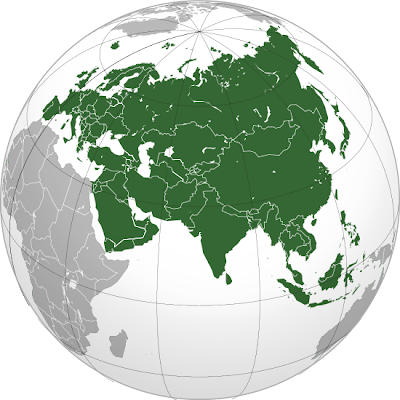
The Eurasian land mass is much bigger than North America, and contains more land in the latitudes of 40N-70N. Thus in winter, when the northern hemisphere is tilted away from the sun, the Eurasian land mass cools much more strongly than does North America. Wintertime temperatures in places like China, Japan, Korea, and southern Siberia, are much colder than areas in eastern North America at similar latitudes.
Thus, we would expect that Alaska would experience somewhat warmer temperatures in winter than Lake E, once the climate system "catches up" to our current 400 ppm CO2 (and it's likely to reach at least 500-550 ppm by 2080 under current emissions scenarios). Below are the current average maximum temperatures for Yakutsk, Siberia, which is at 62N. Summer highs there are warmer than Lake E, because it is further south, and much further removed from the Arctic coast.
The numbers in this link are the average maximum temperatures for Fairbanks, here in Alaska. Note how much milder they are than those for Yakutsk.
http://www.worldclimate.com/cgi-bin/data.pl?ref=N64W147+1300+502968C

Before going any further, let's look at some climate data for an inland area in North America that is relatively moist, still has a fairly cool winter, but is mild enough to allow the growth of hemlock and Douglas fir trees. A beautiful area where these climatic conditions occurred until recently, were favoured upslope areas in the Northern Rocky mountains, in the US states of Idaho and Montana, in their northern, and western portions, respectively.
http://en.wikipedia.org/wiki/Tsuga_heterophylla
http://en.wikipedia.org/wiki/Douglas_fir
As you can see, from this photo of Avalanche Creek, in Glacier National Park, Montana, it is quite moist and lush there during the summer, yet a real winter snowpack occurs, and temperatures can drop to -30C (-22F) occasionally during winter. Below are monthly mean temperatures and precipitation data for West Glacier, Montana. Period of Record : 10/1/1949 to 3/24/2013
http://www.wrcc.dri.edu/cgi-bin/cliMAIN.pl?mt8809

Note the relatively mild winter-time temperature averages, and the 30 inch annual precipitation (76cm). Thus, in our estimation, climatic conditions around Lake E., at 68N, must have been similar to this 2.2-3.6 mya, when the atmospheric CO2 concentration was around 400 ppm.  Siberia would still experience, even under the 400 ppm CO2 scenario, the coldest winter-time temperatures in the Northern Hemisphere. But the current coldest climate that still allows for the growth of Douglas fir/hemlock trees is in the favoured upslope areas of southern British Columbia, Canada, and northern Idaho/western Montana, USA.  That is a huge difference between the frigid Arctic climate Lake E still experiences (but that is changing). Annual precipitation values in Arctic areas like Lake E., are currently only around 5-10 inches (11-25cm). Douglas fir and hemlock trees generally only grow in climates that receive at least 18-20 inches of precipitation annually (hemlocks are an even moister species, and usually require 25-30 inches or more).
Now, since Alaska is surrounded by the Arctic Ocean, Bering Sea, and Pacific Ocean on three of it's sides, under the warmer climate scenario as found 2.2-3.6 mya, open water conditions over the Arctic Ocean and Bering Sea (except perhaps briefly in the depths of winter, a thin transitory ice cover might form), would likely lead to even milder conditions.
Under the warmer climate scenario, a good current analogue for Fairbanks, in the interior, which has very cold winters (but not as cold as Siberia!) might be The Dalles, Oregon. Fairbanks lies at only 100 metres elevation, hundreds of km inland, and so is fairly dry, receiving on average only 10-12 in. of precipitation (30.5 cm) annually. Here are climate data for The Dalles, Oregon. Period of Record : 1/ 1/1893 to 2/28/2013
http://www.wrcc.dri.edu/cgi-bin/cliMAIN.pl?or8407

The Dalles is 150 km inland from the Pacific Ocean, and lies in the "rain-shadow" of the Cascade Mountains, and hence is fairly dry. And heading further inland from there, annual precipitation drops even further to 7-9 inches, at the lowest elevations in central Washington, along the Columbia River. Here are the current climate data for Fairbanks, take a moment to mull that over. When the climate system "catches up" to our current 400 ppm CO2, and then even higher levels after that, eventually the Alaska Interior will likely see conditions more like those from The Dalles, Oregon, or even warmer!
http://www.wrcc.dri.edu/cgi-bin/cliMAIN.pl?ak2968

This also means that the current boreal forest cover throughout Interior Alaska of black/white spruce, aspen, birch, balsam-poplar, and willows, would be unable to grow under these much warmer/drier conditions. Dry valley areas like Fairbanks would transition to just having a grass/sagebrush biome, perhaps with scattered areas of aspen and ponderosa pine on cooler, north-facing slopes.
 
Now what about Anchorage, the biggest city here in Alaska, where over 50% of the people in the state live. What can we expect under the 400ppm CO2 warming scenario here? Let's look at the current data:
http://www.wrcc.dri.edu/cgi-bin/cliMAIN.pl?ak0285
These numbers are for the Anchorage airport, which is somewhat milder in winter, and cooler in summer, than the Chugach Front Research Centre, which lies at the foot of the Chugach mountains, 15 km further inland. Note how relatively dry it is in summer here, the Chugach mountains block precipitation that tries to move in from the south through east and northeast when there are low pressure systems in the Gulf of Alaska. Which occur there very frequently.
What we think could be a good representation of climate conditions for Anchorage under the 400ppm CO2 level scenario would be those currently experienced in Port Townsend, WA.
 
Summer-time temperatures there are fairly cool due to the proximity of the cool waters of the Strait of Juan de Fuca/Puget Sound, yet the annual precipitation is only 18.7 inches (47.5cm), due to the shadowing influence of the Olympic mountains, which blocks precipitation from the southwest through south. Note how infrequent snowfall is there, and that monthly mean snow depths in the coldest months are still zero. Forest cover around Anchorage would likely transition from the current boreal forest species of birch/aspen and white/black spruce, to the Douglas fir/ponderosa pine species found in drier coastal areas around Puget Sound, WA.
 What about around the Gulf of Alaska, where milder maritime conditions already allow thick "rain-forest" type vegetative growth to occur? Say, just 100 km south of Anchorage, in Seward, what might it be like there under the warmer scenario? Following are the current monthly averages for Seward.
 
We think a good analogue for Seward under the 400ppm CO2 warming scenario would be the conditions currently found along the Washington and Oregon coastlines, cool and moist, but lacking any but the most transitory winter snowfalls/snowcover, and rarely experiencing winter temperatures below -10C (14F). This climate allows for the rapid growth of the temperate rainforest cover of Douglas fir, hemlock, western red-cedar, sitka spruce, and grand fir. Some of these can reach 100 metres in height with 5-10m trunk diameters at their bases, in favoured areas. As we see in this photo, which your lead editor took last October, just north of Newport, Oregon, about 2km inland in a 300m deep canyon.
Here are the monthly averages for Newport, Oregon. Note the very mild winter temperatures, but still cool summers, due to the proximity of the cold waters of the Pacific Ocean.
http://www.wrcc.dri.edu/cgi-bin/cliMAIN.pl?or6032

In this case, the current thick vegetative cover found around the Gulf of Alaska coastline of Sitka Spruce and hemlock, would slowly transition to that currently found further south in Washington and Oregon. With Douglas fir, western red-cedar, and grand fir mixing in, and becoming larger, with longer growing seasons, but still-abundant moisture.
 
Now, in all these scenarios we have presented you, with climate data that could represent areas in Alaska under a future 400ppm CO2 warming, nowhere have we mentioned how long it will take for these warmer conditions to be reached. That's because this is a great unknown. Obviously, the longer this takes the better, to allow the ecosystems and humanity in general to adapt. As we mentioned previously, over the past 60 years, roughly, temperatures have warmed 3F (1.7C) on the average in Alaska.
 
Temperatures will continue to warm at least another 4-8C, or more, to "catch-up" with atmospheric CO2 levels of 450-550 ppm, which hopefully will be as high as they reach, before changes in our political/economic systems allows societies to transition to renewable, non-greenhouse gas emitting power sources for energy/transportation needs (if that is even possible before dire collapse scenarios occur).
 
How long will this be? We think it will be 50-80 years, at the minimum, before temperatures in Alaska, and throughout the Arctic, reach these levels. Which is a very short time geologically speaking, and would create large stresses on all the ecosystems (and already are) in the Arctic.
 
We also expect that the current trends we are seeing in our climatic conditions in Alaska will continue, and amplify in frequency and strength, as warming increases. Which will have unfortunate effects for most of us in Alaska.
 
 
Likewise, the snowy winters we have seen recently in south-central Alaska, will transition to increasingly warmer and wetter ones, as the jet stream continues to move further north with the increasing warming.
 
We do hope that climate-change modeling can help to refine timelines for the coming warming, not just here in the Arctic, but throughout the World. To help societies adjust to the coming changes, which are a matter of when, not if. For if climatic conditions in the Arctic under a 400 ppm CO2 concentration were similar to those currently in the northwestern lower 48 states, what do you think conditions would be like in California, or Arizona, let's say, when 500 ppm CO2 is reached, and then the climate system "catches up"?
 
                                             WHERE WE HAVE BEEN
 
 For a break from more serious information, we thought we'd provide you with a few pictures from our activities of the past month. During the latter part of April and into early May, your lead editor flew south to balmy San Diego, CA, where I grew up. And where my sister and brother still live. Always an interesting place to visit, with a large variety of experiences possible.
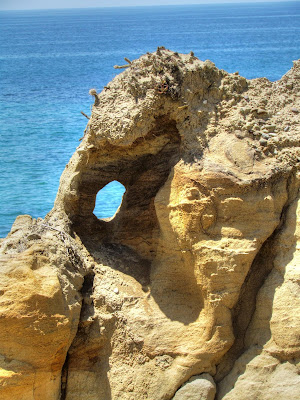


The immediate coastline, especially from La Jolla north to Del Mar, is our favourite area of San Diego, and where I always venture to first, and spend the most time.
Great opportunities for hiking, running, swimming, surfing, scuba diving, and kayaking can be found here, and in which we liberally partake. Kayaking around La Jolla shores beach and to La Jolla Cove, allows you to get up close to the playful sea lions which have greatly increased their numbers in that area, since I was a child in the late 1970s/early 1980s.
They sure are fun to be around, with their bellowing and playful antics, as long as you don't get too close and interfere in their activities.
Whilst on a short side trip north to the appalling dystopian urban agglomeration of the Los Angeles/Hollywood area, our great friend Erik Skye and I were able to do a nice hike in the Hollywood hills, and look back upon it absent it's usual thick air pollution.
I am always on the lookout for representative creatures of whatever ecosystem I happen to be in. And so I was very happy to see this young rattlesnake on the trail, near the top of the Hollywood hills.
These young ones can be even more dangerous than mature rattlesnakes, as they are unable to control the amount of venoum they release during a bite. Hence, I stayed at least a metre away from it.
 
My favourite hike of the San Diego trip was in Anza-Borrego Desert State Park, 110 km to the east, in Palm Canyon.
 
Both on this hike, and in a previous one in 2012, I have seen the shy, endangered desert bighorn sheep. Always a special experience to be close among these tough, but graceful and gentle creatures. To see them nibbling on the desert vegetation, and hear the clacking of their hooves, as they clamber up the steep, rocky canyon walls.
Other denizens of this beautiful remote desert canyon were out for our enjoyment, though not knowing if they were venomous, made us keep our distance.
This Chuckwalla though, we knew not to be venomous, it was trying to elude us before we could get a good photo.
During this time, my left leg was becoming increasingly stiff and sore, due to the titanium screws and plate that were installed last October. Keeping me from running, and causing my hiking to be slower and usually painful. This metal hardware was necessary though to re-build my tibia, which was broken in the running accident that I experienced last fall.

 
Surgery had already been scheduled for the 15th of this month to remove it, as it had served it's purpose, allowing me to walk again, and in it's absence, hopefully to run again. So I had to spend a frantic time after returning from my San Diego trip to prepare for this and a return to temporary disability.

 
The operation to remove the hardware went well, so far with no complications, though the leg is still exceedingly swollen and stiff. Of course, it has only been 8 days after a 15cm incision, and 5 holes (3 for arthroscopic investigation around the knee, which found good conditions, thankfully) were done. Your lead editor hopes to be able to run with the rest of the APR staff again by August. Cheers.