IN A TIME OF UNIVERSAL DECEIT...TELLING THE TRUTH BECOMES A REVOLUTIONARY ACT

"Capitalism is the astounding belief that the most wicked of men will do the most wicked of things for the greatest good of everyone." John Maynard Keynes

" Labor is prior to, and independent of, capital; that, in fact, capital is the fruit of labor, and could never have existed if labor had not first existed. Labor is the superior of capital and deserves much the higher consideration" Abraham Lincoln

Thursday, January 31, 2013

TWICE BITTEN [and] MID-WINTER UPDATE

TWICE BITTEN
 
Now that some time has passed since the presidential inauguration, we thought we'd bring you what we found to be our favourite commentary on it.

Big Money but No Big Lines

On Obama’s Second Inauguration

by DAVE LINDORFF
There were no memorable lines in President Obama’s second inaugural address. Certainly nothing like Franklin Roosevelt’s “The only thing we have to fear is fear itself,” which was in his first inaugural, or like John F. Kennedy’s “Ask not what your country can do for you — ask what you can do for your country.”

But there was plenty he said that was troubling.

The problem mostly wasn’t what he said. It was how he said it, and what he left unsaid.

Take climate change.

The president acknowledged the problem, saying: “We will respond to the threat of climate change, knowing that the failure to do so would betray our children and future generations.”

So far so good, but then he didn’t talk about any serious steps to do that, such as shutting down coal-fired generating plants and putting a stop to plans to import dirty, massively polluting and inefficient oil from Canadian and US tar-sands deposits. Instead he focussed on economic opportunities to be had if the US would start investing seriously in new energy technology. He did not take this unique opportunity to tell Americans honestly what the risks of inaction are: The extinction of half the species on the earth, including primary food sources that keep billions of us alive, and the risk of runaway warming that could raise the oceans by 16 to 60 feet. Instead he focussed parochially on storms and droughts and forest fires getting worse. This was a wasted leadership moment if there ever was one.

When JFK made his one inaugural address, the Cold War was at its height. He didn’t fudge the moment, and instead let Americans and the world know the gravity of the threat of mutual global nuclear annihilation by describing the situation thusly as “both sides overburdened by the cost of modern weapons, both rightly alarmed by the steady spread of the deadly atom, yet both racing to alter that uncertain balance of terror that stays the hand of mankind’s final war.”

President Obama had the chance to lay the current even worse crisis out with equal clarity. He blew it, instead portraying the climate change crisis as simply an opportunity for the US to gain or lose the leadership in a new technological marketplace.  [It's going to take unprecedented large-scale disasters, such as floods, wildfires/drought, and storms before the corporatocracy will realise the graveness of the situation. Will it be too late?... We'll know within 20 years. eds]

On education, he also narrowly focussed on schools as job training centers, instead of as transmitters of culture, saying: “…a modern economy requires railroads and highways to speed travel and commerce; schools and colleges to train our workers.”

What about training our artists, dancers, poets, historians, writers, musicians and philosophers? Today, in school district after school district, art and music teachers, librarians and others are being laid off by financially struggling school districts. Where is the president’s leadership in trying to preserve real education in America?

The president was also disingenuous, and no more so than when he spoke of war. At a time when the US killing machine is still going full speed in Afghanistan, and when he himself is cranking up the use of armed attack drones in countries around the globe, the president, departing from his prepared text, said that the US was “ending ten years of war.” There was particularly loud applause at that line, but it is simply not true. Not only is the US negotiating to keep over 10,000 US troops indefinitely in Afghanistan, but it is expanding its drone and Special Forces attacks in Yemen, Somalia and Pakistan and elsewhere around the globe, while continuing to threaten Iran with an attack.

He also said, in his prepared remarks, “We, the people, still believe that enduring security and lasting peace do not require perpetual war.” Yet he made no announcement of a plan to end Congress’s 2001 Authorization for the Use of Military Force, which over the past 12 years has turned the US into a police state, leading the federal courts to approve all manner of violations of the Bill of Rights and to grant the executive branch exceptional powers on the argument that the US is legally in a state of war and that the 50 states themselves are part of the battlefield.

The president seems content with this situation, which is by definition a “state of perpetual war.”
“We will defend our people and uphold our values through strength of arms and rule of law,” he said. And yet the rest of the world knows that America is violating the highest law, the UN Charter, with its drone attacks and its targeted killing programs, and by failing to prosecute those who authorized the illegal invasion of Iraq, the deliberate torture of captives in the Iraq and Afghan Wars. The president went on to say, “We will show the courage to try and resolve our differences with other nations peacefully – not because we are naïve about the dangers we face, but because engagement can more durably lift suspicion and fear,” and yet there are no negotiations to end the half century long embargo of Cuba, or to resolve disagreements with Iran. Nor is the president demanding that America’s client state, Israel, dependent as that country is on billions of dollars of US military aid every year, cease its military occupation and subjugation of Palestinians and negotiate an end to the conflict between Israel and Palestine.

Surely the most jarring disconnect, though, was the inaugural celebration itself. There is no reason why a Constitutionally-mandated ceremony has to be financed by private money, yet the president’s Inauguration Committee solicited and had, by this last weekend, accepted over $124.3 million in contributions from corporations and labor unions, according to the Center for Public Integrity. That dwarf’s the $50 million that was raised in private donations for the president’s first inauguration. It also came in much bigger amounts, as the president this year dropped a $50,000 maximum donation limit he had set for his first term Inaugural. This time the limit was set at $1 million.

The list of corporations and labor unions seeking to buy influence through this unique funding opportunity provided by the president includes Bank of America, Coca-Cola, FedEx, AT&T, the health care management firms DC Health Care Inc. and Cetene Management Corp., East Lake Management & Development Corp., Financial Innovations, Inc., the electric generating company Southern Company Services and Exxon/Mobil. Exxon alone gave $260,000 to the committee.
 
Unions that donated included the International Association of Fire Fighters, the International Brotherhood of Electrical Workers, American Federation of Government Employees, American Postal Workers Union, International Union of Painters and Allied Trades, Laborers International Union of North America, Sheet Metal Workers International, United Food & Commercial Workers.
 
All these companies and unions are donating not out of some sense of civic duty but to in order to buy favors from the White House during the president’s second term.

These contributors–and especially the corporate ones, since at least the unions are representing large numbers of ordinary working people — make a joke out of the lines the President spoke when he said, “For we, the people, understand that our country cannot succeed when a shrinking few do very well and a growing many barely make it,” and later, “You and I, as citizens, have the power to set this country’s course. You and I, as citizens, have the obligation to shape the debates of our time – not only with the votes we cast, but with the voices we lift in defense of our most ancient values and enduring ideals.”...

Dave Lindors a founder of This Can’t Be Happening and a contributor to Hopeless: Barack Obama and the Politics of Illusion, published by AK Press. Hopeless is also available in a Kindle edition. He lives in Philadelphia.
 
We're not too hopeful for any substantive changes toward relieving unemployment, reigning in corporate excesses, and protection of the environment (which of course fighting global warming is a primary component of) from the new administration. More people just need to become aware of our current situation by abandoning the corporate media, and finding alternative news/information sources, before significant changes can occur in this country, especially. Some of our favourites we provide links to here, that we've found to really be truthful and important.  
 
                                       MID-WINTER UPDATE
 
Now that we are in the peak of our winter here in South-Central Alaska, let's take a look at how it has transpired so far.

A very good climate data source for Alaska, comes from the University of Alaska, Fairbanks' Climate Research Center.

"The Alaska Climate Research Center is a research and service organization at the Geophysical Institute, University of Alaska Fairbanks. Our group conducts research focusing on Alaska and polar regions climatology and we archive climatological data for Alaska."
 
This is the plot of the daily high and low temperatures from the official Anchorage climate station at Ted Stevens International Airport; surrounded by the waters of the Knik and Turnagain arms of Cook Inlet on two sides. And is thus often 5-10C warmer in winter than the Chugach Front, especially on clear nights. Along with some plots (below) of precipitation, snowfall, and snowdepth. As you can see, overall South-Central Alaska had slightly to well-below average temperatures from mid-October, until early December. Along with unusually dry weather and scant snowfall, due to a cool, dry north to northeast flow that was often in place over the region, as a cold upper-level low pressure system was frequently in place over the mainland of Alaska and NW Canada.
 
But by early December, a pattern change occurred where the jet stream became more "progressive" over Alaska, so that upper-level high and low pressure systems began moving through more frequently. This has continued through the current time now, late January, and has brought several warm-ups above 0C to the region, one of which brought significant freezing rain and then rain, in mid-January. This episode in mid-January, caused by a "high-amplitude" southerly flow from the subtropics, brought very warm air northward, at one point rain was falling even as high as 1000-1500 metres in elevation in the Chugach. The snowpack was seriously diminished at this point, with many exposed slopes melting nearly completely. Well-below freezing temperatures after this then caused solid ice to form in what was left of the seriously degraded/ripened snowpacks. Coating much of the landscape in several cm of solid ice, which we had never seen to occur anywhere we have ever lived before (Interior AK, SE AK-the rain forest/maritime panhandle, Western Montana, Eastern, and Western Oregon).
 
Fortunately these appalling and dangerous conditions were mitigated shortly thereafter by somewhat cooler weather systems traversing the region from the south and southwest. The snowpack began re-building, and conditions became safer and more enjoyable for outdoor recreation. There was even a short cold-snap during the past week that brought the region it's coldest temperatures of the winter, for two days. This winter so far has been much more docile and uneventful for us here in South-Central Alaska than the last one.
http://akprogressive.blogspot.com/2012/04/winter-of-our-content-south-central.html

Without any of the strong low-elevation wind-storms, such as we had in December 2011, and last September.
http://akprogressive.blogspot.com/2012/09/williwaw-woes.html
For which we are thankful, and hope will continue.


It's one thing to look at graphs and numbers though, pictures of the actual conditions here in South-Central Alaska really help to fully illustrate the story.
Even before the big snowfall in early December, the colder than average conditions and a little bit of snow in the first two weeks of November kept the landscape looking fresh and wintery. Ice built up thickly, as here on the South Fork of Campbell Creek in early Dec.
 
The big warm-up with rain in mid-January was the most noteworthy and disturbing event of our winter. These numbers are from January at the Anchorage airport. DEP is departure from the long-term (30-year) average. Note 21-22 positive DEPs on the 13th and 14th, our abrupt warm-up and rain event.
 
DY MAX MIN AVG DEP HDD CDD  WTR  SNW DPTH
11       27      21     24       7      41       0      T       T         9
12       39      24     32     15      33       0      T       T         9
13       42      33     38     21      27       0   0.40    0.0        9
14       44      33     39     22      26       0   0.02    0.0        8
15       34      21     28     11      37       0   0.00    0.0        8
16       22      19     21       4      44       0   0.17    3.0        9
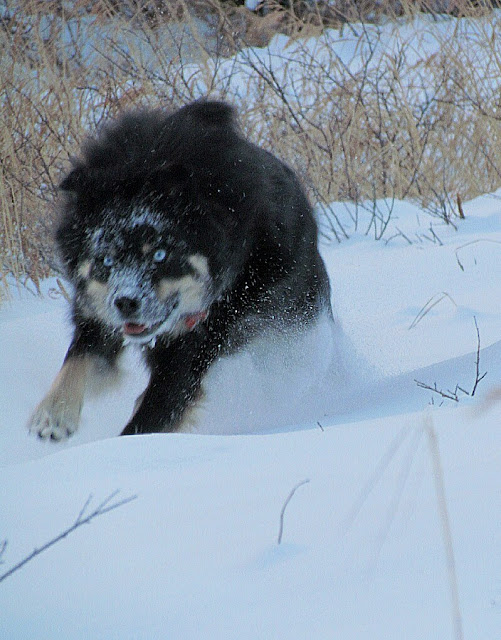
Here on the 14th of January, when the temperature was around 3C in the late afternoon, our snowpack was fully ripe, melted and slushy, and it was raining lightly. Our research assistant Kluane had to splash around in the North Fork of Campbell Creek to stay cool, in his thick winter coat, on one of our regular shorter hikes.
And you can see just how skimpy the snowpack became, even looking up toward the 1400-1600 metre elevations of the Chugach Front. This was on the Konoya Point trail, at around 500 metres, looking back in up the canyon of the North Fork of Campbell Creek.
Whilst the lower elevations became encased in a treacherous coating of solid ice, from the ripened snowpack and rain, which then re-froze.
When we get our warm weather systems moving up from the south, and southeast, usually it still stays below 0C above 800-1000 metres. And above these elevations, strong e-se winds whip and howl through the Chugach, blowing the snow around above treeline. We like to see this occasionally, it's quite dramatic, and although temperatures aren't much below freezing, when winds are 100 kph and greater at times, we have to really be careful.
A few days after the demoralising warm up/rain event, and even after a quick 4 cm shot of new snow, I took the APR staff classic cross-country skiing uphill for the first time this winter. Starting at around 400 metres off of the Powerline trail, temperatures had remained below 0C since the last little snowfall, and conditions were great. As we ascended though and reached elevations above the cooler air flowing over the "Bowl" from the north, it became very icy. As the snow above 600 metres had melted and re-froze, so it was hard and very icy/crusty. Very fast going uphill and on flat stretches. Mattie and Kluane were greatly enjoying their first good outing in some time. But I had to take off my skis on the descent and walk the steepest sections downhill. Snowplowing continually on the icy crust to remain in control, became quite painful over the incision area on my leg and down the front, where the metal plate was installed. We are hoping that will improve with time. 
 
By the time of our assistant-editor Mattie's sixth birthday, on the 25th of this month, continued below-0C temperatures and occasional light snowfalls made for safe and enjoyable nordic skiing conditions. She's very happy I'm able to ski again, as now she can run more, yet still be right at my side. Whilst our research assistant Kluane circles ahead of us. Mattie has become our trusted and true wilderness guide and security chief. She learned from Homer, before he passed on, and now is fully at ease and aware of all our hazards.
 
She's even had four near-death experiences, somewhat similar to her lead editor, which is greatly endearing. Happy Birthday Mattie! And thank you for keeping us safe, and trying to teach our research Assistant Kluane (we do see signs he is maturing and have hopes he will grow into Mattie's level of wisdom and understanding).
 
Just before we had our two coldest days of this winter so far, on the 27th/28th, we had another nordic ski outing on the flatter trails right behind the CFRC, which Kluane was greatly enjoying. The new snow was deep enough now to provide an even more stable footing for skiing and walking (and biking) on top of the solid ice underneath.  On this day, temperatures were around -10C, which was perfect.
Our coldest two days of the season were brought just a few days ago when an upper-level low pressure system developed over Interior Alaska, and very cold air flooded south across the Alaska Range, and over the Chugach, and through the lowlands. Making the snow dance on the higher ridges. We love these kind of days here, which seem to be coming less frequently now.
Temperatures at and around the CFRC here at the Chugach Front dropped to as low as -33C (-28F) at night, recovering only to about -21C by day (-6F). This made for some beautiful hoarfrost displays on the rapidly growing new ice on the N. Fork of Campbell Creek.
Which research assistant Kluane was surveying here, taking breaks occasionally.
 
So, as of the end of January, we've only endured one large warm-up with rain in South-Central Alaska, and no strong lower-elevation windstorms. And snowfall has been much less than average, but at least has been restored to good condition for winter recreation. We hope these relatively benign conditions will continue for the rest of the winter. Cheers.

Wednesday, January 9, 2013

THE COLOUR PURPLE [and] SAFE HARBOUR?

Australia has been the first continent to be truly ravaged by global warming, suffering through great droughts and floods over the past 20 years, and increasingly catastrophic heat waves and wildfire outbreaks.
 
As we have pointed out before, the southeastern quarter of that continent has the unique distinction, because of it's flammable eucalypt-based vegetation, and subtropical location allowing occasional strong summer-time heat waves to occur, of being subject to the worst wildfire conditions on the planet.
 
Over the past few weeks, their latest summer-time heat wave, which are now stronger and more frequent, has made global headlines. Their meteorological service has had to adapt to the changing realities of global warming, by first, in 2009 adding a "Catastrophic" fire danger rating in their fire weather forecasting, and now, this:

https://www.commondreams.org/headline/2013/01/08

Burning 'Deep Purple': Australia So Hot New Color Added to Index

An 'unparalleled setting of new heat extremes' continues

- Jon Queally, staff writer

Deep purple... the Bureau of Meteorology's interactive weather forecasting chart has added new colors. (Photo: Bureau of Meteorology)

Wild fires continue to rage across Australia Tuesday and temperatures have become so hot the country's Bureau of Meteorology was forced to add a new color—deep purple—to show areas that have exceeded all-time heat records.

Previously the Bureau's heat index was capped at 48°C (118.4°F), but now recorded temperatures of over 50°C (122°F) have pushed the limit of the scale to an unheard of 54°C, which is equivalent to 129°F.

‘‘We are well past the time of niceties, of avoiding the dire nature of what is unfolding, and politely trying not to scare the public."–Liz Hanna, climate scientists

"The scale has just been increased today and I would anticipate it is because the forecast coming from the bureau's model is showing temperatures in excess of 50 degrees," David Jones, head of the bureau's climate monitoring and prediction unit, told reporters.
 
Indicating that the worst may yet to come, Jones added that, "The air mass over the inland is still heating up - it hasn't peaked."

Climate scientists in Australia—with Jones among them—say the fires and the heat are unprecedented in scale and intensity, but that Australians should understand the destructive temperatures and ensuing fires across Tasmania and southern sections of the country are the new normal of runaway climate change.

‘The current heatwave – in terms of its duration, its intensity and its extent – is now unprecedented in our records,’’ Jones was quoted as saying in The Age.
 
‘‘Clearly, the climate system is responding to the background warming trend. Everything that happens in the climate system now is taking place on a planet which is a degree hotter than it used to be.’’

“Those of us who spend our days trawling – and contributing to – the scientific literature on climate change are becoming increasingly gloomy about the future of human civilization,’’ Liz Hanna, convener of the human health division at the Australian National University’s Climate Change Adaptation Network, told The Age in a separate interview.
 
‘‘We are well past the time of niceties, of avoiding the dire nature of what is unfolding, and politely trying not to scare the public," she said. "The unparalleled setting of new heat extremes is forcing the continual upwards trending of warming predictions for the future, and the timescale is contracting.’’
Responding to the news from Australia, The Guardian's Damian Carrington put the heat and fires in a global context:
We already know that climate change is loading the weather dice. Scientists have shown that the European heatwave of 2003, that caused over 40,000 premature deaths, was made at least twice as likely by climate change. The Russian heatwave of 2010, that killed 50,000 and wiped out $15bn of crops, was made three times as likely by global warming and led to the warmest European summer for 500 years.
 
The extreme weather forecast is even worse. Mega-heatwaves like these will become five to 10 times more likely over the next 40 years, occurring at least once a decade, scientists predict.
 
Work by the most authoritative group of scientists, the UN's Intergovernmental Panel on Climate Change, found that it is 90% certain that heatwaves will increase further in length and severity, as will extreme high tides. It is 66% likely that hurricanes and typhoon winds will get faster and that intense rain will increase, as well as landslides. It is more likely than not that droughts will intensify in Europe, North and Central America and, most dangerously given the poverty there, Southern Africa. There are uncertainties of course, but the basic physics is that heat-trapping carbon emissions mean more energy is being pumped into the system, increasing climate chaos.
 
The two nations in which the fringe opinions of so-called climate sceptics have been trumpeted most loudly - the US and Australia - have now been hit by record heatwaves and, in the US, superstorm Sandy. The scientists are turning up the volume of their warnings, but whether this leads to loud and clear political action to curb emissions or more shouting from sceptics and the vested fossil fuel interests that support them remains to be seen.
According to the special bulletin (pdf) on the record heatwave from Australia's Bureau of Meteorology:
A particular feature of this heatwave event has been the exceptional spatial extent of high temperatures. The table below gives the national and state/territory average maximum temperature for each day of the heatwave event. Australia set a new record for the highest national area-average temperature, recording 40.33 °C and surpassing the previous record set on 21 December 1972 (40.17 °C). To date (data up to the 7 January 2013) the national area-average for each of the first 7 days of 2013 has been in the top 20 hottest days on record, with 6 January the fifth hottest on record and the first time 6 consecutive days over 39 °C has ever been recorded for Australia.


Your lead editor greatly enjoyed the time I spent in Australia in Dec. 2008/Jan. 2009 living and working in Sydney, and came to really enjoy and admire the people and culture of that interesting and wonderful country. Their meteorological and climatological services are on the forefront of global warming science/research, with good reason, as they are among the most vulnerable of countries on the planet now, as warming intensifies. The agricultural areas in South Australia, Victoria, and New South Wales, are very vulnerable to drought, and already they are facing difficulties allocating the water necessary for irrigation of crops, in addition to the annually increasing danger from catastrophic heat waves and wildfires. This will only be getting worse in the coming decades there.
Meanwhile, in the US lower 48, you probably are already aware that 2012 has now been officially declared to have been the hottest since accurate temperature records have begun. And in looking at other trends, for example, the ratio between the setting of record low temperatures, versus record highs, the trend becomes quite clear. The intense drought of 2012 in the Central U.S. also has been the worst since the 1930s, and as it is forecast to continue for at least a few more months, if not longer, may end up surpassing those of the "dust-bowl" years.

http://www.climatecentral.org/news/noaa-2012-was-warmest-and-second-most-extreme-year-on-record-15436

NOAA: 2012 Hottest & 2nd-Most Extreme Year On Record


It’s official: 2012 was the warmest year on record in the lower 48 states, as the country experienced blistering spring and summer heat, tinderbox fire weather conditions amid a widespread drought, and one of the worst storms to ever strike the Mid-Atlantic and Northeast.

According to the National Oceanic and Atmospheric Administration (NOAA), 2012 had an average temperature of 55.3°F, which eclipsed 1998, the previous record holder, by 1°F. That was just off Climate Central’s calculation in mid-December, which projected an expected value of 55.34°F, based on historical data.

The 1°F difference from 1998 is an unusually large margin, considering that annual temperature records are typically broken by just tenths of a degree Fahrenheit. In fact, the entire range between the coldest year on record, which occurred in 1917, and the previous record warm year of 1998 was just 4.2°F.

The year consisted of the fourth-warmest winter, the warmest spring, second-warmest summer, and a warmer-than-average fall. With an average temperature that was 3.6°F above average, July became the hottest month ever recorded in the contiguous U.S. The average springtime temperature in the lower 48 was so far above the 1901-2000 average — 5.2°F, to be exact — that the country set a record for the largest temperature departure for any season on record.

"Climate change has had a role in this [record],” said Jake Crouch, a climate scientist at NOAA's National Climatic Data Center in Asheville, N.C. He said it isn't clear yet exactly how much of the temperature record was due to climate change compared to natural variability, but that it's unlikely such a record would have occurred without the long-term warming trend caused in large part by emissions of greenhouse gases.
 
During the summer, nearly 100 million people experienced 10 or more days with temperatures greater than 100°F, which is about one-third of the nation’s population, NOAA reported.
 
With 34,008 daily high temperature records set or tied the year compared to just 6,664 daily record lows — a ratio of about five high temperature records for every one low temperature record — 2012 was no ordinary weather year in the U.S. It wasn’t just the high temperatures that set records, though. Overnight low temperatures were also extremely warm, and in a few cases the overnight low was so warm that it set a high temperature record, a rare feat.

Even more astonishing is the imbalance between all-time records. According to data from NOAA's National Climatic Data Center, there were 356 all-time high temperature records set or tied across the entire U.S. in 2012, compared to four all-time low temperature records. All of the all-time record lows occurred in Hawaii.
 
As the climate has warmed during the past several decades, there has been a growing imbalance between record daily high temperatures in the contiguous U.S. and record daily lows. A study published in 2009 found that rather than a 1-to-1 ratio, as would be expected if the climate were not warming, the ratio has been closer to 2-to-1 in favor of warm temperature records during the past decade (2000-2009). This finding cannot be explained by natural climate variability alone, the study found, and is instead consistent with global warming.

Driven largely by the warm temperatures and the massive drought, one measure of extreme weather conditions, known as the Climate Extremes Index, shows that it was the second-most extreme year on record, second only to 1998. Studies show that in response to global warming, some extreme events, such as heat waves, are already becoming more likely to occur and more intense.
 
Nineteen states had their warmest year on record in 2012, mainly in the Plains and Midwest, where summer heat and drought was the most intense. An additional 26 states had one of their top 10 warmest years on record. Remarkably, every state in the lower 48 experienced an above-average annual temperature.
 
The extreme heat is even more vivid when examined at the local level. Cities such as New York, Boston, Washington, Milwaukee, St. Louis, Denver, Des Moines, and Chicago all set records for their warmest year.
 
Marquette, Mich., which is well-known for its cold and snowy winters, not only set a record for the warmest year, but also set a record for the most amount of days above freezing (32°F) in a single year, with 293 such days, and the number of consecutive days above freezing, with 237.
 
In Des Moines, which set a record for its warmest year smashing the old 1931 record by 1.5°F, it was the first year not to reach 0°F. In addition, March had the largest monthly temperature departure from average of any month on record there, coming in at 16.4°F above average.

The year was also characterized by extreme drought, and two states — Nebraska and Wyoming — also had their driest year on record. Eight more states had annual precipitation totals that ranked in the bottom 10.

At its maximum extent in July, drought conditions encompassed 61 percent of the nation, with the most intense conditions in the Great Plains, West, and Midwest. The nationally averaged annual precipitation total was 2.57 inches below average, making 2012 the 15th-driest year, and the driest year since 1988, which also featured a major drought.
 
The drought of 2011-12, which is still ongoing, is comparable in size to severe droughts that occurred in the 1950s, and is already being blamed for more than $35 billion in crop losses alone, according to the reinsurance company Aon Benfield. In fact, it’s quite possible that damage from the drought will eclipse the total bill from Hurricane Sandy, which some estimates place at more than $100 billion. Overall, the drought could end up robbing the limping U.S. economy’s GDP of a full percentage point, said Deutsche Bank Securities.
 
The drought was instigated in large part of very low snow cover and warm temperatures during the winter of 2011, and record warmth during the spring, which allowed for an early start to the growing season and depleted soil moisture earlier than normal. The record March heat wave put the drought into overdrive, accelerating its development across the Plains and Midwest in particular.

The drought conditions created ideal conditions for wildfires, as 9.2 million acres went up in smoke in the West, the third-highest on record.

The same weather patterns that led to the drought helped suppress severe thunderstorms and tornadoes, with a final tornado count that is likely to be under 1,000, which would be the fewest twisters since 2002.
 
According to NOAA, the year saw 11 natural disasters that cost at least $1 billion in losses, including Hurricane Sandy, which struck the Mid-Atlantic and Northeast on October 29-30. Globally, 2012 is expected to be ranked as the eighth-warmest year on record, with that announcement coming later in the month.

Related Content:
Sandy Tops List of 2012 Extreme Weather and Climate Events
Four Major Heat Records Fall in Stunning NOAA Report
Book It: The Hottest Year on Record
2012 Heat Wave is Historic, If Not Unprecedented
Coverage of 2012 Summer Heat Waves
U.S. Drought is Most Severe Since 1950s, Report Says
Ongoing Coverage of Historic Drought in U.S.

Meanwhile, here in Alaska, global warming deniers, usually sponsored by the fossil-fuel industry, have been using what has been happening in our climate to try and deny/downplay the global problem of the overall warming of the planet, irrespective of regional anomalies.
 
As the article below describes, Alaska from the Brooks Range south (but not the Arctic Coastal Plain) has actually had a cooling trend in the first decade of this century, due to the change in phase of the Pacific Decadal Oscillation (PDO).

http://www.benthamscience.com/open/toascj/articles/V006/111TOASCJ.pdf

What is the PDO?
http://jisao.washington.edu/pdo/

"The "Pacific Decadal Oscillation" (PDO) is a long-lived El Niño-like pattern of Pacific climate variability. While the two climate oscillations have similar spatial climate fingerprints, they have very different behavior in time. Fisheries scientist Steven Hare coined the term "Pacific Decadal Oscillation" (PDO) in 1996 while researching connections between Alaska salmon production cycles and Pacific climate (his dissertation topic with advisor Robert Francis). Two main characteristics distinguish PDO from El Niño/Southern Oscillation (ENSO): first, 20th century PDO "events" persisted for 20-to-30 years, while typical ENSO events persisted for 6 to 18 months; second, the climatic fingerprints of the PDO are most visible in the North Pacific/North American sector, while secondary signatures exist in the tropics - the opposite is true for ENSO. Several independent studies find evidence for just two full PDO cycles in the past century: "cool" PDO regimes prevailed from 1890-1924 and again from 1947-1976, while "warm" PDO regimes dominated from 1925-1946 and from 1977 through (at least) the mid-1990's. Shoshiro Minobe has shown that 20th century PDO fluctuations were most energetic in two general periodicities, one from 15-to-25 years, and the other from 50-to-70 years.

http://ingrid.ldeo.columbia.edu/%28/home/alexeyk/mydata/TSsvd.in%29readfile/.SST/.PDO/

Major changes in northeast Pacific marine ecosystems have been correlated with phase changes in the PDO; warm eras have seen enhanced coastal ocean biological productivity in Alaska and inhibited productivity off the west coast of the contiguous United States, while cold PDO eras have seen the opposite north-south pattern of marine ecosystem productivity. Causes for the PDO are not currently known. Likewise, the potential predictability for this climate oscillation are not known. Some climate simulation models produce PDO-like oscillations, although often for different reasons. The mechanisms giving rise to PDO will determine whether skillful decades-long PDO climate predictions are possible. For example, if PDO arises from air-sea interactions that require 10 year ocean adjustment times, then aspects of the phenomenon will (in theory) be predictable at lead times of up to 10 years. Even in the absence of a theoretical understanding, PDO climate information improves season-to-season and year-to-year climate forecasts for North America because of its strong tendency for multi-season and multi-year persistence. From a societal impacts perspective, recognition of PDO is important because it shows that "normal" climate conditions can vary over time periods comparable to the length of a human's lifetime."

What has been happening in Alaska, with our overall warming trend over the past century, is that it has occurred in steps, rather than as a slow, steady increase. Due to changes in overall atmospheric circulation patterns caused by changes in phase of the PDO, and other effects. And as the following research shows, distinct changes in late spring snow-cover seen across the entire Northern Hemisphere are still quite prominent in Alaska as well.

http://earthobservatory.nasa.gov/IOTD/view.php?id=80102&src=ve

Snow Cover Extent Declines in the Arctic   January 8, 2013

In the high latitudes of the Northern Hemisphere, snow typically covers the land surface for nine months each year. The snow serves as a reservoir of water, and a reflector of the Sun’s energy, but recent decades have witnessed significant changes in snow cover extent. Studies of snow cover published in Geophysical Research Letters and the Arctic Report Card: Update for 2012 found that, between 1979 and 2012, June snow cover extent decreased by 17.6 percent per decade compared to the 1979–2000 average.

The maps on this page show June snow cover extent anomalies for every third year from 1967 through 2012. Each June’s snow cover is compared to the 1971–2000 mean. Above-average extent appears in shades of blue, and below-average extent appears in shades of orange. Toward the beginning of the series, above-average extents predominate. Toward the end of the series, below-average extents predominate.

The graph shows June snow cover in millions of square kilometers from 1967 through 2012, and the overall decline in snow cover is consistent with the changes shown in the maps. The graph and maps are based on data from the Rutgers University Global Snow Lab.

The snow-cover study authors, Chris Derksen and Ross Brown, found an overall decline in snow cover from 1967 through 2012, and also detected an acceleration of snow loss after the year 2003. Between June 2008 and June 2012, North America experienced three record-low snow cover extents. In Eurasia, each successive June from 2008 to 2012 set a new record for the lowest snow cover extent yet recorded for that month.

Previous research identified a link between rising air temperatures and shrinking snow cover, so Derksen and Brown were not surprised to see an overall loss of snow, “But we were surprised at the continued broken records of June Arctic snow cover extent over the past five years,” says Brown. “Arctic spring snow cover typically fluctuates over cycles of about three to four years so you don’t expect to see sequences of decreasing snow cover persisting through these natural cycles.”

As with sea ice, declining snow cover extent means decreasing albedo. The overall “whiteness” of an object determines how much sunlight it reflects back into space. Snow has very high albedo, reflecting up to 90 percent of the sunlight it receives. As snow cover declines, dark soils and vegetation absorb more of the Sun’s energy. The Geophysical Research Letters study pointed out that declining snow cover raises ground temperatures and increases the thickness of the active layer—the uppermost layer of permafrost that thaws each summer. When organic material in thawing permafrost decomposes, it can release methane, a potent greenhouse gas when released to the atmosphere.

Anticipating future changes in Arctic snow cover poses challenges for researchers. “Changes in fall snow cover are complicated because the longer open-water season provides additional moisture for increasing snowfall,” Brown says. “As for future snow cover, climate is strongly influenced by interannual variability over periods of five to ten years, so that time range is hard to predict. But global climate models show the rate of Arctic snow cover decline speeding up over the long term.”
  1. References

  2. National Snow and Ice Data Center. (2012, September 19) Arctic sea ice reaches lowest extent for the year and the satellite record. Accessed October 2, 2012.
  3. Derksen, C., Brown, R. (2012) Spring snow cover extent reductions in the 2008–2012 period exceeding climate model projections. Geophysical Research Letters. 39, L19504.
  4. Derksen, C., Brown, R. (2012, November 7) Snow. Arctic Report Card: Update for 2012. National Oceanic and Atmospheric Administration. Accessed January 4, 2013.
  5. Brown, R., Derksen, C., Wang, L. (2010) A multi-data set analysis of variability and change in Arctic spring snow cover extent, 1967–2008. Journal of Geophysical Research, 115, D16111.
Image by Robert Simmon, using data from the Rutgers University Global Snow Lab.
 
So, no, just because Alaska has had a small cooling trend during the first decade of this century, does not mean it is a safe harbour from the ravages of global warming/climate change, occurring over the entire planet. It is still warmer overall than say, 40-50 years ago. And when the PDO changes phase again, an abrupt jump in average temperatures will occur, to a new, higher state, south of the Brooks Range. In addition, increasingly higher amounts of heat energy and moisture available in a warmed atmosphere to the south of Alaska, combined with our cooler conditions, provides more fuel for stronger storms to occur here.
Which in winter, often now bring abrupt changes not seen previously as often in South-Central and interior Alaska, warm-ups with rain, followed by heavy snows, or freezes which leave icy roads/trails to persist all the rest of the winter.
 
A fact that all Alaskans have had to reconcile with. No, we are not a "safe harbour". Cheers.

Wednesday, December 26, 2012

NINE WEEKS IN [and] DOUBLE TROUBLE?

                                               NINE WEEKS IN
 
Happy Holidays all, from all of us here at the Alaska Progressive Review. As you might already know, your lead editor has been recovering from my worst ever injury sustained nine weeks ago. Whilst running on our local trails.
 
As my broken leg has been healing, I've tried to keep up with the latest events regionally, nationally, and globally, while still tending to the needs of our assistant editor Mattie, and research assistant Kluane. Great news was received 9 days ago during my last check-up from the orthopedic surgeon who installed the metal plate/screws to mend my fractured tibia. After looking at current x-rays and talking with my physical therapist, he authorised me to begin weight-bearing, two weeks earlier than at first suggested, 8 weeks previously. A two week reduction in my crutch sentence, what a relief! Now all our lives are getting back to normal, though it will still be a few months yet before I will be able to run or ski again. But my walking is increasing, as well as stationary biking, and I'll be able to use my mountain bike with studded tires on the local trails in a few weeks, when my leg is not quite so stiff.  


We thought we'd show you some scenes of our local area, whilst I've been recovering. Just a few days previous, we walked back to the scene of the accident, where I jammed my leg into a hole, while running fast. Looking behind me, yet still running forward at about a 7:30 pace, thinking a brown bear was coming out of the woods. Here is where it occurred, right where Kluane is nestling. At that time, 18 October, there were just a few patches of snow on the ground, and it was -12C or so.

Here where Mattie is strolling, is about 1 km south of the injury site, where I stumbled into the woods, in great pain and desperation. I actually fell once on a downed log, and pondered just laying there. But then I saw my rescuers, the couple walking their black lab, who helped me out of there and to safety. We greatly look forward to seeing them again, to thank them, and to show that I am walking again.
 
It must be mentioned that during this time of my great desperation, Mattie was always by my side, whilst Kluane kept circling around, looking for help. I know that if I had passed out or become unable to move, they would have been able to attract attention from passers-by in the neighbourhood just about 100 metres away.


During my 8 week recovery, hobbling around on crutches, in the Chugach Front Research Centre, and during our short 30-60 min. hobbles on flat, even trails (though I did work up to a few 60-90 min. ones toward the end of my sentence), we were still able to get the exercise, fresh air, and inspiration from our natural surroundings that sustains us.

Here, at just three weeks in past my operation is how the leg looked, rather ghastly frankly. Still quite swollen and tender from knee all the way to the foot. The incision from the operation to install the metal support apparatus was healing. I had also sprained the ankle and entire foot during the injury, which turned out to be actually more painful during the entire recovery process. Nerve damage around my knee and tibia still keeps that area somewhat numb.
Fortunately during physical therapy, icing, massage, and stretching exercises greatly have helped my sprained foot/ankle, to the point now that they are almost returned to normal.  
During the first month of my recovery, when I was in the greatest pain and im-mobility, you can see that the other staff of the A.P.R. were quite concerned, and always there for me. Helping me feel better with their kind and concerned presence.  
The period from late October through almost all of November was quite dry in South-Central Alaska, with temperatures below average, thanks to a northerly offshore flow, due to a persistant high pressure ridge to our west, over the Bering Sea. Giving us beautiful sunrises and sunsets, as this one in mid-Nov. during one of our short outings. And also helping to keep my crutching around safer, with less snow and ice to contend with.
You can see looking out the window from the CFRC to the nearer ridges at 1200 metres elevation, just how little snow was present, less than 10 cm at this point in mid-November, well below-average. 
By the time of my first steps off crutches, here 9 days ago, we had picked up over 20 cm of new snow, and the trails were in perfect shape for nordic skiing, which of course is one of your lead editor's favourite pursuits. But there will still be a few months left in the season, when my leg will have the strength/stability to resume this.
 
We wasted no time getting out onto further, narrower, steeper trails that I couldn't access earlier on crutches, over the past week. Here, below, the 2000+ metre peaks behind the valley of the South Fork of the Eagle River loom, with some blowing snow on the higher ridges.  
This was the first place we went, as it is one of our favourites. It was -20C this day, with a slight breeze, and I was able to get in about 7 km of walking.  

Whilst Kluane, now free to roam longer in the deeper snow, made the most of it, plunging through the stiff powder full speed, getting quite a workout.

On a longer walk the next day, about 8 km, up a local road that becomes the trail to Rabbit Lake, in Chugach State Park, we did run into some trouble. Kluane had charged well ahead and as he is often wont to do, was harrassing a moose, intending to herd it. Whilst I was unaware of this. All of a sudden as Mattie and I were ascending a curved, uphill stretch of the trail, a young bull moose came charging down at us, with Kluane behind. I only had time to dive into the alder shrubs on the side, before the moose charged through where I had been standing. Fortunately my landing was a soft one, and I didn't aggravate my still stiff left leg.  
Kluane and I have had several conversations since concerning the unacceptability of this type of behaviour, imperiling all our safety, and he has been much better. Mattie also set upon him later that day, with her type of discipline, which I had to intervene in, as she can be somewhat harsh. During that hike though, on the gorgeously sunny day, the surrounding 1200-1600 metre ridges were shining in the low-angle near-Solstice sun, which we greatly enjoyed.
 
Soon we will be going on even longer hikes, in different areas, with some biking mixed in. The orthopedist and my physical therapist think that I will be able to resume running and nordic skiing in the future. Which brings great relief, as during the initial stages of this injury I had great uncertainty about that. So, all in all, nine weeks in to this injury, things are going quite well, and we are all hopeful that we'll be engaging in the pursuits we love, throughout this beautiful region in the coming months. 
 
DOUBLE TROUBLE
 
There are two current events which are greatly troubling, to us at the Alaska Progressive Review, and which we have been thinking about a great deal lately.
 
First, were the tragic mass-murders at the Newtown, CT elementary school a few weeks, which sickened and repulsed us so greatly here at the A.P.R. that we had to deliberately shy away from reading/watching the incessant media coverage. Now that some time has passed, and many different voices have spoken out about why this tragedy occurred, we found Michael Moore's to be the most to our liking, and are in full agreement with it. This tragedy, like no other recently, shines a great light on the problems in U.S. society, given the background racism, excess militarism, and sociopathic greed-based behaviours of the ruling elite, which then erupt violently and unpredictably in ways such as the Newtown massacre. Give this a read, and see what you think.
 
http://webcache.googleusercontent.com/search?q=cache:http://www.michaelmoore.com/words/mike-friends-blog/celebrating-prince-peace-land-guns

Celebrating the Prince of Peace in the Land of Guns
After watching the deranged, delusional National Rifle Association press conference on Friday, it was clear that the Mayan prophecy had come true. Except the only world that was ending was the NRA's. Their bullying power to set gun policy in this country is over. The nation is repulsed by the massacre in Connecticut, and the signs are everywhere: a basketball coach at a post-game press conference; the Republican Joe Scarborough; a pawn shop owner in Florida; a gun buy-back program in New Jersey; a singing contest show on TV, and the conservative gun-owning judge who sentenced Jared Loughner.
 
So here's my little bit of holiday cheer for you:
These gun massacres aren't going to end any time soon.

I'm sorry to say this. But deep down we both know it's true. That doesn't mean we shouldn't keep pushing forward – after all, the momentum is on our side. I know all of us – including me – would love to see the president and Congress enact stronger gun laws. We need a ban on automatic AND semiautomatic weapons and magazine clips that hold more than 7 bullets. We need better background checks and more mental health services. We need to regulate the ammo, too.
 
But, friends, I would like to propose that while all of the above will certainly reduce gun deaths (ask Mayor Bloomberg – it is virtually impossible to buy a handgun in New York City and the result is the number of murders per year has gone from 2,200 to under 400), it won't really bring about an end to these mass slayings and it will not address the core problem we have. Connecticut had one of the strongest gun laws in the country. That did nothing to prevent the murders of 20 small children on December 14th.

In fact, let's be clear about Newtown: the killer had no criminal record so he would never have shown up on a background check. All of the guns he used were legally purchased. None fit the legal description of an "assault" weapon. The killer seemed to have mental problems and his mother had him seek help, but that was worthless. As for security measures, the Sandy Hook school was locked down and buttoned up BEFORE the killer showed up that morning. Drills had been held for just such an incident. A lot of good that did.
 
And here's the dirty little fact none of us liberals want to discuss: The killer only ceased his slaughter when he saw that cops were swarming onto the school grounds – i.e, the men with the guns. When he saw the guns a-coming, he stopped the bloodshed and killed himself. Guns on police officers prevented another 20 or 40 or 100 deaths from happening. Guns sometimes work. (Then again, there was an armed deputy sheriff at Columbine High School the day of that massacre and he couldn't/didn't stop it.)

I am sorry to offer this reality check on our much-needed march toward a bunch of well-intended, necessary – but ultimately, mostly cosmetic – changes to our gun laws. The sad facts are these: Other countries that have guns (like Canada, which has 7 million guns – mostly hunting guns – in their 12 million households) have a low murder rate. Kids in Japan watch the same violent movies and kids in Australia play the same violent video games (Grand Theft Auto was created by a British company; the UK had 58 gun murders last year in a nation of 63 million people). They simply don't kill each other at the rate that we do. Why is that? THAT is the question we should be exploring while we are banning and restricting guns: Who are we?

I'd like to try to answer that question.
 
We are a country whose leaders officially sanction and carry out acts of violence as a means to often an immoral end. We invade countries who didn't attack us. We're currently using drones in a half-dozen countries, often killing civilians.

This probably shouldn't come as a surprise to us as we are a nation founded on genocide and built on the backs of slaves. We slaughtered 600,000 of each other in a civil war. We "tamed the Wild West with a six-shooter," and we rape and beat and kill our women without mercy and at a staggering rate: every three hours a women is murdered in the USA (half the time by an ex or a current); every three minutes a woman is raped in the USA; and every 15 seconds a woman is beaten in the USA.
 
We belong to an illustrious group of nations that still have the death penalty (North Korea, Saudi Arabia, China, Iran). We think nothing of letting tens of thousands of our own citizens die each year because they are uninsured and thus don't see a doctor until it's too late.
 
Why do we do this? One theory is simply "because we can." There is a level of arrogance in the otherwise friendly American spirit, conning ourselves into believing there's something exceptional about us that separates us from all those "other" countries (there are indeed many good things about us; the same could also be said of Belgium, New Zealand, France, Germany, etc.). We think we're #1 in everything when the truth is our students are 17th in science and 25th in math, and we're 35th in life expectancy. We believe we have the greatest democracy but we have the lowest voting turnout of any western democracy. We're biggest and the bestest at everything and we demand and take what we want.
 
And sometimes we have to be violent m*****f*****s to get it. But if one of us goes off-message and shows the utterly psychotic nature and brutal results of violence in a Newtown or an Aurora or a Virginia Tech, then we get all "sad" and "our hearts go out to the families" and presidents promise to take "meaningful action." Well, maybe this president means it this time. He'd better. An angry mob of millions is not going to let this drop.
While we are discussing and demanding what to do, may I respectfully ask that we stop and take a look at what I believe are the three extenuating factors that may answer the question of why we Americans have more violence than most anyone else:

1. POVERTY. If there's one thing that separates us from the rest of the developed world, it's this. 50 million of our people live in poverty. One in five Americans goes hungry at some point during the year. The majority of those who aren't poor are living from paycheck to paycheck. There's no doubt this creates more crime. Middle class jobs prevent crime and violence. (If you don't believe that, ask yourself this: If your neighbor has a job and is making $50,000/year, what are the chances he's going to break into your home, shoot you and take your TV? Nil.)

2. FEAR/RACISM. We're an awfully fearful country considering that, unlike most nations, we've never been invaded. (No, 1812 wasn't an invasion. We started it.) Why on earth would we need 300 million guns in our homes? I get why the Russians might be a little spooked (over 20 million of them died in World War II). But what's our excuse? Worried that the Indians from the casino may go on the warpath? Concerned that the Canadians seem to be amassing too many Tim Horton's donut shops on both sides of the border?

No. It's because too many white people are afraid of black people. Period. The vast majority of the guns in the U.S. are sold to white people who live in the suburbs or the country. When we fantasize about being mugged or home invaded, what's the image of the perpetrator in our heads? Is it the freckled-face kid from down the street – or is it someone who is, if not black, at least poor?

I think it would be worth it to a) do our best to eradicate poverty and re-create the middle class we used to have, and b) stop promoting the image of the black man as the boogeyman out to hurt you. Calm down, white people, and put away your guns.

3. THE "ME" SOCIETY. I think it's the every-man-for-himself ethos of this country that has put us in this mess and I believe it's been our undoing. Pull yourself up by your bootstraps! You're not my problem! This is mine!
 
Clearly, we are no longer our brother's and sister's keeper. You get sick and can't afford the operation? Not my problem. The bank has foreclosed on your home? Not my problem. Can't afford to go to college? Not my problem.
 
And yet, it all sooner or later becomes our problem, doesn't it? Take away too many safety nets and everyone starts to feel the impact. Do you want to live in that kind of society, one where you will then have a legitimate reason to be in fear? I don't.
 
I'm not saying it's perfect anywhere else, but I have noticed, in my travels, that other civilized countries see a national benefit to taking care of each other. Free medical care, free or low-cost college, mental health help. And I wonder – why can't we do that? I think it's because in many other countries people see each other not as separate and alone but rather together, on the path of life, with each person existing as an integral part of the whole. And you help them when they're in need, not punish them because they've had some misfortune or bad break. I have to believe one of the reasons gun murders in other countries are so rare is because there's less of the lone wolf mentality amongst their citizens. Most are raised with a sense of connection, if not outright solidarity. And that makes it harder to kill one another.
 
Well, there's some food for thought as we head home for the holidays. Don't forget to say hi to your conservative brother-in-law for me. Even he will tell you that, if you can't nail a deer in three shots – and claim you need a clip of 30 rounds – you're not a hunter my friend, and you have no business owning a gun.

Have a wonderful Christmas or a beautiful December 25th!

Second, the other current event greatly troubling us here at the A.P.R. concerns the very real possibility that the US will formally be an overtly fascist police state, capable of rounding up and "disappearing" dissidents and other "undesirables" at any time of it's choosing. Politicians in the Obama administration, as well as in the Senate and House of Representatives, are actually supporting a measure, the National Defense Authorisation Act (NDAA), which contains a section, 1021(b)(2) authorising exactly that. The ability of the military to round up and detain indefinitely anyone of the governments choosing, without trial or any due recourse.
 
These politicians are all federal employees, who, upon entering their positions, must "solemnly swear to defend and uphold the Constitution of the United States, against all enemies, foreign and domestic". Yet, what can be more unconstitutional than this NDAA detention authorisation? Please read the following article, describing the court battles of the plaintiffs, who are some of the most prominent peace and social justice advocates in this country; it is of paramount importance that all US citizens understand what is happening, and work to stop it. If this measure does survive the court battles and then begins to be used, no one will be safe. Many prominent scientists and intellectuals were able to see the writing on the wall in Germany in the 1930s, such as Albert Einstein, Sigmund Freud, and others, and fled to other European Countries and the US. It would be a shame if this then happens in the US, where all those who understand, feel compelled to flee to safer nations. We have our own contingency plans here at the A.P.R., just in case...

http://www.commondreams.org/view/2012/12/24

The Final Battle


Over the past year I and other plaintiffs including Noam Chomsky and Daniel Ellsberg have pressed a lawsuit in the federal courts to nullify Section 1021(b)(2) of the National Defense Authorization Act (NDAA). This egregious section, which permits the government to use the military to detain U.S. citizens, strip them of due process and hold them indefinitely in military detention centers, could have been easily fixed by Congress.

The Senate and House had the opportunity this month to include in the 2013 version of the NDAA an unequivocal statement that all U.S. citizens would be exempt from 1021(b)(2), leaving the section to apply only to foreigners. But restoring due process for citizens was something the Republicans and the Democrats, along with the White House, refused to do. The fate of some of our most basic and important rights—ones enshrined in the Bill of Rights as well as the Fourth and Fifth amendments of the Constitution—will be decided in the next few months in the courts. If the courts fail us, a gulag state will be cemented into place.

Sens. Dianne Feinstein, D-Calif., and Mike Lee, R-Utah, pushed through the Senate an amendment to the 2013 version of the NDAA. The amendment, although deeply flawed, at least made a symbolic attempt to restore the right to due process and trial by jury. A House-Senate conference committee led by Sen. John McCain, R-Ariz., however, removed the amendment from the bill last week.
(Photo: AP/Alex Brandon)
I was saddened and disappointed that we could not take a step forward to ensure at the very least American citizens and legal residents could not be held in detention without charge or trial,” Feinstein said in a statement issued by her office. “To me that was a no-brainer.”

The House approved the $633 billion NDAA for 2013 in a 315-107 vote late Thursday night. It will now go before the Senate. Several opponents of the NDAA in the House, including Rep. Morgan Griffith, R-Va., cited Congress’ refusal to guarantee due process and trial by jury to all citizens as his reason for voting against the bill. He wrote in a statement after the vote that “American citizens may fear being arrested and indefinitely detained by the military without knowing what they have done wrong.”

The Feinstein-Lee amendment was woefully inadequate. It was probably proposed mainly for its public relations value, but nonetheless it resisted the concerted assault on our rights and sought to calm nervous voters objecting to the destruction of the rule of law. The amendment failed to emphatically state that citizens could never be placed in military custody. Rather, it said citizens could not be placed in indefinite military custody without “trial.” But this could have been a trial by military tribunals. Citizens, under the amendment, could have been barred from receiving due process in a civil court. Still, it was better than nothing. And now we have nothing.

"Congressional moves concerning the NDAA make it clear that Congress as a whole has no stomach for the protection of civil liberties,” said attorney Bruce Afran, who along with attorney Carl Mayer has brought the lawsuit against President Obama in which we are attempting to block Section 1021(b)(2).

The only hero so far in this story is U.S. District Judge Katherine B. Forrest of the Southern District Court of New York. Forrest in September accepted all of our challenges to the law. She issued a permanent injunction invalidating Section 1021(b)(2). Government lawyers asked Forrest for a “stay pending appeal”—meaning the law would go back into effect until the Court of Appeals for the Second Circuit issued a ruling in the case. She refused. The government then went directly to the Court of Appeals and asked it for a temporary stay while promising not to detain the plaintiffs or other U.S. citizens under the provision. The Court of Appeals, which will hear oral arguments in January, granted the government’s request for a temporary stay. The law went back into effect. If the Court of Appeals upholds Forrest’s ruling, the case will most likely be before the Supreme Court within weeks.

“President Obama should never have appealed this watershed civil rights ruling,” Mayer said. “But now that he has, the fight may well go all the way to the Supreme Court. At stake is whether America will slide more toward authoritarianism or whether the judicial branch of government will stem the decade-long erosion of our civil liberties. Since 9/11 Americans have been systematically stripped of their freedoms: Their phone calls are monitored under [George W.] Bush and Obama’s warrantless wiretapping program, they are videotaped relentlessly in public places, there are drones over American soil and the police control protesters and dissenters with paramilitary gear and tactics. As long as Obama and the leadership of both parties want the military to police our streets, we will fight. This is unacceptable, un-American and unconstitutional.”

We knew the government would appeal, but we did not expect it to act so aggressively. This means, we suspect, that the provision is already being used, most likely to hold people with U.S. and Pakistani dual citizenship or U.S. and Afghan dual citizenship in military detention sites such as Bagram. If the injunction were allowed to stand during the appeal and U.S. citizens were being held by the military without due process, the government would be in contempt of court.
 
Judge Forrest’s 112-page opinion is a stark explication and condemnation of the frightening erosion of the separation of powers. In her opinion she referred to the Supreme Court ruling Korematsu v. United States, which declared constitutional the government’s internment of 110,000 Japanese-Americans without due process during World War II. The 2013 NDAA, like the old versions of the act, allows similar indefinite detentions—of Muslim Americans, dissidents and other citizens.

Section 1021(b)(2) defines a “covered person”—one subject to detention—as “a person who was a part of or substantially supported al-Qaeda, the Taliban, or associated forces that are engaged in hostilities against the United States or its coalition partners, including any person who has committed a belligerent act or has directly supported such hostilities in aid of such enemy forces.”
 
The section, however, does not define the terms “substantially supported,” “directly supported” or “associated forces.” The vagueness of the language means that the plaintiffs, including those who as journalists have contact with individuals or groups deemed by the State Department to be part of terrorist organizations, could along with others find themselves seized and detained under the provision.
 
The corporate state knows that the steady deterioration of the economy and the increasingly savage effects of climate change will create widespread social instability. It knows that rage will mount as the elites squander diminishing resources while the poor, as well as the working and middle classes, are driven into destitution. It wants to have the legal measures to keep us cowed, afraid and under control. 

It does not, I suspect, trust the police to maintain order. And this is why, contravening two centuries of domestic law, it has seized for itself the authority to place the military on city streets and citizens in military detention centers, where they cannot find redress in the courts. The shredding of our liberties is being done in the name of national security and the fight against terrorism. But the NDAA is not about protecting us. It is about protecting the state from us. That is why no one in the executive or legislative branch is going to restore our rights. The new version of the NDAA, like the old ones, provides our masters with the legal shackles to make our resistance impossible. And that is their intention.