IN A TIME OF UNIVERSAL DECEIT...TELLING THE TRUTH BECOMES A REVOLUTIONARY ACT

"Capitalism is the astounding belief that the most wicked of men will do the most wicked of things for the greatest good of everyone." John Maynard Keynes

" Labor is prior to, and independent of, capital; that, in fact, capital is the fruit of labor, and could never have existed if labor had not first existed. Labor is the superior of capital and deserves much the higher consideration" Abraham Lincoln

Wednesday, December 5, 2012

SACRED GROUND

This article really moved us here at the Alaska Progessive Review today, as we read it. We really feel the points of view of Indigenous cultures, throughout the World, are very important. And really find value in learning and understanding from them. As they offer a valuable counter-balance to the conventional "developed nations" culture, which is necessary to bring the global environment back toward a more balanced, safe for future generations state. And since we are here in this beautiful and relatively pristine area, we greatly appreciate and relate to this message.  
 
Celebration, Sacredness, and the Arctic National Wildlife Refuge

(Photo: US Fish and Wildlife Service)It is the holiday season and in Alaska we have much to be grateful for and much to celebrate. On December 6th we will be celebrating the birthday of the Arctic National Wildlife Refuge. It was on this date in 1960 that President Eisenhower established the Arctic National Wildlife Range (later named Refuge) “to preserve its unique wildlife, wilderness, and recreational values”. In 1980, Congress expanded the refuge to encompass more winter habitat of the Porcupine Caribou Herd and the refuge purpose to provide for continued subsistence uses was specified.
 
But the longer history of this special place belongs to the indigenous people of Alaska. The term nan kat in Gwich’in Athabascan translates into ‘on the land’.
 
It is this land, today referred to as the Arctic National Wildlife Refuge that is the home to hundreds of species of birds and animals and it is the coastal plain of the Refuge that is the birthplace and nursery grounds of the Porcupine Caribou Herd. Each spring, between 40-50,000 calves are born there. It is because of the vadzaih – the caribou – that we as Gwich’in people have been able to maintain our way of life. For thousands of years we depended upon this herd for our sustenance, for clothing, shelter, tools and even games. To this day, the Porcupine Caribou now 170,000 strong continues to feed thousands of Gwich’in men, women, and children living in the remote Arctic villages scattered along the migratory route of the herd in both Northeast Alaska and Northwest Canada.

Every society needs sacred places.
 
Another Gwich’in term explains much of our relationship to the caribou and that is gwintł'ee daachįį or ‘the animal gave itself up for sustenance’. In this way, we are living with the understanding that there is a balance to life and that we must take care of and respect the land and animals. This is why, in 1988, with an increased threat of oil and gas development in the birthplace and nursery grounds of the Porcupine Caribou Herd, the Gwich’in Nation came together and agreed unanimously to speak with one voice in opposition to oil and gas development. To accomplish this task the communities established the Gwich'in Steering Committee. This coming summer will mark 25 years of the Gwich’in Steering Committee’s efforts to protect the Arctic Refuge and our way of life.
The late Native American scholar and activist Vine Deloria, Jr. said:

“Every society needs sacred places. A society that cannot remember its past, and honor it, is in peril of losing its soul.”
The coastal plain of the Arctic National Wildlife Refuge is sacred. It is sacred, not only to the Gwich’in, but to millions of Americans who have time and time again voiced their steadfast support of permanent protection of the Refuge. After all, Webster’s definition of a 'refuge' is: a shelter, a place that gives protection from danger or distress. And the Arctic Refuge lives up to this name. Most recently, the Fish & Wildlife Service received close to a million comments in support of Wilderness for the Arctic Refuge the results of which we hope to see at the end of January 2013.
 
In a world of climate change, the Refuge has become increasingly important to polar bears who den and nurse their young on the coastal plain and are the first vertebrate species to be listed by the US Endangered Species Act as threatened by extinction due to climate change. Additionally, of the entire North Slope of Alaska the Arctic Refuge is the only 5% that is protected by law from oil leasing and development. I don’t think that Presidents Eisenhower and Carter, or Mardy Murie and all the many notable activists that have worked on protecting the Arctic Refuge could have foreseen the great peril that the world is in today or how significant this Refuge would become.
 
For the Gwich'in, we are grateful that so many see the logic in protecting the Arctic National Wildlife Refuge. To open the Refuge up to oil and gas development would take an act of Congress and if this travesty were to occur it would set a precedent for the United States that no place is truly protected, no place is truly sacred. [Unfortunately there is a high probability of this occurring in the next few years, neither rethuglicans or even democratic politicians, for the most part, can resist the power/money of the fossil fuel lobby/corporatocrocy. And really, in today's greed-driven/predatory capitalistic environment, nothing has value, just a price, eds..]
 
Today though, a grandmother up in Arctic Village, Alaska is preparing a pot of caribou soup for her grandchildren. Today we give thanks for our ancestors, for the caribou that gave itself up so that we can survive, and we give thanks for the many, many good people in the world who are doing all they can to protect our Mother Earth for future generations. Happy birthday, Arctic National Wildlife Refuge, may we see many more to come!
Princess Lucaj
 
Princess Lucaj (Neet'saii Gwich'in) is a writer/actor/director based in Alaska. Her grandparents are the late Steven & Katherine Peter of Arctic Village. She is the Executive Director of the Gwich'in Steering Committee an indigenous non-profit whose mission is to ensure the long-term health and viability of the Porcupine Caribou Herd that sustains the Gwich'in way of life. She is a mother and loves sharing her rich culture with others.
We think it is very important to enjoy your environment, wherever you are, and appreciate the beauty you find there.
Because every day, there is beauty to be found in it, wherever and whenever you happpen to be out.
 It is vitally important for all people to get out and enjoy, and learn about their local environments. So that we can understand and appreciate what keeps them healthy, as all of global life depends upon the health of them.
This fall/early winter, while your lead editor has been partially disabled by a broken leg, when the APR staff ventures out in the -15 to -30C cold, we still are awed by our beautiful sunsets, and morning light breaking out on some protected old-growth forest in one of our city parks.
Most cities in North America have protected natural areas, which we view as sacred. In the sense of still being in the relatively "natural state" they were in before European-derived cultures overtook them. In Portland, Oregon, Forest Park is a wonderful example. In San Diego, CA, Mission Trails Park is another. Every large city in the lower 48 has something similar, and even in other areas there are numerous wildlife refuges, on both the state and federal levels which people can retreat to. We always find value in seeking these out, wherever we are, and learning about these environments. '
 After all, it is our natural environment, the complex interplay and the cooperative processes between all the species in the different ecosystems, that allows our civilisation and the "human race" to be able to exist, and sustain itself. It is in our greatest interest to fully understand and respect the global environment, if we want a stable and hopeful future to occur for future generations.

The solutions to our problems, of the collapsing global environment, global warming, resource depletion, can be addressed. Jill Stein's (the Green party presidential candidate this past month) eloquent address today in Common Dreams shows just how easy it could be, if the US had a real unbiased media that reported actual news and pressing issues, allowing our populace to become more informed. Here is the best part of her address:
http://www.commondreams.org/view/2012/12/05-8

"Our planet is rapidly approaching a geophysical tipping point at which the consequences of climate change, such as the disappearance of polar ice caps and the melting of frozen methane deposits, trigger an unstoppable acceleration of warming. Once that happens, it will render our climate incompatible with civilization as we know it. [Here is the latest official summary of how global warming is accelerating, and affecting the Arctic:
http://www.noaanews.noaa.gov/stories2012/20121205_arcticreportcard.html, eds]

Throwing the nation over the climate cliff will make our current fiscal challenges look like a minor bump in the road.

Mother Nature must also have a seat at the negotiating table as our leaders hash out their supposedly grand bargain. In a nation already reeling from droughts, wildfires, and superstorms, budget priorities must reconcile the climate and economic imperatives. After all, they're ultimately one and the same.

Our current drive to expand oil and gas drilling on U.S. soil is part of a bipartisan energy policy that's doing nothing to reduce unsustainably high carbon emissions. Showpiece programs to encourage renewable energy alternatives like solar and wind can't avert climate disaster unless they're going to replace fossil fuels.

The $15 billion a year that Obama wants to invest in renewable energy is a small fraction of what's being spent every month on the latest Wall Street bailout. Any boost the environment might get from his administration's showpiece renewable energy programs is more than cancelled by its promotion of dirty energy that runs from natural gas fracking to coal and nuclear reactors, and an expansion of oil drilling in our national parks, offshore, and in the Arctic.


We can avoid both the fiscal and climate crises only if we democratize our priorities and put the public interest ahead of the profiteering elite. One blueprint for this is the Green New Deal, which served as the mainstay of my presidential bid as the Green Party's nominee. Our plan would launch an emergency program to create 25 million jobs in green energy, sustainable agriculture, public transportation, and infrastructure improvements. It would also cut spending, making big tax hikes unnecessary.

Our Green New Deal would be funded by a combination of waste-cutting and targeted fair-tax reforms. These include scaling back the Pentagon's bloated budget to year 2000 levels.

A ”Medicare for All” health insurance system would provide health care to everyone, while eliminating the massive private health insurance bureaucracy and reducing the medical inflation that's straining federal, state, and household budgets alike.

Our proposed tax reforms would extend the Bush tax cuts for 90 percent of Americans. It would rein in Wall Street speculation with a small (0.5 percent) tax on financial transactions, generating $350 billion annually. Capital gains would be taxed as income, and income would be taxed more progressively, with multi-millionaires and billionaires paying in the 50-80 percent range, just as they did before the tax giveaways of recent decades.

If we are to have an economy that serves the people and creates a livable planet for the future, we must insist on nothing less than a grand bargain that is truly worthy of the name."

Cheers.

Monday, November 19, 2012

FUKUSHIMA TODAY

We've always supported the work of one of our favourite activist groups, Physicians for Social Responsibility. Their strong voice helped educate and put reason into all of society during the darkest days of the Cold War in the 1980s. Helping the World realise that  the bulk of humanity could be destroyed in even a limited exchange of nuclear weapons, and putting pressure on politicians on nuclear arms/weapons issues. Since then, they have enlarged their focus to speaking out on global warming and other pressing environmental issues, weighing in with their expert scientific analyses.
Japan is still suffering greatly, as a result of the Fukushima disaster, in March 2011. And with strong earthquake potential still quite high in the area, there is still not just a Japanese hazard looming, from a huge pool of spent fuel from Reactor 4, but a global one.
 
This is the Physicians for Social Responsibility's latest report on the current situation in Japan and the status of the Fukushima Daiichi disaster.

http://truth-out.org/news/item/12832-costs-and-consequences-of-the-fukushima-daiichi-disaster
 
Costs and Consequences of the Fukushima Daiichi Disaster Monday, 19 November 2012 10:55 By Steven Starr, Physicians for Social Responsibility | News Analysis


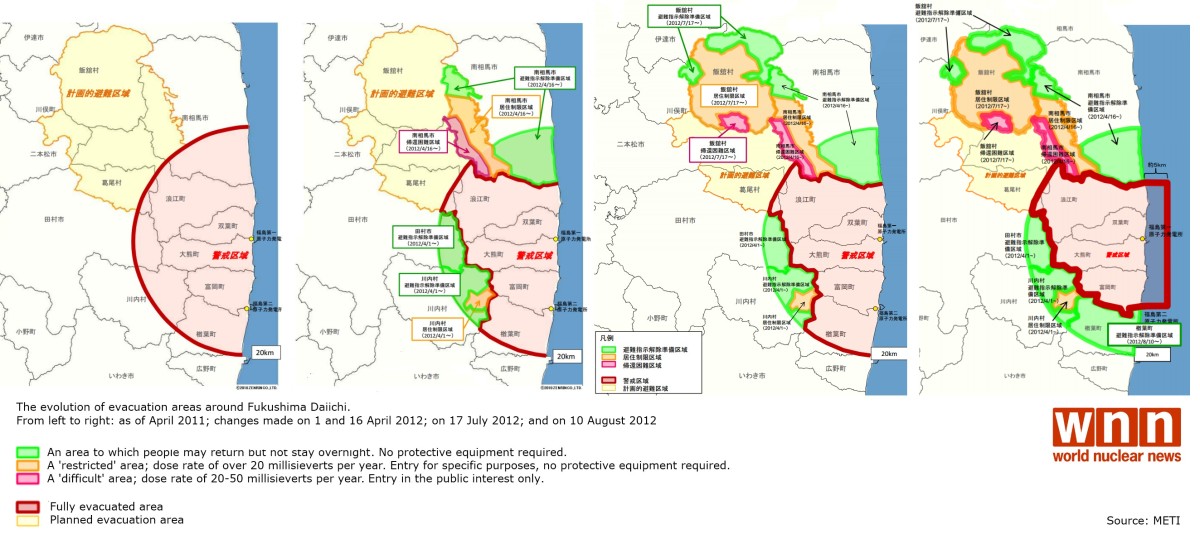
The destruction of the Fukushima Daiichi nuclear power plant in March 2011, caused by an earthquake and subsequent tsunami, resulted in massive radioactive contamination of the Japanese mainland. In November 2011, the Japanese Science Ministry reported that long-lived radioactive cesium had contaminated 11,580 square miles (30,000 sq km) of the land surface of Japan.[i] Some 4,500 square miles – an area almost the size of Connecticut – was found to have radiation levels that exceeded Japan’s allowable exposure rate of 1 mSV (millisievert) per year.
 
About a month after the disaster, on April 19, 2011, Japan chose to drastically increase its official “safe” radiation exposure levels[ii] from 1 mSv to 20 mSv per year – 20 times higher than the US exposure limit. This allowed the Japanese government to downplay the dangers of the fallout and avoid evacuation of many badly contaminated areas.
 
However, all of the land within 12 miles (20 km) of the destroyed nuclear power plant, encompassing an area of about 230 square miles (600 sq km), and an additional 80 square miles (200 sq km) located northwest of the plant, were declared too radioactive for human habitation.[iii] All persons living in these areas were evacuated and the regions were declared to be permanent “exclusion” zones.
The precise value of the abandoned cities, towns, agricultural lands, businesses, homes and property located within the roughly 310 sq miles (800 sq km) of the exclusion zones has not been established. 
 
Estimates of the total economic loss range from $250[iv]-$500[v] billion US. As for the human costs, in September 2012, Fukushima officials stated that 159,128 people had been evicted from the exclusion zones, losing their homes and virtually all their possessions. Most have received only a small compensation to cover their costs of living as evacuees. Many are forced to make mortgage payments on the homes they left inside the exclusion zones. They have not been told that their homes will never again be habitable.
 
Radioactive cesium has taken up residence in the exclusion zone, replacing the human inhabitants. Cesium-137 has a half-life of 30 years, and since it takes about 10 half-lives for any radionuclide to disappear, it will maintain ownership of the exclusion zone for centuries.
 
Once a large amount of radioactive cesium enters an ecosystem, it quickly becomes ubiquitous, contaminating water, soil, plants and animals. It has been detected in a large range of Japanese foodstuffs, including spinach, tea leaves, milk, beef, and freshwater fish up to 200 miles from Fukushima. Radioactive cesium bioaccumulates, bioconcentrates, and biomagnifies as it moves up the food chain. Routine ingestion of foods contaminated with so-called “low levels” of radioactive cesium has been shown to lead to its bioaccumulation in the heart and endocrine tissues, as well as in the kidneys, small intestines, pancreas, spleen and liver. This process occurs much faster in children than in adults, and children are many times more susceptible than adults to the effects of the ionizing radiation their internal organs are then exposed to.
 
Decontamination in the exclusion zones is proving futile. Efforts to clean up highly contaminated areas are generally failing because melting snow and rainwater run off the contaminated hills and return to recontaminate homes and land. Diversion ditches have failed to stop the process. Areas significantly contaminated with radioactive cesium and other long-lived radionuclides can no longer sell and export agricultural crops.
 
In addition to its effects on land, the Fukushima disaster produced the largest discharge of radioactive material into the ocean in history.[vi] Fifteen months after 733,000 curies of radioactive cesium were pumped into the Pacific, 56 percent of all fish catches off Japan were found to be contaminated with it.[vii] Fishing continues to be banned off the coast of Fukushima, where 40 percent of bottom dwelling fish (sole, halibut, cod) were recently found to have radioactive cesium levels higher than current Japanese regulatory limits.
 
Meanwhile, the destroyed Fukushima reactors and spent fuel ponds, which hold huge quantities of radioactive waste, are far from being stabilized. Reactors #1, #2 and #3 every day discharge radioactive gases that emit a billion becquerels of radiation. The uranium cores of reactors 1, 2 and 3, which completely melted down and then melted through the bottom of the steel reactor vessel,[viii] will continue to produce enormous amounts of radiation and heat for many years. Every day, ten tons of seawater is poured upon each of the melted cores; the water becomes intensely radioactive and then rapidly leaks out of the containment4 into the adjacent turbine building. It is then pumped through an expensive cooling system that traps the radioactivity in filters the size of small cars, which become highly radioactive and are being placed in a nearby field. Fifty million gallons of intensely radioactive water have already been collected and stored on site.[ix] Thousands of additional radioactive gallons continue to accumulate daily, and the jury-rigged pipe system connecting the storage tanks remains at risk, should another large quake strike the area.
 
Other forms of maintenance are also required to avoid potentially catastrophic radiation-releasing events. The intense gamma radiation from the melted fuel causes the seawater to disassociate into hydrogen and oxygen gas. In order to prevent further hydrogen explosions, which have already destroyed the buildings housing reactors 1, 3 and 4, nitrogen gas must be continually pumped into the leaking containment vessel. This process must continue for another six or seven years. Reactor building #4 was severely damaged by the earthquake and a massive hydrogen explosion. It holds a spent fuel pool with 1,532 nuclear fuel assemblies, which contain about 10 times more radioactive cesium than was released by the Chernobyl disaster.[x] Should building 4 collapse, its fuel pool would lose its cooling water, and the gamma radiation from the exposed fuel assemblies would then be immediately lethal to anyone within 300 feet. It would be impossible to access the site, including the common pool that contains 6,000 fuel assemblies, which is located 50 feet from building 4.
 
Thus the collapse of building 4 could lead to the release of many times more radiation than has already escaped from Fukushima. This would leave much of Japan uninhabitable and would constitute a global disaster.
 
Tokyo Power and Electric Company (TEPCO, the owner of the Fukushima Daiichi nuclear power plant) is pursuing a timetable that will require about two and a half years to safely removed the spent fuel assemblies from building 4. In August, TEPCO stated that reactor 4 building can withstand a quake in the upper 6 magnitude.[xi] Let’s hope so, because experts forecast that there is a high probability of an earthquake of this magnitude or greater occurring at Fukushima.[xii] It is an open question as to whether or not building 4 could withstand such an event.
 
There are 23 nuclear reactors of the same design as those at Fukushima now operating in the US. US spent fuel pools contain many times more spent fuel than the spent fuel pool at reactor building 4 in Fukushima Daiichi.[xiii] It is past time to shut these reactors down and place their spent fuel rods in dry-cask storage, which is not vulnerable to a loss-of-coolant disaster.[xiv]
[references available at web link, eds]
 
Fukushima is the nail in the coffin for nuclear energy. Germany has forsaken it, promising to be completely free of it by 2020. Other European and Asian countries are inclining similarly, as are the people of Japan, at odds with their government. And rightfully so, it is incredibly dangerous, dirty, and hazardous, for thousands of years.
Even in the US, it seems more and more that nuclear fission energy will die a slow, but steady death, as current reactors age, and none more are built to take their place.
 
There are increasingly more and more options developing across the globe, as a large number of people see dirty fossil fuel energy as being impossible to sustain, without altering the planet tremendously, in ways that would destroy much of humanity.
 
We really like the link below, for it's exciting new clean energy generation potential. As a child in San Diego, CA, in 1978 I still remember seeing a 30 min. documentary on our local station XETV-6 (radio and TV stations in Mexico are given X designations. Because their government allows stronger transmitters, many southern CA radio and TV stations broadcast from right across the border) about the "new hydrogen economy" promised to develop in the 1980s and beyond. With solar power being used to split water, in giant solar plants, that would then ship the cleanly generated H2 gas out for mass use in transportation fueling.
 
It never did develop unfortunately, but still could, if enough popular pressure develops to thwart the power of the fossil fuel corporations. In this documentary, the research group showed off a 1978 Chrysler Cordoba (right at the peak of Detroit's large-car building). It had been converted to run on hydrogen. All that was done, was the installation of a tank of "metal hydrides", mainly lithium. This metal honeycomb would safely store enough hydrogen gas at regular temperatures to give a car a several hundred mile range, but still used the same gas lines and carburetor (before fuel injection!). When heated slightly, the tank gave out a small, steady stream of hydrogen gas. When the tank was shot with a phosphorous-coated tracer bullet, only a small flame, like a candle, came out. 35 years ago!
We like and fervently hope for a hydrogen economy to develop. Existing internal combustion engines can be used, so not too much additional manufacturing/modification would be necessary for most vehicles. Then these can be further refined and enhanced. But it's cleaner, almost the entire emission of the engine is just water vapour.
 
This other link is interesting as well, below. Their claim that they can renewably, and carbon-neutrally generate existing fossil fuels, so that using them is not adding any excess CO2 to the environment. And we do like the fact that biochar is a byproduct of their cycle, it has caused amazing growth for all our trees here at the A.P.R.
 
But, existing internal combustion engines burning gasoline, whether carbon neutral or not, still generate Carbon Monoxide, and NOx (N2O and NO2). CO combines with the CO2 also generated, and under strong sunlight conditions, generates Ozone, O3. Which at ground levels is a serious health and safety issue. Thus large subtropical and tropical cities (and mid-latitude cities in Summer, like NYC, e.g.) would still be plagued with photochemical smog.
 
Neither of these more sustainable scenarios, which would help the planet avert climate change catastrophe are possible though without full government support and emphasis. Similar to the "space race" of the 1960s. Which generated hundreds of thousands of good jobs in the public and private sectors. Cheers.

Friday, November 2, 2012

MODELING THE FUTURE [or] GETTING THE MESSAGE?

Now that the true extent of the devastation unleashed by Hurricane then extratropical hybrid storm Sandy is apparent, 50 billion USD or more in damage, and at least 90 fatalities (there are still people missing who were washed away in NYC), it's possible to put it in perspective, and to see how the US public and government are processing it.  
Many prominent researchers in the Atmospheric Sciences and Climatology are now putting forth their assessments of the situation. Which are very much in agreement with ours. In a nutshell, global warming isn't causing these storms directly, but making the overall environment more ripe for rapid storm development. Which is what we have been seeing here in S-Central Alaska the last few years.
 
We here at the APR view this storm as one of the most globally sigificant weather/climate events of the last five years, not as much in the death/destruction she wrought, but because it is making more people take notice of global warming. And starting to wonder, will we be able to protect our coastal cities from flooding in the decades to come from rising sea levels and stronger storms?
 
The other most significant events of the past five years were the Australian Heat Wave/Wildfires in 2009,
the Drought/Wildfires in Russia 2010 combined with flooding in Pakistan,
and the two year drought in first Texas and the southwestern US in 2011, then in almost all of the western and central US in 2012.
 
This article from the Climate Central website a few days ago offers a great overview of all the features of Sandy that made her so unique and devastating. Along with some input from prominent researchers in the climate change/modeling and atmospheric sciences fields.
 

How Global Warming Made Hurricane Sandy Worse
Published: October 31st, 2012 , Last Updated: October 31st, 2012
 577 324 164 1

 By Andrew Freedman

 As officials begin the arduous task of pumping corrosive seawater out of New York City’s subway system and try to restore power to lower Manhattan, and residents of the New Jersey Shore begin to take stock of the destruction, experts and political leaders are asking what Hurricane Sandy had to do with climate change. After all, the storm struck a region that has been hit hard by several rare extreme weather events in recent years, from Hurricane Irene to “Snowtober.”
 
Photo of coastal flooding along the New Jersey shore, taken from a New Jersey Air National Guard Helicopter.
Credit: NJNG/Scott Anema.


Scientists cannot yet answer the specific question of whether climate change made Hurricane Sandy more likely to occur, since such studies, known as detection and attribution research, take many months to complete. What is already clear, however, is that climate change very likely made Sandy’s impacts worse than they otherwise would have been.

There are three different ways climate change might have influenced Sandy: through the effects of sea level rise; through abnormally warm sea surface temperatures; and possibly through an unusual weather pattern that some scientists think bore the fingerprint of rapidly disappearing Arctic sea ice.

If this were a criminal case, detectives would be treating global warming as a likely accomplice in the crime.

Warmer, Higher Seas

Water temperatures off the East Coast were unusually warm this summer — so much so that New England fisheries officials observed significant shifts northward in cold water fish such as cod. Sea surface temperatures off the Carolinas and Mid-Atlantic remained warm into the fall, offering an ideal energy source for Hurricane Sandy as it moved northward from the Caribbean. Typically, hurricanes cannot survive so far north during late October, since they require waters in the mid to upper 80s Fahrenheit to thrive.

Scientists said about 1°F out of the 5°F East Coast water temperature anomaly may have been due to manmade global warming. Warmer seas provide more water vapor for storms to tap into; this water vapor can later be wrung out as heavy rainfall, resulting in flooding.

The most damaging aspect of the storm was the massive storm surge that struck the coastline from Massachusetts to Maryland. Global warming-related sea level rise gave the surge a higher launching pad than it would have had a century ago, making it more damaging than it otherwise would have been. This is only going to get worse as sea level rise continues as a result of warming ocean waters and melting polar ice caps and glaciers.

The storm surge at The Battery in Lower Manhattan was the highest ever recorded at that location. It surpassed even the most pessimistic forecasts, with the maximum water level reaching 13.88 feet above the average of the daily lowest low tide of the month, known as Mean Lower Low Water, including a storm surge component of 9.23 feet. That broke the official record of 10.5 feet above Mean Lower Low Water set in 1960 during Hurricane Donna, as well as a record set during a hurricane in 1821.

A water vapor satellite image of Superstorm Sandy on Tuesday, Oct. 30.
Credit: Stu Ostro/Facebook.


Or, to put it in simpler terms, the water level reached 9.15 feet above the average high tide line.

Katharine Hayhoe, a climate researcher at Texas Tech University in Lubbock, said manmade climate change likely contributed to the storm surge at The Battery in Lower Manhattan, with 1 foot 3 inches of long-term sea level rise recorded at that location, the result of manmade sea level rise, sinking land, and ocean currents. She said the manmade contribution to the storm surge may have been a small amount.

But to the Metropolitan Transit Authority or Con Ed, the main electric utility in Manhattan, each inch of sea level rise matters a great deal.

If a similar storm were to strike New York in 2050, it would cause even more damage, since sea levels are expected to be considerably higher by midcentury. In fact, a recent study found that sea level rise has taken place at an accelerated rate at locations north of Norfolk, Va., and if this pace continues the Northeast could see much higher sea levels than other parts of the East Coast by midcentury.

A 2012 report by the U.N. Intergovernmental Panel on Climate Change (IPCC) found that sea level rise has likely increased extreme coastal high water events around the world.

By warming the seas and the atmosphere, global warming is also expected to alter hurricane frequency and strength, making North Atlantic hurricanes slightly more powerful, while reducing the overall number of storms during coming decades. Detecting such changes in the observational record is difficult, considering the varying ways people have kept tabs on hurricanes prior to the era of hurricane hunter aircraft flights and satellite imagery?  A recent study published in the Proceedings of the National Academy of Sciences found that warmer sea surface temperatures are tied to an increase in stronger Atlantic hurricanes.

“Blocked” Weather Pattern

In addition, an unusual weather pattern in the northern hemisphere steered the storm in an unprecedented direction, as it made a dramatic — and for many East Coast residents, catastrophic — left hook right into coastal New Jersey. The east to west movement, which is exactly the opposite of how weather systems normally move in this area, helped maximize the storm surge, since a strong easterly air flow struck the coast at a right angle.


Satellite loop from the University of Wisconsin, showing Hurricane Sandy as it made landfall in New Jersey.

The upper air flow over the Atlantic Ocean was temporarily jammed by a powerful area of high pressure near Greenland and a storm system in the Central Atlantic, leaving the storm no escape route away from the U.S. Such patterns are known as “blocking” events, and they have occurred with increasing regularity and intensity in recent years. Blocking patterns have been linked to several noteworthy extreme weather events, such as the deadly 2010 Russian heat wave and Pakistan floods, the 2003 European heat wave, and the March heat wave of 2012 in the U.S.  [and are a factor in increasing the frequency/strength of our windstorms here in S-Central Alaska, eds..]

In this case, the blocking pattern, occurred at precisely the wrong time — when a hurricane was moving out of the Caribbean.

Weather Channel hurricane expert Bryan Norcross wrote about this on Oct. 26. “The freak part is that a hurricane happens to be in the right place in the world to get sucked into this doubled-back channel of air and pulled inland from the coast,” he said. “And the double-freak part is that the upper-level wind, instead of weakening the storm and simply absorbing the moisture — which would be annoying enough — is merging with the tropical system to create a monstrous hybrid vortex. A combination of a hurricane and a nor’easter.”

Some, though not all, scientists think the more frequent blocking events be related to the loss of Arctic sea ice, which is one of the most visible consequences of manmade global warming. The 2012 sea ice melt season, which ended just one month ago, was extreme, with sea ice extent, volume, and other measures all hitting record lows. The loss of sea ice opens large expanses of open water, which then absorbs more of the incoming solar energy and adds heat and moisture to the atmosphere, thereby helping to alter weather patterns. Exactly how sub-Arctic weather patterns are changing as a result, however, is a subject of active research.

Some researchers who warn that climate change is already being felt in extreme weather events, such as Kevin Trenberth of the National Center for Atmospheric Research in Boulder, Colo., are not yet convinced of the Arctic connection. Others, such as Hayhoe, think it is a “plausible theory” that is worth investigating, although she noted there is evidence that Arctic warming may cause more blocking during the winter rather than during the fall.

James Overland, a scientist with the National Oceanic and Atmospheric Administration who recently published a study on how Arctic sea ice loss is altering the weather in the Far North, said it’s not clear whether Hurricane Sandy was just a freak event or a sign of things to come. “What was highly unusual to me was the slowing down of the jet stream that normally turns hurricanes out to sea, allowing Sandy to directly [make] landfall,” he said in an email conversation. Yet, he said it’s important to recognize that there is still a huge role played by randomness, or chaos, in global weather patterns. “Having looked at a lot of weather maps, I don’t think it’s entirely legitimate to make a big possibility for an Arctic connection with Sandy rather than the chaos default,” he said.

And while climate change has undoubtedly altered the background conditions in which all weather systems are born, scientists said that natural variability still plays a very large role, and may have been the dominant factor with Hurricane Sandy.

Martin Hoerling, a researcher at the Earth Systems Research Laboratory, also in Boulder, is a proponent of this view. “Great events, like this meteorological one, can happen with little cause(s). Individually, neither the tropical storm nor the extratropical storm that embraced it, were unusual,” he said via email. “What makes this a rare, perhaps once in a lifetime event, is the fortuity of their timely (“untimely” as far as most are concerned who sit in harms way) intersection.” Randall M. Dole, who is a colleague of Hoerling's at ESRL, noted that the blocking pattern that helped steer Sandy was "highly transient," which suggests to him that it was just "random bad luck" that it coincided with a hurricane along the East Coast.
 
Regardless of the chain of events that led to this disaster, Hurricane Sandy is almost certain to wind up being one of the top 10 costliest hurricanes on record, and it comes soon after Munich Re, a global insurance giant, warned of increasing natural disaster losses in the U.S., a trend the company said is related to global climate change.

And regardless of unequivocal linkages between this particular storm and manmade climate change, questions related to future human-caused changes — how they will make this type of event more likely and destructive, through a combination of sea level rise, extreme weather trends, and vulnerability of coastal populations and infrastructure, deserve to be asked and may be much easier to answer.
 

This image, above, shows the areas that were flooded in NYC, with green the most shallow (not sure of the scaling), and orange the deepest. As we saw, the highest recorded storm surge levels were about 9.2 feet above mean high tide levels. What is this map going to look like when a storm in 2040 buffets the same area when mean sea levels are five feet higher? Ten feet higher? It's highly possible that could happen, as the Greenland Ice Sheet's stability is now in question. Massive pieces of it breaking apart and melting are going to be a real problem in the coming decades as Arctic warming continues to accelerate. For a time last summer, temperatures were above freezing over the entire ice/land mass, and melting was occurring even on it's higher elevations. This melt-water then infiltrates through the ice sheets, and lubricates the bases of them.
That's assuming nothing is done nationally and globally to rein in CO2 and methane emissions from fossil fuels combustion. Which to date, has been a good assumption.
 
Bill McKibben puts the disaster we are calling Sandy in good perspective in the following article, showing that some politicians and corporate media may be getting the message. Will it help tip the scales, so that more people can think of the bigger picture? That the only way we are going to solve problems like this is through abandoning greed as the motive force in societies. And realising that the only stable and sustainable economies are/will be ones that place primary emphasis on meeting people's basic needs and protection of the environment for future generations.
 

A Grim Warning from Science


One of the things that makes Sandy different from Katrina is that it’s a relatively clean story. The lessons of Katrina were numerous and painful—they had to do with race, with class, with the willful incompetence of a government that had put a professional Arabian horse fancier in charge of its
rescue efforts.

Sandy, by contrast, has been pretty straightforward. It’s hit rich, poor, and middle class Americans with nearly equal power, though of course the affluent always have it easier in the aftermath of tragedy. Government officials prepared forthrightly for its arrival, and have refrained from paralysis and bickering in its wake. Which allows us to concentrate on the only really useful message it might deliver: that we live in a changed world, where we need both to adapt to the changes, and to prevent further changes so great that adaptation will be impossible.

Science and its practical consort Engineering mostly come out of this week with enhanced reputations. For some years now, various researchers have been predicting that such a trauma was not just possible but almost certain, as we raised the temperature and with it the level of the sea—just this past summer, for instance, scientists demonstrated that seas were rising faster near the northeast United States (for reasons having to do with alterations to the Gulf Stream) than almost anyplace on the planet. They had described, in the long run, the loaded gun, right down to a set of documents describing the precise risk to the New York subway system.
 
As nature pulled the trigger in mid-October, when a tropical wave left Africa and moved into the Atlantic and began to spin, scientists were able to do the short-term work of hurricane forecasting with almost eerie precision. Days before Sandy came ashore we not only knew approximately where it would go, but that its barometric pressure would drop below previous records and hence that its gushing surge would set new marks. The computer models dealt with the weird hybrid nature of the storm—a tropical cyclone hitting a blocking front—with real aplomb; it was a bravura performance.

In so doing, it should shame at least a little those people who argue against the computer modeling of climate change on the grounds that “they can’t even tell the weather three days ahead of time—how can they predict the climate?” But in fact “they” can tell the weather, and in the process they saved thousands upon thousands of lives. They can tell the future too. No serious climate scientist believes that the sea will rise less than a meter this century, unless we get off fossil fuel with great speed; many anticipate it will rise far more. Think about what that means—as one researcher put it this week, it means that any average storm will become an insidious threat.

[It's already been established that global sea levels were 5-7 metres higher 128,000 years ago, when CO2 levels were also at 390 ppm, due to naturally occuring volcanism.http://akprogressive.blogspot.com/2009/12/what-seems-likely-based-on-what-weve.html
We'll be at 550 ppm by 2050, will global sea levels have risen 5-7 metres, or more, by then? It's quite possible, due to the melting/instability of the Greenland ice sheets. How will humanity adapt? eds..]

It’s possible that we can spend enough money to somehow protect Manhattan—and it’s possible that we can’t. It’s impossible to imagine that we will be able to protect, say, the Asian subcontinent, or the Pearl River delta of China, or any of the other crowded places imperiled by rising seas. In fact, the last year has seen even more serious flooding in Bangkok and Manila, and a recent study found that New York was only seventeenth on the list of cities at risk of such flooding, with Mumbai and Calcutta leading the league.
 
Having great scientists, and taking those scientists seriously, are two different things, of course. Our climate scientists—led by James Hansen, who lives in New Jersey and does his work from a NASA lab on the Upper West Side—have trotted patiently up to Capitol Hill every year for the last two decades to present their latest findings, and been entirely ignored, the fossil fuel industry having purchased one of our political parties and cowed the other. But it may be that firsthand experience will accomplish what academic studies have not—Governor Andrew Cuomo, for instance, was forthright in his declarations this week that climate change was a “reality,” that we were “vulnerable” as a result, and that we would need to adjust to deal with it.
 
But that adjustment can’t just be building new seawalls, because we’ll never catch up. The same researchers who predicted events like this week’s horror have warned that unless we cease burning coal and gas and oil the planet’s temperature—already elevated by a degree—will climb another four or five. At which point “civilization” will be another word for “ongoing emergency response.”

Building new defenses will be expensive but relatively popular; cracking down on the fossil fuel industry will be a great trial, and indeed Cuomo has an important test approaching. He must decide at some point in the coming years whether to allow fracking within the borders of the Empire State. A lead author of a very weak report from his Department of Environmental Conservation is a climate denier; after Sandy it will be interesting to see if the governor asks for a new study from people in touch with actual science. I think he might; as powerful as the fracking lobby is, the sight of a hundred apartment and office lobbies filled with seawater is more visceral. We’ve been given a warning by science, and a wake-up call by nature; it is up to us now to heed them.
 

Saturday, October 27, 2012

A MORE PERFECT STORM

http://en.wikipedia.org/wiki/1991_Perfect_Storm

The "Perfect Storm" that occurred off the northeast US coast in 10/1991 was originally an "extra-tropical" low pressure system, fed by the jet stream and overall tropical-subpolar temperature gradients. It produced it's greatest damage and all the fatalities in this phase of it's existence over the eastern US and southeastern Canada. This was Hollywood-dramatised in the movie of the same name, which came out several years later. The storm ended moving further into the subtropics and then transitioned into a category 1 hurricane. This is different from the "Frankenstorm" Hurricane Sandy, now brewing just off the SE US coast. Sandy had been up to a category 2 hurricane a few days previously in the Caribbean, she has weakened moving further north.

But what happens next is what is so interesting, unusual, and possibly, unprecedented! More will be known within 72 hours as she moves ashore, right now models are mostly pointing toward the Delaware River outlet. But Sandy's evolution is just the opposite of the "Perfect Storm" of 1991. In Sandy's case, she has been/will be weakening considerably as a hurricane moving out of the tropics, but within 48 hours from now will get fed by the contrast of colder/drier air originally moving south from the Arctic. In the form of this low pressure trough over the eastern US, on this mornings 500 mb (usually around 5300-5900 metres, or centred around 18,000 ft.) analysis. Sandy shows up as the small upper-level feature off of the Florida coast.
 
Then she will be undergoing a transition from hurricane-type structure/processes, to an extratropical system, which is much different. And which has not been studied much, as it rarely occurs. Sandy's movement too, is contributing to it's interest. So whilst models are forecasting tropical storm type conditions as it moves ashore, the scale of them will be much larger, and for a longer period of time. Likely to produce severe flooding, from heavy rains, and storm-generated surges on top of the monthly high tide in many areas.


We will certainly be offering you a post-storm assessment, several days after her peak. But for now, just wanted to bring it to your attention. It will be an event of some significance in the next 5 days.
 
Today though, on our usual daily scan, when we saw this headline like something from a U.K. tabloid, but with a "liberal" slant to it, we had no choice but to dive in and take a look.
 
http://www.commondreams.org/view/2012/10/27-6  You've seen much like this before here with us, but Juan Cole put it together very nicely. A little commentary of our own as well, first.
 
We obviously don't envision a "vengeful Mother Nature" throwing this storm at the eastern US as punishment. Any more than Katrina was for the Gulf Coast, or Andrew for Florida. It is what it is, and must be dealt with. Generally speaking, in all powerful and destructive storms in modern history, the well-off are able to flee quickly/safely, while mainly poor people can't, who then can't rebuild quickly/easily. We hope for the best for everyone there. Worst-case scenarios have been discussed involving the flooding of parts of the NYC subway system, among other things.
 
The Alaska Progressive Review does like the tabloidy/seedy headline though. We think it was either Pat Robertson or Jerry Fallwell, the conservative Christian televangelists, who pinned Katrina on the sins of New Orleans, etc.. back in 2005.
 
Candidates Flee East Coast as Frankenstorm Takes Revenge for their Ignoring Climate Change


Mitt Romney and Joe Biden have canceled campaign events planned for this weekend at Virginia Beach as a massive storm bears down on the east coast of the US. The candidates are fleeing from the East Coast, even though they won’t talk about the key environmental issue of our time.
The candidates in this year’s presidential election completely ignored climate change in their debates and their campaigning, even thought it is the most deadly issue facing this country and all humankind. Human beings are dumping massive amounts of carbon dioxide into the atmosphere by burning coal, natural gas and petroleum at feverish rates. They have already increased temperatures significantly since 1750, and are on track to put up the average surface temperature of the earth by 5 degrees C. or 9 degrees Fahrenheit over the next century, enough to turn everyplace on earth over time into a sweating tropics, melt all surface ice, and, over the long term, submerge a third of the current land mass. A global state of emergency would be necessary to keep the temperature increase to 2 degrees C. or less, but the window is rapidly closing for this curbing of disaster.
 

Big oil is pouring money into the Romney campaign or superpacs supporting him, so as to make sure they keep their tax breaks but those for wind power are abolished. The power of big Carbon money is preventing climate change from being discussed in the campaign, even though it affects every American voter. Romney’s energy policies will cause global disaster, but even Obama doesn’t seem to realize the severity and urgency of the problem (or else he does and feels his hands are tied).
 

A new study appearing in Proceedings of the National Academy of Sciences that uses accurate tide measurements since 1923 removes any doubt that hurricanes are more frequent and stronger in warm years (the number of warm years has steadily increased over the past century and especially in the past decade).

[pdf] For every increase of 1 degree Fahrenheit, US hurricanes will likely get 2% stronger (i.e. they are already 5% stronger than 2 centuries ago). In hurricanes, a 5% increase in ferocity matters quite a lot.
 

One mechanism for the increased severity is that higher temperatures produce more high-altitude clouds, called “deep convective clouds,” associated increased rainfall.
 

One recent study [pdf] found that torrential downpours in the United States are occurring a third more often than in 1948. New England has been the worst hit, with torrential downpours 85% more common now than in 1948. Note that these findings are based on actual historical records, and are not a matter of projection.
 
Across the board, storms are 10% more intense now than when Truman was president.

Hurricanes are a more contentious issue than storms but models show that the speed of hurricane winds could increase by as much as 13 percent over the next century as a result of our production of carbon dioxide, and rainfall rates will increase 10-31 percent in hurricanes. Because of the rising level of the seas, hurricanes will cause larger storm surges.
 

A Tel Aviv researcher has shown that every one degree increase Celsius produces a 10% increase in lightning, with the attendant dangers of increased forest and other fires.
 
Those who talk about solar energy being “more expensive” than coal or natural gas are not figuring in the expensiveness of climate change. In many markets, wind and solar are already competitive, and if the damage hydrocarbons are doing to our economy were taken into account, they’d be the only game in town. [but in capitalism as it exists now in most of the world, the only thing sacred, or of value, are short term gain/profits; human life and environmental health must fit within that bracket, eds..].
 
One of the many indexes of the failure of American democracy is that our candidates can’t even publicly say the name of our worst nemesis.