IN A TIME OF UNIVERSAL DECEIT...TELLING THE TRUTH BECOMES A REVOLUTIONARY ACT

"Capitalism is the astounding belief that the most wicked of men will do the most wicked of things for the greatest good of everyone." John Maynard Keynes

" Labor is prior to, and independent of, capital; that, in fact, capital is the fruit of labor, and could never have existed if labor had not first existed. Labor is the superior of capital and deserves much the higher consideration" Abraham Lincoln

Thursday, January 19, 2012

HALF A LEGACY

File:Martin Luther King, Jr Memorial at Dusk.jpg
It is a wonderful thing that MLK's monument on the National Mall in Washington DC has been dedicated, and that every year, the closest monday to his birthdate, 15 JAN, is a federal holiday. Yet in all the "official" recognition his legacy (for his role in this country's civil rights struggles) receives, the other half is ignored.

The last year of his life, before he was murdered for speaking out against the war in Vietnam, and US militarism in general, he was involved in what he felt was his most urgent campaign. And which of course, cost him his life. A campaign not just for ending the Vietnam War, but for true social and economic justice and equality for all people and races in the US, and throughout the World.

It is this legacy that we so urgently need to remember and reflect upon in these uncertain times, when more war clouds are already gathering. As the "corporatocracy"/military-industrial complex sets its sights on fomenting war with Iran, a country which has never threatened or invaded it's neighbours. With the illegal/immoral invasion/occupation of Iraq winding down, and a slow trend toward the same in Afghanistan, the powers that be, feel they need another to keep up their corporate profit margins. And politically, it is thought that this will also help distract attention from the other pressing problems this and all other countries are facing, with their economies, and the global environment.

These speeches MLK gave are some of the most powerful, and so very sadly still relevant ones any prominent figure in this country has ever given.

4 April, 1967
 http://www.americanrhetoric.com/speeches/mlkatimetobreaksilence.htm 

"...It is with such activity in mind that the words of the late John F. Kennedy come back to haunt us. Five years ago he said, "Those who make peaceful revolution impossible will make violent revolution inevitable." Increasingly, by choice or by accident, this is the role our nation has taken, the role of those who make peaceful revolution impossible by refusing to give up the privileges and the pleasures that come from the immense profits of overseas investments. I am convinced that if we are to get on the right side of the world revolution, we as a nation must undergo a radical revolution of values. We must rapidly begin...we must rapidly begin the shift from a thing-oriented society to a person-oriented society. When machines and computers, profit motives and property rights, are considered more important than people, the giant triplets of racism, extreme materialism, and militarism are incapable of being conquered...

...A true revolution of values will soon cause us to question the fairness and justice of many of our past and present policies. On the one hand, we are called to play the Good Samaritan on life's roadside, but that will be only an initial act. One day we must come to see that the whole Jericho Road must be transformed so that men and women will not be constantly beaten and robbed as they make their journey on life's highway. True compassion is more than flinging a coin to a beggar. It comes to see that an edifice which produces beggars needs restructuring.
 
A true revolution of values will soon look uneasily on the glaring contrast of poverty and wealth. With righteous indignation, it will look across the seas and see individual capitalists of the West investing huge sums of money in Asia, Africa, and South America, only to take the profits out with no concern for the social betterment of the countries, and say, "This is not just." It will look at our alliance with the landed gentry of South America and say, "This is not just." The Western arrogance of feeling that it has everything to teach others and nothing to learn from them is not just.

A true revolution of values will lay hand on the world order and say of war, "This way of settling differences is not just." This business of burning human beings with napalm, of filling our nation's homes with orphans and widows, of injecting poisonous drugs of hate into the veins of peoples normally humane, of sending men home from dark and bloody battlefields physically handicapped and psychologically deranged, cannot be reconciled with wisdom, justice, and love. A nation that continues year after year to spend more money on military defense than on programs of social uplift is approaching spiritual death...

America, the richest and most powerful nation in the world, can well lead the way in this revolution of values. There is nothing except a tragic death wish to prevent us from reordering our priorities so that the pursuit of peace will take precedence over the pursuit of war. There is nothing to keep us from molding a recalcitrant status quo with bruised hands until we have fashioned it into a brotherhood.

This kind of positive revolution of values is our best defense against communism. War is not the answer. Communism will never be defeated by the use of atomic bombs or nuclear weapons. Let us not join those who shout war and, through their misguided passions, urge the United States to relinquish its participation in the United Nations. These are days which demand wise restraint and calm reasonableness. We must not engage in a negative anticommunism, but rather in a positive thrust for democracy, realizing that our greatest defense against communism is to take offensive action in behalf of justice. We must with positive action seek to remove those conditions of poverty, insecurity, and injustice, which are the fertile soil in which the seed of communism grows and develops.
 
...These are revolutionary times. All over the globe men are revolting against old systems of exploitation and oppression, and out of the wounds of a frail world, new systems of justice and equality are being born. The shirtless and barefoot people of the land are rising up as never before. The people who sat in darkness have seen a great light. We in the West must support these revolutions.

It is a sad fact that because of comfort, complacency, a morbid fear of communism, and our proneness to adjust to injustice, the Western nations that initiated so much of the revolutionary spirit of the modern world have now become the arch antirevolutionaries. This has driven many to feel that only Marxism has a revolutionary spirit. Therefore, communism is a judgment against our failure to make democracy real and follow through on the revolutions that we initiated. Our only hope today lies in our ability to recapture the revolutionary spirit and go out into a sometimes hostile world declaring eternal hostility to poverty, racism, and militarism. With this powerful commitment we shall boldly challenge the status quo and unjust mores, and thereby speed the day when "every valley shall be exalted, and every mountain and hill shall be made low, and the crooked shall be made straight, and the rough places plain."

...A genuine revolution of values means in the final analysis that our loyalties must become ecumenical rather than sectional. Every nation must now develop an overriding loyalty to mankind as a whole in order to preserve the best in their individual societies.

This call for a worldwide fellowship that lifts neighborly concern beyond one's tribe, race, class, and nation is in reality a call for an all-embracing and unconditional love for all mankind. This oft misunderstood, this oft misinterpreted concept, so readily dismissed by the Nietzsches of the world as a weak and cowardly force, has now become an absolute necessity for the survival of man. When I speak of love I am not speaking of some sentimental and weak response. I am not speaking of that force which is just emotional bosh. I am speaking of that force which all of the great religions have seen as the supreme unifying principle of life. Love is somehow the key that unlocks the door which leads to ultimate reality. This Hindu-Muslim-Christian-Jewish-Buddhist belief about ultimate reality is beautifully summed up in the first epistle of Saint John: "Let us love one another, for love is God. And every one that loveth is born of God and knoweth God. He that loveth not knoweth not God, for God is love." "If we love one another, God dwelleth in us and his love is perfected in us." Let us hope that this spirit will become the order of the day.

We can no longer afford to worship the god of hate or bow before the altar of retaliation. The oceans of history are made turbulent by the ever-rising tides of hate. And history is cluttered with the wreckage of nations and individuals that pursued this self-defeating path of hate. As Arnold Toynbee says: "Love is the ultimate force that makes for the saving choice of life and good against the damning choice of death and evil. Therefore the first hope in our inventory must be the hope that love is going to have the last word" (unquote).

We are now faced with the fact, my friends, that tomorrow is today. We are confronted with the fierce urgency of now. In this unfolding conundrum of life and history, there is such a thing as being too late. Procrastination is still the thief of time. Life often leaves us standing bare, naked, and dejected with a lost opportunity. The tide in the affairs of men does not remain at flood -- it ebbs. We may cry out desperately for time to pause in her passage, but time is adamant to every plea and rushes on. Over the bleached bones and jumbled residues of numerous civilizations are written the pathetic words, "Too late." There is an invisible book of life that faithfully records our vigilance or our neglect. Omar Khayyam is right: "The moving finger writes, and having writ moves on."

We still have a choice today: nonviolent coexistence or violent coannihilation. We must move past indecision to action. We must find new ways to speak for peace in Vietnam and justice throughout the developing world, a world that borders on our doors. If we do not act, we shall surely be dragged down the long, dark, and shameful corridors of time reserved for those who possess power without compassion, might without morality, and strength without sight."
3 April, 1968
 
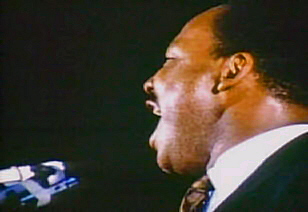
"...Let us rise up tonight with a greater readiness. Let us stand with a greater determination. And let us move on in these powerful days, these days of challenge to make America what it ought to be. We have an opportunity to make America a better nation. And I want to thank God, once more, for allowing me to be here with you.

You know, several years ago, I was in New York City autographing the first book that I had written. And while sitting there autographing books, a demented black woman came up. The only question I heard from her was, "Are you Martin Luther King?" And I was looking down writing, and I said, "Yes." And the next minute I felt something beating on my chest. Before I knew it I had been stabbed by this demented woman. I was rushed to Harlem Hospital. It was a dark Saturday afternoon. And that blade had gone through, and the X-rays revealed that the tip of the blade was on the edge of my aorta, the main artery. And once that's punctured, your drowned in your own blood -- that's the end of you.

It came out in the New York Times the next morning, that if I had merely sneezed, I would have died. Well, about four days later, they allowed me, after the operation, after my chest had been opened, and the blade had been taken out, to move around in the wheel chair in the hospital. They allowed me to read some of the mail that came in, and from all over the states and the world, kind letters came in. I read a few, but one of them I will never forget. I had received one from the President and the Vice-President. I've forgotten what those telegrams said. I'd received a visit and a letter from the Governor of New York, but I've forgotten what that letter said. But there was another letter that came from a little girl, a young girl who was a student at the White Plains High School. And I looked at that letter, and I'll never forget it. It said simply,

Dear Dr. King,

I am a ninth-grade student at the White Plains High School."
And she said,

While it should not matter, I would like to mention that I'm a white girl. I read in the paper of your misfortune, and of your suffering. And I read that if you had sneezed, you would have died. And I'm simply writing you to say that I'm so happy that you didn't sneeze.

And I want to say tonight -- I want to say tonight that I too am happy that I didn't sneeze. Because if I had sneezed, I wouldn't have been around here in 1960, when students all over the South started sitting-in at lunch counters. And I knew that as they were sitting in, they were really standing up for the best in the American dream, and taking the whole nation back to those great wells of democracy which were dug deep by the Founding Fathers in the Declaration of Independence and the Constitution.

If I had sneezed, I wouldn't have been around here in 1961, when we decided to take a ride for freedom and ended segregation in inter-state travel.

If I had sneezed, I wouldn't have been around here in 1962, when Negroes in Albany, Georgia, decided to straighten their backs up. And whenever men and women straighten their backs up, they are going somewhere, because a man can't ride your back unless it is bent.

If I had sneezed -- If I had sneezed I wouldn't have been here in 1963, when the black people of Birmingham, Alabama, aroused the conscience of this nation, and brought into being the Civil Rights Bill.

If I had sneezed, I wouldn't have had a chance later that year, in August, to try to tell America about a dream that I had had.

If I had sneezed, I wouldn't have been down in Selma, Alabama, to see the great Movement there.

If I had sneezed, I wouldn't have been in Memphis to see a community rally around those brothers and sisters who are suffering.

I'm so happy that I didn't sneeze.

And they were telling me --. Now, it doesn't matter, now. It really doesn't matter what happens now. I left Atlanta this morning, and as we got started on the plane, there were six of us. The pilot said over the public address system, "We are sorry for the delay, but we have Dr. Martin Luther King on the plane. And to be sure that all of the bags were checked, and to be sure that nothing would be wrong with on the plane, we had to check out everything carefully. And we've had the plane protected and guarded all night."

And then I got into Memphis. And some began to say the threats, or talk about the threats that were out. What would happen to me from some of our sick white brothers?

Well, I don't know what will happen now. We've got some difficult days ahead. But it really doesn't matter with me now, because I've been to the mountaintop.

And I don't mind.

Like anybody, I would like to live a long life. Longevity has its place. But I'm not concerned about that now. I just want to do God's will. And He's allowed me to go up to the mountain. And I've looked over. And I've seen the Promised Land. I may not get there with you. But I want you to know tonight, that we, as a people, will get to the promised land!

And so I'm happy, tonight.

I'm not worried about anything.

I'm not fearing any man!

Mine eyes have seen the glory of the coming of the Lord!!"


Let's remember the other half of MLK's legacy, and what he died for. And act on it. Support or get involved with your local Occupy movements or any others working for peace and social/economic justice. Withdraw all support from the large criminal banks responsible for destroying our economy through their greed and recklessness, and deal only with credit unions. Support your local economies whenever possible by purchasing goods made nearby, used goods, and relying on farmer's markets and/or community supported agriculture. There are so many things we can all do to make a better future, in line with the other half of MLK's legacy. For if we don't, the future of this and other countries, and humanity in general will be very dark and uncertain. Cheers.

Sunday, January 15, 2012

FOR EVERY ACTION...(Ridge)

THERE IS AN EQUAL AND OPPOSITE REACTION (Trough)

Isaac Newton's third law of motion can in a sense describe what has been going in this winter, in Alaska, and downstream, over the western U.S.

This winter so far in south-central Alaska has been quite turbulent: heavy snow and colder than normal temperatures in November, then 5 strong (of which 2 were especially) damaging windstorms with very warm temperatures bringing heavy rain and snow over the area, including Anchorage from 04-20 December, and finally back to colder temperatures and very heavy snowfall until just two days previous. It's safe to say that many people here are really wondering about what is going on, and there is some apprehension. 
Meanwhile, downstream, in California, there was this from 10 Jan. :

".DISCUSSION...SUNNY SKIES AND MILD TEMPERATURES PREVAIL ACROSS THE CENTRAL CA INTERIOR THIS AFTERNOON. THE WEATHER DOES NOT GET MUCH BETTER THAN THIS IN JANUARY...UNLESS YOU LIKE RAIN AND MOUNTAIN SNOW. LITTLE IF ANY PRECIPITATION HAS FALLEN IN THE CENTRAL CA  INTERIOR SINCE THE 20TH OF NOVEMBER. SADLY...THE WEATHER LOOKS AS   THOUGH IT WILL REMAIN DRY AS A BONE FOR AT LEAST ANOTHER 7 DAYS. AN UPPER LEVEL RIDGE OF HIGH PRESSURE SITUATED ALONG THE WEST COAST IS TO BLAME...AND IT WILL DOMINATE OUR PATTERN THROUGH  SATURDAY. DURING THIS TIME...A WEAK TO MODERATE OFFSHORE FLOW WILL PREVAIL ACROSS CENTRAL CA AND SKIES WILL BE MOSTLY CLEAR. 

AFTERNOON TEMPERATURES THE NEXT COUPLE OF DAYS WILL BE MORE LIKE
THE MIDDLE OF MARCH THAN THE MIDDLE OF JANUARY. THE RECORD HIGHS FOR TOMORROW AND SATURDAY IN FRESNO AND BAKERSFIELD WILL BE WITHIN   REACH…


 …AFTER NEXT THURSDAY...THE MODELS FORECAST A GRADUAL SHIFT SOUTHWARD  OF THE STORM TRACK AND THE POTENTIAL FOR WET WEATHER...PERHAPS AS EARLY AS NEXT FRIDAY NORTH OF FRESNO COUNTY THEN POSSIBLY SOUTHWARD INTO KERN COUNTY NEXT WEEKEND. ALTHOUGH THE PAST FEW RUNS OF THE MODELS HAVE SIGNALLED A SIGNIFICANT CHANGE TO A WET PATTERN...EACH RUN SEEMS TO BACK OFF A LITTLE BIT THIS FAR SOUTH. HENCE...FORECAST CONFIDENCE IS TOO LOW AT THIS TIME TO MAKE ANY GUARANTEES. THE FACT IS...IF FRESNO DOES NOT RECEIVE MEASURABLE RAIN BEFORE THE 25TH OF JANUARY...IT WILL BE THE LONGEST STRETCH OF DRY WEATHER EVER RECORDED BETWEEN THE MONTHS OF NOVEMBER AND MAY SINCE THE LATE 1800S [when records there began, eds]. TODAY IS DAY 53 IN THAT STRING AND WE ARE STILL COUNTING."

This was what is called the Area Forecast Discussion from the NOAA/National Weather Service office in Hanford, CA, which covers the San Joaquin Valley, Central Coast, and central Sierra Nevada mountains. Twice daily, the meteorologists on duty describe the weather pattern(s) of the day, how the different numerical weather prediction models are handling them, and what the prognosis is for the next several days. A great way to get a thorough picture of the weather, in whatever area you may find yourself in.  http://www.nws.noaa.gov/organization.php
The Sierra Nevada snowpack, which almost all the population of California relies upon for it's domestic, industrial, and agricultural irrigation water, as of two weeks ago (and it's been dry since), was only at 19 % of average. Which does not bode well for the coming year, if it doesn't start building up soon.

The most recent graphic of snowdepths there, shows the story. It's actually bare around Lake Tahoe! And snowdepths which should be in the multiple metres over the higher elevations, are not even reaching 50 cm across most of the region!

The snow drought situation is a little better further north, in the Cascades of Oregon and Washington.
http://wsunews.wsu.edu/pages/publications.asp?Action=Detail&PublicationID=29499

"Despite the presence of La Niña, which favors wetter and snowier than normal winter conditions, December was unusually dry and calm across Washington. Low clouds and poor air quality were the most notable weather concerns of the month.

"Normally, December is one of the more active weather months of the year,” said Washington State University AgWeatherNet meteorologist Nic Loyd. "However, a strong ridge of high pressure blocked the storms that might have otherwise reached the Northwest.

"The high-pressure system persisted over the region from the end of November through Christmas,” he said. "As a result, Washington experienced very little interesting winter weather until the final week of the year.”

Mountain snowfall was very low in December, and the Cascade snowpack remains below normal at the beginning of 2012. Northwest Avalanche Center data indicate that mountain snow depths ranged from 55 to 103 percent of normal on Jan. 1. Paradise and White Pass snow depths were at record low levels for a La Niña winter.

"If the mountain snowpack remains below normal, it could have a negative impact on available water for irrigation during the summer,” said AgWeatherNet Director Gerrit Hoogenboom. Even so, there is still a chance to recover from the snow deficit if heavy snows materialize during the later part of winter.

At year’s end, increasingly unsettled weather brought heavy rain to the coast and strong wind and unseasonable warmth to eastern Washington. Prosser experienced its warmest December day on record on the 28th, and the daily low temperature of 52 degrees smashed the old December record by four degrees. Long Beach recorded 2 1/2 inches of rain Dec. 28-29, winds at St. John gusted to more than 50 mph and, in the Walla Walla area, temperatures jumped to around 60 degrees."
As the latest graphic of Cascade snowpack depth shows, there is quite a bit more here than in the Sierra, as you might expect, since they are further north, but, still well below average.

Meanwhile, to the north, here in Alaska:
Valdez digs out from under a world class snowfall

By CASEY GROVE
Anchorage Daily News
Published: January 15th, 2012 05:21 PM   

"VALDEZ -- This city feels like a hamster maze.
  
WINTER WALLOP
The 322 inches of snow in Valdez as of Saturday was:
• 44.3 inches more than the same date in 1990, the year Valdez set its seasonal snowfall record
• An average depth of 78 inches, or 61/2 feet
• Weighing an average of 112 pounds per square feet
• 168.1 inches more than the seasonal average for the same date
• About even with the average total snowfall for an entire winter
         Eight-foot-tall walls of snow border icy, scraped-clean streets. Around every corner, a piece of heavy equipment is pushing, carrying or blowing snow. An army of workers on rooftops wields shovels against the thick blanket of white, tearing off one massive chunk at a time.
   The word "snow" has become just another four-letter expletive uttered in this Prince William Sound hub.
   Valdez is known as the snowiest place in Alaska and one of the snowiest in the world, a longtime source of local pride and a basis for well-earned bragging rights.
   But with half a winter still to come and history-making accumulation already for this point in the season -- 322.1 inches as of Saturday -- the snow has begun to take a toll on the mental and physical well-being of the hardy residents here.
   "Many of us can't see out of our windows," said Sheri Pierce, the city clerk. "My house, when you look at it from the street, it's completely covered. It's a little like living in a cave. It's dark inside."
   "This kind of snow season puts stress on people," said Mayor Dave Cobb. "It's easy to get cabin fever."
   After 31 straight days of snowfall, the dumping stopped Wednesday. By Friday, the sky was clear and windy, and the nearby mountains shone with sun. The break in the weather is expected to last about another week, allowing the city to catch up.
   Some weary residents reported 18- and 20-hour-long days between work and shoveling snow. A local massage therapist says his calendar is filled with appointments due to back and muscle pain -- and because he's had to take time off for the snow at his own home. Local stores are sold out of shovels and snow scoops, so people brought stacks of them from Anchorage and Fairbanks...
...Day-to-day life has been more difficult lately in Valdez, to be sure. The stories are often downright wacky. But then there are the frightening tales that residents tell, some of them bordering on near-death experiences.
   There's the one about the electrician who ran to escape a warehouse on the edge of town when the roof collapsed and the corrugated walls folded in on him. Or the man partially buried in snow that sloughed off his neighbor's roof, crashed through a door and inundated his bedroom while he slept. And his other neighbor, across the street, who just a few minutes later was knocked off her feet when her own roof avalanched.
   "It's been crazy, and from what I understand, it's the next two months we have to worry about," said Doug Mason while taking a short break from shoveling a church roof.
   The overload forced what is likely the first-ever school closure in Valdez from snow buildup, said Cobb, the mayor, who's lived here for about 40 years. Technicians were measuring the weight on local buildings, and a structural engineer from Anchorage was looking for damage Saturday.
   The city put out a call last week for temporary shovelers to first clear the school roofs, then other city buildings, and raised the standard pay from about $16 to a little more than $20 an hour. About 160 laborers, some from Interior and Southcentral communities, had signed up by Saturday.
   "People take pride in being able to say they live in 'the snow capital of the world,' and bucking up and doing what they need to do to deal with something like this," said John Hozey, the city manager. "Just the thought of considering asking for help from outside didn't sit well with a lot of people."..."

In Anchorage, while only 89 inches of snow has fallen since the season began, this is more than double the average for the season up to mid-January, and several inches greater than the entire winter average amount.
This has left our back-streets clogged as well, as large piles from people's driveways kept growing and growing, then bulging out into the road, as this view near the Chugach Front Research Centre attests.

Even our intrepid assistant editor Mattie is wearying of the deep snow. Here she is swimming in deep powder yesterday as I broke open our favourite running trail on snowshoes, heading up to 1424 metre (4670') Konoya Point.
She got quite tired plowing/swimming her way through a metre of thick, deep powder, ascending 600 metres uphill, in temperatures ranging from -25 to -30C (-11 to -22F). Although it was just a 16 km trip, it took us 4 1/2 hours. Last winter we were able to run on this trail all through the winter season, but since heavier snowfalls began during this one in Mid-November, no one has been in on it.
This graphic tells the story of our winter here, and in the western Lower 48 quite succinctly. This is the "Composite Mean" for the month of December, 2011, of the 500 millibar height field. Remember, these values, in metres, are the height at which atmospheric pressure equals 500 millibars, which is about half of sea level pressure. The lower these heights are, the colder the airmass, and higher values, those bulging northward, just off the lower 48 coastline, represent an "upper level ridge", whilst the very low values over the Bering Sea, an "upper-level trough". Warm, dry weather is to be found adjacent to, and under these ridges, generally speaking. This chart then is a mean of all 31 days of the month of Decembers' 500 millibar heights and shows that strong ridging was generally present there all month, keeping California warm and dry, and preventing any snowpack development in the Sierra Nevada.

Needless to say, with this "blocking ridge" in place more strongly than average, the mean pattern for Alaska then, was for low pressure systems moving in the colder onshore flow ahead of the very deep, cold Bering Sea trough to move into the Gulf of Alaska and move ashore there between Kodiak and Yakutat, bringing strong winds and rain initially, then heavy snow in their wakes. In fact, when this ridging pattern off of California was at it's most amplified, the flow onto the Gulf Coast and South-Central Alaska was more southerly, and warmer. And this is what occurred during that memorable 04-20 December period, when Anchorage was subjected to the five consecutive low pressure systems/frontal passages, which brought strong winds (up to 200 kph in one case!), and heavy/rain snow.

The pattern finally began to change with the last heavy snowfall event, on the 11th-12th of this month.
This low, which initially looked as though it might behave similarly to the December ones, ended up tracking inland a little further east, and spared Anchorage from receiving any rain, and kept the strongest winds higher up on the Chugach hillsides, instead of descending into the city. Temperatures did warm up for several hours above freezing in some parts of the Anchorage "Bowl", but this was not accompanied by any rain. Then, on the back-side of this low, as it tracked inland, 20-32 additional cm of snow (8-12") fell. This was the last heavy-snowfall producing system for the beleaguered communities of Cordova and Valdez as well, fortunately. The pattern has since changed in the last few days. The ridging along the west coast has weakened, and an upper-level low is now centred just off the OR/WA coast, bringing them cool, showery weather with light snow, even at the lower elevations. Leaving Alaska on its back side, under a cold, dry, northerly flow. The prognosis for this pattern by the long range numerical weather prediction models is for it to persist at least another week, possibly longer. Let's hope so, so that at least the Cascades, and northern Rockies, if not the Sierra Nevada, can begin to build their much-needed snowpacks again.

So to sum up then, during a La Nina winter, http://www.publicaffairs.noaa.gov/lanina.html, cooler and wetter than normal conditions tend to occur over the Pacific Northwest, and colder conditions, overall in Alaska.

In spite of this, strong and persistent upper-ridging along the west coast of the U.S., brought just the opposite, and forced the majority of low pressure systems to move into Alaska, with just the weaker remnants affecting British Columbia and Washington/Oregon. Whilst California remained high and dry.

We've been warning you for some time, here at the Alaska Progressive Review, that strong, persistent upper-ridging weather patterns have been increasing and amplifying, over the past ten years especially. Because high pressure ridging, when the jet stream expands further northward, carrying heat from the tropics and subtropics northward into the mid-latitudes and sub-arctic, is how the atmospheric circulation maintains a global energy balance. So that the Tropics don't overheat, and the poles chill to levels that would allow semi-persistent snow/ice cover in place to expand (at least in the Northern Hemisphere, Antarctica remains frozen because it is a high-elevation land/ice mass). Since more heat is now available, and increasing, this pattern is amplifying.

Now that global heating is accelerating, these are the kind of patterns we will continue to see amplify, over the coming decades. Remember, the Earth overall has warmed about 0.8C (1.44F) over the past 100 years, as atmospheric CO2 concentrations from fossil fuel combustion and deforestation increased from about 300 ppm to 392 ppm. Since it is now expected that CO2 levels will reach 550-600 ppm in the next 40 years, and along with that, global average temperatures to rise a minimum of 2C, think about what that will mean for the weather patterns that will be occurring here in Alaska, and in the Western US. To say nothing of the rest of the World. Cheers.

Friday, December 23, 2011

LOGICAL PROGRESSION

We came across this article recently, and were very moved by it. Just because the "Iraq War has been declared over", does not mean that we should forget what happened there. And, there still will be thousands of mercenaries, privatised soldiers with all manner of weapons, still in place in Iraq, for some time to come. As well as the most heavily fortified, and largest US embassy complex, in any country. Why?

Remember, the aggressive war waged upon the essentially defenseless country of Iraq in 2003, was done to enhance corporate profits, re-make that country into a "free-market" paradise, and wrest control of it's oil from Sadam Hussein's government, which was threatening to discontinue marketing it in US Dollars, which would have then encouraged other countries to do so. With deleterious effects upon US energy corporations profit margins.

Thus, the perpetrators of this illegal and immoral war, waged for greed and power, are guilty of genocide/murder, and waging aggressive warfare, in violation of national and international law, and must be prosecuted. And perhaps some day, that will occur, when more people in the US become educated to what has been, and is happening, in our political and economic system.
http://akprogressive.blogspot.com/2011/08/its-about-time.html

http://www.commondreams.org/view/2011/12/23-5
I Am Sorry for the Role I Played in Fallujah

As a US marine who lost close friends in the siege of Fallujah in Iraq seven years ago, I understand that we were the aggressors

by Ross Caputi

It has been seven years since the end of the second siege of Fallujah – the US assault that left the city in ruins, killed thousands of civilians, and displaced hundreds of thousands more; the assault that poisoned a generation, plaguing the people who live there with cancers and their children with birth defects.

It has been seven years and the lies that justified the assault still perpetuate false beliefs about what we did.

The US veterans who fought there still do not understand who they fought against, or what they were fighting for.
US soldiers return to their barracks at a military base outside Fallujah, Iraq, in 2004. Photograph: Stefan Zaklin/EPA
I know, because I am one of those American veterans.

In the eyes of many of the people I "served" with, the people of Fallujah remain dehumanized and their resistance fighters are still believed to be terrorists. But unlike most of my counterparts, I understand that I was the aggressor, and that the resistance fighters in Fallujah were defending their city.

It is also the seventh anniversary of the deaths of two close friends of mine, Travis Desiato and Bradley Faircloth, who were killed in the siege. Their deaths were not heroic or glorious. Their deaths were tragic, but not unjust.

How can I begrudge the resistance in Fallujah for killing my friends, when I know that I would have done the same thing if I were in their place? How can I blame them when we were the aggressors?
It could have been me instead of Travis or Brad. I carried a radio on my back that dropped the bombs that killed civilians and reduced Fallujah to rubble. If I were a Fallujan, I would have killed anyone like me. I would have had no choice. The fate of my city and my family would have depended on it. I would have killed the foreign invaders.

Travis and Brad are both victims and perpetrators. They were killed and they killed others because of a political agenda in which they were just pawns. They were the iron fist of American empire, and an expendable loss in the eyes of their leaders.

I do not see any contradiction in feeling sympathy for the dead US Marines and soldiers and at the same time feeling sympathy for the Fallujans who fell to their guns. The contradiction lies in believing that we were liberators, when in fact we oppressed the freedoms and wishes of Fallujans. The contradiction lies in believing that we were heroes, when the definition of "hero" bares no relation to our actions in Fallujah.
What we did to Fallujah cannot be undone, and I see no point in attacking the people in my former unit. What I want to attack are the lies and false beliefs. I want to destroy the prejudices that prevented us from putting ourselves in the other's shoes and asking ourselves what we would have done if a foreign army invaded our country and laid siege to our city.

I understand the psychology that causes the aggressors to blame their victims. I understand the justifications and defence mechanisms. I understand the emotional urge to want to hate the people who killed someone dear to you. But to describe the psychology that preserves such false beliefs is not to ignore the objective moral truth that no attacker can ever justly blame their victims for defending themselves.

The same distorted morality has been used to justify attacks against the native Americans, the Vietnamese, El Salvadorans, and the Afghans. It is the same story over and over again. These people have been dehumanized, their God-given right to self-defense has been delegitimized, their resistance has been reframed as terrorism, and US soldiers have been sent to kill them.

History has preserved these lies, normalized them, and socialised them into our culture: so much so that legitimate resistance against US aggression is incomprehensible to most, and to even raise this question is seen as un-American.

History has defined the US veteran as a hero, and in doing so it has automatically defined anyone who fights against him as the bad guy. It has reversed the roles of aggressor and defender, moralized the immoral, and shaped our societies' present understanding of war.

I cannot imagine a more necessary step towards justice than to put an end to these lies, and achieve some moral clarity on this issue. I see no issue more important than to clearly understand the difference between aggression and self-defense, and to support legitimate struggles. I cannot hate, blame, begrudge, or resent Fallujans for fighting back against us. I am sincerely sorry for the role I played in the second siege of Fallujah, and I hope that some day not just Fallujans but all Iraqis will win their struggle.

Sunday, December 18, 2011

FOULING THE NEST [or] NORTH IS THE FUTURE?

No less than in our own corporate media for Anchorage, the Anchorage Daily News, did we see this heartbreaking story today about what has been going on in Russia, with their oil/gas industries over the last several decades. It was distributed by the U.S.'s corporate-owned Associated Press, so it may have gotten published in many other U.S. city's newspapers as well.

http://www.adn.com/2011/12/17/2223143/toxic-legacy-russian-oil-spills.html
Russian oil spills spread devastation
By NATALIYA VASILYEVA
Associated Press
USINSK, Russia --

This is the face of Russia's oil country, a sprawling, inhospitable zone that experts say represents the world's worst ecological oil catastrophe.

Environmentalists estimate at least 1 percent of Russia's annual oil production, or 5 million tons, is spilled every year. That is equivalent to one Deepwater Horizon-scale leak about every two months. Crumbling infrastructure and a harsh climate combine to spell disaster in the world's largest oil producer, responsible for 13 percent of global output.

Oil, stubbornly seeping through rusty pipelines and old wells, contaminates soil, kills all plants that grow on it and destroys habitats for mammals and birds. Half a million tons every year get into rivers that flow into the Arctic Ocean, the government says, upsetting the delicate environmental balance in those waters.

It's part of a legacy of environmental tragedy that has plagued Russia and the countries of its former Soviet empire for decades, from the nuclear horrors of Chernobyl in Ukraine to lethal chemical waste in the Russian city of Dzerzhinsk and paper mill pollution seeping into Siberia's Lake Baikal, which holds one-fifth of the world's supply of fresh water.

WORST IN THE WORLD
Oil spills in Russia are less dramatic than disasters in the Gulf of Mexico or the North Sea, more the result of a drip-drip of leaked crude than a sudden explosion. But they're more numerous than in any other oil-producing nation, including insurgency-hit Nigeria, and combined they spill far more than anywhere else in the world, scientists say.

"Oil and oil products get spilled literally every day," said Dr. Grigory Barenboim, senior researcher at the Russian Academy of Sciences' Institute of Water Problems.

No hard figures on the scope of oil spills in Russia are available but Greenpeace estimates that at least 5 million tons leak every year in a country producing about 500 million tons a year.

Dr. Irina Ivshina of the government-financed Institute of the Environment and Genetics of Microorganisms supports the 5 million ton estimate, as does the World Wildlife Fund. The figure is derived from two sources: Russian state-funded research that shows 10 percent to 15 percent of Russian oil leakage enters rivers, and a 2010 report commissioned by the Natural Resources Ministry that shows nearly 500,000 tons slips into northern Russian rivers every year and flows into the Arctic.
'INCIDENTS' UNREPORTED
The estimate is considered conservative: The Russian Economic Development Ministry in a report last year estimated spills at up to 20 million tons per year.

That astonishing number, for which the ministry offered no elaboration, appears to be based partly on the fact most small leaks in Russia go unreported. Under Russian law, leaks of less than 8 tons are classified only as "incidents" and carry no penalties.

Russian oil spills also elude detection because most happen in the vast swaths of unpopulated tundra and conifer forest in the north, caused either by ruptured pipes or leakage from decommissioned wells.

Weather conditions in most oil provinces are brutal, with temperatures routinely dropping below minus 40 degrees Fahrenheit in winter. That makes pipelines brittle and prone to rupture unless they are regularly replaced and their condition monitored.

Asked by The Associated Press to comment, the Natural Resources Ministry and the Energy Ministry said they have no data on oil spills and each referred to the other ministry for further inquiries.
BLACK-HAT AWARD
Even counting only the 500,000 tons officially reported to be leaking into northern rivers every year, Russia is by far the worst oil polluter in the world.
• Nigeria, which produces one-fifth as much oil as Russia, logged 110,000 tons spilled in 2009, much of that due to rebel attacks on pipelines.
• The U.S., the world's third-largest oil producer, logged 341 pipeline ruptures in 2010 -- compared with Russia's 18,000 -- with 17,600 tons of oil leaking as a result, according to the U.S. Department of Transportation. Spills have averaged 14,900 tons a year between 2001 and 2010.
• Canada, which produces oil in weather conditions as harsh as Russia's, [hold it, this is not quite so...average winter temps. in nrn/ern Siberia are the coldest in the northern hemisphere, significantly colder than nrn Canada's, eds.. ] does not see anything near Russia's scale of disaster. Eleven pipeline accidents were reported to Canada's Transport Safety Board last year, while media reports of leaks, ranging from sizable spills to a tiny leak in a farmer's backyard, come to a total of 7,700 tons a year.
• In Norway, Russia's northwestern oil neighbor, spills amounted to some 3,000 tons a year in the past few years, said Hanne Marie Oeren, head of the oil and gas section at Norway's Climate and Pollution Agency.
MOVING INTO THE ARCTIC
Now that Russian companies are moving to the Arctic to tap vast but hard-to-get oil and gas riches, scientists voice concerns that Russia's outdated technologies and shoddy safety record make for a potential environmental calamity there.

[ahh...but then this just happened, very sad...worse in fatalities than the Deepwater Horizon...
http://www.adn.com/2011/12/17/2223193/russian-oil-platform-capsizes.html eds]

Gazpromneft, an oil subsidiary of the gas giant Gazprom, is preparing to drill for oil in the Arctic's Pechora Sea, even as environmentalists complain that the drilling platform is outdated and the company is not ready to deal with potential accidents.

Government scientists acknowledge that Russia does not currently have the required technology to develop Arctic fields but say it will be years before the country actually starts drilling.

"We must start the work now, do the exploration and develop the technology so that we would be able to ... start pumping oil from the Arctic in the middle of this century," Alexei Kontorovich, chairman of the council on geology, oil and gas fields at the Russian Academy of Sciences, told a recent news conference.

The same academy's Barenboim said, however, that Russian technology is developing too slowly to make it a safe bet for Arctic exploration.

"Over the past years, environmental risks have increased more sharply compared to how far our technologies, funds, equipment and skills to deal with them have advanced," he said.
RUSSIA'S BIGGEST SPILL
In 1994, the republic of Komi, where Usinsk lies 40 miles south of the Arctic Circle, became the scene of Russia's largest oil spill when an estimated 100,000 tons splashed from an aging pipeline.
It killed plants and animals, and polluted up to 25 miles of two local rivers, killing thousands of fish. In villages most affected, respiratory diseases rose by 28 percent in the year after the leak.
Seen from a helicopter, the oil production area is dotted with pitch-black ponds. Fresh leaks are easy to find once you step into the tundra north of Usinsk. To spot a leak, find a dying tree. Fir trees with drooping gray, dry branches look as though scorched by a wildfire. They are growing in soil polluted by oil.

Usinsk spokeswoman Tatyana Khimichuk said the city administration had no powers to influence oil company operations.

"Everything that happens at the oil fields is Lukoil's responsibility," she said, referring to Russia's second largest oil company, which owns a network of pipelines in the region.

Komi's environmental protection officials also blamed oil companies. The local prosecutor's office said in a report this year that the main problem is "that companies that extract hydrocarbons focus on making profits rather than how to use the resources rationally."
REPAIRS COST MONEY
Valery Bratenkov works as a foreman at oil fields outside Usinsk.

After hours, he is with a local environmental group. [he's lucky to be alive! he would've been murdered long ago in Colombia or Nigeria, environmental/labour activists are murdered there frequently, this is a slightly positive reflection on Russia, at least, eds.] Bratenkov used to point out to his Lukoil bosses that oil spills routinely happen under their noses and asked them to repair the pipelines. "They were offended and said that costs too much money," he said.

Activists like Bratenkov find it hard if not impossible to hold authorities to account in the area since some 90 percent of the local population comprises oil workers and their families who have moved from other regions of Russia, and depend on the industry for their livelihood.

Representatives of Lukoil denied claims that they try to conceal spills and leaks, and said that no more than 2.7 tons leaked last year from its production areas in Komi.

Ivan Blokov, campaign director at Greenpeace Russia, who studies oil spills, said the situation in Komi is replicated across Russia's oil-producing regions, which stretch from the Black Sea in the southwest to the Chinese border in Russia's Far East.

"It is happening everywhere," Blokov said. "It's typical of any oil field in Russia. The system is old and it is not being replaced in time by any oil company in the country."
NO MORE FISHING, HUNTING
What also worries scientists and environmentalists is that oil spills are not confined to abandoned or aging fields. Alarmingly, accidents happen at brand new pipelines, said Barenboim.

At least 400 tons leaked from a new pipeline in two separate accidents in Russia's Far East last year, according to media reports and oil companies. Transneft's pipeline that brings Russian oil from Eastern Siberia to China was put into operation just months before the two spills happened.

The oil industry in Komi has been sapping nature for decades, killing or forcing out reindeer and fish. Locals like the 63-year-old Bratenkov are afraid that when big oil departs, only poisoned terrain will be left in its wake.
"Fishing, hunting -- it's all gone," Bratenkov said.


Bjoern H. Amland contributed to this report from Oslo, Norway.

What an amazing story, just think about the devastation going on in Russia/Siberia every year. And which we will be seeing in this country too, if current political trends continue. Alaska's own esteemed Senator, Ms. Lisa Murkowski, is introducing legislation to shift air quality monitoring/enforcement of our oil industry's exploration and production operations from the Environmental Protection Administration (EPA) to the Department of the Interior. Why? Because the DOI is headed by former oil industry people and is not an independent government entity, in the sense that we would like to think. It routinely responds to oil industry requests and withdraws, delays, or refuses to consider regulatory action upon those it is chartered to monitor. We think it would be reasonable to assume that oil industry lobbyists/executives, wrote this legislation for her.

And that is just the tip of the iceberg, as the overtly-corporate owned/fascist Congressional Republicans continue to push for the idea to actually gut/eliminate the EPA altogether! It must be that they think they can have clean/safe air/water/food in their gated communities, or else eventually live underground or in space, after destroying the Earth's ecosystems.

And then there's this, also ocurring in Russia/Siberia:
http://www.independent.co.uk/environment/climate-change/shock-as-retreat-of-arctic-sea-ice-releases-deadly-greenhouse-gas-6276134.html

Dramatic and unprecedented plumes of methane – a greenhouse gas 20 times more potent than carbon dioxide – have been seen bubbling to the surface of the Arctic Ocean by scientists undertaking an extensive survey of the region.

This is the scenario we have been reporting on as a future possibility previously.
http://akprogressive.blogspot.com/2009/08/ac-cu-iii-update-it-gets-worse-and-can.html

To put this in perspective though, other researchers are saying that this is not the start of the "methane time bomb" i.e., melting of frozen underwater and permafrost-encased methane deposits which would lead to runaway greenhouse warming. That the Independent newspaper is engaging in tabloid-style journalism. The jury is still out, as the following shows.

Siberian shelf methane emissions not tied to modern warming
Colin Schultz
American Geophysical Union, Washington, D. C., USA

Eight thousand years ago, a rising sea inundated the vast permafrost regions off the northern coast of Siberia. Comprising the modern east Siberian shelf, the region holds enormous quantities of methane hydrates bottled up in remnant subterranean permafrost zones that are, in turn, trapped beneath the ocean waters. Records of seafloor water temperature showing a 2.1°C rise since 1985, coupled with recent observations of methane emissions from the seabed, have led some scientists to speculate that the rising temperatures have thawed some of the subsurface permafrost, liberating the trapped methane. The connection is compelling, but an investigation by Dmitrenko et al. into the sensitivity of permafrost to rising temperatures suggests the two observations are not connected. Using a permafrost model forced with paleoclimate data to analyze changes in the depth of frozen bottom sediments, the authors found that roughly 1 meter of the subsurface permafrost thawed in the past 25 years, adding to the 25 meters of already thawed soil. Forecasting the expected future permafrost thaw, the authors found that even under the most extreme climatic scenario tested this thawed soil growth will not exceed 10 meters by 2100 or 50 meters by the turn of the next millennium. The authors note that the bulk of the methane stores in the east Siberian shelf are trapped roughly 200 meters below the seafloor, indicating that the recent methane emissions observations were likely not connected to the modest modern permafrost thaw. Instead, they suggest that the current methane emissions are the result of the permafrost's still adjusting to its new aquatic conditions, even after 8000 years. (Journal of Geophysical Research-Oceans, doi:10.1029/2011JC007218, 2011)
Published 6 December 2011.

Citation: Schultz, C. (2011), Siberian shelf methane emissions not tied to modern warming, Eos Trans. AGU, 92(49), 464, doi:10.1029/2011EO490014.

We certainly would like to believe the researchers who wrote this paper, and presented it at this year's American Geophysical Union conference in San Francisco. Since this is such an important topic, the Alaska Progressive Review will be sure to continually review the latest research regarding these Arctic methane releases, and report on it to you.

Meanwhile, here in South-Central Alaska, we are enduring our fourth "chinook" windstorm in three weeks, with one more expected, this coming wed/thu! Since the staff of the Alaska Progressive Review has only spent one winter here previously, we solicited long-time residents about this. None of them can ever remember having this many in a winter, and certainly not consecutively. There have been much stronger ones, but two of the four have been quite potent, and have had some effect on the local environment. Let's look at that.
This is a "POES" infrared image from 04 DEC, when we had our strongest storm of this series. POES are polar-orbiting satellites that rotate quickly around the earth roughly 600-800 KM above, and take image swaths. Since they are so close to the Earth, they offer better resolution, the downside being the swaths have to be stitched together, and they only pass over the same area twice daily. There is a deep low pressure system in the Bering Sea with a strong front ahead of it, just beginning to move over South-Central Alaska.  All of our storms have followed similar trajectories, some a little further east, some further west. But all bringing strong winds and warming. Why? Because strong persistent high pressure ridging along the West Coast of North America has been forcing these lows along these paths, right into the eastern Bering Sea or Gulf of Alaska.
The corresponding 500 millibar analysis (which meteorologists use to track the major weather features in the "jet stream" flow) is rather interesting. A very strong high pressure ridge to the south of Alaska has forced a long trajectory of south-southwest flow into Alaska, a pattern we have been seeing alot more of in the past 10-20 years here. This is how more heat is transported northward from the subtropics into the Arctic, and is occurring more frequently in winter especially. When the right factors come together, low pressure systems in this flow can deepen rapidly as they move north, feeding on the contrast of the colder air coming off Siberia or mainland Alaska, while moving over the warmer ice-free waters of the Bering Sea and Gulf of Alaska.

This particular storm brought wind gusts as high as 192 KPH (120 mph) over the higher elevations of the Anchorage hillsides, and at least 128 KPH (80 mph) here at the Chugach Front Research Centre. The following three have been somewhat weaker, but two have brought winds to the CFRC in excess of 112 KPH (70 mph), damaging some roofs in our neighbourhood, amongst other things.
This large dead cottonwood came down across the bridge of the N. Fork of Campbell Creek, along one of our primary running/skiing/hiking access routes with the strong 04 DEC storm. It took us a couple hours of chain-sawing to clear it.

Our latest storm, earlier today, brought more trees down throughout the area, including many large spruce like these, right behind our neighbourhood.
In addition, many roofs in the streets around the CFRC are missing shingles, and some fences have blown down.
It has also been a very difficult time for air travel during these storms. The Anchorage "Bowl", is prone to severe turbulence and low level wind shear because of it's unique geography, sheltered by the southwest-northeast oriented Chugach Mtns., but with two passes through this barrier on it's northern/southern ends, Knik Arm, and Turnagain Arm.
When strong winds are forced up and over the Chugach Mtns., and through the Knik and Turnagain Arms, as during these storms, they mix and mingle over the Anchorage Bowl and are quite gusty, erratic, and turbulent, especially along the Chugach Mtn. hillsides. With the most powerful of our storms, many flights to Anchorage couldn't land, and had to divert to Fairbanks, and many couldn't take off, and were canceled. There have even been a few pilot reports of turbulence unprecedented in their decades of experience, causing momentary losses of control of the aircraft.

We mentioned in our future climate projections for Anchorage, fourty years hence, in the year 2051, that there would be an increasing trend for these kind of storms here.

As with all global-warming related changes so far, this seems to be occurring faster and sooner than expected. Global annual CO2 emissions have actually increased over the past few years, and show no signs of leveling off. And the latest attempts for global agreements/treaties to limit them, have been complete failures, since now all the major governments of the industrialised nations are controlled by corporate interests, the so-called 1%. The Earth is now on course for a 2C average warming by the year 2050 (but which will be much greater here in the Arctic) as a result. We shudder to think what our storm seasons/patterns will be like then here at the Chugach Front. Cheers.