IN A TIME OF UNIVERSAL DECEIT...TELLING THE TRUTH BECOMES A REVOLUTIONARY ACT

"Capitalism is the astounding belief that the most wicked of men will do the most wicked of things for the greatest good of everyone." John Maynard Keynes

" Labor is prior to, and independent of, capital; that, in fact, capital is the fruit of labor, and could never have existed if labor had not first existed. Labor is the superior of capital and deserves much the higher consideration" Abraham Lincoln

Tuesday, February 1, 2011

IT CAN HAPPEN HERE?

Three cheers for the valiant people of Egypt, struggling to overthrow the corrupt dictatorship of Hosni Mubarak, who has been "president" there for 31 years. Events there are unfolding so quickly, that by the time you read this, quite a bit will have changed, since our writing.

The Mubarak regime in Egypt, actively supported by the US government with billions of dollars in aid over the past 31 years, has a history of jailing and torturing any individuals or groups opposing it's policies. Corruption of the police force there is endemic and has been worsening over the past 20 years especially. And, the policies they follow, under the dictates of the World Bank, and the global (but mostly US) financial/corporate sectors, has guaranteed that little would change for the masses of poor people in that country, with extremely high unemployment, rising prices, and little opportunity for any improvements in their low standards of living. It took the inspiration of the popular uprising in Tunisia last month to act as a catalyst for their actions.

Now, the global elites in all the "developed" countries, and especially the US, are quite uneasy, because there are signs that masses of people in other countries are waking up to the injustice of the current socio-political and economic system. Where goverments prop up corrupt financial and corporate sectors that swindle their populations and perpetuate policies guaranteeing massive unemployment and poverty, which keeps wages and benefits low, and people afraid. Countries ripe for popular uprisings like Tunisia had, and Egypt now undergoing, are these: In the middle east /Africa- Syria, Morocco, Algeria, Yemen, Jordan, Saudi Arabia, Pakistan, in Asia - Burma (Myanmar), Bangladesh, Uzbekistan, Kazakhstan, and in the Western Hemisphere - Mexico, Honduras, Guatemala, and Colombia.

All these countries are controlled by corrupt, despotic, oligarchical governments that rely on torture and intimidation to stay in power and prevent any real change in living standards to occur in the masses of the people's lives there, in support of  multi-national corporate profit. Most supported by the US government and corporatocracy (really, one and the same thing).
 

A good summation of the situation in Egypt, and it's ramifications, can be found in this article, off of Common Dreams. We'd like to quote the first several paragraphs, as they are very astute:

Tunisia's Spark & Egypt's Flame: The Middle East Is Rising

by Phyllis Bennis
Is this how empires end, with people flooding the streets, demanding the resignation of their leaders and forcing local dictators out? Maybe not entirely, but the breadth and depth of the spreading protests, the helplessness of the U.S.-backed governments to stop them, and the rapidly diminishing ability of the United States to protect its long-time clients, are certainly resulting in a level of revolutionary fervor not visible in the Middle East in a generation. The legacy of U.S.-dominated governments across the region will never be the same. The U.S. empire's reach in the resource-rich and strategically vital Middle East has been shaken to its core.
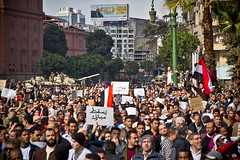
There's a domino effect underway in the Arab world. Tunisia was the spark, not only because its uprising came first but because the people of Tunisia won and the dictator fled. Egypt remains for the United States the most important strategic Arab ally.

The fall of Hosni Mubarak, the U.S.-backed dictator in power for more than three decades, would mean an end to Washington's ability to rely on Cairo to stave off Arab nationalism and independence and an end to Egypt's role as a collaborator in the Israeli occupation of Palestine. Whatever happens, what's likely, though not inevitable, is that never again will Tunisia be used as a transit point or Egypt as a "black site" secret prison for U.S. agents engaged in the "extraordinary rendition" of detainees for interrogation and torture.

Stirrings of popular dissent are already underway in Yemen and Jordan too. All the other U.S.-backed monarchies and pseudo-democracies across the region are feeling the heat. The U.S. empire in the region is crumbling.

Tipping Points
The alliances of the last half century are being shattered, the old order is ending. What's next? As is always the case when revolutionary processes erupt, it's still too soon to tell. Things move slowly until a sudden tipping point, and then it's all too quick, too sudden to keep up.

The breadth of public participation is key for understanding the implications of these uprisings. In Tunisia, the protests involved workers and middle class professionals, but were composed at the core by disenfranchised, disempowered, and educated unemployed people. Mohammed Bouazizi, a young man in the impoverished town of Sidi Bouzid, symbolized these demonstrators by setting himself ablaze to protest not only unemployment and poverty, but also the humiliation and degradation he faced.

Among the hundreds of thousands across Tunisia who marched, chanted, demanded, and won the abdication of their longstanding dictator, thousands are the young men and women whose college degrees have provided no security, whose lives were constrained by the lack of jobs, lack of opportunities, and lack of hope.

In Egypt, participation was even broader. The thousands and hundreds of thousands filling the streets, occupying Cairo's famed Tahrir (Liberation) Square, include not only the most impoverished of Egypt's urban slums and rural farmers and peasants. They also include the educated, the middle classes, even many of the wealthy, all finally saying no to the paucity dignity and freedom of their lives. Their demand was clear: not just reform, not just new elections, but an end to the Mubarak regime.

It is also important to recognize what the demands in Tunisia and most essentially in Egypt were not about. They were not about opposition to the United States; we have not seen the U.S. flag burning or crowds attacking the U.S. embassy. They were not even about Egypt's thirty years of collaboration with Israel's occupation, especially its role in maintaining the siege of Gaza – opposition to which is arguably the greatest point of political unity in the country. People have been very clear – and very public in the media – about their awareness of and outrage towards the U.S. history of arming Mubarak with the very weapons killing protesters in the streets; the "Made in USA" tear gas canisters from Jonestown, PA are featured all over the media. But the demands of this mobilization are directed to domestic, internal issues, aimed at changing the very nature of the ruling structures of the country and its impact on the people who live there. Foreign policy will come just a little bit later.

It's very telling that today in Jordan, King Abdullah sacked the current government cabinet, and appointed a new prime minister, as popular unrest there grows.
http://www.bbc.co.uk/news/world-middle-east-12336960

But will that be enough to satisfy the demands of the people of that country for political and economic justice? Probably not, with the active inspiration now being provided by the people of Egypt. So Jordan may be next in line to finally see a more democratic government. Isn't it amazing and inspiring, how quickly and suddenly positive changes like this can occur, that seemingly come out of the blue. These events are reminiscent of the fall of the Berlin Wall in 1989, as East Germans finally were able to achieve their dream of reunification with the West. 

But we here at A.P.R. view these events in Tunisia and Egypt, as even more hopeful. As they are so inspirational, showing that the aspirations of long-suffering impoverished peoples can be achieved, when they come together in solidarity, and stand up to the forces of oppression. It does almost seem like a wildfire, or even, conflagration, is beginning, of uprising against the global corporate oligarchy

Major ramifications of these events for the U.S. empire are many. For one thing, whatever new government Egypt ends up with, and other countries (and there will be others), will be less likely to follow the unjust economic policies that kept most of their population in poverty. They will demand more control, and more just compensation, for their resources, which are usually extracted by US and European corporations. Of course, oil springs instantly to mind here, so the major oil companies will probably have to make concessions to these new governments. Oil prices will most certainly rise greatly in the US and Europe, over the next few years, leading to inflation, and an even worse economic situation for most people. With the already high unemployment levels, significant inflation and even worsening job creation prospects, we think it will only be a matter of time, before significant pressure begins to develop in this country. For things like jobs programmes, and universal health care. The US corporate media so far hasn't really been able to demonise the Egyptian protestors, and have even (some of them, not Faux News of course) shown rather thorough coverage of the situation there. 

This will only help to embolden people in the US, and we must, all of us, when we talk with people about what is happening in Egypt, and other countries, spread the word, that yes, positive change, can happen here! 

In spite of the billionaire-supported ravings of racist fringe people like Glenn Beck:

http://www.commondreams.org/headline/2011/01/30-1

Frances Fox Piven Defies Death Threats After Taunts by Anchorman Glenn Beck

by Paul Harris in New York 

Frances Fox Piven is not going into hiding. Not yet.

[Frances Fox Piven]Frances Fox Piven
The 78-year-old leftwing academic is the latest hate figure for Fox News host Glenn Beck and his legion of fans. While she has decided to shrug off the inevitable death threats that have followed, she is well aware of the problem. "I don't know if I am scared, but I am worried," she told the Observer as she sat in a bar on Manhattan's Upper West Side.

"At the start I thought it was funny, but now I know that is dangerous... their paranoia works better when they can imagine a devil. Now that devil is me."

For the past three weeks Beck has relentlessly targeted Piven via his television and radio shows as a threat to the American way of life, seizing on an essay that she and her late husband wrote in 1966 as a sort of blueprint for bringing down the American economy.
Called The Weight of the Poor, it advocated signing up so many poor people for welfare payments that the cost would force the government to bring in a policy of a guaranteed income. For Piven, a committed voice of the left, known in academic circles but little recognized outside them, it was just one publication in a lifetime dedicated to political activism and theorizing.

For Beck, however, Piven is a direct threat to the US. In show after show, the rightwing commentator has demonized Piven and framed her as part of a decades-old conspiracy to take over the country that culminated in the election of President Barack Obama. Beck's heated language has provoked a tidal wave of death threats against both Piven and her academic colleagues at the City University of New York.

The threats are blunt and - in light of the recent shooting of Arizona congresswoman Gabrielle Giffords - truly frightening. Many appear on Beck's news website, The Blaze. "One shot... one kill," wrote one. Others are sent directly to her email address or those of her colleagues. There are so many that she has contacted the police and this week will ask her college to make a formal complaint to the FBI.

Despite that real security fear, she refuses to back down. Indeed, for someone portrayed as a revolutionary communist, Piven's choice of a meeting place with the Observer was a sly poke back at her critics: a Cuban hangout called Havana Central.

It is typical of Piven. The spry, twinkle-eyed academic pulls no punches when talking of Beck. "He is a very neurotic and peculiar type of person. I don't think he is capable of sane discussion," she said. And his supporters? "They creep me out."

One thing to remember, the numbers of the mainly aging, white, male, racist people in the US are dwindling. So even though the corporatocracy/oligarchy are using/supporting people like the Tea Party, Glenn Beck, and Rush Limbaugh, to continually scapegoat and demonise progressives and minorities, their influence will continue to decline. Especially now, in light of current events. Amen to that!

So, again, here's to the valiant people of Tunisia and Egypt, and the other countries to come! Thank you for your courage and inspiration, lighting the way for people all over the World, in their quest for sane and just political and economic systems! Cheers.

Monday, January 17, 2011

TOP TO BOTTOM [and] LET'S NOT FORGET

South-Central Alaska experienced a massive chinook/warm-up beginning New Year's day, for four days. Well-above freezing temperatures of 5-8C (41-47F) were accompanied by strong southeast winds and rain in some areas, and so here around Anchorage, half the snowpack melted, and our nordic skiing trails were reduced to slabs of dirty, wet ice, which then  re-froze into treacherous sheets. 

With conditions like these, skiing became less attractive and so running and hiking were going to have to substitute. So last sunday the 9th, we decided to summit Konoya Point, behind the Chugach Front Research Centre, a very prominent point visible right out our windows.

The trail ascends quickly up the drainage of the North Fork of Campbell Creek, reaching the tree-line of 760 metres (2500 ft) in about 5 KM. It was a mild sunny day, about -5C (23F) at the start, just a 100 metres or so above sea level, thanks to high pressure ridging still dominating the area. In fact, a very unusual pattern was occurring, an exceedingly strong, record-breaking high pressure ridge was in place over western Alaska (more on this later). 

Since I wasn't sure how much snow would be on the route, and in what condition, I wore my Katoola shoe chains over my boots, which are like mini-crampons, and brought my snowshoes in my pack, in case we had to go through deep, loose snow. But the strong winds (probably well in excess of 100 kph or 60 mph) the week before had blown off much of it above tree-line, and what was left was packed brick-hard. I never ended up using my snowshoes, and with the Katoola's, felt like a fly climbing a wall, on the steep, sometimes icy sections. 

Just above the first bench, above tree line, around 1000 metres (3300 ft.), we could see 5315 metre (17,450 ft) Foraker shining in the distance. Denali is just beside it, behind the slope. We often get more clearing and nice sun in the winter, when we have offshore flow from the interior.

Anchorage was bathed in fog below, and colder, under it's valley temperature inversion. Probably around -12C (10F).  The downtown skyscrapers (such as they are...not much by lower 48 big city standards!) were just visible poking through.

Our objective was visible above, the 1433 metre (4700 ft.) summit of Konoya. It's mostly just a steep walk, very steep in some sections, but there are some rocks to clamber over at the very top.

Since we didn't get started until just after 1030, we had lunch about halfway in, around 1400, on  a nice little ledge, not far beneath the summit. Once we got above 1220 metres (4000 ft.), a northeast breeze, probably just 10-20 kph, combined with the temperatures around -7C, made it feel cooler. 

Homer and Mattie both were having a great time exploring the icy, rocky, snowy expanse. Homer still can walk about anywhere, but his back legs are weaker now, since he's 14. Just below the summit, the trail gives out, and the rest of the way is finding the best way, with some rock scrambling. 

Homer actually chose to stay behind for the summit "push", I think due to his weaker back legs. Mattie of course, is unstoppable, and so she chose to appear in my self-timed picture there. It was a little windier, probably around 20-30 kph, so we didn't stay up too long, and it would be getting dark in a few hours. The part of the trail down in the canyon near the start was exceedingly icy, and we wanted daylight for that.

Heading back down, the Anchorage "bowl" began to be bathed in the gentle rays of the late afternoon winter sun. Denali and Foraker, being fully visible, as well. The Chugach Front Research Centre is right at the base of these slopes, but we have to take a circuitous route on different trails, to reach this area. 

More of the city began to appear, as the fog burned off a little. Sure is a beautiful place we live in. I can't think of any cities with terrain like this, so close at hand, except maybe Salt Lake City. The pack ice in Cook Inlet had been pushed to the west side and had melted substantially, by the New Year's warm-up. The inlet never freezes solid, our 8 metre daily tidal range prevents that from happening, no matter how cold it ever gets. 

There are certain times when Homer's wolfiness becomes more apparent. I always love it when he is walking in settings like this, and that really comes out. As far as I know, he is at least one-quarter wolf, though I know very little of his background, what his parents were like. I'd like to find out. Wolf hybrids have gotten a bad rap, Nimbus, the gentle wolf/husky giant I had for six months in 2006, was the sweetest, kindest, most timid large dog I had ever met.
http://akprogressive.blogspot.com/2009/10/alaska-sled-dogs-edge-of-wild.html
As we got lower, and the lighting more orange and subdued, the "fata morgana" mirages began appearing more prominent in the mountains across the inlet. These are caused by strong temperature inversions in the atmosphere, the density gradients in the different layers act as lenses, distorting distant features. These little mountain-tops near Redoubt (the larger volcano, with just a bit of steam issuing forth) were looking rather interesting, so we had to stop and get a picture. By this time we were back below tree line.

We finished up around 1700, just as darkness descended. What a fantastic day for an outing like this. When the days get longer, we'll be able to do 30-50 km traverses across even higher ridges from this area. Looking forward to it!

Since this was the top of the terrain, around the Anchorage Bowl, our next outing several days later, was to hopefully explore the bottom. Specifically, to ski part of the Iditarod trail in the beautiful 2000-2300 metre (6500-7500 ft) deep canyon of the Eagle River, about 25 km north of the Anchorage bowl. This deep canyon receives no direct solar radiation for at least three months in winter, and is usually the coldest spot in the entire area. We were hoping it hadn't warmed up as much in there with the New Year's chinook, so that the skiing would be better, than here in town. 

Sure enough, when we arrived there on 1/13, it was -26C (-15F), but the ranger working at the Nature Centre, told us it was unski-able. They had four days of temperatures starting 1/01, of 5-8C (40-46F), with rain and strong east winds funneling through the deep canyon.  Yep, the trail was just a solid slab of dirty ice, totally unski-able. I just kept walking in my ski boots, hoping that the further I went in, the better it might get, but it was getting worse! In some places, the snow was just in patches of ice, looking like late April or early May! So we only walked about 4 km in, then came back out. What a disappointment. We headed back to Hillside Park in Anchorage, where I classic skied with Homer and Mattie running along-side, for a few hours.

Speaking of warm-ups, chinooks, and high pressure ridging, the pattern we had in Alaska 7-10 days ago was very unusual, and worth commenting on. 

In this image, a standard 500 millibar analysis for the 11th of January, something really stands out. 500 millibar analyses are a standard reference level meteorologists use in weather forecasting. Millibars are an atmospheric pressure unit, sea level pressure is usually around 1000 millibars. The height at which the pressure equals a certain value is a function of the air-mass temperature. The warmer the air-mass, the higher these heights will be for a given pressure, since warmer air is less dense, and will occupy more volume. Thus, the 500 millibar charts, are a contour map, showing forecasters the flow pattern (parallel to the contours) and features at this level, around 4800 to 6000 metres (depending on the temperature, 15,700 to 20,000 ft). 

Well, on this map, above, what looks like a bubble, over Alaska, is an exceptionally strong high pressure ridge, a mass of warm air. 500 mb heights reached 5830 metres in the centre of it, over 600 metres higher than average for this time of year. Free-air freezing levels were as high as 3050 metres (10,000 ft) in western Alaska inside it. Think about that, there in arctic Alaska, in early January, except for shallow surface-based temperature inversions (because of no solar heating), the temperature was above freezing all the way up to 3050 metres! These heights are measured by radiosonde balloons twice daily world-wide, and the database extends back to 1948. This ridge is the strongest one to ever have occurred over Alaska in winter, since the beginning of the measurement database. And the second strongest ever recorded, period, in this part of Alaska! The colour shading on the map is the temperature at the 850 millibar pressure level, also temperature-dependent, but generally, around 1250 to 1500 metres (4100-5100 ft.)  What this shows, is that the air at 850 mb in this high pressure ridge, is of the same temperature of that in most areas around 30-38 degrees north, the subtropics. That warm subtropical air was brought north to the Arctic by a south flow ahead of lows much further south. This always, and has always been occurring. Just in the past few decades, this pattern is stronger, more persistent, and more frequent. This would have been exceptional in June or July, but in January, what gives?

Transport of warmer air poleward by the jet stream, is how the global energy balance between the tropics and poles is maintained. Again, since the Earth's atmosphere is warming due to the increasing levels of CO2 and methane from fossil fuel combustion and deforestation, these ridging patterns are therefore becoming stronger, more frequent, and more persistent. It is actually fortunate this one occurred in January here. Had it been in summer, a strong warm spell and drought would have led to high fire danger in the Alaska Interior. The extreme drought, heat, and wildfires in Russia last summer, as well as in Australia two years ago, were caused by excessively strong, record-breaking, high pressure ridging. Something we'll be writing more about in the coming months. 

                                  LET'S NOT FORGET

Today, of course, is the 82nd anniversary of the birth of America's most prominent spokesman for peace, civil rights, and political and economic justice. Dr. Martin Luther King. Rather than write a new tribute to this great man, who was murdered by the corporatocracy on the 4th of April, 1968 (exactly one year to the day after his landmark speech where he spoke out strongly against the Vietnam War and US militarism in general), we think this one from a year ago speaks quite well. 

His murder was a great loss to the world. He was just beginning to gather momentum in his push for social and economic justice in the US, after his civil rights work. Which was why he was murdered. We often wonder, what things would be like, had this not happened. Would the Vietnam War have ended sooner? Would the US have become less militaristic? Would we have a more sane and just political and economic system here, more in line with the rest of the "developed" countries, with things like universal health care and jobs programmes? Let's all remember, just exactly why it was that he was murdered, and not let what he was working for go unfulfilled. Cheers.

Thursday, December 30, 2010

SOMETHING NEW UNDER THE SUN? [and] THE BAD WITH THE GOOD

                        SOMETHING NEW UNDER THE SUN?

We came across this article on the BBC News web-site week before last. It is about a new technology under research that is very interesting, and potentially, could go a long way, if developed fully, to meeting much of the World's energy needs. Take a look, then we'll give you our view on this interesting research. 


New solar fuel machine 'mimics plant life'


In the prototype, sunlight heats a ceria cylinder which breaks down water or carbon dioxide  
In the prototype, sunlight heats a ceria cylinder which breaks down water or carbon dioxide
 
A prototype solar device has been unveiled which mimics plant life, turning the Sun's energy into fuel.
The machine uses the Sun's rays and a metal oxide called ceria to break down carbon dioxide or water into fuels which can be stored and transported. 

Conventional photovoltaic panels must use the electricity they generate in situ, and cannot deliver power at night.  Details are published in the journal Science.

The prototype, which was devised by researchers in the US and Switzerland, uses a quartz window and cavity to concentrate sunlight into a cylinder lined with cerium oxide, also known as ceria.

Ceria has a natural propensity to exhale oxygen as it heats up and inhale it as it cools down.
If as in the prototype, carbon dioxide and/or water are pumped into the vessel, the ceria will rapidly strip the oxygen from them as it cools, creating hydrogen and/or carbon monoxide.

Hydrogen produced could be used to fuel hydrogen fuel cells in cars, for example, while a combination of hydrogen and carbon monoxide can be used to create "syngas" for fuel. It is this harnessing of ceria's properties in the solar reactor which represents the major breakthrough, say the inventors of the device. They also say the metal is readily available, being the most abundant of the "rare-earth" metals. Methane can be produced using the same machine, they say. 

Refinements needed:
The prototype is grossly inefficient, the fuel created harnessing only between 0.7% and 0.8% of the solar energy taken into the vessel. Most of the energy is lost through heat loss through the reactor's wall or through the re-radiation of sunlight back through the device's aperture. But the researchers are confident that efficiency rates of up to 19% can be achieved through better insulation and smaller apertures. Such efficiency rates, they say, could make for a viable commercial device.

"The chemistry of the material is really well suited to this process," says Professor Sossina Haile of the California Institute of Technology (Caltech). "This is the first demonstration of doing the full shebang, running it under (light) photons in a reactor." She says the reactor could be used to create transportation fuels or be adopted in large-scale energy plants, where solar-sourced power could be available throughout the day and night. However, she admits the fate of this and other devices in development is tied to whether states adopt a low-carbon policy. "It's very much tied to policy. If we had a carbon policy, something like this would move forward a lot more quickly," she told the BBC. It has been suggested that the device mimics plants, which also use carbon dioxide, water and sunlight to create energy as part of the process of photosynthesis. But Professor Haile thinks the analogy is over-simplistic.

"Yes, the reactor takes in sunlight, we take in carbon dioxide and water and we produce a chemical compound, so in the most generic sense there are these similarities, but I think that's pretty much where the analogy ends."
The PS10 solar tower plant near Seville, Spain. Mirrors concentrate the sun's power on to a central tower, driving a steam turbine The PS10 solar tower plant near Seville, Spain. Mirrors concentrate the sun's power on to a central tower, driving a steam turbine
 
Daniel Davies, chief technology officer at the British photovoltaic company Solar Century, said the research was "very exciting".  "I guess the question is where you locate it - would you put your solar collector on a roof or would it be better off as a big industrial concern in the Sahara and then shipping the liquid fuel?" he said.
Solar technology is moving forward apace but the overriding challenges remain ones of efficiency, economy and storage.

New-generation "solar tower" plants have been built in Spain and the United States which use an array of mirrors to concentrate sunlight onto tower-mounted receivers which drive steam turbines.A new Spanish project will use molten salts to store heat from the Sun for up to 15 hours, so that the plant could potentially operate through the night. 

This is really exciting. Think about it, CO2, the greenhouse gas pollutant that is building up inexorably in our atmosphere, from fossil-fuel combustion, and that is poised to reach 550-600 ppm concentration by mid-century (it is now about 392ppm), could actually be converted with sunlight, back into fuel. A cycle that would add no net CO2 into the atmospheric system, if developed and implemented on an emergency, mass scale, world-wide. The 550-600 ppm CO2 concentration expected to be reached in mid-century, is one not seen by humanity, ever. Global climate-change modeling suggests world-wide average temperature increases of 3-5C with this. Which may not seem cause for alarm, but we've already had about a 1C increase since 1900. And we've documented what has, and is occurring here. The Arctic Ocean summer-ice shrinkage, which is happening far faster than modeling had been suggesting. Increasing forest-fire severity and longer fire season duration in Australia, North America, and Russia/Siberia. A stunning 40 percent loss in the production of phytoplankton in the oceans, since 1950, which is the base of the marine food chain, due to warmer seawater. Droughts and floods on every continent, more frequent, and more severe. 

So do we think this research will receive the funding and emphasis it deserves, by the US, and other developed countries? Unfortunately, no. Because we know who really dictates policy to the US and to different extents, the other industrialised countries.

Which is to say, producing hydrogen, or natural gas this way, would not be as profitable, as oil extraction/use currently is, for the large corporations. So, there will have to be concerted pressure on politicians by the populace in the US and all the other industrialised nations, to shift resources and attention to alternative energy research and development, before global sea-level rises of up to ten metres, from Greenland, and northern Canadian island rapid ice sheet melting occurs. How much longer do we have, before this could happen? 30-40 years, at best. 

The US defense budget is now almost a trillion dollars annually, after factoring in the costs of the Iraqi and Afghani occupations. More than all the rest of the World combined, and at least six or more times that of China, the next biggest spender. And what is there to show for it?

You aren't seeing these kind of images on the US corporate media, but this is what is occurring, and has been, in Iraq and Afghanistan, on a daily basis, for many years now. Afghanistani military operations have now gone on longer than any other US war? Why?The UN has estimated that for 47 billion USD, all the people in the World, who need clean water, could be provided it. Think about that. One-twentieth of the annual US defense/offense outlay. Which do you think would bring greater global good-will and safety?


"...A true revolution of values will soon look uneasily on the glaring contrast of poverty and wealth. With righteous indignation, it will look across the seas and see individual capitalists of the West investing huge sums of money in Asia, Africa, and South America, only to take the profits out with no concern for the social betterment of the countries, and say, "This is not just." It will look at our alliance with the landed gentry of South America and say, "This is not just." The Western arrogance of feeling that it has everything to teach others and nothing to learn from them is not just.

A true revolution of values will lay hand on the world order and say of war, "This way of settling differences is not just." This business of burning human beings with napalm, of filling our nation's homes with orphans and widows, of injecting poisonous drugs of hate into the veins of peoples normally humane, of sending men home from dark and bloody battlefields physically handicapped and psychologically deranged, cannot be reconciled with wisdom, justice, and love
. A nation that continues year after year to spend more money on military defense than on programs of social uplift is approaching spiritual death." (4 April, 1967)

But it is corporate profit that drives our military spending, operations, and governmental policy, in general. Which is why the new solar technology we just presented, will have a tough time expanding, unless big changes occur in our system of government. We'll leave it to you to judge for yourselves, about where the US is, as a nation, spiritually speaking, according to MLK's guidelines. 

                         THE BAD WITH THE GOOD

We often scan the BBC News web-site, just for quick updates on fast-moving global events, such as natural disasters, political upheaval, etc.. The A.P.R. understands that although it is from a European country, and hence, less likely to be corrupted by the usual US corporate media's sports/celebrity/fluff bread-and-circus pulp for the masses, it still is an entity of the U.K. government. And hence, not to be fully trusted for some categories of news and events. But when we came across this, yesterday, we were appalled! This is blatant propaganda, and for us, totally untrustworthy. So much so, we are even going to seek a second opinion on this, more on that to come, in the weeks ahead. But for now, give this a look, supposed Peruvian Shamans, in a ceremony.

There are so many things wrong with this, it's hard to know where to begin. Firstly, any shamanic practitioner world-wide, who knew the truth about Wiki-leaks exposes of how the global elite works, and it's courageous head, Julian Assange's travails as he faces possible extradition, to the US, followed by torture and murder or a long prison sentence, would never behave in this way. 

Second, most shamanic practitioners, world-wide, don't engage in behaviours like that anyway, cursing and demonising actual people. They are healers, who access alternate levels of reality to gain information and energy to heal their people, and bring beneficial things like rains for the crops, or locations of animals to hunt for their food supply. 

It's frankly disgusting, that these people were put up this way, probably by the Peruvian government, with some help from the US/UK. To soften up the populaces of both these countries, for Julian Assange's likely deportation and torture. 

As Paul Craig Roberts, former Assistant Secretary of the US Treasury, in the Reagan Administration, astutely puts it: 

"Today the press is a propaganda ministry for the government. Any member who departs from his duty to lie and spin the news is expelled from the fraternity.  A public increasingly unemployed, broke and homeless is told that they have vast enemies plotting to destroy them in the absence of annual trillion dollar expenditures for the military/security complex, wars lasting decades, no-fly lists, unlimited spying and collecting of dossiers on citizens supplemented by neighbors reporting on neighbors, full body scanners at airports, shopping centers, metro and train stations, traffic checks, and the equivalence of treason with the uttering of a truth. 
     
Two years ago when he came into office President Obama admitted that no one knew what the military mission was in Afghanistan, including the president himself, but that he would find a mission and define it. On his recent trip to Afghanistan, Obama came up with the mission: to make the families of the troops safe in America, his version of Bush’s “we have to kill them over there before they kill us over here.”

No one snorted with derision or even mildly giggled. Neither the New York Times nor Fox News dared to wonder if perhaps, maybe, murdering and displacing large numbers of Muslims in Iraq, Afghanistan, Pakistan, and Yemen and US support for Israel’s similar treatment of Lebanese and Palestinians might be creating a hostile environment that could breed terrorists. If there still is such a thing as the Newspaper Publishers Association, its members are incapable of such an unpatriotic thought.

Today no one believes that our country’s success depends on an informed public and a free press. America’s success depends on its financial and military hegemony over the world. Any information inconsistent with the indispensable people’s god-given right to dominate the world must be suppressed and the messenger discredited and destroyed.

Now that the press has voluntarily shed its First Amendment rights, the government is working to redefine free speech as a privilege limited to the media, not a right of citizens. Thus, the insistence that WikiLeaks is not a media organization and Fox News turning in a citizen for exercising free speech. Washington’s assault on Assange and WikiLeaks is an assault on what remains of the US Constitution. When we cheer for WikiLeaks’ demise, we are cheering for our own."  Cheers.   

Friday, December 24, 2010

SOLSTICIAL GREETINGS 2010 [and] DOWN AT THE BEACH

                 SOLSTICIAL GREETINGS

Solstices have great meaning to those of us living in the Northland, especially the Winter Solstice, as it means now that our short days will be getting minutes longer every day, and our low mid-day sun, creeping back higher, giving us a little more warmth. At least here in the Anchorage area, we get a minimum sun angle of five degrees above the horizon, low, but still just enough to slightly add a few degrees of warmth to the day. 

We here at A.P.R. like to imagine what our distant ancestors in pre-Roman and pre-Christian Europe did to observe these significant times, since they were even more important to them, tied so strongly to the rhythm of the seasons, as they were. These people who raised Stonehenge (and it is still unknown how, 4-5000 years ago!), and left all manner of strange stone monuments and structures tied to geographical and seasonal patterns throughout Europe.
It is also the time to reflect on the previous year's events. Rather than focus on the sad, dangerous, or unhealthy ones, let's at least see what we can be thankful for. Sarah Van Gelder in this article, gives us ten hopeful stories: 
http://www.commondreams.org/view/2010/12/23-3

10 Most Hopeful Stories of 2010

There was plenty of disappointment and hardship this year. But the year also brought opportunities for transformation.

by Sarah van Gelder
It was a tough year. The economy continued its so-called jobless recovery with Wall Street anticipating another year of record bonuses while most Americans struggle to get work and hold on to their homes. The wars in Iraq and Afghanistan continued, and spilled over into Pakistan and Yemen, and more American soldiers died by suicide than fighting in Afghanistan. And it was a year of big disasters, some of them indicators of the growing climate crisis.

World leaders, under the sway of powerful corporations and banks, have been unable to confront our most pressing challenges, and one crisis follows another.
Nonetheless, events from 2010 also contain the seeds of transformation. None of the following stories is enough on its own to change the momentum. But if we the people build and strengthen social movements, each of of these stories points to a piece of the solution.

1.    Climate Crisis Response Takes a New Direction. After the failure of Copenhagen, Bolivia hosted a gathering of indigenous people, climate activists, and grassroots leaders from the global South—those left out of the UN-sponsored talks. Their solution to the climate crisis is based on a new recognition of the rights of Mother Earth. Gone are notions of trading the right to pollute (which gives a whole new meaning to the term "toxic assets"). Instead, life has rights, and we can learn ways to live a good life that doesn’t require degrading our home.

The official climate agreement that came out of Cancún was weak and disappointing, although it did represent a continued commitment to work to address the challenge. But the peoples' mobilizations, and the solutions born in Cochabamba, continue to energize thousands.

Meanwhile, Californians voted to uphold their ambitious climate law, despite millions spent by oil companies to rescind the measure in November's election. And cities—Seattle, for one—are moving ahead with their own plans to reduce, and even zero-out, their climate emissions.

2.    Wikileaks Lifts the Veil. The release of secret documents by Wikileaks has lifted the veil on U.S. government actions around the world. While the insights themselves don't change anything, they do offer grist for a national dialogue on our role in the world—especially at a time when our federal budget crisis may require scaling back on our hundreds of foreign military bases, our protracted overseas wars, and our budget-busting weapons programs. Likewise, the traumas inflicted on civilian populations and on our own military are spurring fresh thinking. We now have data points for a bracing, reality-based conversation on the future of war—the kind of conversation that makes democracy a living reality.

3.    Momentum is Building for the Abolition of Nuclear Weapons. The ratification of the START Treaty is an important step in the right direction. And the National Council of Churches, the U.S. Conference of Catholic Bishops, the U.S. Conference of Mayors, and others from across the political spectrum have joined UN Secretary-General Ban Ki-moon in calling for an even more ambitious goal: the end of nuclear weapons.

4.    Resilience is the New Watchword. As familiar sources of security erode, people are rebuilding their communities to be green and resilient. Detroit, a city abandoned by industry and many of its former residents, now has over 1,000 community gardens, a six-block-long public market with some 250 independent vendors, and a growing support network among small businesses. Around the country, faith groups and others are forming Common Security Clubs to help members weather the recession and consider more life-sustaining economic models. Communities are becoming Transition Towns as a means to prepare for breakdowns in society that may result from any combination of the triple crises of climate change, an end to cheap fossil fuels, and an economy on the skids.

5.    Health Care—Still in Play. The passage of the Obama health care package seemed to lock us into a reform package that maintains the expensive and bureaucratic role of private insurance and props up the mega-profits of the pharmaceuticals industry. But the story is not over. The decision by U.S. District Judge Henry Hudson to strike down the individual mandate in the health care reform may begin unraveling the new health care system. As insurance premiums continue their steep climb, some are advocating expansion of Medicare to cover more people—or everyone. Thom Hartmann points out this could be done with a simple majority vote in Congress—expanding Medicare to everyone was what its founders had in mind in the first place, he says.

Vermont is exploring instituting a statewide single-payer healthcare system. The United States may wind up following Canada’s path to universal coverage, which began when the province of Saskatchewan made the switch to single-payer health care, and the rest of Canada, seeing the many benefits, followed suit.

6.    Corporate Power Challenged. Small businesses are distancing themselves from the Chamber of Commerce, which promotes the interests of mega-corporations over Main Street businesses. And there are more direct confrontations to corporate power. The citizens of Pittsburgh, Penn., passed a law prohibiting natural gas “fracking,” and declaring that the rights of people and nature supersede the rights of corporations. Other towns and cities are adopting similar laws. The biggest challenge will be undoing the damage of the Citizens United decision, which opened the floodgates to wealthy special interests to spend what they like on elections. Groups around the country are gearing up to take on the issue, with a constitutional amendment just one of the potential fixes.

7.    A local economy movement is taking off as it becomes clear that the corporate economy is a net drain on our well-being, the environment, communities, and even jobs.  A “Move Your Money” campaign inspired thousands to close their accounts with predatory big banks, and instead, to open accounts at credit unions and locally owned banks. Schools, hospitals, local retailers, and families are increasingly demanding local food. Farmers markets are spreading. Independent, local stores have huge cachet as people look local for a sense of community. And the experience of one state with a budget surplus and very low unemployment is capturing the imagination of other states—North Dakota’s state bank is creating a buzz.

8.    Cooperatives Make a Comeback. A new model for local, just, and green job creation is gaining national attention. Leaders in Cleveland, Ohio, created worker-owned cooperatives with some of the strongest, local institutions (a hospital and university) promising to be their customers. The result: formerly low-income workers now own shares in their workplace and earn family-supporting wages. They can plan for their families’ futures, knowing that their jobs can be counted on not to flee the country. The model is spreading, and people now talk about how to bring "the Cleveland model" to their cities.

9.    A Turn Away from Homophobia. The revoking of Don’t Ask, Don’t Tell is just the most dramatic sign that the country has turned away from homophobia. A widespread anti-bullying campaign sparked by the suicide of Rutgers freshman Tyler Clementi led to an “It Gets Better” campaign with videos created by celebrities and others.

10.   Social Movements Still Our Best Hope. Thousands gathered in Detroit in June for the second US Social Forum, an event that galvanized grassroots social movements from across the United States. In Toronto, the meeting of the G20 was greeted by thousands of protesters, many of whom were subjected to police beatings and gassing. The Cancún climate talks brought caravans of farmer/activists and global justice activists as well as greens to press for a meaningful response to the climate crisis. Social movements are alive and well, even though they are disparaged or ignored by the corporate media, which choose to instead shower attention on the well-funded Tea Party. And movement leaders are connecting the dots between Wall Street’s plunder, growing poverty, and the climate crisis, and setting priorities instead for people and the planet.


The turbulence of our lives is increasing, spurred by the crises in the economy and the environment, growing inequality and debt, military overreach, deferred peacetime investments, and species extinctions. Turbulent times are also times when rigid belief systems and institutions are shaken, and change is more possible. Not automatic, and definitely not easy, but possible. The question of our time is how we use these openings to work for a better world for all life.

Sarah van Gelder is co-founder and executive editor of YES! Magazine, a national, independent media organization that fuses powerful ideas with practical actions for a just and sustainable world. Sarah is executive editor of YES!

It is so easy to get caught up in all the bad and dangerous events and situations in today's socio-political and environmental scene. So it's all the more vital to step back occasionally, and see what has gone right, in the past, and what is currently happening, that is hopeful. Not just in the World at large, but in our own lives too. So look back on your accomplishments and happy times this past year, there were many, and there will be many more! 

Let's take a quick look at how some things have changed in the last 50 years, for the better, here in the United States. In 1960, if you were a person of colour, that is, black, hispanic, indigenous, or asian, your prospects for employment, were much lower. You would have faced much greater harrassment in general, from law enforcement, for no specific reason. If any white person were to claim you were bothering them, the police would side with them, not you, and if you were assaulted or harrassed because of your ethnicity, you would have had no recourse. And of course, you had no real voting rights, or recourse if denied housing or loans because of your ethnicity.

In 1960, if you were a young single woman, you would have faced significant societal disapproval, if you were to remain unmarried beyond your late 20s. Forget about birth control, or pre-marital sex, those things were not encouraged, or approved (though they were still widely engaged in) of in 1960. 

In 1960, the air pollution in Los Angeles and New York, was much worse than it is today (though it's still not good!). In 1960, not much thought was given to environmental protections, and large industrial areas on the East Coast were blighted with air, water, and land pollution.

So those are just a few things where significant progress has been made in our society in the past 50 years. And how did they come about? Through direct action, by supporting movements for peace and justice, racial  equality, and environmental respect and protection, that were out protesting and demonstrating. Only then did the politicians respond. 


                                                DOWN AT THE BEACH

We are truly blessed in Anchorage to have not just the Chugach Mountains, to our east, to recreate in, but  semi-protected coastal areas as well. The Anchorage Coastal Trail runs through much of this, from downtown, then around the peninsula that is Anchorage, separating the Knik Arm of Cook Inlet, from the Turnagain Arm.

The Alaska Progressive Review staff love to spend time here as well as in the mountains. We even have a real beach, Point Woronzof, which is about a 2 km expanse of sand and gravel beneath the bluffs on which Anchorage International Airport is perched. And which offers beautiful views across Cook Inlet, to the wild and undeveloped Alaska wilderness. In summer, we can swim here and have a nice bonfire, while in winter, skiing on the Coastal Trail, on the bluff above, is a treat.

Although your lead editor had to work on the actual day of the solstice, this past 21st, I had yesterday off. I had wanted to celebrate the Solstice, and the fact that here in Cook Inlet, we have the northernmost winter semi-open water in North America, by plunging in to the icy waters, at least for a few seconds.

But it was not to be. As you can see here, at the Point Woronzof beach, although there is plentiful open water further out the Inlet, due to the high tidal ranges (8 metres!), a shorefast ice ledge drops 1-2 metres to the water, which is an undetermined depth. Unless I were to be roped up with my climbing harness on, with someone onshore to pull me out, to drop in here, would be to stay in!

So, the best I could do under the circumstances, was just a roll in the snow. But it was invigourating, and a good way to start out the new year. Since it was a cool -18C (-1F), with a light breeze, I wasn't bare for very long.

Today continued sunny and cool, under the northerly flow of dry, cold air from the interior. Although on days like this, it may be -40C north of the Alaska Range, here, where the wind is blowing, it was much warmer, only -12C (14F). Of course, the wind was blowing, in the exposed areas like Point Woronzof, as high as 30-60 KPH, but it still is better than having to deal with -40C!

So we decided to skate ski the entire Coastal Trail, which runs from downtown Anchorage, to Kincaid Park, south of the airport. We started at the Earthquake Park trailhead (this is the park which used to be a subdivision that slid into Cook Inlet during the 1964 quake, with many fatalities there...), and first skied north up to downtown, stopping at Westchester Lagoon. This is a small lake, fed by Chester Creek, that freezes solid, and then is maintained for ice skating.

When we got to the lagoon, and went out on it for a bit, Homer got a little uneasy. His footing on the ice is not as solid as Mattie's, since he has a little arthritis in his back legs. Much of the snow was scoured off the lake, by the north winds, in the part of it not maintained for ice skating.

So we then went back south to Earthquake Park, with the wind at our backs. About 2 KM south of Earthquake Park though, we got into a strange area. The snow turned brown, and I lost my glide completely. I was skiing on sand! I stopped immediately. I didn't want to lose my glide wax, but more importantly, did not want to destroy the gliding surface of my skate ski. On classic skis, we often sand the kick zone to roughen it up. Holds the grip wax on better, and when you do lose it, the sanded zone can still give you some grip on the snow. Just what you do not want on your skate skis!

So, I quickly soft-stepped back to where the snow was uncontaminated, and skated back out of there. What was happening, was that sand/dirt was blowing up the bluff in the strong north winds, and depositing there. So we had to go back to Earthquake Park, then drive past the dirty area, to the Point Woronzof parking area, the site of our Solstice Roll yesterday. We got back on the trail here, and had a beautiful time skiing/running down to Kincaid Park, then back.

Here is a little of what we saw:

Our tremendous tidal ranges in Cook Inlet move alot of water, in very short times. So massive ice chunks like these can be seen, stranded at low tide.  These must easily be three metres thick!

We love just seeing the interesting textures and patterns in the shorefast and moving packs of ice, in the waters flowing in the outgoing tide.

All in all, we just did about 30 KM today, on our back-and-forth outing on the Coastal Trail. But it sure was beautiful, and not bad skating conditions, considering the gusty north winds. How fortunate we are to live in such an interesting and diverse environment. Cheers, and Happy Solstice!