IN A TIME OF UNIVERSAL DECEIT...TELLING THE TRUTH BECOMES A REVOLUTIONARY ACT

"Capitalism is the astounding belief that the most wicked of men will do the most wicked of things for the greatest good of everyone." John Maynard Keynes

" Labor is prior to, and independent of, capital; that, in fact, capital is the fruit of labor, and could never have existed if labor had not first existed. Labor is the superior of capital and deserves much the higher consideration" Abraham Lincoln

Thursday, September 16, 2010

((CROW PASS)**2) [and] CRYOSPHERE TOMORROW?

                                       ((CROW PASS)**2)


Saturday last, we decided to run up Crow Pass, near Girdwood, then down the other side, to the Eagle River, then turn around about 21 km out, and return to the trailhead. This is a beautiful area in the Chugach Range, just about 60 KM east of Anchorage, with a little higher mountains, up to 2000-2500 metres, than the ones nearer to the Chugach Front Research Centre.

It is also part of the route for a really tough, almost-marathon length race every July, the Crow Pass Crossing. Which starts at the trailhead near Girdwood, crosses the pass, runs down the trail to the Eagle River ford, which is a challenge, crossing the fast-flowing, cold river, ending up at the Eagle River Nature Center, 40 km from the start. But since Homer, like most sled dogs, doesn't like crossing streams much deeper than his knees, and it would likely have been too high in the afternoon anyway, from glacial melt, we decided to just do the out and back. The double summitting of the pass we felt, more than makes up for the lack of the challenge of fording the Eagle River.

So we made it to the trailhead around 1100 and started up. It was the second day of a wonderful break in our long, gloomy, summer weather we had this year, which is still going on, thanks to a persistent high pressure ridge. Which had this strong of one been in place last June or July, would have given us record high temperatures and wildfires. But this late in the season, what we are getting instead, are clear, cool days and nights, with fog around the Cook inlet, which is playing havoc with Anchorage's busy airport.

Heading up the trail, we were awestruck by the verticality of the terrain here. Tree line is only around 600 metres here, and we quickly got above that and enjoyed the scenery. Ragged Top mountain here rises to 1591 metres (5218'), 1220 metres above the trailhead. And the mountains rise even higher as the trail ascends.

The trail splits about 4 km in, one section goes up gradually, into some gold mining ruins abandoned in 1940, before a rapid ascent to the pass, while the other ascends at a steady, moderate rate up to the pass, above the ruins. After approaching the ruins, we went off-trail to go up to the upper route, as we liked it's more steady ascent up to the pass. And this is the route that the Crow Pass Crossing race uses.

We reached the pass, 6 km in, in 50 minutes (it's slow running uphill!). Homer was running strong, and we were hoping that would continue, since at 14, he is an older dog, especially considering his size.

The top of the pass was just as, or even more beautiful, with small lakes, and high peaks all round. We kept running, wanting to get up and over, but it was tempting to slow down and savour this incredible scenery.

There is a small USFS cabin that rents out, and another under construction that will be ready next year. We will definitely be renting one then, to use as a base to explore and climb the surrounding peaks and high country.

Mattie of course was in heaven, I think she was wet continually, the whole time we were on this outing. Because there are so many streams and ponds, for her to get into. Which she wasted no time in doing.

When we got to the top of the pass, we could look down, and see our objective, in the far distance. The Eagle River crossing, behind which rear the higher 2000-2500 metre peaks in the heart of the Chugach range, which are extensively glaciated.

As we dropped down from the pass, it got quite steep, and in some sections, quite precarious, with sheer drops of 30-50 metres, while the trail was only 15-20 cm wide. We definitely had to watch our step!

But the scenery continued to be stunning on all sides. Raven glacier was on our left (east) side, shining beautifully in the sun. It was clear though, that it has receded quite a bit, judging from the newly exposed unvegetated rocks at its base (more on this later).

As we dropped further and got down to a little less steep and precarious sections, the view was a little different. Instead of a glacier on our left side, the mountainsides had these beautiful little cascades flowing down, of clean, clear water. One of which we drank from later, when our water ran out.

At the end of the steepest section on the north side of the pass, was our only unbridged major stream crossing. Clear Creek, which emanates from Clear Glacier. I took off my shoes and socks, and strolled across, after having an energy break. On the way back, I drank heavily from it's beautiful blue, clear water, and it was great!

A few km north of this crossing, the trail crosses Raven Creek, which has cut a sheer 30-40 metre deep cleft through solid rock. Truly amazing to contemplate, as the little bridge crosses over it, and pictures just cannot do it justice. To see this large, boiling stream straight down through this narrow gorge is an amazing sight. Something not possible to see in the Interior!

I had to get after Mattie and Homer though, they were getting out to the edge of this sheer drop-off, harvesting tasty ripe blueberries. But I was afraid they would lose their footing, which would have been fatal, so called them back.

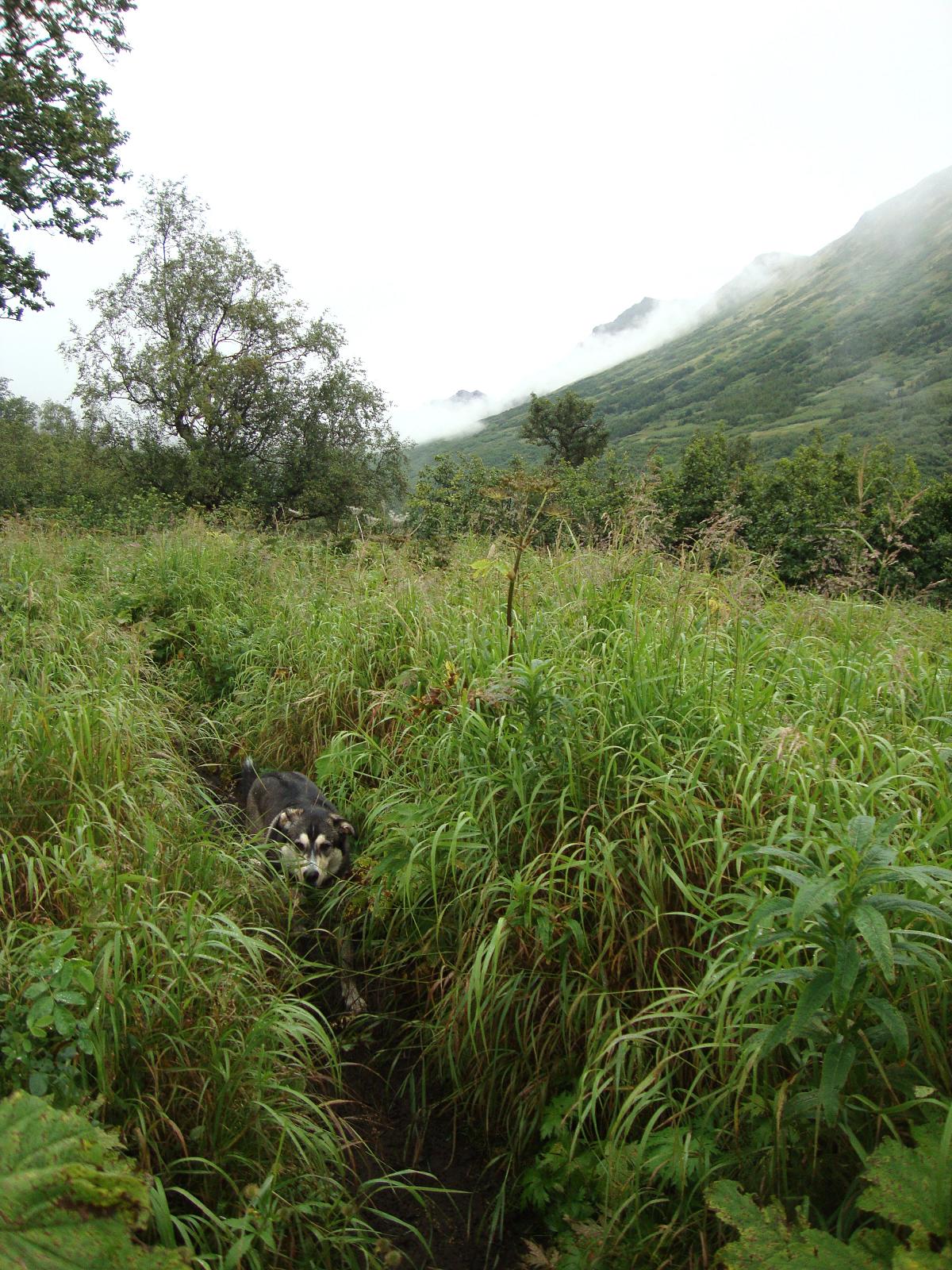
After this amazing gorge, the trail then took on a much different character. As we descended more slowly down the valley of Raven Creek toward the Eagle River, it got muddier, and went through dense thickets of alder and willows, and tall grass. Roots and slippery muddy rocks were always a problem, and hard to see, with the dense, overgrown vegetation around the trail. As we got closer to the Eagle River, some beautiful mountain ash trees made an appearance, backed by the higher mountains. We got tired of this overgrown, muddy, rocky trail though, and decided to turn back, shortly before reaching the Eagle River. We wanted to be in the sun, in the higher terrain, with the beautiful mountains surrounding us, not in the alder/willow thickets. This was about 19 km and 2 1/2 hours in.
The way back was much harder, as it was steeper going up the north side of the pass, than the south side had been. I decided to just walk the rest of the way back, it was so steep, and, it was so beautiful out, I wanted to spend more time in this beautiful area. Fast-packing for me is always a spur-of-the-moment decision, as far as how it will be done. If the trail or route is not too steep, I'll run the majority of the 40-65km, otherwise, I'll run some, and walk a good percentage, as well. In this case, I probably ran 14-16 of the 39 km of this outing.
I was sweating hard coming back up the steepest part of this route, it was fairly mild, 15-17C or so, and in the bright sun, I was quite warm. I had to stop a couple times and hydrate, it's amazing how thirsty I get, and how much water weight I can lose on these kind of outings.

We stopped at the top of the pass, and rested a bit, and I drank almost all the water I had filled my bottles with in Clear Creek earlier, after having my lunch there. 
I also went in the little lake up to my thighs there, I was already getting sore, from the double pass ascent of 1524 metres (5000'), and that cold water felt good. After that, we just walked the rest of the way down, enjoying the inspiring scenery and warm early fall sunshine. We reached the trailhead around 1730, about 6 1/2 hours after our start. My legs were quite sore from the double ascent/descent, so I wasted no time in getting my legs into this beautiful, fast-flowing, COLD, glacial-fed Milk Creek. Which comes off of Milk glacier, and flows right next to the parking area near the trailhead. In addition to the beautiful scenery, the other thing which made the day a resounding success, was that 14 year old Homer was just as fresh at the end, as when we started! I sure am proud of him! Mattie of course, ran at least double our distances, with all her side excursions, often at her full speed. We long ago realised that she is incapable of tiring, at least in all that we do!
This was easily one of the most beautiful fast-packs/hikes I've ever been on. And just an hour from Anchorage! We'll surely be spending alot more time to come over the years in there. Skiing could be pretty dicey in there though, the steep slopes all round  might be dangerous for avalanches. I'm going to ask around about that before venturing in there in winter, for sure.
                     CRYOSPHERE TOMORROW?

The Cryosphere Today is a website maintained by the University of Illinois at Champagne-Urbana, which provides current images of sea ice and snow cover around the globe, as well as archived images from the periods of record of them. A very interesting and informative site.  This university is a major centre for glacial and cryospheric research, and global climate change.

The period of record for satellite-measured Arctic Ocean sea-ice concentrations only extends back to 1979. Yet serious and troubling changes have occurred in those 31 years, which we have alluded to in previous articles. Which deserve another look, and now that you have the link, we encourage you to go to the site, and check things out for yourselves. 
First though, after seeing what we were sure was rapid recession of Raven Glacier, on our fast-pack last saturday, we needed to find an older picture for reference to compare. And what luck, we found one from another blogger who had hiked through there in 2006, in exactly the same spot! And so here, for your inspection, we present to you our comparison, and forecast for the Raven Glacier. 
Here is an image I downloaded today from The Cryosphere Today, which I found particularly compelling. In the image from 1979, note how the majority of the ice-cover in the Arctic basin is measured at 80-100 percent coverage, and how large it is. Most the Beaufort Sea north of Alaska is covered, as well as that north of Eastern Siberia. 31 years later, most of that is gone, and less than half of what is left, is at 80-100 percent coverage. The rest is 50 percent or less, meaning, there is open water throughout those areas, including extending across the North Pole, from Alaska, to Siberia! 
We don't think it takes a glaciologist or climatologist to figure out this trend! We would therefore expect open water throughout the Arctic, including over the pole, within five summers. This of course, is a tipping point, in the global climate system, as we have mentioned before. 

Since global CO2 and methane emissions are going to accelerate in the coming years, as countries like China and India "develop" further, and the US does nothing to curb it's emissions, the effects we expect we'll see will test the capacity of all humanity to adapt to, and cooperate in surviving, in the coming two to three decades. Cheers.

Saturday, September 4, 2010

VICTOR JARA'S HANDS

Wire fences still coiled with flowers of the night
Songs of the birds like hands call the earth to witness
Sever from fear before taking flight

Fences that fail and fall to the ground
Bearing the fruit from Jara's Hands

Me siento solo y perdido
Una vela alumbra mi camino
Cruzando tierras que nunca he visto
Cruzando el rio de mi destino
Solo soy un chico mas
Que suena en alto y mirando al mar
All alone and lost
My path is lit by flame
Crossing lands never seen
Crossing rivers of my destiny
Only a boy nothing more
Day dreaming wanting more 
 
http://www.youtube.com/watch?v=n_pZ0zn0qjg

These are the lyrics from and the actual song, "Victor Jara's Hands", by one of our favourite bands, Tucson, AZ-based Calexico. They create beautiful, haunting, alternative rock music with a Tex-Mex, and Chicano flair about mainly southwestern themes. 

Víctor Jara

From Wikipedia, the free encyclopedia
Víctor Jara
Birth name Víctor Lidio Jara Martínez
Born September 28, 1932(1932-09-28)
Origin Chillán Viejo, Chile
Died September 15, 1973 (aged 40)
Genres Folk, Nueva canción, Andean music
Occupations Singer/Songwriter, Poet, Theatre director, University academic, Social activist
Instruments Vocals, Spanish Guitar
Years active 1959–1973
Labels EMI-Odeon
DICAP/Alerce
Warner Music
Associated acts Violeta Parra, Patricio Castillo, Quilapayún,
Inti-illimani, Patricio Manns, Ángel Parra, Isabel Parra, Sergio Ortega, Pablo Neruda, Daniel Viglietti, Atahualpa Yupanqui, Joan Baez, Dean Reed, Silvio Rodriguez, Holly Near, Cornelis Vreeswijk
Website Official website

Víctor Lidio Jara Martínez 
(September 28, 1932 – September 15, 1973[1]) was a Chilean teacher, theatre director, poet, singer-songwriter, political activist and member of the Communist Party of Chile. A distinguished theatre director, he devoted himself to the development of Chilean theatre, directing a broad array of works from locally produced Chilean plays, to the classics of the world stage, to the experimental work of Ann Jellicoe. Simultaneously he developed in the field of music and played a pivotal role among neo-folkloric artists who established the Nueva Canción Chilena (New Chilean Song) movement which led to a revolution in the popular music of his country under the Salvador Allende government. Shortly after the Chilean coup of 11 September 1973, he was arrested, tortured and ultimately shot to death by machine gun fire. His body was later thrown out into the street of a shanty town in Santiago.[2] The contrast between the themes of his songs, on love, peace and social justice and the brutal way in which he was murdered transformed Jara into a symbol of struggle for human rights and justice across Latin America.  
"As long as we sing his songs, as long as his courage can inspire us to greater courage, Victor Jara will never die."
Pete Seeger


Early life

Víctor Jara was born in the locality of Lonquén, near the city of Santiago, to poor peasants Manuel Jara and Amanda Martínez. Jara's father, Manuel, was illiterate and wanted his children to work as soon as they could rather than get an education, so by the age of 6, Jara was already working on the land. Manuel Jara was unable to extract a livelihood from the earnings as a peasant in the Ruiz-Tagle estate nor was he able to find stable work to support his large family. He took to drinking and became violent. His relationship with his wife deteriorated, and Manuel left the family when Víctor was still a child to look for work elsewhere. Amanda persevered in raising Víctor and his siblings by herself, insisting that all of them should receive a good education. Amanda, a mestiza with deep Araucanian roots in the south of Chile, was not illiterate, she was autodidactic; played the guitar, the piano and was a singer in her town, singing traditional folk songs at local functions like wedding and funerals for the locals.[3]

Jara's mother died when he was 15, leaving him to make his own way thereafter. He began to study to be an accountant, but soon moved into a seminary instead, studying to become a priest. After a couple of years, however, he became disillusioned with the Church and left the seminary. Subsequently he spent several years in the army before returning to his home town to pursue interests in folk music and theater.


Artistic life

Jara was deeply influenced by the folklore of Chile and other Latin American countries; he was particularly influenced by artists like Violeta Parra, Atahualpa Yupanqui, and the poet Pablo Neruda. Jara began his foray into folklore in the mid-1950s when he began singing with the group Cuncumen. He moved more decisively into music in the 1960s getting the opportunity to sing at Santiago's La Peña de Los Parra, owned by Ángel Parra. Through them Jara became greatly involved in the Nueva Canción movement of Latin American folk music. He published his first recording in 1966 and, by 1970, had left his theater work in favor of a career in music. His songs were drawn from a combination of traditional folk music and left-wing political activism. From this period, some of his most renowned songs are Plegaria a un Labrador ("Prayer to a Worker") and Te Recuerdo Amanda ("I Remember You Amanda"). He supported the Unidad Popular ("Popular Unity") coalition candidate Salvador Allende for the presidency of Chile, taking part in campaigning, volunteer political work, and playing free concerts.

Political activism

Allende's campaign was successful and, in 1970, he was elected president of Chile. However, the Chilean military, who opposed Allende's socialist politics, staged a coup on September 11, 1973, in the course of which Allende was killed (See Death of Salvador Allende). At the moment of the coup, Jara was on the way to the Technical University (today Universidad de Santiago), where he was a teacher. That night he slept at the university along with other teachers and students, and sang to raise morale.

Víctor Jara's grave in the General Cemetery of Santiago. The note left reads: “‘Till Victory!”

Death

On the morning of September 12, Jara was taken, along with thousands of others, as a prisoner to the Chile Stadium (renamed the Estadio Víctor Jara in September 2003). In the hours and days that followed, many of those detained in the stadium were tortured and killed there by the military forces. Jara was repeatedly beaten and tortured; the bones in his hands were broken as were his ribs.[4] Fellow political prisoners have testified that his captors mockingly suggested that he play guitar for them as he lay on the ground with broken hands. Defiantly, he sang part of "Venceremos" (We Will Win), a song supporting the Popular Unity coalition.[4] After further beatings, he was machine-gunned on September 15, his body dumped on a road on the outskirts of Santiago and then taken to a city morgue.

Jara's wife Joan was allowed to come and retrieve his body from the site and was able to confirm the physical damage he had endured. After holding a funeral for her husband, Joan Jara fled the country in secret.
Joan Turner Jara currently lives in Chile and runs the Víctor Jara Foundation. The Chile Stadium, also known as the Víctor Jara Stadium, is often confused with the Estadio Nacional (National Stadium).

Before his death, Jara wrote a poem about the conditions of the prisoners in the stadium, the poem was written on a paper that was hidden inside a shoe of a friend. The poem was never named, but is commonly known as Estadio Chile.

In June 2008, Chilean judge Juan Eduardo Fuentes re-opened the investigation into Jara's death. Judge Fuentes said he would examine 40 new pieces of evidence provided by the singer's family.[5] On May 28, 2009, José Adolfo Paredes Márquez, a 54-year-old former Army conscript arrested the previous week in San Sebastian, Chile, was formally charged with Jara's murder. Following Paredes' arrest, on June 1, 2009, the police investigation identified the name of the officer who first shot Víctor Jara in the head. The officer played Russian roulette with Jara, by placing a single round in his revolver, spinning the cylinder, placing the muzzle against Jara's head and pulling the trigger. The officer repeated this a couple of times, until a shot fired and Víctor fell to the ground. The officer then ordered two conscripts (one of them Paredes) to finish the job, by firing into Jara's body.[6][7][8] A judge ordered Jara's body to be exhumed in an effort to determine more information regarding his death.[9]
On December 3, 2009, a massive funeral took place in the "Galpón de Víctor Jara" across from "Plaza Brazil". Jara's remains were honoured by thousands. His remains were re-buried in the same place he was buried in 1973.[10]

Víctor Jara's legacy

Although the military regime managed to burn the vast majority of master recordings of Jara's music, Joan Jara managed to sneak recordings out of Chile, which were later copied and distributed worldwide. Joan Jara later wrote an account of Víctor Jara's life and music, titled Víctor: An Unfinished Song.

On September 22, 1973, the Soviet/Russian astronomer Nikolai Stepanovich Chernykh named a newly found asteroid 2644 Víctor Jara, in honor of Víctor Jara's life and artistic work.

American folksinger Phil Ochs, who met and performed with Jara during a tour of South America, organized a benefit concert in his memory in New York in 1974. Titled "An Evening With Salvador Allende", the concert featured Bob Dylan, Pete Seeger, Arlo Guthrie and Ochs.

An East German biographical movie called El Cantor (the Singer) was made in 1978. It was directed by Jara's friend Dean Reed, who also played the part of Jara.

Dutch-Swedish singer-songwriter Cornelis Vreeswijk recorded "Blues för Victor Jara" on his album Bananer - bland annat in 1980.

In the late 1990s British actress Emma Thompson started to work on a screenplay, which she planned to use as the basis for a movie about Víctor Jara. Thompson, a human rights activist and fan of Jara, considered the political murder of the Chilean artist as a symbol of human rights violation in Chile. She believed a movie about Jara's life and death would make more people aware of the Chilean tragedy.[11] The movie would feature Antonio Banderas – another fan of Víctor Jara – as Jara himself where he would sing some of his songs and Emma Thompson as Víctor Jara's British wife Joan Jara.[12] The project has not yet been made into a film.

The Soviet musician Alexander Gradsky created the rock opera Stadium (Стадион, Stadion) in 1985 based on the events surrounding Jara's death.[13]

The Southwestern American band Calexico open their 2008 album Carried to Dust with the song "Victor Jara's Hands".

So why are we writing about Victor Jara today? Because his life, death, and legacy in Chile, paint a sad and tragic portrait of what happens when Fascism comes to a country. Which is what happened in Chile, on 11 September, 1973, (the first 9/11!) actively supported and encouraged by the Nixon administration, which we've written about in previous articles.

This is a good short article about why we are, and have been concerned, for some years now, about the increasing fascist trends we are seeing in the USA. Aided and abetted by the corporate media.

Glenn Beck and the Yearning for Fascism

by Matthew Rothschild

Glenn Beck’s got me worried again about fascism in America.

His so-called restoring honor rally last weekend assumed that somehow America has been dishonored, and that is a classic trope of fascists.
Nor was I comforted by all talk from Beck about “America today begins to turn back to God.”
Nor was I comforted by the full-throated and repeated chants of “USA, USA.”

Nor by Sarah Palin having the gall to claim “we feel the spirit of Dr. Martin Luther King,” this just 10 days after she told Dr. Laura to “reload,” after the talk show host said the N word 11 times in five minutes.

As if the rally wasn’t enough, Beck continued on his crusade during the week. Check this comment out: Beck said, “There are a lot of universities that are as dangerous with the indoctrination of the children as terrorists are in Iran or North Korea.”

The irony is that Ahmadinejad has actually denounced the universities in Iran with similar disdain. One year into his first term, he asked scornfully “why liberal and secular university lecturers are present in the universities." He and Beck see eye to eye on that one.

Beck made a fool of himself also when he said, later in the week, that a flock of geese that appeared in the sky “was God’s flyover,” taking the place of an Air Force flyover he was not able to arrange. All of Beck’s references to “divine providence” and doing the work of God reminded me of a quote from W. S. Merwin, our new poet laureate, who once wrote: “The president of lies quotes the voices of God.”

I’ve been taking seriously the warnings of Noam Chomsky http://www.progressive.org/rothschild0610.html, who says he senses “the dark clouds of fascism” gathering here at home. I also take seriously the writings of Chris Hedges, the former New York Times reporter and author of several great books, including “War Is a Force that Gives Us Meaning.” A couple years ago, Hedges wrote another book called “American Fascists: The Christian Right and the War On America.”

And back in March, Hedges elaborated on the theme: “The language of violence always presages violence. When someone like Palin posts a map with cross hairs on the districts of Democrats, when she says “Don’t Retreat, Instead—RELOAD!” there are desperate people cleaning their weapons who listen. When Christian fascists stand in the pulpits of megachurches and denounce Barack Obama as the Antichrist, there are messianic believers who listen. . . .These movements are not yet full-blown fascist movements. They do not openly call for the extermination of ethnic or religious groups. They do not openly advocate violence. But, as I was told by Fritz Stern, a scholar of fascism who has written about the origins of Nazism, ‘In Germany there was a yearning for fascism before fascism was invented.’ It is the yearning that we now see, and it is dangerous. If we do not immediately reincorporate the unemployed and the poor back into the economy, giving them jobs and relief from crippling debt, then the nascent racism and violence that are leaping up around the edges of American society will become a full-blown conflagration. Left unchecked, the hatred for radical Islam will transform itself into a hatred for Muslims. The hatred for undocumented workers will become a hatred for Mexicans and Central Americans. The hatred for those not defined by this largely white movement as American patriots will become a hatred for African-Americans. The hatred for liberals will morph into a hatred for all democratic institutions, from universities to government agencies to the press.”

Hedges was prescient here, anticipating the anti-immigrant wave and the anti-Muslim wave—and even Beck’s swipe at the universities.

Hedges also talked about the urgent need to give people jobs lest more people succumb to the lure of fascism.

Another intellectual I greatly admire, Walden Bello, just echoed Hedges’s warning about the economic crisis feeding into fascism. In his article “Can You Say, Fascism? The Political Consequences of Stagnation,” Bellow writes: “The common failure of both market fundamentalists and technocratic Keynesians so far to address the fears of the unemployed, the about-to-be unemployed, and the vast numbers of economically insecure people will most likely produce social forces that would tackle their fears and problems head-on. A failure of the left to innovatively fill this space will inevitably spawn a reinvigorated right with fewer apprehensions about state intervention, one that could combine technocratic Keynesian initiatives with a populist but reactionary social and cultural program. There is a term for such a regime: fascist. . . . Fascism in the United States? It's not as far-fetched as you might think.”

Consider yourself forewarned.

Remember, THERE IS GOING TO BE NO ECONOMIC RECOVERY IN THE US WITHOUT MASSIVE GOVERNMENT INTERVENTION IN THE FORM OF JOBS PROGRAMMES AND TIGHTER REGULATION OF THE FINANCIAL INDUSTRY. Very little manufacturing is left in this country, since all the previous administrations over the past 30 years encouraged corporations through tax breaks and looser regulation, to outsource jobs to low-wage/non-regulatory countries, China being the main example. Unless this is turned around, and soon, through tax breaks and stimulatory loans/guarantees to corporations to bring back manufacturing to this country, and to finance alternative energy research and manufacturing, the millions of long-term unemployed in this country will become very desperate. And many will fall prey to the loud messages of the Palins, Becks, Limbaughs, and other right-wing demagogues. Who are now openly racist and xenophobic. There will be race riots, and possibly even insurrection, or civil war, if this trend continues.

Remember too, many of the same people in the conservative movement supported the fascist dictatorships around the World, especially in South and Central America, and were part of the US administrations which aided and abetted these regimes. Which tortured and murdered millions of people in the 1960s through 1990s, for the crime of working to bring basic human rights, peace, and economic justice to the suffering people in these countries (Chile, Argentina, Colombia (still!), Brasil, Uruguay, Paraguay, Bolivia, Peru, Indonesia, Iran (until 1979), Nicaragua, El Salvador, Honduras, Guatemala, Haiti, and the Dominican Republic). 

Chile was a vibrant, democratic country with an expanding economy when Salvador Allende was freely and fairly elected in 1970. Pressure from the US corporate interests that had holdings in that country enabled the murderous coup and dictatorship of General Augusto Pinochet to come to power just three years later. Just because the US has nominally considered itself a "democracy" for the last 234 years (though for any person of colour or Indigenous group, really only the past 40), does not mean that the descent into fascism can't happen here. It already is starting, and it has to be stopped! Or the suffering of Victor Jara and the multitudes of others who died in great suffering over the past 50 years, separated from their loved ones, at the hands and weapons of fascist regimes, will have been in vain. And we will see a renewal of these tragedies, in this country. Cheers.

Tuesday, August 17, 2010

GOING NEUTRAL

Carbon-Neutral that is. That's the buzz-word for activities, industries, and products that don't emit CO2 or Methane as part of their operations or production. And thus, are not contributing to global warming. Here in Alaska there is almost unlimited opportunity to explore wilderness, as it exists in the modern era of air travel and satellite phones (meaning, there really isn't any true wilderness left anywhere on the Earth's surface, since we can always be in contact with someone, and be plucked out if necessary). However, that usually means a significant amount of driving, or even worse (because of greater CO2 emissions per KM of travel), air travel. The smaller the plane the better though, for instance a little Super Cub doesn't burn much more fuel than an automobile, so much better to be flown in somewhere in one of those, than on a fuel-guzzling Twin Otter, or other larger plane.

We are lucky, here at the Alaska Progressive Review, to actually be able to get into some of our "wilderness" carbon-neutrally, right from the front door of the Chugach Front Research Centre, since the Chugach Mountains rear up only 2-3 KM behind our neighbourhood. 

Our first foray this week on an expedition of this kind went very well, and left us anticipating more, both for long day trips/fast-packs or skis, or multi-day outings.

We set out thursday last late in the day, around 1600, as we were waiting (in vain) for the rain to let up. My plan was to ride my mountain bike, with Mattie and Homer attached, to the North Fork Campbell Creek trailhead (my name for it, it is not listed in any guide books), to save a little time. Then pack right in. Homer was wearing a pack containing their food. Since he always stays right with me, he won't lose it running off after marmots or ptarmigan.

Homer ran the Yukon Quest in 2003, the toughest sled dog race in the World, 1600 KM of cold, hard trail from Whitehorse to Fairbanks. Led by our friend Eric Nicolier in Fairbanks, who was a serious musher then. That was when Homer was in his prime, at seven years of age. Even now though at 14, he keeps up with Mattie and I in everything we do. So he's used to being in the traces, and behaves superbly, attached to the bike. Mattie actually picked up the procedures quickly, in the few other times we've done this, so it goes very well.

In just 15 minutes or so from the research centre door, we stashed the bike, locked it to a tree, and headed up the trail. Since we're starting at the base of the mountains at only around 50 metres elevation, and not at one of the established trailheads that are at 300 to 600 metres, we have a longer, and steeper route to do, to get above treeline. With my 16 kg pack, that means a slower time of it. We run on this trail 4-5 times a week, usually only up to about 500 metres, as it gets very steep above that level. It is also very brushy, with tall grass and shrubs closing it in, making it difficult to see roots and rocks, or a bear, in the distance. It took about an hour to get the 5 km up toward tree-line.
Once we got up to around 600 metres, we could see the city above the lowest cloud layer, kind of a gloomy scene. Which has been the case for much of this summer, unfortunately.

There were higher clouds as well, and as we ascended further, went in to the fog, at around 800 metres. This is a very steep portion of the trail, that leads to a point, then a saddle, then several more points, before reaching the summit of Konoya point, at 1425 metres (4670 ft.)
We reached a saddle beyond the first two points, at around 1000 metres, about 10 KM, and two and half hours in. This little pond had about a metres depth of water in it, when we were last here in late June. Unfortunately, that was from snow melt, and now just water-bug infested puddles were left in it. But it was good enough for Mattie and Homer, and I actually cooked with it, just straining out the parboiled bugs after it boiled, since I needed boiling water for my dehydrated dinner. It stopped raining overnight, and friday morning dawned partly sunny and breezy.

We left the established trail, and went over the edge of the Campbell Creek canyon, and began sidehilling down into it. Our map showed a route/trail on the north side of the canyon, which we hoped to intercept, so that we hopefully would not have to brushwhack. At first we had easy going in the stunted tundra vegetation of grass, dwarf willows and birch, and berries (the blueberries are ripe now, very tasty!). But as we got lower, shrub willow and alder and stunted hemlocks made their appearance, and, no route/trail. The map was wrong.

So we had about an hour of nasty brushwhacking through these, to get to Campbell Creek, which we needed to cross. Unfortunately, I had forgotten to bring my scuba diving booties, which I usually use for creek crossings, so that I can keep my boots dry. The creek here was too wide to jump across with a pack on, so I just had to plow through. That meant wet, cold socks and feet from then on, the rest of that day. It's wider than it looks in this picture, trust me. I'm proud of Homer though, he doesn't like getting in water much, like most sled dogs, but plowed right through.

We did find the trail/route, on the other side of the creek, and it made the going much faster, though it would fade in and out at times. We had about 12 KM more to go up the canyon, to Long Lake, where we thought we might camp for the night. Looking up the slope of Konoya point, to the north, we could see sheep in the distance, always worth bringing our binoculars.

The wind really began howling directly down the canyon, as we headed in. That was a sign to me, that perhaps another weather system was moving in. The forecast models had indicated high pressure ridging for today, when I looked at them on wednesday, could they be wrong?

As we got up to Long Lake, a few hours later, Mattie came back from one of her many side trips with a nasty gash on her right front paw. This was cause for concern, as it was bleeding profusely, and we might have had to turn back.

I helped her into the cool 5C or so waters of the lake to soak it, and that seemed to help. After a little wait, we started up again. She wasn't limping, so that was a good sign.

At this point, the wind really began to howl, the clouds thickened, and it started sprinkling. Looked like the models were wrong.

Half-metre swells with little whitecaps were forming on the beautiful pale blue surface of Long Lake, so the winds were probably blowing around 45-55 KPH here, enough for what we would categorise as a Small Craft Advisory, in our marine forecasts. Note how there are no trees or large shrubs here, at just 950 metres elevation. It is so cool and windy here in summer, that tundra vegetation is all that can survive.

We found what we thought to be a slightly wind-sheltered spot at the base of a ridge, at the eastern end of Long Lake. Behind it reared the majestic headwall of 1659 metre Williwaw Peak (5440 ft). I quickly set up my amazingly light 0.9 kg Big Agnes SL1 tent, which is just big enough for me and a pack. Then I left my pack and most of our supplies there, and we went further up the route. On my map, a string of lakes were shown, with a 350 metre pass separating two of them. We had to check this out, and look across the pass. For a real trail does come up the other side, the Williwaw Lakes trail, I wanted to see if I could find it, for future reference.

Just 100 metres higher and a kilometer behind camp, we found this next lake, Brush Lake, and were captivated by its beautiful pale blue colour, which we only ever see in the high country, fed from glaciers or permanent snowfields.

We stopped for a few minutes to admire the scene and get some pictures. It was still windy, and starting to rain a little harder. Our self portrait even turned out here.

I think my favourite scene is this one though, just a little further up the route, toward the actual pass. The top of Williwaw and adjacent peaks were obscured more now in the clouds, as the rain picked up.

It only took about another 30 minutes or so, to get to the pass, and look back both ways. Very beautiful, and well worth the trip.

On one side, the little blue gem of Brush Lake. And, on the other, down a very steep drop-off of 300 metres or so, Williwaw Lake, and I could see the real trail, on it's north side. Some time before late September, if we have an actual nice day, we're going to do a 50-70K all-day fast-pack from the research centre, up that trail and around, then back.

We just hung around the summit for a few minutes, went down slightly, then back up, and down again to camp. As it really began to rain in earnest, at this point, by 1600.

By 1700, a full-force east-wind gale and moderate rain was occurring, and I had to beat a hasty retreat into my little tent. Poor Mattie and Homer had to stay out in it, but Mattie doesn't like tents, so even if it was larger, that would have been the case. For two hours I just read a book and hoped the wind and rain would drop off, but it never did. I didn't feel like cooking, so just had snacks. The east winds, which must have been 60-90 kph, judging by how the little tent was rocking, and rain continued until at least 0500! Finally, I woke up at 0730 saturday, and the sun was partially out. Though it was still windy, but only about half as strong as earlier. Amazingly, Mattie and Homer seemed to be none the worse for the wear, after being out all night in those nasty conditions. But they just wrapped themselves into a ball, and rode it out. 

We had a quick breakfast in the nice, dry, breezy weather, and by 0900 were packed and on the trail again. I wanted to be on the way out, in case the weather got worse again. 

The plan for the return trip was a little different. We would go back the same way down the canyon, but instead of crossing Campbell Creek again, find the trail that goes up from it, to Near Point, on the south side of the canyon. And from there, take the well established trails back to the Tank Road, and the stashed bicycle. 

I had seen this trail last April on my Near Point fast-pack, but as we got down the canyon, to where we thought it was, I couldn't see it. Then followed another hour of sweaty brushwhacking, followed by steep foot-stressing sidehilling up toward Near Point.

This is looking back up the canyon, just as we started sidehilling, and getting out of the worst of the brush. It got very steep quite soon from here. 

You can see Near Point in the distance here on this next picture, the little knob in the middle. It is about 950 metres elevation, and looks right out over the Anchorage Bowl. 
We found the trail when we were almost at the ridge behind Near Point. This was a relief for my feet to be on more level footing. We made Near Point at noon, and had a nice half-hour water/food break. It was sprinkling, and a little windy, but compared to the day before, quite comfortable. It took us three hours to drop down on the very muddy, sloppy trails from Near Point, then connect to other ones leading to the Tank Road and our bike. Which was still there and unmolested. We got back to the research centre at 1530, after leaving camp at 0900, which wasn't too bad for our 16 km hike, what with the brushwhacking and heavier pack, and all. Mattie's cut paw was bleeding a little more, but fortunately not as bad as the day before. All in all, we had a great time, in spite of the weather, seeing these beautiful, protected areas. And especially, that we could do it NEUTRALLY! How fortunate we are here. Cheers.

Thursday, August 12, 2010

HOW CLOSE ARE WE NOW

to reaching climatic "tipping points", when positive feedbacks in the system, such as melting sea ice, melting/thawing permafrost (releasing even more CO2/Methane), and wildfire CO2 emissions, create warming that is overwhelming and unstoppable? Due to our accelerating emissions of CO2 and Methane from fossil fuel combustion.

As you may or may not be aware, Russia has been enduring it's worst-ever measured drought/summer heat wave this year. Which has accelerated wildfire outbreaks west of the Urals in it's more heavily populated European section, including even near Moscow. The normal mortality rate in Moscow has more than doubled, over the past month, due to the heat, and dangerously unhealthy air quality.
The Russian wheat harvest is now expected to sustain a loss of at least one-third, because of this. And for this reason, their government has suspended wheat exports, so that there will be an adequate supply for their own population.   http://www.commondreams.org/view/2010/08/06-7

The price of wheat has risen 88 percent on the international grain market so far this year, as a result, since Russia is the globe's fourth largest exporter of it.

What's been causing the severe drought/heat wave in Russia? The same thing that causes our droughts/bad fire seasons here in Alaska. Anomalously strong and persistent high pressure ridging, which pushes very warm air northward from the tropics and subtropics, to the high latitudes. This is the pattern that in the middle and high latitudes that has been increasing over the past few decases with global warming, as more heat is pushed northward, in order to try and maintain a global heat balance. I found this image to be incredible, from 01 August. This is a 500 millibar analysis (the height at which the pressure equals 500 mb, which is a function of the airmass temperature, usually between 5500 and 5800 metres in summer) overlain with the temperature at the 850 mb level (roughly 1500 metres).

This incredibly strong high pressure ridge (on the far right portion of the image), extending well north beyond 65 degrees north (Moscow is at about 56 degrees N latitude), has 850 mb temperatures exceeding 20C north to just past 60 deg. N. The highest-ever measured 850 mb temperature in Interior Alaska has been 19C. This is why surface high temperatures in European Russia have been 30-40C (86-104F) for several weeks this summer, 8-15C above average (the average high temperature in July in Moscow is a comfortable 24C, or 75F), and why there has been very little rainfall. Here in Alaska, after an early start to our fire season in May and early June, abundant rainfall from mid-June on slowed things down considerably. Yet we still burned 536,000 hectares (1.19 million acres) in the state, which is above the 1955-2009 mean of 405,000 hectares.

At the same time, the heaviest monsoon rains ever recorded this summer, in tropical Pakistan, have killed thousands, and affected 14 million people in that country. Global climate change modeling has been suggesting that more extremes of heavy precipitation will also be occurring, as warmer temperatures enable the atmosphere to hold more water vapour, which can then fall as heavier rainfall, when weather patterns permit. 

Then, there are these three facts to consider:

1.  According to the National Oceanic and Atmospheric Administration, the planet has just come through the warmest decade, the warmest 12 months, the warmest six months, and the warmest April, May, and June on record.

2.  A “staggering” new study from Canadian researchers has shown that warmer seawater has reduced phytoplankton, the base of the marine food chain, by 40% since 1950. All marine life depends, ultimately, on the health and availability of phytoplankton.

3.  Nine nations have so far set their all-time temperature records in 2010, including Russia (111 degrees), Niger (118), Sudan (121), Saudi Arabia and Iraq (126 apiece), and Pakistan, which also set the new all-time Asia record in May: a hair under 130 degrees.


Huge ice sheet breaks from Greenland glacier

A glacial bay on the western coast of Greenland - 2008 file photo Thousands of icebergs calve from Greenland's glaciers every year.
 
A giant sheet of ice measuring 260 sq km (100 sq miles) has broken off a glacier in Greenland, according to researchers at a US university.

The block of ice separated from the Petermann Glacier, on the north-west coast of Greenland.
It is the largest Arctic iceberg to calve since 1962, said Prof Andreas Muenchow of the University of Delaware.

The ice could become frozen in place over winter or escape into the waters between Greenland and Canada.
 
If the iceberg moves south, it could interfere with shipping, Prof Muenchow said.

Cracks in the Petermann Glacier had been observed last year and it was expected that an iceberg would calve from it soon. The glacier is 1,000 km (620 miles) south of the North Pole.
Graphic
A researcher at the Canadian Ice Service detected the calving from Nasa satellite images taken early on Thursday, the professor said. The images showed that Petermann Glacier lost about one-quarter of its 70km-long (43-mile) floating ice shelf. There was enough fresh water locked up in the ice island to "keep all US public tap water flowing for 120 days," said Prof Muenchow.

He said it was not clear if the event was due to global warming.

Patrick Lockerby, a UK engineer with a background in material science, told the BBC he had predicted the calve on 22 July, posting images on the science2.0 website.

"I was watching the floating ice tongue wedged between two walls of a fjord for three quarters if its length with the last part at the outlet end wedged by sea ice. I thought once the sea ice was gone, the pressure would be too great and the tongue would calve."

He said there could be a beneficial outcome if the calving drifts to block the Nares Strait and effectively prevents the loss of more ice from the Lincoln Sea.

The first six months of 2010 have been the hottest on record globally, scientists have said.
Map 
 
All of these things occurring, right now as you read this, are exactly what climate change modeling has been suggesting will occur. More extremes of heat waves and wildfires, heavy precipitation and flooding, and glacial breakup in Greenland, and the northern fringes of Antarctica. Since this part of the Petermann Glacier in Greenland was a floating ice shelf, it is not expected to cause any global sea level rises. However, as more of this, and other glaciers on Greenland's fringe melt further back, and land-based ice surges into the sea, this will soon be occurring. 

Because we are losing our Arctic summer sea ice. Once this occurs more fully, the Arctic Ocean waters will absorb far greater amounts of heat than they do currently, which will be transported in the air above, and through ocean currents to the surrounding lands and glaciers throughout the region. Which will cause even more melting. In addition, the Arctic sea ice will take longer to form each year, forming later, freezing thinner, and melting earlier.

This image is from two days ago, showing the current state of the Arctic Ocean's sea ice. The colours of blue and green correspond to just 20-30 percent ice coverage, while yellow and red is 50-70 percent, and the purple shades, 80 percent or more. What this is showing, is that a large area of broken ice and water with just 20-50 percent ice coverage is now reaching north from Canada, to the North Pole, and south, across the other side, toward western Siberia. This has never been observed before! And, there are six more weeks, at least, of melting left, in the warm season.

So, let's sum things up, as they are currently occurring. European Russia is experiencing it's worst ever drought and heat wave, causing massive wildfire outbreaks, and high death rates in Moscow and other cities from the heat and dangerous air quality. The cutback in grain exports from Russia, due to the drought, has already raised wheat prices 88 percent. This in and of itself will cause suffering and even some starvation in poorer countries. Pakistan is experiencing it's worst ever flooding, with a large percentage of it's population being affected. Globally, the past decade, year, six months, and spring have been the warmest ever recorded, with many countries also setting extreme heat records. Glaciers in the Arctic are losing large portions of ice, and the Arctic sea ice is melting in a way never seen before. With more and even worse droughts expected in the coming few decades, and global population continuing to increase to over 7, and eventually, 8 billion, what will the effect be on the global food supply?

It is our estimation then, here at the Alaska Progressive Review, that we are currently pushing through the "tipping points" leading to the positive feedbacks previously mentioned, that will then produce enough warming that will melt much of Greenland's ice, in the coming decades. The "developed" capitalist countries, whose energy policies are dictated by the transnational fossil-fuel energy corporations, are not going to do anything, until it is much too late. Within 30 years, we will be up to at least 450-500 ppm CO2, up from the current 390 ppm. Remember, from previous research we described, the last time atmospheric CO2 concentration was 390 ppm, global sea levels were 5-8 metres higher than they are now. What will they be when we reach 500 ppm? That's the reality. Sorry for the bad news, but that is really what we are seeing. 

Cheers.