IN A TIME OF UNIVERSAL DECEIT...TELLING THE TRUTH BECOMES A REVOLUTIONARY ACT

"Capitalism is the astounding belief that the most wicked of men will do the most wicked of things for the greatest good of everyone." John Maynard Keynes

" Labor is prior to, and independent of, capital; that, in fact, capital is the fruit of labor, and could never have existed if labor had not first existed. Labor is the superior of capital and deserves much the higher consideration" Abraham Lincoln

Thursday, July 29, 2010

WHICH WOULD YOU PREFER?

I came across this article several days ago in the truthout.org. website. It's interesting, and refreshing to see, that people are out there working on technologies that could really help move our society in the right direction toward sustainability. At the same time, it illustrates just who runs our system of government in the US, and how unhealthy that is for us, and the global environment. Give this a read, and see what you think.

http://www.truth-out.org/clean-energy-and-us-handicap-one-mans-story61706

Clean Energy and the US Handicap: One Man's Story 

Sunday 25 July 2010

On-again, off-again federal support cripples emerging industries in the United States, America’s pre-eminent wind energy pioneer believes.
Jim Dehlsen, America’s most successful wind power innovator and entrepreneur, has been tilting at windmills since the early 1980s.

Back then, he installed one of the largest wind farms in the world in the mountains near Mojave, Calif., where a strong gust could snap a windmill blade in two. He called it his “Victory Garden.”
Today, at 73, Dehlsen is producing one of the most advanced and efficient windmills in the world, employing 300 people at a plant in Cedar Rapids, Iowa. And he is building a plant in England to manufacture the largest offshore windmill in the world, creating 500 green jobs.

Like Don Quixote of La Mancha, the errant knight of windmill fame, Dehlsen is on a life’s quest, propelled by the vision of a moral world — by his definition, a planet that is much less dependent on coal and oil.
Now, he is drawing on his expertise in wind to explore the untapped energy of the sea. With his son Brent, Dehlsen has designed an underwater “windmill” to harvest the unstoppable flow of the Gulf Stream off Florida. For the wind-whipped waters off the U.S. West Coast, the Dehlsens have designed a grid of floating pods equipped with pistons to capture the energy in the rise and fall of the waves.
In his lifetime, Jim Dehlsen hopes to see the ocean powering American homes and providing American jobs.
 
“We’re determined to make it happen,” he said. “I really want to see this in deployment. The continental shelf off the coast of Florida extends out 20 miles, and flowing over it is a river that has a constant flow equal to 50 times all the rivers of the planet. It’s just tremendous. It’s always there.”
What’s not always there, Dehlsen said, is government support in grants and subsidies for pioneers who, like him, struggle to come up with the millions needed to invest in new technologies in renewable energy. Federal support for wind blows hot and cold: During the past decade, tax credits for wind power have expired and been extended — usually for one or two years at most — on seven different occasions, creating uncertainty in the market and scaring investors away. The American Recovery and Reinvestment Act of 2009, or stimulus fund, gave wind power big boost with cash grants covering 30 percent of construction costs, but the time frame, as usual, was short: To qualify, projects have to begin construction by the end of this year.
By contrast, the U.S. government showers support on fossil fuels for electricity.
Most of Dehlsen’s early competitors went bankrupt in 1985, when the first round of subsidies dried up. After giving birth to the wind-power industry, the U.S. lost its position as the top producer of wind power in the world for more than two decades. It holds the No. 1 spot for now, but China is the world’s leading manufacturer of wind turbines.
The U.S. also has ceded a global market in offshore wind to Europe, where generous government subsidies, higher energy prices and $7-per-gallon gasoline provide a more favorable climate for renewables. Denmark built the first offshore “wind park” in 1991, and as of last year, according to one report, there were 67 in operation or pending in Northern Europe.
The first offshore wind farm in the U.S., a 131-turbine project off Cape Cod, was approved by the U.S. interior secretary in April. The turbines themselves will be manufactured by Siemens, Europe’s largest engineering conglomerate.
“In Europe, the oil and gas industries have much less influence on government policymaking,” Dehlsen said. “That kind of environment is crucial for wind.”

Likewise, in the field of marine renewable energy, the U.S. is roughly a decade behind Europe, where 15 tidal energy and 13 wave energy plants are in operation or pending, primarily in the British Isles. By contrast, the U.S. has installed only a few pilot projects, including a “power buoy” off Hawaii and tidal energy turbines in New York City’s East River. As noted in a special issue of Oceanography this month on marine renewable energy, the industry doesn’t even have the proper infrastructure to test new devices.
Dehlsen hopes the country will learn from its past mistakes.

“The real subsidies are going to carbon fuels,” he said. “How can we turn this around in the U.S.? It’s ingrained in the whole system.”
Wind is the world’s fastest-growing energy source: In the U.S. alone, the wind-power industry expanded by 39 percent last year.
But in the early days of modern windmills, Dehlsen recalled, investors wouldn’t even look at wind farms. “It was just too far out,” he said. “The response was, ‘You’re going to do what?’ You could see their eyes glaze over.
“Early-stage technology is really the appropriate place for government support to be involved, because traditional financing can’t deal with new concepts. They put a risk premium on it.”
When the government began offering tax credits and grants for emerging wind technologies, Dehlsen was able to test his design, attract investors and compete with oil, an industry that has been heavily subsidized in the U.S. since the 1920s. By 1985, he employed 600 people at his windmill manufacturing plant in Mojave. But the nation’s memories of the 1973 and 1979 oil embargoes faded, and the government allowed the subsidies for wind to expire.
“It really killed off the industry,” Dehlsen said. “We managed to survive, but we were one of the few.”
Dehlsen later sold his wind farm to Enron, which sold it to General Electric. To date, he said, GE has produced 13,000 of the Mojave-style windmills, with some refinements to his design.
In the 1990s, as U.S. support for wind picked up again, Dehlsen received $32 million in federal grants to create three generations of wind turbines, each the largest in the world when they were built. He also won an additional $9 million federal grant to develop a windmill that could operate in variable wind speeds. This model was a significant technological advance that opened up new areas for the industry, places where the wind was not perpetually howling. The blades of variable-speed wind turbines accelerate in gusts of wind, retaining their momentum when the gusts pass.
It’s the kind of breakthrough that would not have been possible without government support, Dehlsen said. Plus, he added, “you got to have crazy people like me who think they can do it.”
In testimony before the U.S. House of Representatives Subcommittee on Energy and Environment in December, Dehlsen told how the $9 million grant had helped attract $150 million in private investment for his Liberty wind turbine. It is now being manufactured in Cedar Rapids by Dehlsen’s company, Clipper Windpower Inc.,which recently sold 49 percent of its stock to United Technologies Corp. Clipper has 700 employees worldwide and has produced 500 windmills for 17 projects in the U.S. and Mexico.
“But there is the other side of the coin,” Dehlsen told the committee. He related how the government abruptly ended its support for offshore wind projects in 2006, just as Clipper was trying to partner with the National Renewable Energy Laboratory on a project.
“Perhaps the hardest policy lesson that has come out of the American wind effort has been the repeated crippling effect on the industry from discontinuity in government support,” Dehlsen testified.
In 2007, finding no support for offshore wind in his own country, Dehlsen turned to United Kingdom and was received with open arms. To date, Clipper has received nearly $30 million from the royal family’s Crown Estate and the British government to develop and manufacture what will be the largest offshore turbine in the world. The Crown Estate owns the rights to the offshore regions of the British Isles and is advancing the price of Clipper’s first commercial windmill. The manufacturing plant for the blades is under construction in Newcastle, once best known for its coal; production will begin in 2013.

Dehlsen’s views on government support are shared by entrepreneurs and investors alike.
Peter Grubstein, the founder and managing member of NGEN Partners, a Santa Barbara, Calif.-based firm that bills itself as “one of the most active cleantech venture investors in the world,” with $500 million under management, said that government grants are “extraordinarily important” for emerging technologies to succeed. Without that help, Grubstein said, “a lot of little companies will not get funded, particularly given the dearth of capital in the financial sector.”
NGEN typically invests in early-stage companies that have developed proven prototypes for the products, a process that can take five years, Grubstein said.


“Companies that are small and not well-financed are unlikely to get our financing,” he said. “Taking a chance on the new technologies that are unproven is very, very hard for an investor to do.”
Sidney Tassin, the founder and president of Carta Energy LLC, a Dallas-based investment firm, and a director of Clipper Windpower, oversaw an $11 million investment in Clipper in 2001 when the Liberty turbine, then the world’s largest, did not yet exist. It was in very early design stages. Dehlsen needed the money to launch Clipper, develop the turbine and purchase options on land. It was not a traditional investment for Energy Spectrum Capital LLC, the Dallas firm that Tassin headed at the time, and, he said, his partners were initially reluctant to take the risk.

Dehlsen’s stature as a pioneer in the U.S. wind industry helped change their minds, and so did the government’s $9 million grant to Clipper, Tassin said.

“It definitely helped attract the capital,” he said. “It said that our equity dollars would go further because we would be matching these federal government dollars.”
“I tend to be a strong free-market oriented person,” Tassin added. “I’m not looking for the government to decide who’s going to get the money and who’s going to have the better idea. But I think a nascent industry like renewables is an appropriate place for government research dollars to help prime the pump of innovation.
“We can always find another deal somewhere. Deals are like streetcars; one comes by every 15 minutes. But government funding helps energize the entrepreneurial part of it.”
Zachary Solomon, a project manager for American Ventus Energy LLC, an Austin, Tex.- based company that develops wind farms, put it this way:

“Without government subsidies, I wouldn’t be in this business,” he said.
“Private industry can only invest so much. If you look at Europe’s successes in this area, you have to recognize the fact that the governments there have been very open-minded when it comes to investing in renewable technologies for the past two decades. Europe has a better understanding of the potential applications of renewable energy.”

Robert Thresher, a research fellow at the National Renewable Energy Laboratory, a facility of the U.S. Department of Energy, and a former director of the lab’s National Wind Technology Center, said that Europe first “started to get religion” about renewable energy after the nuclear meltdown at Chernobyl in Ukraine in 1986. In 2007, the European Union set a goal of supplying 20 percent of its energy needs from renewable sources by 2020. The U.S. clean energy bill passed by the House last year set a similar target, but the Senate last week shelved plans for a broad energy bill.

American support for renewable energy has been driven by crises and the high cost of oil, Thresher said. “It’s a classic American way of doing business. We do everything sort of piecemeal, so there’s no stable policy. That’s been the key problem. Every administration changes its energy plan. It’s been very difficult for people like Jim Dehlsen to know what the ground rules are so that they can make a rational investment.
“But no matter what happens, I don’t think this industry can be stopped. It may have slowdowns and speedups, but it’s the cheapest form of very low-carbon energy. And people want jobs.”

On Dehlsen’s hypothetical energy map of the U.S., there are land-based wind farms in the Midwest and offshore wind farms along the East Coast north of North Carolina. As previously reported by Miller-McCune, the combined output of a fleet of offshore wind farms could provide more than enough electricity for the heavily populated East Coast, without interruption, because when the wind dies down in one spot off the Atlantic coast, it’s invariably kicking up in another spot.
Florida has no good wind resources, but it could get power from the Gulf Stream, Dehlsen said. The U.S. Minerals Management Service has calculated that harvesting just one one-thousandth of the Gulf Stream’s energy flow could supply Florida with 35 percent of its electrical needs. Ocean current speeds are lower than wind speeds, but because water is 835 times denser than wind, a 12 mile-per-hour water flow packs the same amount of energy as 110-mile-per-hour hurricane.
As for the West Coast, Dehlsen said, wave energy could be harnessed along the windy shores north of San Francisco and at Point Conception in Santa Barbara County.

“It’s all stuff to be done,” he said.
Palpable federal support for marine renewable energy began in 2008, the first year of a $250 million five-year appropriation for research in the field. At the House committee hearing in December, Dehlsen and others requested a reauthorization of those funds. In its report, the committee noted that approximately 10 percent of U.S. national electricity demand “may be met through river in-stream sites, tidal in-stream sites and wave generation,” not including ocean currents.

A 10-year reauthorization has been included in a Senate energy bill, but the upcoming House version does not yet include those funding levels. Meanwhile, the proposed Marine Renewable Energy Promotion Act, legislation that would accelerate federal tax breaks and technological aid, has been stalled in Congress for more than a year.

This spring, in a “roadmap” drawn up by Thresher and modeled after the U.K.’s, the National Renewable Energy Laboratory proposed setting a goal of 23 gigawatts from marine renewable energy in the U.S. by 2030. That’s the equivalent of 23 nuclear power plants – an aggressive plan, Thresher said, but attainable, in part because the technology of wind is transferable to marine energy.

“It reminds me of where wind was in 1985,” he said. “But it doesn’t have to take 30 years for marine renewables to mature. There’s a potential for a much more stable market with climate change and the rising cost of carbon fuels.”

In a recent survey, the department found that most entrepreneurs in the field, including Dehlsen, were operating on small amounts of money – between $2 million and $10 million – and were struggling to find the capital to test their expensive designs beyond the lab. They said they needed between $4 million and $25 million each to build demonstration projects and get certified by an independent engineering firm. That’s how an emerging technology proves that it is “bankable” and can borrow money.

“In the early stages of an industry, the support has to be continuous,” Jim Dehlsen said. “You can’t build projects if it takes three years to put it together and the support expires and you’re not going to get financing.”
The Dehlsens have patented their design for the Aquantis Current Plane, or C-Plane, a series of “windmills” 
that would be suspended about 150 feet underwater, tethered to the ocean floor about 12 miles offshore. The Dehlsens also have patents for the Centipod, which can be installed in waves 6 feet high between offshore wind turbines or along the coast, a mile from shore.
Dehlsen has received $3 million in federal funding for the Aquantis and about $150,000 for the Centipod for preliminary engineering expenses. He estimates there will be two more years of engineering costs before prototypes can be built. For Aquantis alone, Dehlsen says he’ll need $26 million, primarily in government funding, to get it ready for the market.

For this undaunted entrepreneur, it’s not just clean energy: It’s the way to rebuild America.
“There really needs to be consistent support for these projects, or you kind of waste your money,” Dehlsen said. “Ten years ago, we had the luxury of being frivolous about supporting this type of thing. We don’t have that luxury anymore. We have so much loss of industry, we’d better find a way to start building it back. How will we ever regain our position as an economic force in the world?” 

So, you can see, if our government would shift its priorities and act in the best interests of people in this country, to support research, development, and implementation of environmentally friendly industries, large amounts of good jobs would result. And there would be significant progress in reducing the US's global emissions of greenhouses gasses from using fossil fuels to generate electricity.

Instead, this is what we are getting:

http://counterpunch.org/roberts07282010.html
Deaf, Dumb and Blind

US Treasury is Running on Fumes

By PAUL CRAIG ROBERTS 

The White House is screaming like a stuck pig. WikiLeak's
http://www.commondreams.org/view/2010/07/27 release of the Afghan War Documents “puts the lives of our soldiers and our coalition partners at risk.” 

What nonsense. Obama’s war puts the lives of American soldiers at risk, and the craven puppet state behavior of “our partners” in serving as US mercenaries is what puts their troops at risk. 

Keep in mind that it was someone in the US military that leaked the documents to WikiLeaks. This means that there is a spark of rebellion within the Empire itself. 

And rightly so. The leaked documents show that the US has committed numerous war crimes and that the US government and military have lied through their teeth in order to cover up the failure of their policies. These are the revelations that Washington wants to keep secret.

If Obama cared about the lives of our soldiers, he would not have sent them to a war, the purpose of which he cannot identify. Earlier in his regime, Obama admitted that he did not know what the mission was in Afghanistan. He vowed to find out what the mission was and to tell us, but he never did. After being read the riot act by the military/security complex, which recycles war profits into political campaign contributions, Obama simply declared the war to be “necessary.” No one has ever explained why the war is necessary.

The government cannot explain why the war is necessary, because it is not necessary to the American people. Any necessary reason for the war has to do with the enrichment of narrow private interests and with undeclared agendas. If the agendas were declared and the private interests being served identified, even the American sheeple might revolt.

The Obama regime has made war the business of America. Escalation in Afghanistan has gone hand in hand with drone attacks on Pakistan and the use of proxy forces to conduct wars in Pakistan and North Africa. Currently, the US is conducting provocative naval exercises off the coasts of China and North Korea and instigating war between Columbia and Venezuela in South America. Former CIA director Michael Hayden declared on July 25 that an attack on Iran seems unavoidable. 

With the print and TV media captive, why doesn’t Washington simply tell us that the country is at war without going to the trouble of war? That way the munitions industry can lay off its workers and put the military appropriations directly into profits. We could avoid the war crimes and wasted lives of our soldiers.

The US economy and the well-being of Americans are being sacrificed to the regime’s wars. The states are broke and laying off teachers. Even “rich” California, formerly touted as “the seventh largest economy in the world,” is reduced to issuing script and cutting its state workers’ pay to the minimum wage. 

Supplemental war appropriations have become routine affairs, but the budget deficit is invoked to block any aid to Americans--but not to Israel. On July 25 the Israeli newspaper, Haaretz, reported that the US and Israel had signed a multi-billion dollar deal for Boeing to provide Israel with a missile system. 

Americans can get no help out of Washington, but the US ambassador to the UN, Susan Rice, declared that Washington’s commitment to Israel’s security is “not negotiable.” Washington’s commitment to California and to the security of the rest of us is negotiable. War spending has run up the budget deficit, and the deficit precludes any help for Americans.

With the US bankrupting itself in wars, America’s largest creditor, China, has taken issue with America’s credit rating. The head of China’s largest credit rating agency declared: “The US is insolvent and faces bankruptcy as a pure debtor nation.”

On July 12, Niall Ferguson, an historian of empire, warned that the American empire could collapse suddenly from weakness brought on by its massive debts and that such a collapse could be closer than we think.
Deaf, dumb, and blind, Washington policymakers prattle on about “thirty more years of war.”

Paul Craig Roberts was an editor of the Wall Street Journal and an Assistant Secretary of the U.S. Treasury.  His latest book, HOW THE ECONOMY WAS LOST, has just been published by CounterPunch/AK Press. He can be reached at: PaulCraigRoberts@yahoo.com

This is why in our earlier post, we came up with our future vision of North America, and the World, based on current trends.   http://akprogressive.blogspot.com/2010/06/run.html

It seems pretty likely that a scenario like we described earlier will occur, unless enough people in this country become educated to what is really going on, and decide to do something about it. Democrats are clearly not going to "save us" from the predations of unregulated capitalism and the neo-fascist corporatists. They are part and parcel of that system, bought and paid for just as much as the Republicans, though not quite as overtly fascistic. The conservative movement over the past 30+ years has done an incredible job of shifting the discourse of accepted political wisdom in this country, through control of the media. Most people in this country really believe that government is bad, taxes must be cut on the wealthy, and "defense" spending should never be touched. As well as all the manifest lies about the "Global War on Terrorism", which is creating more terrorism, because of the destruction and killing of innocent civilians in Iraq and Afghanistan that continues apace.

We have to do our best to wake people up in this country, to get alternative parties in power, and help them realise, why there are fewer jobs in this country, thanks to both Democrats and Republicans encouraging corporations to outsource their jobs (because they are bought and paid for by them). Which occurred through tax breaks and treaties like NAFTA. Because if we don't, we will end up with an overtly fascist state, and/or, there will be a truly horrendous attack in this country, possibly involving the destruction of a city with a nuclear weapon. That is what we will be reaping, if we allow our country to continue on it's path of unrestrained greed and militarism. Our greatest export now, instead of autos, electronics, or other manufactured consumer goods, are weapons, death, and destruction. Cheers.

Wednesday, July 7, 2010

WHAT'S GOING ON (and how we'd fix it) [and] NITE SHIFT RESET


http://www.youtube.com/watch?v=SJR71e6zTtc

Rockets, moon shots
Spend it on the have nots
Money, we make it
Fore we see it you take it

Oh, make you wanna holler
The way they do my life
Make me wanna holler
The way they do my life
This ain't livin', This ain't livin'
No, no baby, this ain't livin'
No, no, no

Inflation no chance
To increase finance
Bills pile up sky high
Send that boy off to die

Oh, make me wanna holler
The way they do my life
Make me wanna holler
The way they do my life

Dah, dah, dah
Dah, dah, dah

Hang ups, let downs
Bad breaks, set backs
Natural fact is
I can't pay my taxes

Oh, make me wanna holler
And throw up both my hands
Yea, it makes me wanna holler
And throw up both my hands

Crime is increasing
Trigger happy policing
Panic is spreading
God knows where we're heading
Oh, make me wanna holler
They don't understand

Dah, dah, dah
Dah, dah, dah
Dah, dah, dah

Mother, mother
Everybody thinks we're wrong
Who are they to judge us
Simply cause we wear our hair long

Ah...the immortal words of Marvin Gaye, from his masterful 1971 l.p. "What's Going On". Here we are almost 40 years later, and has anything really changed, in this country, or the World, for all that much better, for most people? What do you think? 

Now, I know much of what you read here in the Alaska Progressive Review might be considered depressing, but we feel it is necessary, to describe WHAT'S GOING ON, in our society at large, for better or worse, so that we can make positive changes, to develop a sane, just, and sustainable society, based on meeting people's needs, and respecting Pachemama (the Aymara people's of Bolivia's term for Mother Earth). Rather than one based on greed, which is destroying the environment and maintaining billions of people in abject poverty. And if left unchecked, will bring an end to civilisation as we know it, by the end of this century.  

I'd like to introduce this article that was on today's CommonDreams website, one of our favourite news-sites. Because it illustrates so nicely how the system we live under works, which we'll discuss, and offer our take on it.


Dead Zone in Gulf Linked to Ethanol Production

by Carolyn Lochhead, Chronicle Washington Bureau

WASHINGTON - While the BP oil spill has been labeled the worst environmental catastrophe in recent U.S. history, a biofuel is contributing to a Gulf of Mexico "dead zone" the size of New Jersey that scientists say could be every bit as harmful to the gulf.

[The Gulf of Mexico dead zone threatens valuable commercial and recreational Gulf fisheries that generate about $2.8 billion annually. (Credit: NOAA) ]The Gulf of Mexico dead zone threatens valuable commercial and recreational Gulf fisheries that generate about $2.8 billion annually. (Credit: NOAA)
Each year, nitrogen used to fertilize corn, about a third of which is made into ethanol, leaches from Midwest croplands into the Mississippi River and out into the gulf, where the fertilizer feeds giant algae blooms. As the algae dies, it settles to the ocean floor and decays, consuming oxygen and suffocating marine life.
Known as hypoxia, the oxygen depletion kills shrimp, crabs, worms and anything else that cannot escape. The dead zone has doubled since the 1980s and is expected this year to grow as large as 8,500 square miles and hug the Gulf Coast from Alabama to Texas.

As to which is worse, the oil spill or the hypoxia, "it's a really tough call," said Nathaniel Ostrom, a zoologist at Michigan State University. "There's no real answer to that question."
Some scientists fear the oil spill will worsen the dead zone, because when oil decomposes, it also consumes oxygen. New government estimates on Thursday indicated that the BP oil spill had gushed as much as 141 million gallons since an oil-rig explosion and well blowout on April 20 that killed 11 workers.

Corn is biggest culprit

The gulf dead zone is the second-largest in the world, after one in the Baltic Sea. Scientists say the biggest culprit is industrial-scale corn production. Corn growers are heavy users of both nitrogen and pesticides. Vast monocultures of corn and soybeans, both subsidized by the federal government, have displaced diversified farms and grasslands throughout the Mississippi Basin.
"The subsidies are driving farmers toward more corn," said Gene Turner, a zoologist at Louisiana State University. "More nitrate comes off corn fields than it does off of any other crop by far. And nitrogen is driving the formation of the dead zone."

The dead zone, he said, is "a symptom of the homogenization of the landscape. We just have a few crops on what used to have all kinds of different vegetation."

In 2007, Congress passed a renewable fuels standard that requires ethanol production to triple in the next 12 years. The Department of Agriculture has just rolled out a plan to meet that goal, including building ethanol refineries in every state. The Environmental Protection Agency will decide soon whether to increase the amount of ethanol in gasoline blends from 10 percent to 15 percent. 

A 2008 National Research Council report warned of a "considerable" increase in damage to the gulf if ethanol production is increased.

Pet cause of Congress

One of the authors of that report, agricultural economist Otto Doering at Purdue University, said that a 50 percent boost in the ethanol blend in gasoline will significantly raise corn prices, driving farmers to pull land out of conservation and pastureland and into corn production. They are also likely to add more nitrogen fertilizers to boost yields.

Corn ethanol has been heavily subsidized since the Arab oil embargo in the 1970s. Viewed by the corn industry as a lucrative market, ethanol is a perennial favorite in Congress.

Ethanol consumes two-thirds of all federal subsidies for renewable fuels, said Ken Cook, president of the Environmental Working Group, an advocacy group, leaving solar, wind and the rest to fight over the remaining third. Corn ethanol cost taxpayers $17 billion from 2005 to 2009, his group estimates.

"This is another industry that's entirely a creature of the government, even more so than corn growing per se," Cook said. "The production of ethanol wouldn't happen at all without government subsidies and protection."

The National Corn Growers Association ran a media blitz in Washington last week to press for the renewal of the 51-cents-a-gallon tax credit for ethanol. With pictures of the BP oil spill looming in the background, the Corn Growers' video announces, "Ethanol: Now is the time."

Conservation plan hurt

The ethanol boom over the past decade has lured farmers to withdraw millions of acres from the Conservation Reserve Program, which pays farms not to plant fragile land. Much of this land has been returned to native prairie grasses, at taxpayer expense. Millions more acres are up for renewal over the next few years.

"There's been a very large-scale conversion of these CRP lands to biofuel production," Ostrom said. Those soils have accumulated carbon from the atmosphere and stored it, becoming "a pretty significant sink for atmospheric CO2," he said. "If we suddenly start farming those soils, we basically release all of the carbon that's been sequestered for decades, and that may more than offset any carbon benefit of switching to biofuels."

To meet its goal of tripling ethanol production, Congress called for more cellulosic ethanol, which is made from wood, crop waste, perennial grasses such as switchgrass, and even native prairie grasses. Perennial grasses are considered far less damaging to the environment than corn because they require less fertilizer and their roots remain in the ground, helping to stabilize the soil and reduce runoff.

But commercial production of cellulosic ethanol remains a pipe dream. It would require large subsidies to dislodge corn ethanol.

There is no experience with commercial production of switchgrass. Purdue's Doering said it will require fertilizer and is likely to be planted on conservation lands and pasture instead of displacing corn.
Joan Nassauer, a professor at the University of Michigan who has studied how alternative agricultural policies could alleviate the dead zone, said cellulosic ethanol could work.

"It might be one of those win-wins, but it's not in production yet," she said. "What we've got now all over the Corn Belt is corn, and that's definitely not a win-win."

Then there is this: BP and federal officials are deliberately downplaying/hiding health hazards/effects associated with the Gulf oil poisoning.

http://www.commondreams.org/headline/2010/07/07-4 Millions of people will possibly be affected by this over the coming months and years! It will be impossible to hide then.

Your lead author has been asked to dispatch to Venice, Louisiana and Mobile, Alabama in the last week. To serve as an incident meteorologist, forecasting weather conditions for the support/cleanup operations associated with the BP gusher. I haven't been able to go, because we are still putting together the Chugach Front Research Centre. But in a week or so, after we are finished with this, it's quite likely I will. I'm certainly uneasy, but there are very few meteorologists that have oil spill response training and experience, and so I feel a responsibility, as the safety of the people working there is our primary concern. Just have to hope for the best. It will be a great opportunity though for me to learn from people there how operations are proceeding, and how they feel they are being treated. As well as to see first-hand, the actual area/magnitude of the poisoning. We'll keep you posted!

So what are we to do, if we want to change things for the better? To make our national and global society healthy and sustainable, before it is too late? The Alaska Progressive Review thinks first that we need to step back, and examine just what we believe in, and lay out our priorities. Then find people and political organisations that believe as we do, and support them. So, for your edification, this is what we think, and would like to see.

That all human beings are entitled to food, clothing, shelter, medical care, education, and the possibility to engage in meaningful work that will benefit themselves and their families, as well as their society at large. THESE ARE HUMAN RIGHTS not "SOMETHING FOR NOTHING" as many conservatives like to describe social benefits, in countries that offer them. Many of them, if not most, probably never knew what it feels like to be out of work, with no prospects, while their families suffer. Now that almost all the manufacturing in the US has been outsourced to China and other low-wage countries (driven in part by governmental tax credits from the 1980s on, lobbied for by, guess who?), where are the 20 percent of the working population of this country who are unemployed going to find jobs [the official rate is listed as around 9.2 percent, but hey, guess what, the criteria for measuring unemployment, was changed in....the 1980s! eds]?

Something for nothing? How about the bailouts of the criminally greedy financial institutions, "too large to fail", that nearly destroyed the global economy, and which will end up costing trillions of dollars? Or, no-bid contracts for grossly inflated, un-necessary, and destructive weapons systems, in the offense (defense) industry.

But the "oligarchy" (large corporations, etc...) who drive US, and increasingly, global economic and political policy like having high percentages of unemployment. Because then desperate people will work for increasingly lower wages, and in worse conditions, raising profits. Which is why we will not see any significant relief in the overall dismal employment situation in this country, and why it will get worse, as long as the major two parties are in power in the US. And, within a few decades we will live in a society very much like the third world, where poor people literally die in the streets, and if they can find work, it is hard, physically debilitating, and without medical or retirement benefits. Don't believe us? Visit Mexico any time, it's the easiest for us in the US to see, and quite representative of how most of the World's population lives. 

Within a few decades, if not sooner, this is what we'll be seeing on the streets of any city in the US. A ten year old child (child labour still occurs in these countries), in this case, in Bangladesh, part of a group protesting low wages in their garment industry a few weeks ago, set upon by the police, paid for by their corporate masters. Look at your clothing labels, if anything is made in Bangladesh, this is what you are paying for! Those that are fortunate enough in these kind of societies to be in the "middle" or "upper class", surrounded by the prevailing poverty, live cloistered in fear behind walls and gated communities. In my Bolivian and Peruvian travels a few years ago, in the "richer" areas, the walled houses had razor-wire and broken glass on tops of them! Coming soon...to neighbourhoods like yours! If nothing is done soon...
So this is why we must first educate ourselves and others to WHAT'S GOING ON, and then find people and groups to work with to effect positive changes. We don't have much time! Here at the Alaska Progressive Review, we support the Green Party, as they espouse the same ideals and goals as we do. All the socialist parties, for the most part, do as well. 

What would we do, if the Alaska Progressive Review could decide on governmental policies? First and foremost, immediately cease all military operations in Afghanistan and Iraq, and bring all the soldiers and civilian contractors home.

Negotiate with the governments of those countries for reparations payments to be made to them, for the death and destruction caused by the illegal and immoral actions in their countries.


Slash the military offense (not defense) budget by 3/4, and close all overseas bases, 700 or more in number.

End "corporate personhood" by a constitutional amendment, and change campaign financing laws to only allow government funding of candidates, who initially are pre-screened by voters, then those selected in this process, stand in a general election. Immediately end "bailout" programmes to the finance industry, and force repayment from them. Implement small financial transaction taxes on stock, bond, and investment purchases. Strictly regulate this industry to downsize the larger institutions, and prevent them from engaging in risky and destructive trading/investment schemes. Create a national bank that caters to smaller customers for basic loans for housing, transportation, small business development, education, etc.. Declare college educations to be accessible to all, through guaranteed zero-interest loans, repayable after the student enters the workforce, with repayment scalable to income.

Amend the Constitution to declare that food, clothing, shelter, medical care, and gainful employment, are human rights, and set policy accordingly. For example, expanding medicare to cover the entire population, and creating massive public-works programmes to rehabilitate decaying infrastructure such as roads, bridges, rail-lines, schools, and hospitals.

Increase corporate income tax rates to companies that have outsourced significant portions of their labour force. Give tax credits to those who will return jobs to this country. Give tax credits to worker-owned, and publicly owned cooperatives, like credit unions, farmers cooperatives, public utilities, etc.. Either nationalise or strictly regulate corporations that government regulations require people to purchase from. Automobile insurance companies, for instance.

Expropriate the resources and infrastructure of all the major energy companies and merge them into a nationalised energy sector. Expropriate all the major "defense" corporations resources and infrastructures, unless they agree to be bought out for fair and reasonable sums. Put the people and resources of these high-technology corporations immediately to work developing and building alternative energy and transportation sources (solar power stations in desert areas, wind-farms, geothermal power stations, high-speed inter-city rail systems, intra-city light-rail systems, improved battery technology for electric cars, intensive algae cultivation to produce aviation fuel that is carbon neutral, etc..).

So there you have it, some ideas from us, about how we would like to change things. The important thing is to think about these things, talk about them with people, and support groups and politicians who can help make them happen. Forget the commercial, corporate media, for the most part. Get your real and unbiased news from web-sites like truthout.org, counterpunch.org, commondreams.org, and many others. Together, we need to make a difference, before it is too late! We must have a political and economic system that is based on meeting people's needs, and respecting the environment, it's that simple. There is no alternative, if we with to preserve some form of civilisation.

                                            NITE SHIFT RESET  

Part of your lead editor's other job as a meteorologist, which helps fund the Chugach Front Research Centre, and the activities of the Alaska Progressive Review, entails working night shifts, about one week out of four. After working a string of these, I need to come back to the day world, as after a few days off, I'll be on day shifts again. And I much prefer being a day person. One thing I've found which really helps me make that transition, is to do something physically tiring, so that after getting off my last shift in the morning, that same night, I'll fall down hard, and get a good sleep. And be mostly transitioned, in one night. It usually works quite well.

This last 04 July, after working five 10 hour nite shifts, from 1900-0500, I slept about four hours, got up, and we decided a good thing to do, would be to hike up to Konoya point a 1423 metre (4669 ft) knob in the Chugach Range, visible from, and looming above the Chugach Front Research Centre.

We would have liked to do an overnight or two night pack trip, but the weather promised to get colder and rainy at the higher elevations, so we decided just to make a day hike out of it. But which would still tire us out, as it is a very steep route, going from only 30 metres elevation, up to 1423, in only 8-9 km (though the last 3 km were very steep).

Sunday, June 20, 2010

UNCHARTED WATERS [and] PANDORA'S WELL

Greetings folks, with the untamed methane/oil gusher in the Gulf of Mexico (and which threatens to be a planetary disaster - more on this later), we've not been paying much attention until recently of the other most urgent environmental issue facing us. Global Warming. As we've mentioned before in previous articles, we are in UNCHARTED WATERS, scientifically, and environmentally speaking, when it comes to the state of the atmosphere, and it's increasing CO2 and Methane concentrations, from our reliance on fossil fuels.

Research has shown that the last time the concentration of CO2 in the atmosphere was as high as it is now, 390 ppm (from naturally occuring volcanism then), 200,000 years ago, global sea levels were five to seven metres higher. What is not known about then, is how long it took for those sea levels to rise, based on how fast the atmospheric CO2 levels increased. So, in our estimation, here at A.P.R., based on our decades of experience analysing the global weather and climate, we have to expect, that this is going to happen again. But when? Well, as our previous articles have described, disturbing signs are appearing on the Greenland ice sheet, and in portions of the fringes of Antarctica. Melt water has opened holes through these each summer, over the past decade or more, and it's surmised that this water flowing down to the bottoms of these glacial sheets is acting to lubricate the bases of them, which could allow them to surge rapidly, possibly even in massive chunks, breaking from their land base, then slumping into the surrounding seas.  Which would then create catastrophic sea level rises, in a period of 10 to 20 years, possibly faster! IT'S NOT A MATTER OF IF, BUT WHEN! Remember also, CO2 concentrations are increasing now at 3-4 ppm per year, so 30 years from now, it will be at least 500 ppm, possibly more. Which has never appeared in the past several million years (though in the End-Permian extinction event, 250 MYA, volcanism-released CO2 reached greater levels, and 95% of all life on Earth disappeared from the geological record!).

But will it be ten years from now, twenty, fifty, or a hundred? There are researchers trying to assess this, but the U.S. and other governments so far have not really put alot of emphasis or funding into this vital research question. Which will affect the state of civilisation as we know it. 

This is the latest from the National Snow and Ice Data Center, Arctic Sea Ice News and Analysis:

http://nsidc.org/arcticseaicenews/

 June 8, 2010

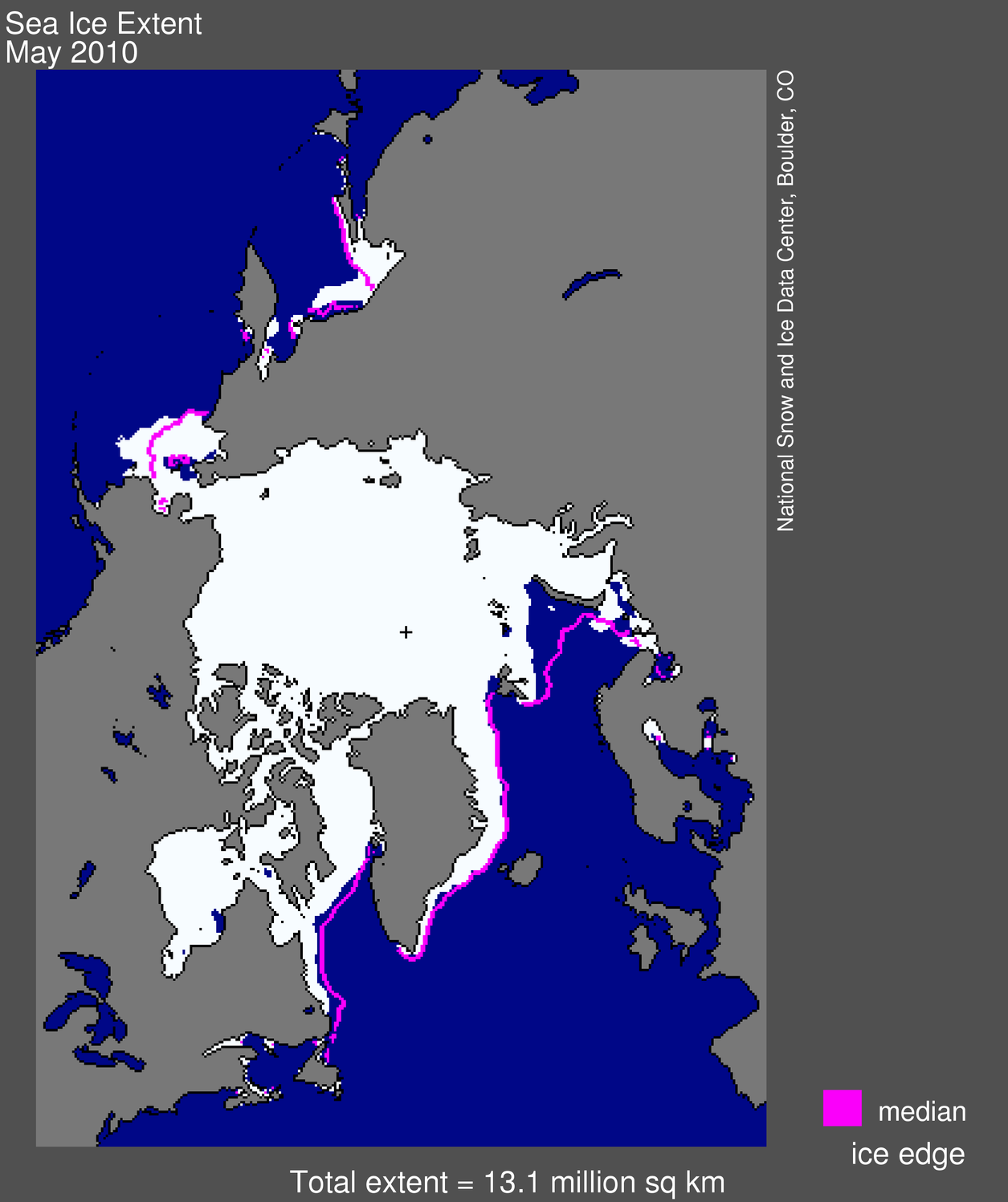
Arctic sea ice extent declines rapidly in MayIn May, Arctic air temperatures remained above average, and sea ice extent declined at a rapid pace. At the end of the month, extent fell near the level recorded in 2006, the lowest in the satellite record for the end of May. Analysis from scientists at the University of Washington suggests that ice volume has continued to decline compared to recent years. However, it is too soon to say whether Arctic ice extent will reach another record low this summer—that will depend on the weather and wind conditions over the next few months.

map from space showing sea ice extent, continentsFigure 1. Arctic sea ice extent for May 2010 was 13.10 million square kilometers (5.06 million square miles). The magenta line shows the 1979 to 2000 median extent for that month. The black cross indicates the geographic North Pole. Sea Ice Index data. About the data.
—Credit: National Snow and Ice Data Center

High-resolution image
Overview of conditions
Arctic sea ice extent averaged 13.10 million square kilometers (5.06 million square miles) for the month of May, 500,000 square kilometers (193,000 square miles) below the 1979 to 2000 average. The rate of ice extent decline for the month was -68,000 kilometers (-26,000 square miles) per day, almost 50% more than the average rate of -46,000 kilometers (18,000 square miles) per day. This rate of loss is the highest for the month of May during the satellite record.

Ice extent remained slightly above average in the Bering Sea, and below average in the Barents Sea north of Scandinavia, and in Baffin Bay.
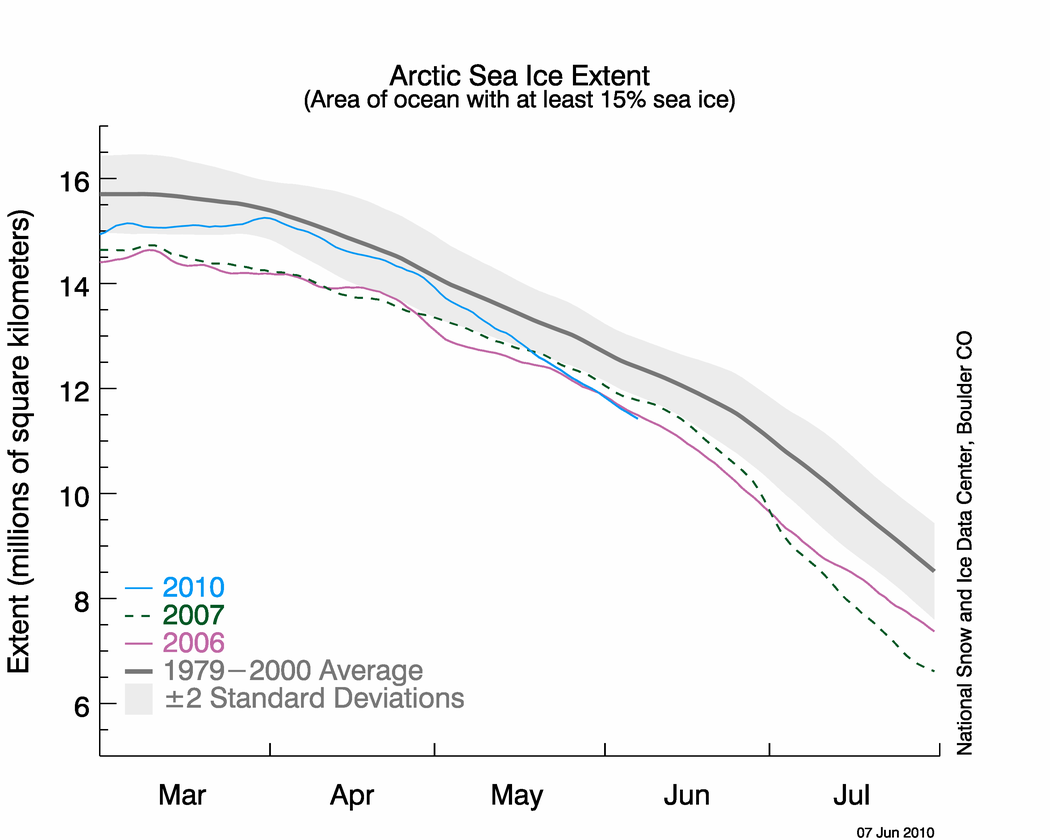
graph with months on x axis and extent on y axis Figure 2. The graph above shows daily sea ice extent as of June 7, 2010. The solid light blue line indicates 2010; dashed green shows 2007; solid pink shows 2006, and solid gray indicates average extent from 1979 to 2000. The gray area around the average line shows the two standard deviation range of the data. Sea Ice Index data.
—Credit: National Snow and Ice Data Center

High-resolution image
Conditions in context
As we noted in our May post, several regions of the Arctic experienced a late-season spurt in ice growth. As a result, ice extent reached its seasonal maximum much later than average, and in turn the melt season began almost a month later than average. As ice began to decline in April, the rate was close to the average for that time of year.

In sharp contrast, ice extent declined rapidly during the month of May. Much of the ice loss occurred in the Bering Sea and the Sea of Okhotsk, indicating that the ice in these areas was thin and susceptible to melt. Many polynyas, areas of open water in the ice pack, opened up in the regions north of Alaska, in the Canadian Arctic Islands, and in the Kara and Barents and Laptev seas.

The polynyas are clearly visible in high-resolution passive microwave images from the Advanced Microwave Sounding Radiometer (AMSR-E) aboard NASA’s Aqua satellite. What do current ice conditions mean for the minimum ice extent this fall? It is still too soon to say: although ice extent at present is relatively low, the amount of ice that survives the summer melt season will be largely determined by the wind and weather conditions over the next few months.

What this article is showing, is this. The Arctic sea ice, once again, is approaching record low-levels this year, and stands a very good chance of breaking 2007's record low summer extent. And, it is 3.5 standard deviations below the 1979-2000 average. Summer so far here in Alaska has been only slightly above-average, temperature-wise, for the bulk of the interior, and along the southern coastal fringes. But along the North Slope and in the Arctic Ocean just to the north, high pressure ridging has been dominating for the past few months. Which basically is a warmer than average air-mass. As long as this pattern continues, and continues to recur more often (which it is), summer temperatures over the Alaska and Western Canadian portion of the Arctic will remain above average, and increased ice melting will continue. Already, much more of the Arctic ice, as a whole, is thinner now than in decades past, as much as 30-40%, as it freezes later in the fall, and melts earlier, each spring. Global climate change modeling was, just up to five years ago, predicting summer ice-free Arctic Ocean conditions not occurring until 2060 or 2070. Now, many climate researchers are estimating it will happen in five to ten years. This will be a "tipping point" in the global climate balance, as then the Earth's overall "albedo" (the percentage of solar radiation reflected back to space, which is a net cooling factor), will be greatly increased. The waters of the Arctic Ocean will warm up much more quickly, absorbing much more solar radiation, and will then take longer to freeze in autumn. This warmer water will help erode the bases of the glaciers of  Greenland, and the northern Canadian Islands (such as Baffin and Ellesmere Islands). 


This combined with their summer melt lubrication of their bases, could then result in their quick collapse into the surrounding seas, and then the rapid global sea level rises. This is why, in our previous article, a fictional future projection, we came up with those timelines. We hope we are too soon in this projection, but all the World governments, and the UN need to understand, THIS IS GOING TO HAPPEN, AND WE NEED TO START PLANNING FOR IT.

        PANDORA'S WELL

All of us here at the Alaska Progressive Review like to look at things in a positive constructive light, when we can. And to realise that we all have a significant hand in creating our own personal realities, based on our own beliefs and expectations.

However, sometimes large-scale events are of such significance, that we have to have to realise, this is going to affect all of us, in ways that could be very detrimental, and we need to stay abreast of the latest ACCURATE information, and share it with you. The untamed British Petroleum methane/oil gusher, 1500 metres below the surface of the Gulf of Mexico, stemming from a blown-out well that extends another 6100 metres (20,000 feet) below the sea-floor, IS AN EVENT WITHOUT PRECEDENT IN HUMAN HISTORY, and has the potential to harm not just the Gulf of Mexico's ecosystems (frankly, it looks like much of the Gulf will soon be a dead zone), but eventually the Atlantic Ocean's, and possibly more.

Before we delve more into that, did any of you listen to President Obama's speech earlier this week? I'm sorry, but we gave him some benefit of our doubt when he was elected, but almost nothing his administration has done, has been much different than the previous criminally sociopathic Bush's. The appointing of Wall Street criminals to high posts in the current administration, no change in ending the disastrous, immoral, and bankrupting wars in Iraq and Afghanistan, and now, still catering to the oil industries whims.

But in his speech, he actually said that the "Gulf would be restored to not just as it was before, but better!" That is not going to happen, in any of our lifetimes. We're sorry to say. And he had to have known this, had to! Because there are thousands of competent scientists working in the federal government who can, and have, analysed the video stream of the gushing blown-out well on the sea-floor. And who have calculated that the actual gush rate is between 60,000 and 115,000 barrels per day (10,080,000 to 19,320,000 litres). Or, one Exxon Valdez spill, every 4 to 5 days, since 20 April! And even if British Petroleum is able to do as they say, and drill relief wells, which would then take the pressure of this one, that is still two months, minimum, away, not counting any hurricane disruption! So why the overt lies? Well, our best guess, is to cover for his corporate patrons, who got him elected, and keep the pressure on him. But the grim reality of what will happen to the Gulf of Mexico, it's ecosystems, fisheries, tourism, and hence, economic base, will not be denied, in the coming months. Which will spread throughout the USA. A large percentage of the seafood consumed in this country, comes from the Gulf of Mexico. Agriculture in Florida has the potential to be adversely affected, if oil-laden winds blow inland from tropical storms or hurricanes. And what of the health effects of this on the people in these areas?

This is actually worse, for this administration, and the country, than Chernobyl was, for the Soviets. Because at least with Chernobyl, once the fires in the graphite control-rod dampered nuclear reactor's core were extinguished, and then covered with cement sarcophagi, the uncontrolled emission of deadly radiation ceased. And although several hundred thousand people had to be relocated, it was a one-time event. Not a continuing one. People around the Gulf of Mexico are going to learn a hard lesson what unrestrained Capitalism brings.

However, that is the best-case scenario. I'm almost despondent having to share this information, because it is heart-breaking, and terrifying, if it is true.

We found this web-site last week, which is moderated by professionals in the global oil industry, and has knowledgeable contributors who provide informed commentary. This particular link has a discussion of the Deepwater Horizon tragedy, and what this particular commenter's take on it is. He is a professional in the oil industry. Here is some of that discussion, then we'll provide some of our own commentary, it's long, but worth the reading, because it describes the mess in terms everyone can understand:

"Editors' note for first-time visitors: What follows is a comment from a The Oil Drum reader. To read what The Oil Drum staff members are saying about the Deepwater Horizon Spill, please visit the front page. (Were the US government and BP more forthcoming with information and details, the situation would not be giving rise to so much speculation about what is actually going on in the Gulf. This should be run more like Mission Control at NASA than an exclusive country club function--it is a public matter--transparency, now!)

OK let's get real about the GOM oil flow. There doesn't really seem to be much info on TOD that furthers more complete understanding of what's really happening in the GOM.

As you have probably seen and maybe feel yourselves, there are several things that do not appear to make sense regarding the actions of attack against the well. Don't feel bad, there is much that doesn't make sense even to professionals unless you take into account some important variables that we are not being told about. There seems to me to be a reluctance to face what cannot be termed anything less than grim circumstances in my opinion. There certainly is a reluctance to inform us regular people and all we have really gotten is a few dots here and there...

First of all...set aside all your thoughts of plugging the well and stopping it from blowing out oil using any method from the top down. Plugs, big valves to just shut it off, pinching the pipe closed, installing a new bop [blow out preventer, eds] or lmrp, shooting any epoxy in it, top kills with mud etc etc etc....forget that, it won't be happening..it's done and over. In fact actually opening up the well at the subsea source and allowing it to gush more is not only exactly what has happened, it was probably necessary, or so they think anyway.

So you have to ask WHY? Why make it worse?...there really can only be one answer and that answer does not bode well for all of us. It's really an inescapable conclusion at this point, unless you want to believe that every Oil and Gas professional involved suddenly just forgot everything they know or woke up one morning and drank a few big cups of stupid and got assigned to directing the response to this catastrophe. Nothing makes sense unless you take this into account, but after you do...you will see the "sense" behind what has happened and what is happening. That conclusion is this:

The well bore structure is compromised "Down hole".

That is something which is a "Worst nightmare" conclusion to reach. While many have been saying this for some time as with any complex disaster of this proportion many have "said" a lot of things with no real sound reasons or evidence for jumping to such conclusions, well this time it appears that they may have jumped into the right place...

TOP KILL - FAILS:

This was probably our best and only chance to kill this well from the top down. This "kill mud" is a tried and true method of killing wells and usually has a very good chance of success. The depth of this well presented some logistical challenges, but it really should not of presented any functional obstructions. The pumping capacity was there and it would have worked, should have worked, but it didn't.

It didn't work, but it did create evidence of what is really happening. First of all the method used in this particular top kill made no sense, did not follow the standard operating procedure used to kill many other wells and in fact for the most part was completely contrary to the procedure which would have given it any real chance of working.

When a well is "Killed" using this method heavy drill fluid "Mud" is pumped at high volume and pressure into a leaking well. The leaks are "behind" the point of access where the mud is fired in, in this case the "choke and Kill lines" which are at the very bottom of the BOP (Blow Out Preventer) The heavy fluid gathers in the "behind" portion of the leaking well assembly, while some will leak out, it very quickly overtakes the flow of oil and only the heavier mud will leak out. Once that "solid" flow of mud is established at the leak "behind" the well, the mud pumps increase pressure and begin to overtake the pressure of the oil deposit. The mud is established in a solid column that is driven downward by the now stronger pumps. The heavy mud will create a solid column that is so heavy that the oil deposit can no longer push it up, shut off the pumps...the well is killed...it can no longer flow.

Usually this will happen fairly quickly, in fact for it to work at all...it must happen quickly. There is no "trickle some mud in" because that is not how a top kill works. The flowing oil will just flush out the trickle and a solid column will never be established. Yet what we were told was "It will take days to know whether it
worked"...."Top kill might take 48 hours to complete"...the only way it could take days is if BP intended to do some "test fires" to test integrity of the entire system. The actual "kill" can only take hours by nature because it must happen fairly rapidly. It also increases strain on the "behind" portion and in this instance we all know that what remained was fragile at best.

Early that afternoon we saw a massive flow burst out of the riser "plume" area. This was the first test fire of high pressure mud injection. Later on same day we saw a greatly increased flow out of the kink leaks, this was mostly mud at that time as the kill mud is tanish color due to the high amount of Barite which is added to it to weight it and Barite is a white powder.

We later learned the pumping was shut down at midnight, we weren't told about that until almost 16 hours later, but by then...I'm sure BP had learned the worst. The mud they were pumping in was not only leaking out the "behind" leaks...it was leaking out of someplace forward...and since they were not even near being able to pump mud into the deposit itself, because the well would be dead long before...and the oil was still coming up, there could only be one conclusion...the wells casings were ruptured and it was leaking "down hole"

They tried the "Junk shot"...the "bridging materials" which also failed and likely made things worse in regards to the ruptured well casings.

"Despite successfully pumping a total of over 30,000 barrels of heavy mud, in three attempts at rates of up to

80 barrels a minute, and deploying a wide range of different bridging materials, the operation did not overcome the flow from the well."

80 Barrels per minute is over 200,000 gallons per hour, over 115,000 barrels per day...did we seen an increase over and above what was already leaking out of 115k bpd?....we did not...it would have been a massive increase in order of multiples and this did not happen.

"The whole purpose is to get the kill mud down,” said Wells. “We'll have 50,000 barrels of mud on hand to kill this well. It's far more than necessary, but we always like to have backup."

Try finding THAT quote around...it's been scrubbed...here's a cached copy of a quote...


"The "top kill" effort, launched Wednesday afternoon by industry and government engineers, had pumped enough drilling fluid to block oil and gas spewing from the well, Allen said. The pressure from the well was very low, he said, but persisting."

"Allen said one ship that was pumping fluid into the well had run out of the fluid, or "mud," and that a second ship was on the way. He said he was encouraged by the progress."


Later we found out that Allen had no idea what was really going on and had been "Unavailable all day"


So what we had was BP running out of 50,000 barrels of mud in a very short period of time. An amount far and above what they deemed necessary to kill the well. Shutting down pumping 16 hours before telling anyone, including the president. We were never really given a clear reason why "Top Kill" failed, just that it couldn't overcome the well.

There is only one article anywhere that says anything else about it at this time of writing...and it's a relatively obscure article from the wall street journal "online" citing an unnamed source.

"WASHINGTON—BP PLC has concluded that its "top-kill" attempt last week to seal its broken well in the Gulf of Mexico may have failed due to a malfunctioning disk inside the well about 1,000 feet below the ocean floor.

The disk, part of the subsea safety infrastructure, may have ruptured during the surge of oil and gas up the well on April 20 that led to the explosion aboard the Deepwater Horizon rig, BP officials said. The rig sank two days later, triggering a leak that has since become the worst in U.S. history.

The broken disk may have prevented the heavy drilling mud injected into the well last week from getting far enough down the well to overcome the pressure from the escaping oil and gas, people familiar with BP's findings said. They said much of the drilling mud may also have escaped from the well into the rock formation outside the wellbore.

As a result, BP wasn't able to get sufficient pressure to keep the oil and gas at bay. If they had been able to build up sufficient pressure, the company had hoped to pump in cement and seal off the well. The effort was deemed a failure on Saturday.

BP started the top-kill effort Wednesday afternoon, shooting heavy drilling fluids into the broken valve known as a blowout preventer. The mud was driven by a 30,000 horsepower pump installed on a ship at the surface. But it was clear from the start that a lot of the "kill mud" was leaking out instead of going down into the well."

There are some inconsistencies with this article.

There are no "Disks" or "Subsea safety structure" 1,000 feet below the sea floor, all that is there is well bore. There is nothing that can allow the mud or oil to "escape" into the rock formation outside the well bore except the well, because it is the only thing there.

All the actions and few tid bits of information all lead to one inescapable conclusion. The well pipes below the sea floor are broken and leaking. Now you have some real data of how BP's actions are evidence of that, as well as some murky statement from "BP officials" confirming the same.

I took some time to go into a bit of detail concerning the failure of Top Kill because this was a significant event. To those of us outside the real inside loop, yet still fairly knowledgeable, it was a major confirmation of what many feared. That the system below the sea floor has serious failures of varying magnitude in the complicated chain, and it is breaking down and it will continue to.

What does this mean?

It means they will never cap the gusher after the wellhead. They cannot...the more they try and restrict the oil gushing out the bop?...the more it will transfer to the leaks below. Just like a leaky garden hose with a nozzle on it. When you open up the nozzle?...it doesn't leak so bad, you close the nozzle?...it leaks real bad,
same dynamics. It is why they sawed the riser off...or tried to anyway...but they clipped it off, to relieve pressure on the leaks "down hole". I'm sure there was a bit of panic time after they crimp/pinched off the large riser pipe and the Diamond wire saw got stuck and failed...because that crimp diverted pressure and flow to the rupture down below.

Contrary to what most of us would think as logical to stop the oil mess, actually opening up the gushing well and making it gush more became direction BP took after confirming that there was a leak. In fact if you note their actions, that should become clear. They have shifted from stopping or restricting the gusher to opening it up and catching it. This only makes sense if they want to relieve pressure at the leak hidden down below the seabed.....and that sort of leak is one of the most dangerous and potentially damaging kind of leak there could be. It is also inaccessible which compounds our problems. There is no way to stop that leak from above, all they can do is relieve the pressure on it and the only way to do that right now is to open up the nozzle above and gush more oil into the gulf and hopefully catch it, which they have done, they just neglected to tell us why, gee thanks.

A down hole leak is dangerous and damaging for several reasons.

There will be erosion throughout the entire beat up, beat on and beat down remainder of the "system" including that inaccessible leak. The same erosion I spoke about in the first post is still present and has never stopped, cannot be stopped, is impossible to stop and will always be present in and acting on anything that is left which has crude oil "Product" rushing through it. There are abrasives still present, swirling flow will create hot spots of wear and this erosion is relentless and will always be present until eventually it wears away enough material to break it's way out. It will slowly eat the bop away especially at the now pinched off riser head and it will flow more and more. Perhaps BP can outrun or keep up with that out flow with various suckage methods for a period of time, but eventually the well will win that race, just how long that race will be?...no one really knows....However now?...there are other problems that a down hole leak will and must produce that will compound this already bad situation.

This down hole leak will undermine the foundation of the seabed in and around the well area. It also weakens the only thing holding up the massive Blow Out Preventer's immense bulk of 450 tons. In fact?...we are beginning to the results of the well's total integrity beginning to fail due to the undermining being caused by the leaking well bore.

The first layer of the sea floor in the gulf is mostly lose material of sand and silt. It doesn't hold up anything and isn't meant to, what holds the entire subsea system of the Bop in place is the well itself. The very large steel connectors of the initial well head "spud" stabbed in to the sea floor. The Bop literally sits on top of the pipe and never touches the sea bed, it wouldn't do anything in way of support if it did. After several tens of feet the seabed does begin to support the well connection laterally (side to side) you couldn't put a 450 ton piece of machinery on top of a 100' tall pipe "in the air" and subject it to the side loads caused by the ocean currents and expect it not to bend over...unless that pipe was very much larger than the machine itself, which you all can see it is not. The well's piping in comparison is actually very much smaller than the Blow Out Preventer and strong as it may be, it relies on some support from the seabed to function and not literally fall over...and it is now showing signs of doing just that....falling over.

If you have been watching the live feed cams you may have noticed that some of the ROVs are using an inclinometer...and inclinometer is an instrument that measures "Incline" or tilt. The BOP is not supposed to be tilting...and after the riser clip off operation it has begun to...

This is not the only problem that occurs due to erosion of the outer area of the well casings. The way a well casing assembly functions it that it is an assembly of different sized "tubes" that decrease in size as they go down. These tubes have a connection to each other that is not unlike a click or snap together locking action. After a certain length is assembled they are cemented around the ouside to the earth that the more rough drill hole is bored through in the well making process. A very well put together and simply explained process of "How to drill a deep water oil well" is available here:


The well bore casings rely on the support that is created by the cementing phase of well construction. Just like if you have many hands holding a pipe up you could put some weight on the top and the many hands could hold the pipe and the weight on top easily...but if there were no hands gripping and holding the pipe?...all the weight must be held up by the pipe alone. The series of connections between the sections of casings are not designed to hold up the immense weight of the BOP without all the "hands" that the cementing provides and they will eventually buckle and fail when stressed beyond their design limits.

These are clear and present dangers to the battered subsea safety structure (bop and lmrp) which is the only loose cork on this well we have left. The immediate (first 1,000 feet) of well structure that remains is now also undoubtedly compromised. However.....as bad as that is?...it is far from the only possible problems with this very problematic well. There were ongoing troubles with the entire process during the drilling of this well. There were also many comprises made by BP IMO which may have resulted in an overall weakened structure of the entire well system all the way to the bottom plug which is over 12,000 feet deep. Problems with the cementing procedure which was done by Haliburton and was deemed as “was against our best practices.” by a Haliburton employee on April 1st weeks before the well blew out. There is much more and I won't go into detail right now concerning the lower end of the well and the troubles encountered during the whole creation of this well and earlier "Well control" situations that were revieled in various internal BP e-mails. I will add several links to those documents and quotes from them below and for now, address the issues concerning the upper portion of the well and the region of the sea floor.

What is likely to happen now?

Well...none of what is likely to happen is good, in fact...it's about as bad as it gets. I am convinced the erosion and compromising of the entire system is accelerating and attacking more key structural areas of the well, the blow out preventer and surrounding strata holding it all up and together. This is evidenced by the tilt of the blow out preventer and the erosion which has exposed the well head connection. What eventually will happen is that the blow out preventer will literally tip over if they do not run supports to it as the currents push on it. I suspect they will run those supports as cables tied to anchors very soon, if they don't, they are inviting disaster that much sooner.

Eventually even that will be futile as the well casings cannot support the weight of the massive system above with out the cement bond to the earth and that bond is being eroded away. When enough is eroded away the casings will buckle and the BOP will collapse the well. If and when you begin to see oil and gas coming up around the well area from under the BOP? or the area around the well head connection and casing sinking more and more rapidly? ...it won't be too long after that the entire system fails. BP must be aware of this, they are mapping the sea floor sonically and that is not a mere exercise. Our Gov't must be well aware too, they just are not telling us.

All of these things lead to only one place, a fully wide open well bore directly to the oil deposit...after that, it goes into the realm of "the worst things you can think of" The well may come completely apart as the inner liners fail. There is still a very long drill string in the well, that could literally come flying out...as I said...all the worst things you can think of are a possibility, but the very least damaging outcome as bad as it is, is that we are stuck with a wide open gusher blowing out 150,000 barrels a day of raw oil or more. There isn't any "cap dome" or any other suck fixer device on earth that exists or could be built that will stop it from gushing out and doing more and more damage to the gulf. While at the same time also doing more damage to the well, making the chance of halting it with a kill from the bottom up less and less likely to work, which as it stands now?....is the only real chance we have left to stop it all.

It's a race now...a race to drill the relief wells and take our last chance at killing this monster before the whole weakened, wore out, blown out, leaking and failing system gives up it's last gasp in a horrific crescendo.

We are not even 2 months into it, barely half way by even optimistic estimates. The damage done by the leaked oil now is virtually immeasurable already and it will not get better, it can only get worse. No matter how much they can collect, there will still be thousands and thousands of gallons leaking out every minute, every hour of every day. We have 2 months left before the relief wells are even near in position and set up to take a kill shot and that is being optimistic as I said.

Over the next 2 months the mechanical situation also cannot improve, it can only get worse, getting better is an impossibility. While they may make some gains on collecting the leaked oil, the structural situation cannot heal itself. It will continue to erode and flow out more oil and eventually the inevitable collapse which cannot be stopped will happen. It is only a simple matter of who can "get there first"...us or the well.

We can only hope the race against that eventuality is one we can win, but my assessment I am sad to say is that we will not.

The system will collapse or fail substantially before we reach the finish line ahead of the well and the worst is yet to come.

Sorry to bring you that news, I know it is grim, but that is the way I see it....I sincerely hope I am wrong.

We need to prepare for the possibility of this blow out sending more oil into the gulf per week then what we already have now, because that is what a collapse of the system will cause. All the collection efforts that have captured oil will be erased in short order. The magnitude of this disaster will increase exponentially by the time we can do anything to halt it and our odds of actually even being able to halt it will go down.

The magnitude and impact of this disaster will eclipse anything we have known in our life times if the worst or even near worst happens...

We are seeing the puny forces of man vs the awesome forces of nature.

We are going to need some luck and a lot of effort to win...

and if nature decides we ought to lose, we will....

Reference materials:

On April 1, a job log written by a Halliburton employee, Marvin Volek, warns that BP’s use of cement “was
against our best practices.”

An April 18 internal Halliburton memorandum indicates that Halliburton again warned BP about its practices,
this time saying that a “severe” gas flow problem would occur if the casings were not centered more carefully.
Around that same time, a BP document shows, company officials chose a type of casing with a greater risk of collapsing.


Mark Hafle, the BP drilling engineer who wrote plans for well casings and cement seals on the Deepwater
Horizon's well, testified that the well had lost thousands of barrels of mud at the bottom. But he said models
run onshore showed alterations to the cement program would resolve the issues, and when asked if a cement
failure allowed the well to "flow" gas and oil, he wouldn't capitulate.

Hafle said he made several changes to casing designs in the last few days before the well blew, including the
addition of the two casing liners that weren't part of the original well design because of problems where the
earthen sides of the well were "ballooning." He also worked with Halliburton engineers to design a plan for
sealing the well casings with cement.

Casing joint


Kill may take until Christmas


BP Used Riskier Method to Seal Well Before Blast


There you have it folks. Information we here at the Alaska Progressive Review certainly trust more than that coming from BP or our CSA government (Corporate States of America). There are even more apocalyptic scenarios being discussed by other geologists, surmising that if the seafloor totally collapses around this well, and the entire vast highly pressurised methane/oil deposit is open to the sea, that tremendous quantities of methane gas would surface, accelerating global warming, and even posing a health hazard to people in the region! We only hope these are just worst-case surmises, and won't be the reality! Vaya con dios.